About rrb group d Exam Series
📖 Table of Contents
- RRB Group D 2027 Examination Blueprint
- Computer Based Test (CBT) Exam Pattern
- Comprehensive Section Wise Syllabus Breakdown
- 1. General Science (25 Marks)
- 2. Mathematics (25 Marks)
- 3. General Intelligence & Reasoning (30 Marks)
- 4. General Awareness & Current Affairs (20 Marks)
- Essential Product Features of our RRB Group D Mock Test Series
- 90 Day Systematic Study Roadmap
- Physical Efficiency Test (PET) Readiness
- Official PET Benchmarks
- Practical PET Preparation Guidelines
- Practical Exam Hall Tips: Speed, Accuracy & Time Management
- Common mistakes made by aspirants:
- Daily Free Current Affairs & Mini Quiz
- Why this RRB Group D 2027 Mock Test Series was created
- About the Author
Preparation for the RRB Group D is all about a structured, diagnostic approach rather than just randomly solving questions. The CBT will test your command of conceptual General Science, your ability to solve multi step Reasoning puzzles, your accuracy in Mathematics and your General Awareness. The entire guide and mock test series has been put together to take you through the exact level of difficulty of the upcoming RRB exams. It has a full syllabus analysis, a detailed breakdown of the questions, a preparation timeline, PET criteria and a whole host of diagnostic tools to build your speed and accuracy.
RRB Group D 2027 Examination Blueprint
Understanding the actual exam pattern is the first step to not wasting your study time. The RRB Group D selection process has 4 stages:
Computer Based Test (CBT) Exam Pattern
| Section | No. of Questions | Total Marks |
|---|---|---|
| General Science | 25 | 25 |
| Mathematics | 25 | 25 |
| General Intelligence & Reasoning | 30 | 30 |
| General Awareness & Current Affairs | 20 | 20 |
| Total | 100 | 100 |
Allotted Duration: 90 Minutes (120 Minutes for PwBD)
- +1 mark for each correct answer
- -1/3 (0.33) mark for each incorrect answer
- Unanswered/flagged questions get 0 marks with no penalty
Normalization / Percentile Method:
Raw marks obtained in the various shifts will be converted to a percentile using the official RRB normalisation formula to ensure fairness across shifts.
Comprehensive Section Wise Syllabus Breakdown
1. General Science (25 Marks)
The RRB will be using the Class 10 NCERT as the basis for this section. The questions won't be simple recall of facts but will require application of the concepts in the three main areas of science.
- Optics: convex/concave mirror and lens ray diagrams, magnification formulae, focal length (1/f = 1/v + 1/u), refraction through a glass prism.
- Electricity: Ohm's Law (V = IR), series and parallel equivalent resistances, electrical power (P = VI = I2R = V2/R), domestic electricity billing in kilowatt hours (kWh).
- Mechanics and Work Energy: Newton's Laws of Motion, work done (W = F.s.cos(theta)), kinetic energy (Ek = 1/2mv2), potential energy (Ep = mgh), conservation of momentum.
- Sound: wave speed (v = nu.lambda), echo calculations, audible range, ultrasonic applications.
- Chemical Reactions: Balancing chemical equations, types of reaction (combination, decomposition, displacement, double displacement, redox).
- Acids, Bases and Salts: pH scale calculations, properties of bleaching powder, washing soda, baking soda and plaster of Paris.
- Periodic Table: Periodic trends in a period and a group (atomic radius, electronegativity, ionisation energy, metallic character) as per the Modern Periodic Table.
- Metals and Non-Metals: reactivity series, methods of extraction, alloys and corrosion prevention.
- Carbon compounds: homologous series, functional groups (alcohols, aldehydes, ketones, carboxylic acids), saponification.
- Human physiology: double circulation in the human heart, structure and function of the nephron, reflex arc, action of digestive enzymes.
- Plant Physiology: light and dark reactions of photosynthesis, transpiration pull, xylem and phloem transport, plant hormones (auxins, gibberellins, abscisic acid).
- Genetics & Reproduction: Mendel's monohybrid and dihybrid cross ratios, asexual and sexual modes of reproduction, human reproductive health.
- Ecology: trophic levels, the 10% law of energy transfer, biomagnification and waste management.
2. Mathematics (25 Marks)
This section will test your ability to do calculations with precision, your conceptual clarity and your ability to apply shortcuts:
- Number systems: rational numbers, recurring decimals, divisibility rules, remainder theorem.
- BODMAS: Complex simplification involving multiple brackets and fractions with bar brackets.
- Fractions, LCM & HCF: Prime factorisation, decimal fractions, word problems on simultaneous alarms / traffic lights.
- Percentages, Profit & Loss: Successive discounts, marked price relationships, false weight problems, cost price problems.
- Ratio & Proportion: Proportional sharing, partnership distributions, mixture and alligation.
- Time & Work: Pipe and cistern problems (efficiency methods), alternate day's work problems, wage problems.
- Time, Speed & Distance: Relative speed, train crossing platforms/poles, upstream and downstream boat problems.
- Simple & Compound Interest: the difference between CI and SI for 2 and 3 years (with half yearly compounding).
- Algebra: Linear equations. Roots of a quadratic equation (ax2 + bx + c = 0). Polynomial identity expansions.
- Geometry: triangle congruence and similarity, tangents to a circle, properties of chords, angle subtensions.
- Mensuration: Volume and surface area of cylinder, cone, sphere, frustum and composite solids.
- Trigonometry: the basic trig ratios, complementary angles, basic height and distance problems.
- Elementary Statistics: mean, median, mode, standard deviation, empirical rule (Mode = 3 Median - 2 Mean).
3. General Intelligence & Reasoning (30 Marks)
This is the largest section of the CBT and tests your ability to deduce structure:
- Syllogisms: standard statements and conclusions (including the modern 'only a few' and 'possibility' types).
- Statement and Assumptions / Arguments / Course of Action: Ability to differentiate between strong and weak inferences without making any external assumptions.
- Cause and Effect: ability to identify the cause of a situation and the likely effect.
- Analogy and Classification: Semantic, numerical and figural grouping.
- Series Completion: Alphanumeric and symbol based alternating series.
- Coding-Decoding: Letter shifting, reverse alphabet mapping, fictitious language ciphers.
- Direction and Distance: Multi point turns, Pythagoras based displacement, shadow direction.
- Blood Relations: Coded relations (A + B means A is brother of B) and conversational pointing statements.
- Seating arrangements and puzzles: circular facing in/out arrangements, linear queues and box stacking floor puzzles.
- Venn Diagrams: set theoretic intersections representing real world classifications.
- Mathematical operations: swapping of operator symbols to check that an equation is balanced.
4. General Awareness & Current Affairs (20 Marks)
Rather than an endless timeline of history, the general awareness for the RRB will be focused on functional knowledge:
Key government schemes, major transport sector infrastructure projects, recent national sports tournaments, central budget outlays and key appointments.
- Indian Geography: River basins, major dams, mountain passes, national parks, thermal and nuclear power stations.
- Indian Polity: Fundamental Rights, Directive Principles of State Policy, Constitutional Amendments and the powers of the President and the Governor.
- Indian Economy: basic inflation concepts, GDP terminology, the various instruments of monetary policy (Repo, Reverse Repo) and the primary, secondary and tertiary sectors.
- Railway Heritage: Major Railway Zones and Divisional HQs, centres of indigenous locomotive manufacture and track gauge.
Essential Product Features of our RRB Group D Mock Test Series
To give the candidate a truly effective preparation engine we've built in a number of targeted test features:
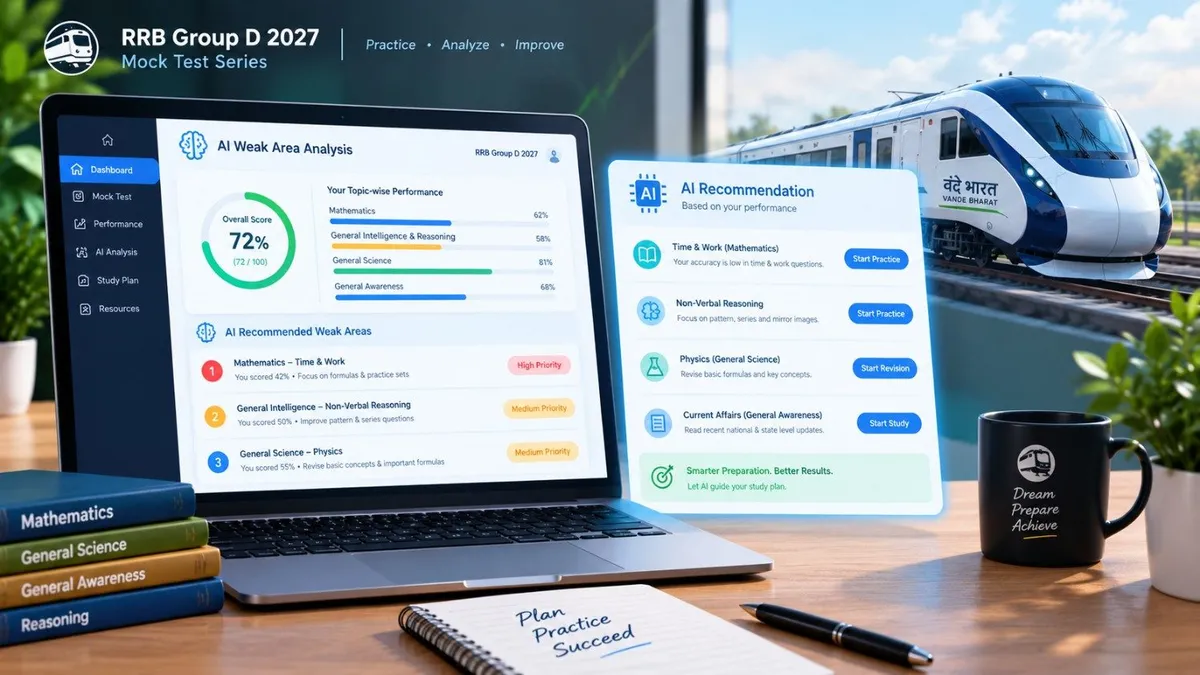
Rather than just give you a total score we actually go further and analyse your performance across topics and across difficulty levels. After you've taken a test the system will identify your exact weak areas (e.g. the sign convention of a concave lens in Science or the deductions in a floor puzzle in Reasoning) and give you very specific recommendations as to what you need to revise. It works as an active personal tutor in that it tells you exactly what you need to do to improve your accuracy on the next go.
90 Day Systematic Study Roadmap
A 4 subject systematic study requires a very disciplined approach on a weekly basis. Here's a fairly balanced 12 week schedule:
- NCERT Class 9-10 Basics
- BODMAS, Arithmetic, Puzzles
- Numerical Problem Sets
- Time-Bound Speed Drills
- Full 90-Min Mocks
- Revision & Error Logs
Mathematics: Go over basic operations, BODMAS, prime factorisation, fractions, percentages, and simple ratios. Answer 30 practice questions each day.
General Science: Go through the Class 9 NCERT text on Motion, Force, Gravitation, Matter and Tissues. Write down all the basic formulae and SI units.
Reasoning: Practice coding decoding, alphanumeric series, direction sense, blood relations.
Daily habit: 30 minutes reading the monthly current affairs digests.
Maths: Study time & work, speed, time & distance, mensuration formulae, simple and compound interest and basic quadratic equations.
General Science: go through the Class 10 NCERT chapters on Light (Reflection and Refraction), Electricity, Magnetic Effects of Current, Acids Bases and Salts and Metals and Non-Metals. Do the numericals.
Reasoning: Complex Circular Seating Arrangements, Multi Floor Puzzles and Syllogisms.
Sectional Tests: Do 2 topic wise quizzes every day to track your speed per question.
Full Length Tests: take 3 full length CBT mock tests each week in a distraction free environment.
Error analysis: spend at least 90 minutes going through each test. Look at your mistakes, read the step by step solutions and log your errors in a separate notebook.
Targeted revision: go through the weak areas that you've highlighted in your diagnostic reports.
PET Training: start with the morning physical conditioning (walking/jogging) to build up your stamina for the PET.
Physical Efficiency Test (PET) Readiness
Clearing the CBT will entitle you to the PET. The PET is just a qualifying test and if you fail at that point you are automatically disqualified.
Official PET Benchmarks
| Candidate Category | Weight Carrying Task | Distance Running Task |
|---|---|---|
| Male | Must lift and carry 35kg of sand/weight for a distance of 100m in 2 minutes in one go (without putting the weight down). | Must run 1000m in 4 minutes 15 seconds in one go. |
| Female | Must lift and carry 20kg of sand/weight for a distance of 100m in 2 minutes in one go (without putting the weight down). | Must run 1000m in 5 minutes 40 seconds in one go. |
| Transgender | Assessed against the female physical criteria | Assessed against the female physical criteria |
| PwBD | Exempt from PET stage | Exempt from PET stage |
Practical PET Preparation Guidelines
- Weight handling: lift the sandbags from a waist high platform rather than yanking them straight off the ground (this will protect your lower back). Keep the weight on one shoulder or hold it close to your chest.
- Running: run on a 400m outdoor track rather than on a treadmill. Learn to maintain a steady pace rather than sprinting off the line and then being completely winded on the final lap.
- Hydration and footwear: run in your comfortable, well broken in running shoes to avoid blisters during the track drills.
Practical Exam Hall Tips: Speed, Accuracy & Time Management
You have 90 minutes to complete a 100 question paper which means you've got just 54 seconds per question. Use a multi-pass strategy to get as many marks as possible.
The 45 Second Bailout Rule: if you can't do an arithmetic simplification or reasoning question in 45 seconds then mark it for review and move on. Getting stuck on one question will eat into your time that you need to spend on the easier questions that come later in the paper. Don't guess without calculation: with a -1/3 penalty for wrong answers uncalculated guessing will actually work against you. Only eliminate options when you can eliminate at least 2 with logic. Be very careful with unit conversions in the Physics numericals (make sure all your values are in the correct SI units before you do your calculation).
Common mistakes made by aspirants:
- Relying on General Science trivia one liners. A lot of aspirants go through their General Science prep using just a few trivia books. The RRB Group D papers are full of circuit calculations, chemical equation balancing and ray diagram questions which require a proper understanding of the concepts.
- Ignoring sectional time: as the 90 minute time is the same for the whole paper a lot of aspirants will spend 45 minutes on the Maths section alone and will be left with very little time to go through the final 20 questions.
- Delaying PET preparation: a lot of aspirants will wait until they get their CBT results before they start doing any physical training and as a result are often unprepared for the 35kg weight carry and the 1000m run.
- Skipping systematic test reviews: a lot of people will take multiple mock tests but never go back to review their wrong answers. This means they will be making the same mistakes on exam day.
Daily Free Current Affairs & Mini Quiz
Enhance your 20-mark General Awareness score with our daily 10-question rapid quiz. Covers government policies, major transport projects, national sports awards, and central appointments.
Why this RRB Group D 2027 Mock Test Series was created
I, Subhan Kumar Sah, created this mock test series after I noticed a very real problem in the railway prep space. The last major recruitment drive under CEN 09/2025 was in August 2026 and the evaluation of the candidates had moved into the document stage. Despite this the vast majority of the education portals still had pages full of 2026 material and a lot of the pages were still referring to the previous cycle as if it were the future. Aspirants starting to prepare for the 2027 cycle were left having to wade through all that old material and incomplete question banks.
The second issue was with the depth of the content.
A lot of the content available is very shallow with General Science being reduced to a few trivia one liners. The actual RRB Group D papers require a much deeper application of concepts (circuit calculations, balancing of chemical equations, ray diagrams etc). The majority of the material available completely ignores the Physical Efficiency Test (PET) so the aspirants are unprepared for the physical stage after they have cleared the CBT.
This test series was created to fix those two problems: every mock test is based on verified, cycle aware content. The previous cycles are clearly identified as previous cycles and the 2027 cycle is clearly identified as the upcoming cycle. The General Science questions are based on the application of the NCERTs rather than just the one liners. There is very clear guidance on how to prepare for the PET. We are making this practice series completely free as cycle aware diagnostic material of this quality should be available to all aspirants at no cost, particularly when it comes to a major railway recruitment drive.