
AFCAT 2 Admit Card 2026 — Direct Download Link
Last Updated: 5 August 2026
AFCAT 2 Admit Card 2026 — What's Actually Live Right Now
The Indian Air Force released the AFCAT 2 Admit Card 2026 on 5 August, three days before the written exam on 8 August. You'll find it at afcat.cdac.in, not through any third-party site. IAF followed a two-stage release this cycle: the Exam City Intimation Slip came first, on 29 July, then the actual admit card followed once your centre was locked in.
If you're appearing for the Technical branch, there's a detail buried in this cycle's coverage worth knowing before exam day — more on that below.
Quick Facts Table
| Detail | Information |
|---|---|
| Conducting Body | Indian Air Force (IAF) |
| Exam Name | AFCAT 02/2026 |
| Notification Released | 12 May 2026 |
| Application Window | 20 May – 19 June 2026 |
| Exam City Slip Released | 29 July 2026 |
| Admit Card Released | 5 August 2026 |
| Written Exam Date | 8 August 2026 |
| Official Portal | afcat.cdac.in |
| Application Fee | ₹550 + GST |
AFCAT 2 Admit Card 2026 — Direct Download Link
Go to afcat.cdac.in. Log in with your application number, password or date of birth, and the security PIN you set during registration. Your admit card opens as a PDF — check your name, photo, exam centre, and reporting shift before you close the tab.
Print at least two copies. IAF won't let you inside without one.
**➡️ Download your AFCAT 2 Admit Card 2026 today if you haven't already — the 8 August exam gives you almost no buffer for last-minute login issues.
The Full Selection Process — Not Just "Written Exam Then Interview"
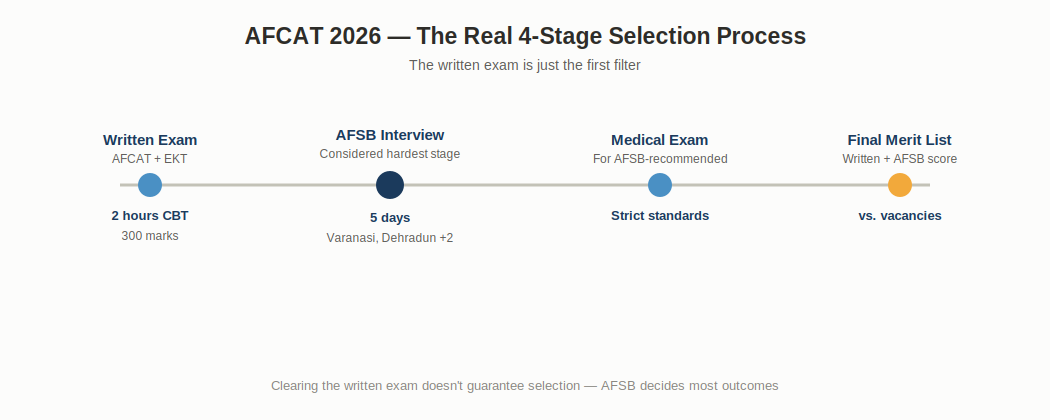
Most coverage compresses this into two lines. It's actually four distinct stages, and each one filters out a real number of candidates:
Stage 1 — Written Exam (AFCAT + EKT for Technical branch). AFCAT itself is 100 questions, 300 marks, 2 hours, covering General Awareness, English, Numerical Ability, and Reasoning & Military Aptitude. One mark gets deducted per wrong answer. Technical branch candidates also sit the EKT — 50 questions, 150 marks, 45 minutes, pulling from Mechanical, Computer Science, and Electrical & Electronics topics.
Stage 2 — AFSB Interview. This isn't a single sitting. It's a 5-day process held at designated Air Force Selection Board centres — Varanasi, Dehradun, Gandhinagar, and Mysore among them. Expect intelligence testing, psychological assessment, group tasks, and a personal interview spread across those five days. Candidates who've been through it consistently describe it as the hardest stage, not the written exam.
Stage 3 — Medical Examination. Only candidates recommended by the AFSB move here. IAF's medical standards for officer commissions are strict — this isn't a formality.
Stage 4 — Final Merit List. Built from your combined written exam and AFSB scores, weighed against available vacancies. Clearing every stage doesn't guarantee a seat if vacancies run out ahead of your rank.
The EKT Uncertainty — What Technical Candidates Should Actually Check
Here's something worth flagging honestly rather than repeating old information as settled fact: multiple 2026 sources note that the Engineering Knowledge Test may have been discontinued starting the 2025 cycle, with some notifications no longer requiring it for Technical branch candidates. This isn't confirmed consistently across every source. If you applied for Ground Duty (Technical) and you're not sure whether EKT applies to you this cycle, check your own admit card directly — it will either list an EKT slot and timing or it won't. Don't rely on last year's process assumption.
What's on the Admit Card
- Full name and photograph
- Roll number and application number
- Exam date, shift, and reporting time
- Exam centre name and address
- Branch and category applied for
- General instructions for exam day
Check every field against your original application the moment you download it. Corrections this close to the exam are difficult, so catching an error today matters more than it would have a month ago.
Age Limit — Different for Each Branch
This trips people up more than it should, since it's not one number:
| Branch | Age Limit |
|---|---|
| Flying Branch | 20 to 24 years |
| Ground Duty (Technical & Non-Technical) | 20 to 26 years |
If you're on the edge of either range, this was locked in at the application stage — nothing to do now except confirm your DOB is correctly reflected on your admit card.
What to Carry, What to Leave at Home
- Bring: Printed admit card, a valid original photo ID (Aadhaar, PAN, Passport, Driving Licence, or Voter ID), and simple clothing — IAF's own guidance suggests plain attire and slippers or sandals are preferred over anything elaborate.
- Leave at home: Smartwatches, smart devices, earphones, calculators, any electronic accessories, and study material of any kind. These get flagged at entry and cost you time you don't have on exam morning.
If You Can't Access Your Admit Card
Login issues happen, especially with heavy traffic close to release. Double-check your application number and password before assuming the portal is down — a surprising number of access issues come down to a typo, not a server problem. If the issue persists, use the official helpdesk contact listed on afcat.cdac.in rather than a third-party number found through a general search.
For updates on other defence recruitment exams running this cycle, check our Admit Cards section.
AFCAT 2 2026 — Update Log
- 5 August 2026: Admit card released at afcat.cdac.in.
- 29 July 2026: Exam City Intimation Slip activated.
- 12 May 2026: AFCAT 02/2026 notification released.
(This section will keep updating through result declaration.)
The AFCAT 2 Admit Card 2026 is your entry ticket for 8 August, but the exam itself is just the first of four stages standing between you and an IAF commission. Download your card today, confirm every detail matches your application, and if you're a Technical branch candidate, check your own card for whether EKT actually applies to you this cycle rather than assuming based on older information. The written test is competitive, but candidates who've been through the full process consistently point to the 5-day AFSB as the stage that actually decides most outcomes — prepare accordingly, not just for the CBT in front of you this week.
Frequently Asked Questions (FAQ)
Q. Q1. When was the AFCAT 2 Admit Card 2026 released?
5 August 2026, at afcat.cdac.in, three days ahead of the 8 August written exam.
Q. Q2. What is the direct link to download the admit card?
afcat.cdac.in — log in with your application number, password/date of birth, and security PIN.
Q. Q3. Is the Exam City Slip the same as the Admit Card?
No. The City Slip (released 29 July) only confirmed your exam city. The admit card, released separately on 5 August, has your exact centre and reporting time.
Q. Q4. What is the full AFCAT selection process?
Four stages: Written Exam (AFCAT, plus EKT for Technical branch), a 5-day AFSB Interview, Medical Examination, and Final Merit List.
Q. Q5. Is EKT mandatory for Technical branch candidates this cycle?
It's uncertain — some 2026 sources report possible discontinuation. Check your own admit card directly for an EKT slot rather than assuming based on past cycles.
Q. Q6. What is the age limit for AFCAT 2026?
20 to 24 years for Flying Branch, 20 to 26 years for Ground Duty (Technical and Non-Technical).
Q. Q7. What should I carry to the exam centre?
Printed admit card and a valid original photo ID. Leave smartwatches, electronics, and calculators at home — they aren't allowed inside
Q. Q8. Where is the AFSB Interview conducted?
At designated Air Force Selection Board centres, including Varanasi, Dehradun, Gandhinagar, and Mysore.

Ali Hassan is a dedicated exam research specialist and education content strategist at Mock Test Center. He has over 4 years of experience analyzing Sarkari job exams, syllabus pat...