
About AIBE 2027 Chapter Tests
- 1.AIBE Chapter Wise Test: Key Facts First
- 2.What a Chapter Means in This Exam
- 3.The Seven Heavy Chapters Carry 62 of the 100 Questions
- 4.How a Chapter Test Runs on This Tab
- 5.One Chapter Test Worked in Full: Articles 12 to 35
- 6.The Small Chapters: Subjects of 2, 3 and 4 Questions
- 7.Mistakes We See Every Cycle
- 8.Your Next Step
Quick Answer: An AIBE chapter wise test on this tab means one law subject at a time, set at the same question count the Bar Council of India prints for that subject. The All India Bar Examination holds 100 questions from 19 subjects in one paper of 3 hours 30 minutes. Constitutional Law, the CrPC with the BNSS, and the CPC carry 10 questions each, and the smallest subjects carry 2. You may take bare acts without notes into the hall, nothing else. There is no negative marking, and the pass line is 45 marks for General and OBC candidates and 40 marks for SC, ST and PwD candidates. Chapter tests train the one skill this exam really pays for: finding the right line in the right bare act, fast.
AIBE Chapter Wise Test: Key Facts First
Fix the frame before we talk about chapters. The All India Bar Examination is a qualifying test run by the Bar Council of India under the Advocates Act, 1961. What it hands you is the Certificate of Practice, and without that certificate you cannot practise in court. There is no rank list in this exam. A law graduate with a 3-year LLB or a 5-year integrated LLB from a BCI-recognised institution, enrolled with a State Bar Council, can sit it. There is no upper age limit, and there is no limit on attempts.
The latest cycle is AIBE XXII. The Bar Council announced the schedule on 18 July 2026, registration ran from 19 August 2026 to 27 October 2026, admit cards came out on 14 November 2026, and the exam is on 29 November 2026. The fee was Rs 3,500 for General and OBC candidates and Rs 2,500 for SC and ST candidates, with Rs 60 of bank charges on top. The exam now runs twice a year: AIBE XX was held on 30 November 2025 and AIBE XXI on 7 June 2026.
Now the shape of the paper, because a chapter test must copy that shape. One paper, offline, on an OMR sheet, marked with a blue or black ballpoint pen. 100 questions, 100 marks, 1 mark for each right answer, and no cut for a wrong answer or a blank. The paper comes in 11 languages, from Hindi and English to Tamil, Telugu, Bengali and Punjabi. You get 3 hours 30 minutes for the full paper, which is about 2 minutes a question.
And one rule decides how you should practise. The old open book days are over. You may carry bare acts into the hall, but only bare acts without notes or comments. Books with commentary, digests, guides and written notes stay outside. So a chapter test works as a finding test. Memory plays the smaller part.
The size of this exam is worth one line. In AIBE XX, held on 30 November 2025, a total of 2,51,968 candidates sat the paper and 1,74,386 of them qualified, a pass share of 69.21 percent. So roughly 3 out of every 10 candidates failed a qualifying test with no negative marking and a book allowed in the hall. Most of them did not fail on law. They failed on finding. They failed on time. And many failed on chapters they had never tested alone. That is the gap this tab exists to close.
| Fact | Detail |
|---|---|
| Exam | All India Bar Examination (AIBE), run by the Bar Council of India |
| What passing gives | The Certificate of Practice, needed to practise law in courts in India |
| Latest cycle | AIBE XXII; registration 19 August 2026 to 27 October 2026; exam on 29 November 2026 |
| Fee, AIBE XXII | Rs 3,500 for General and OBC; Rs 2,500 for SC and ST; Rs 60 bank charges extra |
| Paper shape | 100 questions, 100 marks, offline OMR, 3 hours 30 minutes, about 2 minutes a question |
| Subjects | 19 law subjects, each with a fixed question count in the BCI syllabus |
| Negative marking | None. A wrong answer and a blank answer both cut nothing |
| Books in the hall | Bare acts without notes or comments only. No commentary, digest, guide or notes |
| Pass marks | 45 out of 100 for General and OBC; 40 out of 100 for SC, ST and PwD |
| Languages | 11 languages, including Hindi, English, Tamil, Telugu, Bengali, Marathi, Punjabi |
| Attempts and age | No limit on attempts; no upper age limit |
| Official websites | allindiabarexamination.com and barcouncilofindia.org |
What This Page Covers
- What a chapter means in this exam
- The seven heavy chapters carry 62 of the 100 questions
- How a chapter test runs on this tab
- One chapter test worked in full: Articles 12 to 35
- The small chapters: subjects of 2, 3 and 4 questions
- Mistakes we see every cycle
- Your next step
What a Chapter Means in This Exam
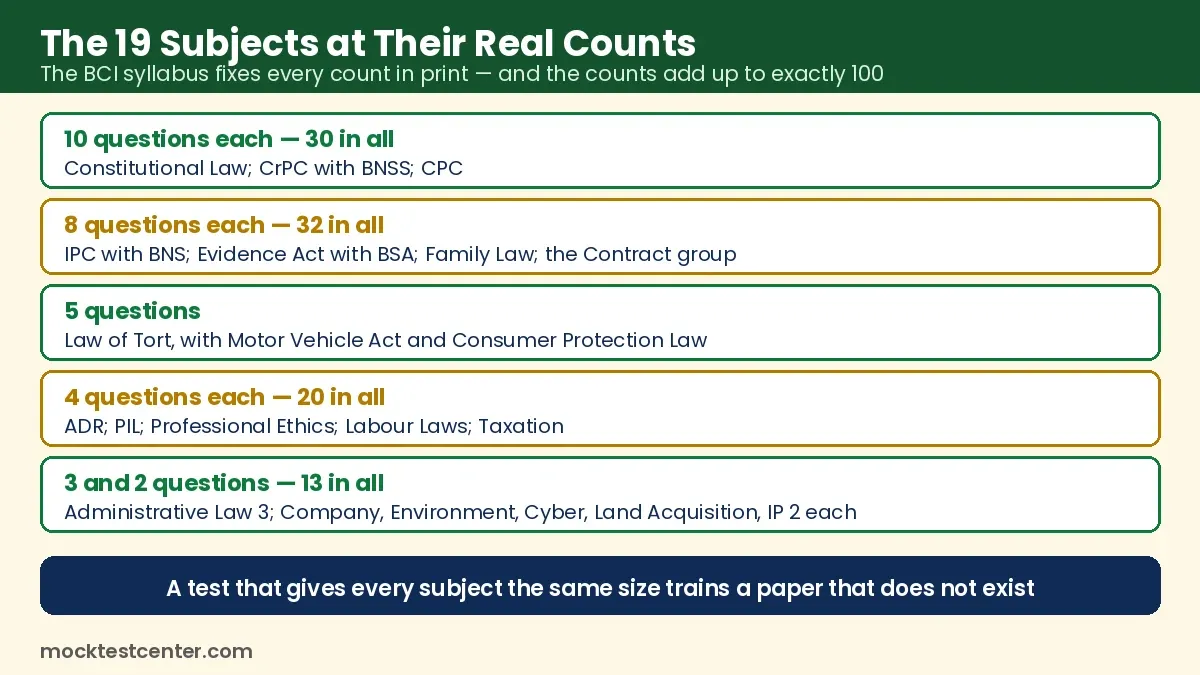
In a school exam, a chapter is one part of one book. In the AIBE, the word works at two levels, and a good chapter test respects both. At the top level, a chapter is one of the 19 subjects in the Bar Council syllabus. The syllabus fixes the size of every subject in print. Each subject carries a fixed count of questions, and the counts add up to exactly 100.
Read the table below the way a paper setter reads it. Three subjects carry 10 questions each. Four carry 8. One carries 5. Six carry 4. One carries 3. Five carry just 2. That spread is the whole game of chapter tests. A test that gives every subject the same number of questions trains you for a paper that does not exist.
The second level sits inside the subject. A subject like the CPC is one bare act with 158 sections and a long set of orders and rules behind it. Inside that act, your real chapters are its working parts: jurisdiction, pleadings, interim orders, appeals, execution. A chapter test on this tab works at the subject level, at the count printed above. But the questions inside it are drawn part by part from the act, so a weak part shows up in your score instead of hiding inside a big total.
| Subject in the BCI syllabus | Questions |
|---|---|
| Constitutional Law | 10 |
| Cr.P.C. (Criminal Procedure Code) and Bharatiya Nagarik Suraksha Sanhita | 10 |
| C.P.C. (Code of Civil Procedure) | 10 |
| I.P.C. (Indian Penal Code) and Bharatiya Nyaya Sanhita | 8 |
| Evidence Act and Bharatiya Sakshya Adhiniyam | 8 |
| Family Law | 8 |
| Law of Contract, Specific Relief, Property Laws, Negotiable Instruments Act | 8 |
| Law of Tort, including Motor Vehicle Act and Consumer Protection Law | 5 |
| Alternative Dispute Redressal, including Arbitration Act | 4 |
| Public Interest Litigation | 4 |
| Professional Ethics and Cases of Professional Misconduct under BCI Rules | 4 |
| Labour and Industrial Laws | 4 |
| Law related to Taxation | 4 |
| Administrative Law | 3 |
| Company Law | 2 |
| Environmental Law | 2 |
| Cyber Law | 2 |
| Land Acquisition Act | 2 |
| Intellectual Property Laws | 2 |
| Total | 100 |
One more thing has changed the meaning of a chapter since 1 July 2024. The Bharatiya Nyaya Sanhita replaced the Indian Penal Code, the Bharatiya Nagarik Suraksha Sanhita replaced the CrPC, and the Bharatiya Sakshya Adhiniyam replaced the Indian Evidence Act. The syllabus now names each old law with its new code. So the criminal chapters have two faces: the old section numbers many teachers still quote, and the new numbers the paper now uses. A chapter test that drills only the old numbers is training you for a paper that has already gone.
Keep the two levels in one line in your head. Subject first, at its printed count. Parts of the act second, so you learn where inside the act your time goes.
The Seven Heavy Chapters Carry 62 of the 100 Questions
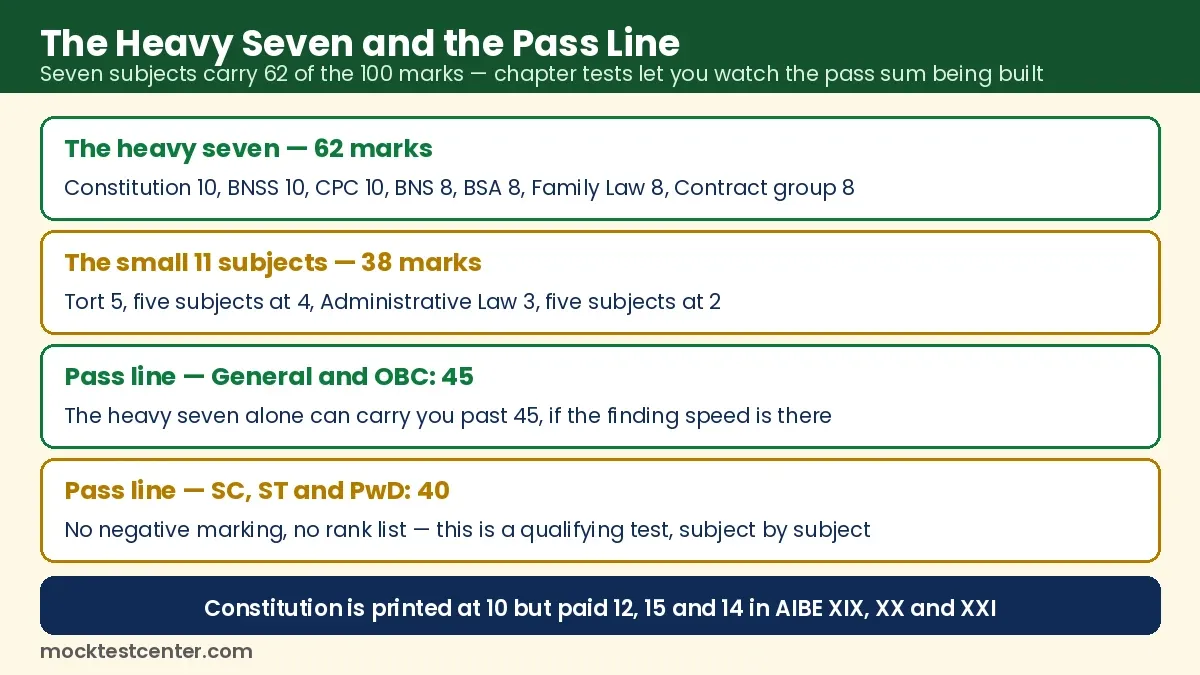
Count it yourself. Constitutional Law 10, CrPC and BNSS 10, CPC 10. That is 30. IPC and BNS 8, Evidence Act and BSA 8, Family Law 8, and the Contract group 8. That is 32 more. Seven subjects, 62 questions, 62 marks. A General category candidate needs 45 marks to pass. The heavy seven alone can carry a candidate past the line, with marks to spare, if the finding speed is there.
This is why chapter tests start with the heavy seven on this tab. The small subjects matter too, and a later section of this page gives them their own plan. But marks follow weight, and your first month of chapter tests should follow the same order the paper follows: big chapters first, tested again and again, until the lookup inside each act feels like a habit of the hand.
Now a warning that most test sellers skip, because it does not fit on a poster. The printed table is a plan. It is not a promise. Taxmann counted the questions of the real papers against the printed table, and the count moved. Constitutional Law came at 12 questions in AIBE XIX, 15 in AIBE XX and 14 in AIBE XXI, against a printed 10. The CrPC and BNSS count moved the other way in AIBE XX, down to 7. CPC held near its line at 10, 8 and 9.
Read that drift like a candidate, not like a fan. The Constitution has run heavy three papers in a row. A chapter plan that tests Constitutional Law at exactly 10 questions and stops is a plan built on the poster, not on the papers. On this tab, the chapter tests for the heavy subjects run a little long on purpose, and the Constitution tests run longest of all. If the next paper again gives the Constitution 13 or 14 questions, the candidate who drilled it deep will smile. The candidate who stopped at 10 will pay for those extra questions with time taken from other subjects.
There is a second reason the heavy seven come first, and it is about the bare acts themselves. The CPC and the BNSS are thick books. Nobody learns to move inside a thick book in one week. A young advocate in Patna told us she opened her CPC bare act for the first time in the exam hall of AIBE XIX, because her coaching had taught from a commentary. She knew the law. She could not find it. She scored 41, four marks below the General line of 45, and she is sure the marks sat inside that book, on pages she turned too slowly. Chapter tests exist so that this story does not repeat. The finding must be practised subject by subject, act by act, while there is still time to fix it.
So the order of work is plain. Constitutional Law, BNSS, CPC first, in rotation. Then BNS, BSA, Family Law and the Contract group. One chapter test a day is honest work. Two a day in the last month, when the hand is faster, is better work.
How a Chapter Test Runs on This Tab
A chapter test here is a small sitting with four rules, and the rules matter more than the questions. First, the count is the real count. A CPC test holds 10 questions, a Family Law test holds 8, a Company Law test holds 2 large ones or a pair of short sittings clubbed in practice. Second, your bare act stays open beside you, clean, with no notes in it, exactly as the hall allows. Third, the clock runs at the paper rate, about 2 minutes a question, so a 10-question chapter gets about 21 minutes. Fourth, after the test, you write down every question where the answer took long to find, with the section or article number beside it. That list is the real result of the test.
The Chapter Test Loop: Four Steps
Why keep the bare act open in a practice test, when you could test your memory instead? Because the hall keeps it open too. Memory still matters, since a question you can answer from your head takes 20 seconds and a lookup takes 2 minutes. But the AIBE pays for settling: what you can settle, from your head or from the act, inside 210 minutes for 100 questions. Reciting is only one part of that. A chapter test with the book shut trains a skill the hall never tests. A chapter test with the book open trains the exact mix the hall rewards: know some, find the rest, find them fast.
And keep the pen honest. In the hall you will mark an OMR sheet with a blue or black ballpoint pen, and a wrongly filled circle is not easy to fix. When you take a chapter test on paper at home, mark your answers the same way, in ink, one clean circle each. Small habits like this look dull in practice and pay in the hall.
When a full chapter starts to feel easy, do not leave it. Raise the mix. The sectional tests join your strong chapters into subject groups, and the full tests then put all 19 subjects on one clock, the way the real paper does.
One Chapter Test Worked in Full: Articles 12 to 35
Let us work one chapter test the way we ask candidates to work it, with real numbers. Take Constitutional Law. The printed count is 10, the real papers have given it 12 to 15, so the chapter test on this tab gives you a sitting of 10 questions drawn from the Fundamental Rights part of the Constitution, Articles 12 to 35, with the Constitution bare act open beside you and 21 minutes on the clock.
A candidate in Gaya, enrolled with the Bihar State Bar Council in 2025, sat this test with us in her second week. Her first 3 questions, on the meaning of State under Article 12 and the rights under Articles 14 and 19, she answered from memory in under a minute each. Question 4 asked which article covers protection in respect of conviction for offences, Article 20, and she found it in the act in about a minute. Then the test turned. A question on Article 32 and the writs took her 4 minutes, because she kept opening the act at the wrong part and had to walk back through the index. A question on Article 21A, the right to education, she answered wrong, from a half-remembered coaching line.
Her score was 7 out of 10. In a memory test, that score would read as fair. In a chapter test read the right way, the score is not the news. The news is the list she wrote after it: writs under Article 32, slow to find; Article 21A, wrong from memory; one question on Article 15 where the lookup took 3 minutes because she did not know that the rights articles run in order and that Article 15 sits just after Article 14. Three fixes, all inside one part of one act. She drilled the Fundamental Rights part for two evenings, sat the chapter test again, and scored 9, with no lookup over 2 minutes.
Now scale that story up. The Constitution chapter holds 10 printed questions and has paid 14 in a real paper. A candidate who lifts her Constitution score from 7 to 9 in practice, and who also cuts her slow lookups, gains twice: marks in the subject, and minutes for the rest of the paper. Those saved minutes move to the CPC or the BNSS, where another chapter test has already shown which parts of those acts her hand reaches slowly.
This is also where the pass line stops being a fear and becomes a sum. A General candidate needs 45. Say the heavy seven give her 38 at her present level, and the small subjects give her 9. That is 47, over the line, with no heroics. Chapter tests let you watch that sum being built subject by subject, in ink, before the Bar Council builds it for real. The previous year papers then show you how the real questions were worded, and the PYQ PDF files give you those papers for print sittings at home.
One rule for the worked example to stay honest. Do not sit the same chapter test twice in one week and call the second score growth. Memory of the questions, not skill in the act, lifts that score. Leave a gap, change the mix, and let the act, not your memory of the test, do the work.
Her story has a second half, and it is the half that matters for the small list method. Two weeks later she sat a CPC chapter test, 10 questions in 21 minutes, and scored only 5. The slow list this time was longer: appeals, review and revision all sat in one part of the act she had never opened, and execution took her 5 minutes on a single question. A full mock would have buried that news inside a total of 52 or 54. The chapter test put it on one line: one act, one weak part, one week of repair. She spent that week inside the CPC with the bare act and a senior's old case diary for company, sat the chapter test again with a fresh mix, and scored 8. Two chapter tests, two repair weeks, two subjects made safe. That is the whole method, and it scales to all 19 subjects without any new idea added.
The Small Chapters: Subjects of 2, 3 and 4 Questions
Now the other end of the table. Company Law 2, Environmental Law 2, Cyber Law 2, Land Acquisition Act 2, Intellectual Property Laws 2. Administrative Law 3. ADR 4, Public Interest Litigation 4, Professional Ethics 4, Labour and Industrial Laws 4, Taxation 4. Law of Tort with the Motor Vehicle Act and Consumer Protection Law stands a little higher at 5. Add them up and the small subjects hold 38 of the 100 questions. Thirty-eight marks is most of a pass by itself.
The trouble with small chapters is not that they are hard. Most are not. The trouble is that they are easy to skip in a study plan, week after week, because 2 questions feel too small to sit for. Then the paper asks its 2 Company Law questions, and the candidate who never opened the Companies Act bare act spends 6 minutes finding what a prepared candidate finds in 1. Small chapters punish neglect out of all size.
Chapter tests fix this with rotation. Give the small subjects a fixed day. Say, every Friday: two small chapter tests back to back, each at its real count, each on its own clock. A 2-question subject takes about 5 minutes of test time, but give it 15 minutes of your day, because the checking and the slow-lookup list are where the value sits. In 4 Fridays you will have touched all 11 small subjects once. In 8 Fridays, twice. That is how a 2-question subject stops being a stranger.
Professional Ethics deserves a line of its own. Its 4 questions come from the Bar Council Rules and the known cases of professional misconduct, and they are among the most scoring questions in the paper, because the ground is narrow and the facts repeat. Candidates leave these 4 marks unclaimed every cycle for one sad reason: the subject feels too small to open. Open it. Four marks is four marks, and on a paper where the pass line is 45, four marks is the width of the line itself for many candidates.
There is one more use for small chapter tests, and it is about the head, not the book. On a bad study day, when the CPC feels like a wall, a small chapter test finished well keeps the day honest. Marks are marks. A candidate who collects the small subjects calmly walks into the hall with a base of 25 to 30 marks she trusts, and then the heavy chapters only have to do the rest, not everything.
If your base itself feels shaky, if school civics and the first ideas of the Constitution feel far away, the NCERT tests on this site rebuild that ground floor first, and the current affairs tests keep your general reading warm for the questions that lean on recent law news.
Mistakes We See Every Cycle
The first mistake is reading a commentary when the hall allows only the bare act. A commentary teaches well and explains more, and at home it has its place. But a candidate whose fingers know a commentary will reach the hall with a skill the hall does not let her use. Read the commentary to understand. Test with the bare act to pass.
The second mistake is writing inside the bare act. Candidates underline, note case names in margins and stick flags all over their acts during study, then carry the same books to the hall. Bare acts with notes or comments are not allowed, and a strict centre can bar the book or the candidate. Keep two sets if you can: a marked set for home study, and a clean set that travels to the hall. If you can keep only one set, keep it clean from the start and put your notes in a notebook.
The third mistake is testing every chapter at the same size. A candidate who takes 20 questions on Company Law and 20 on the CPC has built a plan for a paper that gives Company Law 2 questions and the CPC 10. Her time went where the marks are not. Match the test to the table. The table is printed by the Bar Council itself, and it is the one free gift this exam gives you before the paper.
The fourth mistake is old-code comfort. Teachers who learned on the IPC and CrPC still quote the old section numbers, and old notes still fill the market. Since 1 July 2024 the BNS, BNSS and BSA stand in their place, and the AIBE syllabus names the new codes beside the old. A chapter test on criminal law must run on the new books. A right answer under a dead section number is a wrong answer in the hall.
The fifth mistake is never timing the lookup. Candidates count right answers and feel ready. Then the hall gives them 210 minutes for 100 questions, and the questions they knew but found slowly eat the questions they could have answered at the end. A chapter score without a time beside it is half a score. Write both, every time: marks, and minutes.
The sixth mistake is leaving questions blank. This paper has no negative marking. A blank answer and a wrong answer cost the same, which is nothing, and a guessed answer can only gain. Yet every cycle, OMR sheets come back with 8 or 10 circles left empty, marks thrown away by habit from other exams. In a chapter test, mark every question, even the ones you settle by a fair guess after the lookup fails. Train the hand to finish the sheet. In the hall, an empty circle is the only answer that can never be right.
Your Next Step
Do this tonight, and it will take less than half an hour. Pick Constitutional Law. Open the Constitution bare act at Part III, Articles 12 to 35. Sit the chapter test for this subject on this tab with the act open and a clock running at 2 minutes a question. When you finish, do not look at the score first. Write the slow list first: every article you could not reach fast, every answer you took from a shaky memory. That list is your study plan for the next two evenings, written by the test itself.
Then move in the order the paper sets. BNSS and CPC next, because they carry 10 each and their acts are thick. BNS, BSA, Family Law and the Contract group after that. One small subject every Friday. When two or three chapters start scoring steady, join them on the sectional tests, and once a week sit a full paper from the full tests so the single long clock of 3 hours 30 minutes stops being a stranger.
Keep your facts from the source, always. The syllabus, the notices and the admit card live on allindiabarexamination.com, and the Bar Council itself sits at barcouncilofindia.org. New exam notices also land on the Latest Jobs page of this site. AIBE XXII is on 29 November 2026. The candidates who pass it will not be the ones who read the most pages. They will be the ones whose hands find the right page first. Chapter tests build that hand, one subject at a time.







