
About AIBE 2027 NCERT-based Tests
- 1.NCERT Books for AIBE: Key Facts First
- 2.NCERT Is Not in the AIBE Syllabus. Start There.
- 3.The 17 Questions That Grow Out of the School Base
- 4.How the NCERT Tests Run on This Tab
- 5.One Base Rebuild Worked in Full: Three Weeks in Darbhanga
- 6.The Book List, Class by Class
- 7.Where the School Base Stops
- 8.Mistakes We See Every Cycle
- 9.Your Next Step
Quick Answer: NCERT Books for AIBE is a search thousands of candidates run every cycle, and it starts from a wrong idea. NCERT books are not in the AIBE syllabus, and this page will not pretend they are.The Bar Council of India names 19 law subjects for the All India Bar Examination, and not one of them is a school book. So the NCERT tests on this tab do one limited job, and they do it for one kind of candidate: the law graduate whose school-level base under the Constitution is weak. Class 11 and 12 Legal Studies, the Class 11 book Indian Constitution at Work, and the Democratic Politics books rebuild that base. Under it sit 17 of the 100 AIBE questions: Constitutional Law 10, Public Interest Litigation 4 and Administrative Law 3. The base cannot replace the bare acts, and for the other 83 questions it does nothing at all. Read this page with that limit clear, and the tab will serve you well. Used as a main book for AIBE, it will fail you.
NCERT Books for AIBE: Key Facts First
The All India Bar Examination is a qualifying test run by the Bar Council of India. Passing it gives a law graduate the Certificate of Practice. The latest cycle is AIBE XXII: registration ran from 19 August 2026 to 27 October 2026, admit cards came out on 14 November 2026, and the exam is on 29 November 2026. The paper holds 100 questions for 100 marks in 3 hours 30 minutes, offline, on an OMR sheet, with no negative marking. The pass line is 45 marks for General and OBC candidates and 40 for SC, ST and PwD candidates. Only bare acts without notes or comments may be carried into the hall.
Every one of those 100 questions comes from the 19 law subjects in the BCI syllabus: the Constitution, the CPC, the new criminal codes, Family Law, and the rest of the list this site's other pages carry in full. School books appear nowhere in that list. If a seller shows you an AIBE course built on NCERT books as the main material, close the page. That course is built for some other exam, or for no exam at all.
Then why does this tab exist? Because a real group of candidates needs it, and pretending otherwise helps no one. Every year, law graduates reach the AIBE with a Constitution base made only of coaching notes and guide summaries. They can recite Article 21. They cannot say how the Constitution divides power between the Union and the States, why the judiciary sits where it sits, or where a PIL comes from. Their chapter test scores in Constitutional Law sit at 3 or 4 out of 10 while their criminal law scores sit at 7. For that candidate, and only that candidate, two or three weeks with the school books can change the paper. The NCERT books are free in PDF on the NCERT site, they are written in plain words, and the Class 11 Constitution book was made for a student meeting these ideas for the first time. That is the ground floor. This tab tests whether the ground floor is firm before you build on it with bare acts.
| Fact | Detail |
|---|---|
| Is NCERT in the AIBE syllabus? | No. The BCI syllabus names 19 law subjects only. No school book is in it |
| What the school base feeds | Constitutional Law 10 questions, Public Interest Litigation 4, Administrative Law 3: 17 of 100 |
| Main school books for the base | Class 11 Indian Constitution at Work; Class 11 and 12 Legal Studies; Class 11 Political Theory; Class 9 and 10 Democratic Politics |
| Cost of the books | Free PDFs on the NCERT website, ncert.nic.in |
| What the base cannot do | It cannot replace bare acts. The other 83 questions gain nothing from school books |
| Paper shape | 100 questions, 100 marks, offline OMR, 3 hours 30 minutes, no negative marking |
| Books in the hall | Bare acts without notes or comments only. School books are not allowed in the hall |
| Pass marks | 45 out of 100 for General and OBC; 40 out of 100 for SC, ST and PwD |
| Who this tab is for | Candidates whose Constitutional Law chapter test score sits at 4 or below out of 10 |
| Time the base should take | Two to three weeks at most, beside bare act work, never instead of it |
| Official websites | allindiabarexamination.com, barcouncilofindia.org and ncert.nic.in |
What This Page Covers
- NCERT is not in the AIBE syllabus. Start there.
- The 17 questions that grow out of the school base
- How the NCERT tests run on this tab
- One base rebuild worked in full: three weeks in Darbhanga
- The book list, class by class
- Where the school base stops
- Mistakes we see every cycle
- Your next step
NCERT Is Not in the AIBE Syllabus. Start There.
Open the Bar Council syllabus and read its table. Nineteen subjects, each with a fixed count of questions, adding to 100. Constitutional Law 10. CPC 10. The criminal codes, the Evidence law, Family Law, the Contract group, Tort, ADR, PIL, Professional Ethics, Labour Law, Taxation, Administrative Law, Company Law, Environmental Law, Cyber Law, Land Acquisition, Intellectual Property. Law subjects, all of them, drawn from the LLB course and from the bare acts a practising advocate keeps on the desk. There is no line for school social science, no line for Legal Studies, no line for any NCERT book.
This matters because the AIBE market is full of borrowed material. A course made for a school teaching exam or a clerk exam gets a new cover and a new price, and the NCERT set sits in the middle of it. A candidate with four months in hand buys it, reads Class 6 to 12 social science with care, and walks into the hall to find a paper on the BNSS and the CPC. The books were good books. They were simply for a different room. Before you spend one week on any material for this exam, hold it against the 19-subject table on allindiabarexamination.com. If the material serves no subject in that table, it is not AIBE material, whatever its cover says.
So this tab makes a narrower claim, and it makes it in plain words. The NCERT tests here carry no AIBE questions and draw nothing from the syllabus. They test the school books that stand under one corner of the syllabus: the Constitution corner. A candidate weak in that corner loses marks in three subjects at once, Constitutional Law, PIL and Administrative Law, because all three grow out of the same root ideas. Rights. Federal division of power. The place of the courts. The writs. Those ideas were first taught to most of us at school, in books written to be understood by a 15-year-old. When the LLB years built on a cracked school base, the crack shows up years later in the AIBE hall.
Who should use this tab? One test tells you. Sit a Constitutional Law sitting from the chapter tests, 10 questions with the Constitution bare act open. If you score 6 or more, close this tab and spend your weeks on bare acts; your base is fine. If you score 4 or less, and the wrong answers are idea questions rather than article-number questions, your base has the crack this tab exists to repair. The repair is short, it is cheap, and it has a clear end. That end is the day your Constitution chapter score crosses 6 and stays there.
The 17 Questions That Grow Out of the School Base
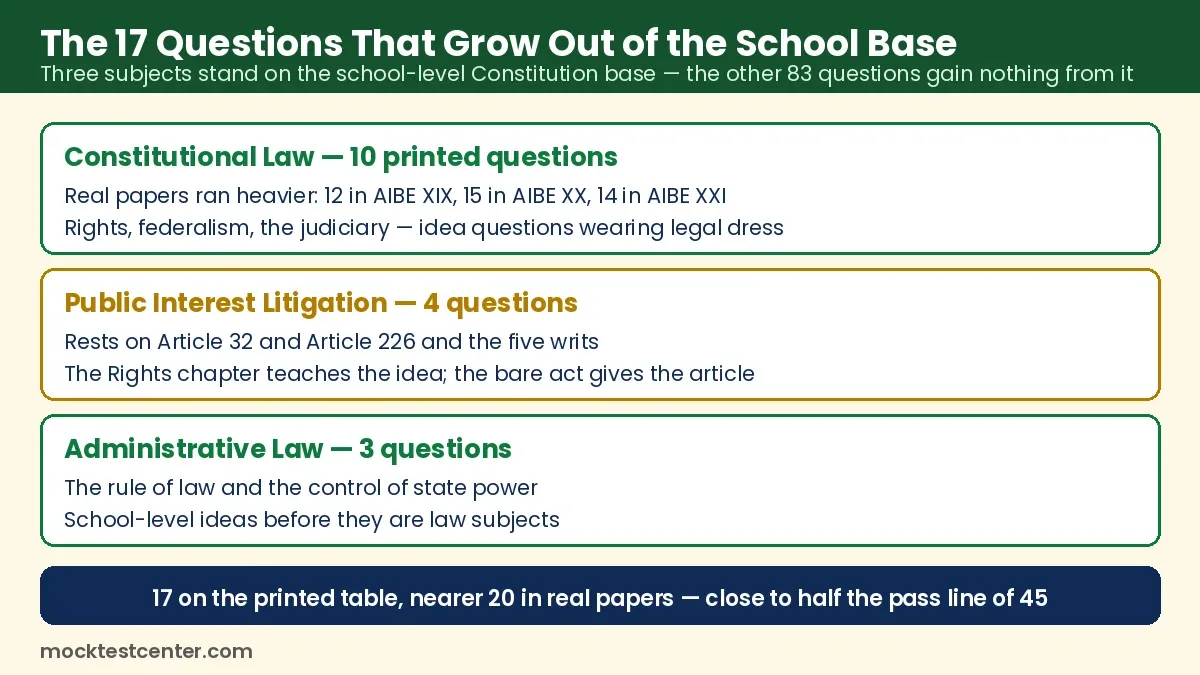
Count what the base feeds. Constitutional Law carries 10 printed questions, and real papers have carried more: Taxmann counted 12 in AIBE XIX, 15 in AIBE XX and 14 in AIBE XXI. Public Interest Litigation carries 4. Administrative Law carries 3. Together, 17 questions on the printed table, and nearer 20 on the papers of the last three cycles. For a General candidate who needs 45, that corner of the paper is close to half the pass line. A weak base costs far more than a mark here and there. It can cost the exam.
Look at what the questions in this corner ask. Some are bare act questions, and only the Constitution bare act can answer them: which Article, which Schedule, which amendment. But a large share are idea questions wearing legal dress. A question on federalism is a question about the Class 11 chapter on the same word. A question on the judiciary's place is the school chapter on the judiciary, grown older. A PIL question rests on Articles 32 and 226, yes, but also on the idea of who may move a court and why the courts opened that door, and that idea is taught at school before it is taught in any law college. Administrative Law's core, the rule of law and the control of state power, stands on the same ground.
The Class 11 book Indian Constitution at Work maps onto this corner almost chapter for chapter. Its ten chapters run: Constitution: Why and How; Rights in the Indian Constitution; Election and Representation; Executive; Legislature; Judiciary; Federalism; Local Governments; Constitution as a Living Document; and The Philosophy of the Constitution. A candidate who has read those ten chapters with care holds the map of the whole Constitution corner. The bare act then gives him the house numbers on that map: the articles, the parts, the schedules. Map first, numbers second. Most weak candidates try to learn the numbers with no map under them, and the numbers will not stay.
The PIL slice of this corner shows the join between school book and bare act at its clearest. The Class 11 Rights chapter teaches the writs and tells you why Dr Ambedkar called Article 32 the heart and soul of the Constitution. That is the idea layer. The bare act layer sits right on top of it: Article 32 for the Supreme Court, Article 226 for the High Courts, and the five writs by name. A PIL question in the paper often needs both layers in one answer, the idea to read the question and the article to close it. Candidates with only the guide summary hold neither layer firmly. Candidates who walked the school chapter and then the articles hold both, and the 4 PIL questions stop being a lottery for them.
Be clear about the other side of the line too. The school base feeds nothing outside this corner. It will not help you in the CPC, where 10 questions wait. It will not help in the BNSS, the BNS or the BSA, 26 questions of criminal law. It will not touch Family Law, the Contract group or Tort. A candidate strong in the Constitution corner and empty everywhere else scores near 17 and fails by a wide margin. The base is a repair for one corner of a 19-subject paper. Size it that way in your plan, and it will pay you. Size it as the whole plan, and it will sink you.
How the NCERT Tests Run on This Tab
An NCERT test on this tab follows one school chapter or one small group of chapters, and it asks the idea questions those chapters teach, in the same plain words the books use. You read the chapter first, with a notebook beside you, and you sit the test the same day or the next. The test is short. It is not timed like the paper, because its job is not speed. Its job is to find the idea that did not land: the chapter you read with your eyes and missed with your mind. When the test names that idea, you go back to those pages only, not to the whole book.
The Base Rebuild Path: Four Steps
The fourth step is the one that makes this tab an AIBE tab and not a school tab. Every weak line must end inside the bare act. If the test shows your federalism is shaky, the school chapter repairs the idea, and then you open the Constitution at the Seventh Schedule and the articles around it, and you read what the hall will actually ask about. The school book is the road. The bare act is the address. A sitting that ends at step 3 has done half its work.
Set the size of this work before you start. Two chapters a day is a full pace: the ten chapters of Indian Constitution at Work take five days of reading with their tests, the Legal Studies units that matter take about a week, and a second pass over the weak lines takes the third week. Three weeks, running beside your bare act subjects, not instead of them. Give the mornings to the CPC or the BNSS as usual. Give one evening slot to the base. When the three weeks end, this tab ends for you, whatever your score. Its job is done or it has failed, and either way the bare acts are where your remaining weeks belong.
One Base Rebuild Worked in Full: Three Weeks in Darbhanga
Take a real shape of candidate. A graduate in Darbhanga finished her LLB from a college where Constitution classes ran on a senior's guide and a thin set of notes. She enrolled with the Bihar State Bar Council and started AIBE practice with fair scores in criminal law: 7 of 8 in a BNS chapter test, 6 of 10 in BNSS. Her Constitutional Law chapter tests sat at 3 and 4 out of 10 across three sittings. Look at her wrong answers and a pattern stood up. She missed almost no article-number question she attempted with the bare act open. She missed the idea questions: why local governments sit in the Constitution at all, what the chapter on the judiciary protects, how a bill becomes law and where the money bills split from the rest. The map was missing. The numbers had nothing to stand on.
Her repair ran on the path this tab sets out. Week one: Indian Constitution at Work, two chapters a day, each followed by its test here. The Rights chapter and the Federalism chapter named her two weakest lines, and she wrote them in her own words: what a right against the State means, and how the lists divide power. Week two: the remaining chapters, plus the Class 11 and 12 Legal Studies units on the judiciary and the legal system, with their tests. Week three: no new school reading at all. Only the bare act end of the path: the Constitution open at the parts her weak lines pointed to, Part III for rights, the Seventh Schedule for federalism, the judiciary chapters of the act for the courts.
Then the same test that had sent her here. Her fourth Constitutional Law chapter sitting scored 7 of 10. The fifth, a week later with a fresh mix, scored 8. Her PIL answers in a sectional test of the public law part rose in the same weeks, because the writ ideas had a floor under them at last. Count the cost in full: three weeks of evenings, beside her morning subjects, which kept moving the whole time. Count the gain: a corner of the paper worth 17 printed questions moved from a third to four-fifths. No other three weeks in her plan could have bought that.
And count what the repair did not do, because the limit is part of the lesson. Her CPC score did not move in those weeks. Her Taxation answers stayed where they were. The base paid only where a base was missing, in the one corner that grows out of school ideas. That is why the entry test matters: score 6 or more in the Constitution chapter test, and this whole path is a waste of your evenings. Score 4 or less on idea questions, and few things you can do will pay you faster.
The Book List, Class by Class
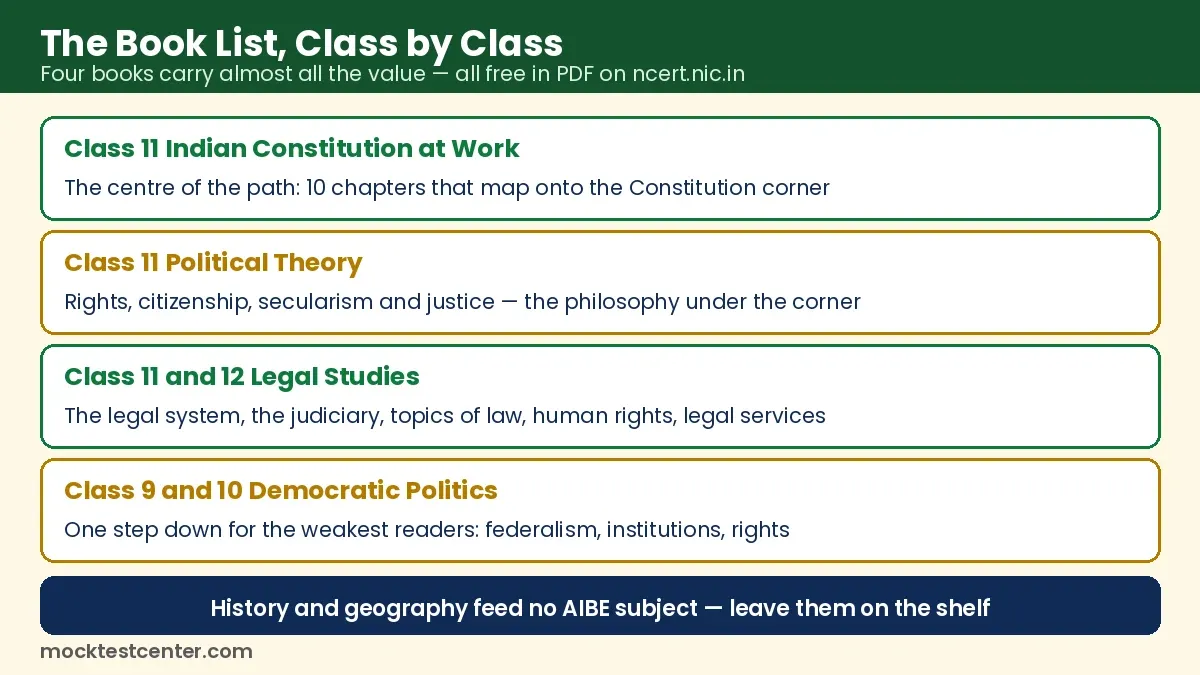
Keep the list short, because a long list is how this repair goes wrong. Four books carry almost all of the value, and all four are free in PDF on ncert.nic.in. The first is Class 11 Indian Constitution at Work, the centre of the whole path, with its ten chapters on rights, the executive, the legislature, the judiciary, federalism and the rest. The second is Class 11 Political Theory, whose chapters on rights, citizenship, secularism and justice give the philosophy under the Constitution corner; read the chapters that touch rights and the state, and skip the rest. The third and fourth are the Legal Studies books of Class 11 and Class 12, which walk through the Indian legal system, the judiciary, the topics of law, human rights and legal services in school language. For a law graduate these read fast, and their value is order: they lay the system out in the sequence a beginner can hold.
Below those four, two more books help the weakest readers, and only them. Class 10 Democratic Politics II carries power sharing, federalism, political parties and the outcomes of democracy in the simplest words NCERT prints. Class 9 Democratic Politics I carries constitutional design, electoral politics, the working of institutions and democratic rights. A candidate who found the Class 11 Constitution book heavy going can start one step down, spend four or five days there, and come back up. There is no shame in that order. The hall will never know which class book rebuilt you. It will only see the score.
The Class 6 to 8 Social and Political Life books sit below even that, and for this exam they earn one line only. The Class 8 book carries early chapters on the Constitution, Parliament and the Judiciary, and a candidate returning to books after many years away from study can use them as a first week of warm reading. Nobody should plan a month there. And the rest of the school shelf, the history, geography and economics books, feeds no AIBE subject at all. Leave it on the shelf, however fond you are of it.
One buying note. You need none of these in print. The PDFs on the NCERT site are the full books, free, and a phone or a borrowed tablet reads them well enough for three weeks of evenings. Spend your money where this exam actually bills you: on clean bare acts without notes, the Constitution first among them, because those are the books that enter the hall with you.
Where the School Base Stops
Every page on this site tries to tell you where a thing ends, and this one has a sharper end than most. The school base stops at the door of the bare act. The real paper's Constitution questions include article-level asks that no school book carries: the article for a writ, the schedule for the languages, the amendment that moved a subject between lists. Those come from the Constitution bare act and from sittings on the previous year papers, where you can watch the real paper's own level. A candidate who finishes the base and stays with school books has built a floor and refused the house.
The base also stops at a date. Three weeks is its full size for a law graduate. If a fourth and fifth week on school books still feels needed, the problem has changed: it is no longer a base problem, it is a reading-speed or language problem, and more school chapters will not fix it. At that point the honest move is to return to the bare acts with the base you have, take the chapter tests at real counts, and let the slow list method from the chapter tab do the rest of the teaching, act by act.
And the base stops, finally, at the hall door. No NCERT book enters the examination hall. The books that enter are bare acts, clean ones. So the last test of this whole path leaves NCERT behind. It is a Constitution chapter test sat with the bare act open and the school books in another room. When that sitting scores 7 or more, the base has done its work and become invisible, the way a floor should be. Keep the school PDFs on your phone even after the fence ends, for the odd evening when one weak line calls you back for ten minutes. Build the rest of your paper on the full tests and the other tabs of this sub-category, and let this one go.
Mistakes We See Every Cycle
The first mistake is buying an NCERT set as the main AIBE preparation. It happens every cycle, usually on the word of a seller whose course was built for another exam. The syllabus check takes five minutes and saves five months: 19 law subjects, no school books, no exceptions.
The second mistake is reading the school books cover to cover. The economics chapters, the history chapters, the geography of Class 6 to 10: none of it feeds any AIBE subject. The base that matters is a short list of polity and legal studies chapters. Read those, test those, and stop.
The third mistake is staying on the base too long. The base feels safe. The words are easy, the tests go well, and the bare acts wait on the desk looking thick and unfriendly. Candidates hide in the school books for two months and call it preparation. It is rest, not preparation, after the third week.
The fourth mistake is treating Legal Studies as a substitute for law. The school Legal Studies books give the shape of the system in simple words. They do not give the sections, the articles or the case law the paper asks about. A graduate who reads them instead of the bare acts has read a map and skipped the country.
The fifth mistake is skipping the entry test and guessing at weakness. Some candidates rebuild a base that was never broken, and lose three weeks they owed to the CPC. Sit the Constitution chapter test first. Let its score, 6 or more against 4 or less, decide whether this tab is yours at all.
Your Next Step
Do the entry test today. One Constitutional Law sitting from the chapter tests, bare act open, 10 questions at the paper rate. If the score is 6 or more, close this page with thanks and give your weeks to the heavy chapters and the current affairs tests that keep your reading warm. If the score is 4 or less and the idea questions did the damage, start the path tonight: the first two chapters of Indian Constitution at Work, their tests, and your weak lines written in your own words.
Keep the three-week fence around the work. Base in the evenings, bare acts in the mornings, and the public law part of the sectional tests once a week to watch the corner move. When the fence ends, sit the Constitution chapter test again with the school books in another room. That score is the report card of this whole tab.
The official word stays where it always is: the syllabus and notices on allindiabarexamination.com, the Council at barcouncilofindia.org, the free books at ncert.nic.in, and fresh notices tracked on the Latest Jobs page of this site. AIBE XXII is on 29 November 2026, and its syllabus has no school book in it. Use the school books the way this page sizes them: a short repair under one corner, finished in three weeks, and then put down for good.







