
About AIBE 2027 Sectional Tests
- 1.AIBE Sectional Test: Key Facts First
- 2.The Real Paper Has No Sections. Read That Again.
- 3.The Four Working Parts of This Tab
- 4.How a Sectional Test Runs Here
- 5.One Sectional Test Worked in Full: The Criminal Law Part
- 6.What a Part Score Shows That a Total Hides
- 7.Mistakes We See Every Cycle
- 8.Your Next Step
Quick Answer: One fact shapes everything about AIBE sectional tests: the real All India Bar Examination paper has no sections at all. It is one booklet of 100 questions from 19 subjects, one OMR sheet, and one single clock of 3 hours 30 minutes, and you may move from any subject to any other as you like. So the sectional tests on this tab do a different job from the sectional tests of a bank or SSC exam. They group the 19 subjects into 4 working parts, Public Law with 17 questions, Criminal Law with 26, Civil Law with 37 and Other Laws with 20, and they train you to hold each part inside its fair share of the 210 minutes. The pass line stays 45 marks for General and OBC candidates and 40 for SC, ST and PwD candidates, and bare acts without notes are the only books allowed in the hall.
AIBE Sectional Test: Key Facts First
The All India Bar Examination is run by the Bar Council of India, and passing it gives a law graduate the Certificate of Practice. The latest cycle is AIBE XXII: registration ran from 19 August 2026 to 27 October 2026, admit cards came out on 14 November 2026, and the exam is on 29 November 2026. The fee was Rs 3,500 for General and OBC candidates and Rs 2,500 for SC and ST candidates, plus Rs 60 of bank charges. AIBE XX before it, on 30 November 2025, saw 2,51,968 candidates sit the paper, and 1,74,386 of them qualified.
Hold the paper shape clearly, because this whole page hangs on it. The paper is offline, on paper, with answers marked on an OMR sheet in blue or black ballpoint pen. 100 questions, 100 marks, no negative marking, 11 languages. One sitting. No part of the paper is sealed, no part has its own timer, and no part has its own pass mark. The only line that matters is the total: 45 for General and OBC, 40 for SC, ST and PwD.
So why does this tab run sectional tests at all? Because a total can hide a rot. A candidate can score 57 in a full mock and still be bleeding inside one part of the paper, and the total will not tell him which part. A sectional test takes one group of subjects, at its real question count, on its fair share of the clock, and puts that part's true level in front of his eyes. That is the real use of the word sectional for this exam, and this page will not pretend the real paper has sections it does not have.
| Fact | Detail |
|---|---|
| Exam | All India Bar Examination (AIBE), run by the Bar Council of India |
| Sections in the real paper | None. One booklet, 100 questions, one sitting, free movement across subjects |
| Paper shape | 100 questions, 100 marks, offline OMR, 3 hours 30 minutes in total |
| Working parts on this tab | Public Law 17 questions, Criminal Law 26, Civil Law 37, Other Laws 20 |
| Clock share of each part | About 36, 55, 78 and 42 minutes, at the paper rate of about 2 minutes a question |
| Negative marking | None. A wrong answer and a blank answer both cut nothing |
| Books in the hall | Bare acts without notes or comments only. No commentary, digest, guide or notes |
| Pass marks | 45 out of 100 for General and OBC; 40 out of 100 for SC, ST and PwD, on the total only |
| Latest cycle | AIBE XXII; registration 19 August 2026 to 27 October 2026; exam on 29 November 2026 |
| Fee, AIBE XXII | Rs 3,500 for General and OBC; Rs 2,500 for SC and ST; Rs 60 bank charges extra |
| Official websites | allindiabarexamination.com and barcouncilofindia.org |
What This Page Covers
- The real paper has no sections. Read that again.
- The four working parts of this tab
- How a sectional test runs here
- One sectional test worked in full: the Criminal Law part
- What a part score shows that a total hides
- Mistakes we see every cycle
- Your next step
The Real Paper Has No Sections. Read That Again.
Most candidates who come to this page have given other exams before, or have friends who have. In SSC and bank exams, a sectional test copies something real: the paper itself is cut into parts, each part sits on its own locked timer, and a weak part can end your run even under a strong total. Candidates carry that picture into AIBE practice without checking it. For this exam, the picture is wrong.
The AIBE paper is one booklet. The 100 questions sit in one run, subject mixed with subject, and the OMR sheet takes all 100 answers in one sitting of 3 hours 30 minutes. You can start at question 1, jump to a Family Law question in the middle, come back to the Constitution questions at the end, and nobody's timer will stop you. The Bar Council prints no sectional cut-off for this exam. There is one cut-off only, and it sits on the total: 45 marks for General and OBC candidates, 40 for SC, ST and PwD candidates.
This freedom is a gift, and like most gifts in an exam hall, it cuts both ways. A candidate who loves criminal law can spend 100 of his 210 minutes inside the criminal subjects because they feel like home, and reach the last 30 questions with 15 minutes left and a hand that has started to shake. The paper never stopped him. That is the point. In this exam, the clock discipline that other papers force on you from outside must come from you, from the inside. Nobody will lock a part for you. You have to lock it yourself, in practice, until the locking feels natural.
That is the true job of a sectional test on this tab. It is a training frame, not a copy of the paper. It teaches your hand and your head what one part of the paper should cost: about 36 minutes for the public law subjects, about 55 for the criminal group, about 78 for the big civil group, about 42 for the rest. When you have felt those costs in practice, part by part, you can walk into the single long sitting of the real paper and spend your 210 minutes like a person who has a plan, not like a person the paper is dragging.
One more line belongs here, because sellers blur it. If a site tells you the AIBE has sectional timing, or a sectional cut-off, or that you must clear each subject group to pass, that site is selling you another exam's rules under this exam's name. Check the word on allindiabarexamination.com before you pay for any such claim. The Bar Council's own syllabus and notices are short, and they are free.
The Four Working Parts of This Tab
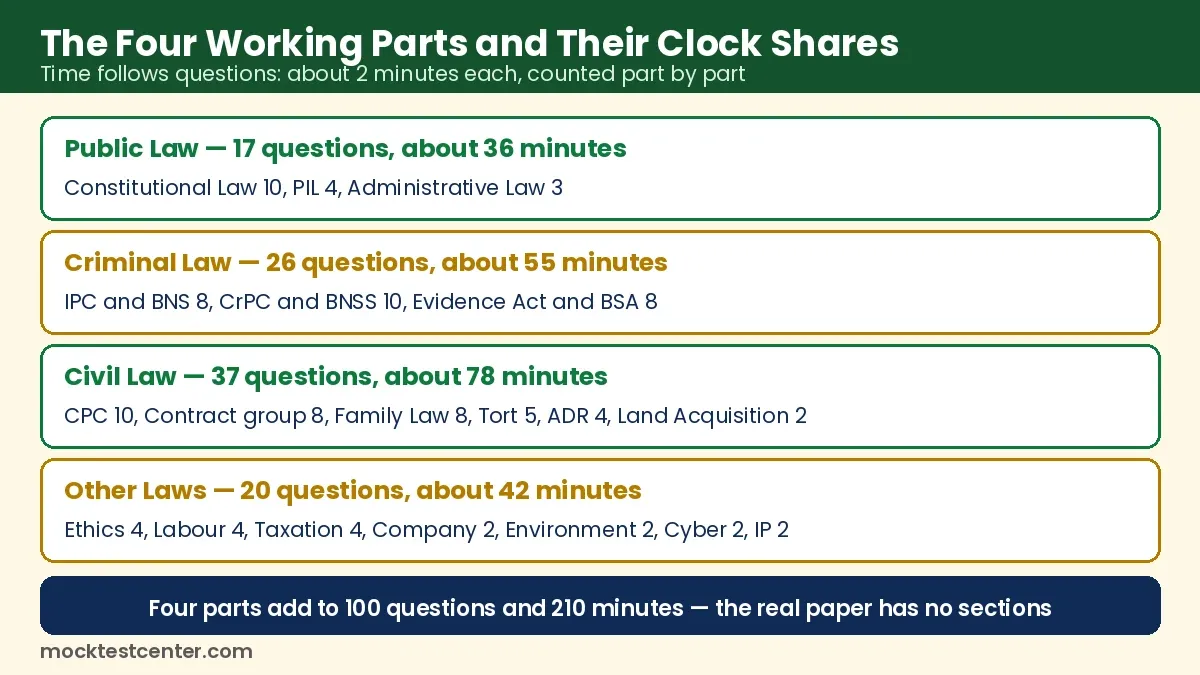
The grouping used here is simple, and it follows the way the subjects sit together in practice. Public Law holds Constitutional Law with its 10 questions, Public Interest Litigation with 4, and Administrative Law with 3. That is 17 questions. Criminal Law holds the IPC with the BNS at 8, the CrPC with the BNSS at 10, and the Evidence Act with the BSA at 8. That is 26. Civil Law is the giant: CPC 10, the Contract group 8, Family Law 8, Law of Tort with the Motor Vehicle Act and Consumer Protection Law 5, ADR with the Arbitration Act 4, and the Land Acquisition Act 2. That is 37. Other Laws holds what is left: Professional Ethics 4, Labour and Industrial Laws 4, Taxation 4, Company Law 2, Environmental Law 2, Cyber Law 2, and Intellectual Property Laws 2. That is 20. The four parts add to 100, as they must.
| Working part | Subjects inside it | Questions | Fair clock share |
|---|---|---|---|
| Public Law | Constitutional Law 10, Public Interest Litigation 4, Administrative Law 3 | 17 | About 36 minutes |
| Criminal Law | IPC and BNS 8, CrPC and BNSS 10, Evidence Act and BSA 8 | 26 | About 55 minutes |
| Civil Law | CPC 10, Contract group 8, Family Law 8, Tort group 5, ADR 4, Land Acquisition Act 2 | 37 | About 78 minutes |
| Other Laws | Professional Ethics 4, Labour and Industrial Laws 4, Taxation 4, Company Law 2, Environmental Law 2, Cyber Law 2, Intellectual Property Laws 2 | 20 | About 42 minutes |
| Total | All 19 subjects of the BCI syllabus | 100 | 210 minutes |
The clock shares come from one sum, and you should know it by heart: 210 minutes for 100 questions is about 2 minutes a question. Multiply a part's questions by that rate and you get its fair cost. Civil Law at 37 questions costs about 78 minutes, more than a third of your whole paper. A candidate who has never felt 78 minutes inside the civil subjects will feel it for the first time in the hall, and the hall is a costly place to learn the size of a thing.
Notice also what the parts do to your books. Each part has its own shelf of bare acts. The criminal part runs on three acts that changed their names and numbers on 1 July 2024, the BNS, the BNSS and the BSA. The civil part runs on the CPC, a thick book, plus the Contract Act family and the family law acts. A sectional test keeps one shelf open at a time, so your hands learn one shelf deeply before the full paper asks them to run across all four shelves in one sitting.
One warning about part sizes, drawn from real papers. The parts above are built on the printed syllabus counts. Real papers drift, and the drift lands inside the parts. Taxmann counted 15 Constitution questions in AIBE XX against the printed 10, which means the public law part of that paper was heavier than 17 questions, while some other part of the paper ran lighter to keep the total at 100. The lesson is not to rebuild the parts every week. The lesson is to keep a small time cushion in every part sitting: finish a part 4 or 5 minutes inside its share when you can, so a heavier part in the real paper borrows from your cushion and not from the part after it.
How a Sectional Test Runs Here
A sectional test on this tab takes one working part, at its full real count, on its fair clock share, with that part's bare acts open beside you, clean and without notes. Public Law: 17 questions, about 36 minutes. Criminal Law: 26 questions, about 55 minutes. Civil Law: 37 questions, about 78 minutes. Other Laws: 20 questions, about 42 minutes. When the part clock ends, you stop, even if 3 questions stand open. In the real paper you could borrow time from another part, and sometimes you should. But you can only borrow wisely if you know the true cost of each part, and knowing comes from sittings where borrowing was not allowed.
The Four Part Clock Plan: Four Steps
After the sitting, read the result in two lines, never one. Line one is the part score: marks out of the part count. Line two is the leak list: the questions where the lookup ran past 3 minutes, named by subject and by the part of the act. A part score of 19 out of 26 with a leak list of 2 questions is a healthy part. A part score of 19 with a leak list of 7 is a part living on luck, and the next sitting will expose it.
Use the parts in rotation across the week, and weigh the rotation by size and by weakness. Civil Law, at 37 questions, earns two sittings in a week where Public Law earns one. A part that scores under half earns an extra sitting and a trip back to the chapter tests for its weakest subject. A part that scores steady above two-thirds can rest for a week while you feed the others. And once a week, all four parts must still meet on one clock in a sitting from the full tests, because the real paper will not let them sit apart.
A sample week, to make the rotation concrete. Monday: Criminal Law, 26 questions on the 55-minute clock. Tuesday: Civil Law, the long sitting, 37 questions in about 78 minutes. Wednesday: Public Law, short and sharp, 17 questions in about 36 minutes, with the evening given to chapter repairs from Monday's leak list. Thursday: Civil Law again, because size earns it. Friday: Other Laws, 20 questions in about 42 minutes, the part most candidates forget and this plan refuses to. Saturday: one full paper on the single 210-minute clock, from the full tests or from a paper kept in the PYQ PDF set. Sunday: no sitting at all, only the repair reading the week's leak lists named. Six days of work, one day of repair, and every part touched at least once.
One Sectional Test Worked in Full: The Criminal Law Part
Work one sitting with real numbers. The Criminal Law part holds 26 questions: 8 from the BNS side, 10 from the BNSS side, 8 from the BSA side. Its fair clock share is about 55 minutes. The three bare acts stay open. A candidate in Lucknow, in his first year after enrolment with the UP State Bar Council, sat this test in his third week of practice. His full mock scores at the time sat between 55 and 59, and he felt ready. His teachers felt he was ready. This one sitting told a more useful story.
The BNS questions went well: 7 right out of 8, most answered from memory, none slow. The BNSS questions broke the rhythm. A question on bail took him 5 minutes inside the BNSS, because the bail provisions sit in a part of the act he had never walked through in order. A question on the time limits for investigation took 4 minutes more. He finished the BNSS block with 6 right out of 10, but he had spent 31 of his 55 minutes reaching the halfway line of the part. The BSA block then ran on a short clock. He answered 6 of 8, guessed 2 in the last minutes, and closed the part at 19 out of 26, with the clock dead on 55.
Read that result the way this tab teaches. The part score, 19 of 26, is fine. It sits above the share a General candidate needs from this part. The leak list is the news: bail in the BNSS, investigation time limits in the BNSS, and burden of proof questions in the BSA where he guessed instead of looking. Three leaks, all named, all fixable inside two acts. His full mock total of 57 had hidden all three, because the total mixes his strong BNS with his slow BNSS and calls the mixture health.
His next week wrote itself. Two evenings inside the BNSS, walking the bail and investigation parts in order, with the act open and a notebook beside it. One evening on burden of proof in the BSA. Then the criminal part again, fresh mix: 22 out of 26, and the slowest lookup down to 3 minutes. When he next sat a full paper, his total moved to 64, and more of that gain came from minutes saved than from law newly learned. The criminal part had stopped eating the civil part's time.
That last line is the one to carry out of this example. In a one-booklet paper, parts do not fail alone. A slow part steals from the parts after it. The candidate who fixes a leak in the criminal part is also, without any extra work, giving the civil part its full 78 minutes back. Sectional tests are how you find which part is doing the stealing.
What a Part Score Shows That a Total Hides
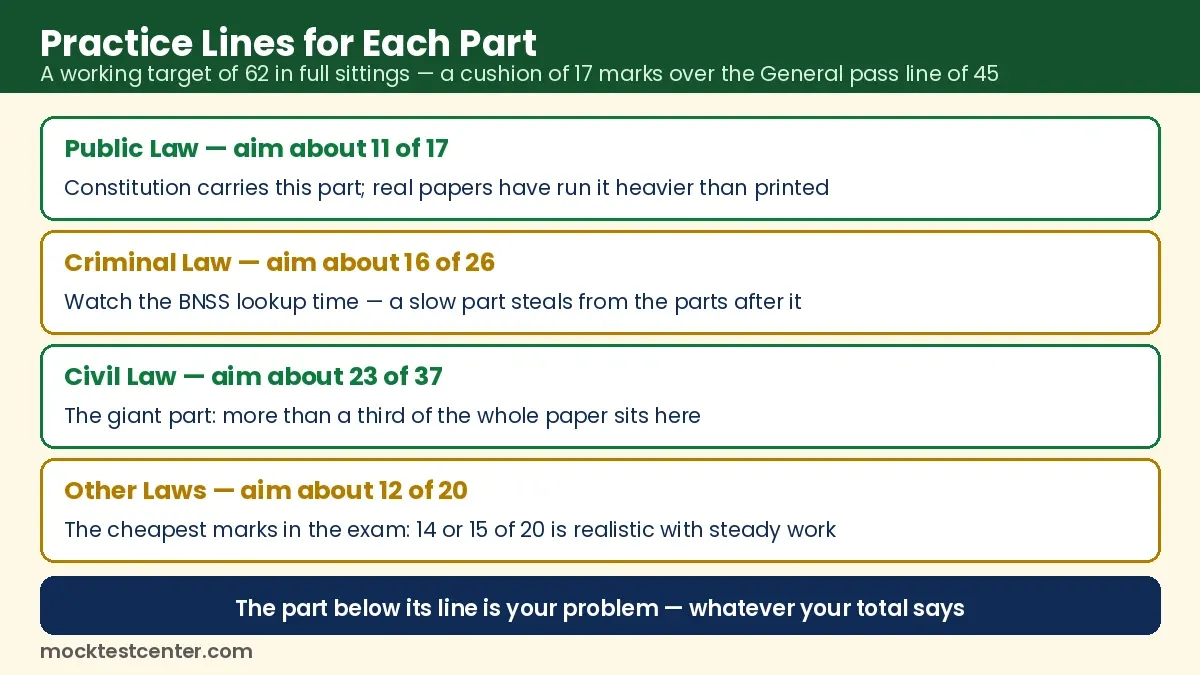
So how should you read your four part scores together? Start with the pass sum. A General candidate needs 45 marks. A safe practice line for a single part, set above the pass mark so the paper's small surprises do not sink you, runs like this: Public Law about 11 of 17, Criminal Law about 16 of 26, Civil Law about 23 of 37, Other Laws about 12 of 20. That is 62, with a cushion of 17 marks over the line.
Now hold your own part scores against that line, part by part. The part that sits below its line is your problem, whatever your total says. We see candidates with totals of 60 whose Civil Law sits at 17 of 37, carried by a strong criminal part and a kind paper elsewhere. One hard civil paper in the real hall, and that total falls under 45 in a single morning. The part scores saw it coming a month early. The total never said a word.
The Other Laws part deserves a hard look in this reading, because candidates treat it as small change. It holds 20 questions. Twenty marks is nearly half the pass line for a General candidate. Its subjects are small, 2 and 4 questions each, and most of its questions are direct for a candidate who has opened the acts once. A part score of 14 or 15 out of 20 in Other Laws is a realistic target for steady work, and it changes the whole maths of the paper: the other three parts then need only 30 to 33 marks between them to cross 45. Candidates who skip this part in practice are refusing the cheapest marks in the exam.
Keep the four part scores in one register, one line per sitting, with the date and the minutes used. Four lines a week. In a month you hold a map no full mock can draw: which part pays, which part leaks, and where the next week belongs. When a part stays weak after two repair weeks, go smaller: the chapter tests take that part apart subject by subject. When all four parts hold their lines twice in a row, go bigger: the previous year papers and full sittings take over, and sectional tests drop to one sitting a week as a check.
One more fact about the total, drawn from AIBE XX, belongs in this reading. In that cycle, candidates filed objections on the provisional answer key, and the final key dropped 5 questions. The result was then calculated on 95 marks, and the pass line moved with the smaller base, to 45 percent of it for General and OBC candidates and 40 percent for SC, ST and PwD candidates. Notice what the Council did not do. It did not protect any subject's count or promise any part its share. It fixed the total, and the total alone carried the result. A candidate whose practice spread marks across all four parts lost nothing when those 5 questions vanished. A candidate whose whole plan rested on one strong part felt every dropped question that came out of that part. An even spread of marks in this exam is not just a study habit. It is cover against the answer key itself.
Mistakes We See Every Cycle
The first mistake is treating the parts as sealed. A candidate trains himself never to return to a part, because his last exam locked its sections. In the AIBE hall that habit wastes a real gift. If a CPC question will not settle in 3 minutes, mark it, move on, and come back with a fresh head in the last half hour. The paper allows the return. Your practice should allow it too, in full sittings, even while sectional sittings train the single-part cost.
The second mistake is giving every part the same time. Four parts, four equal blocks of 52 minutes, sounds fair and is wrong. Civil Law holds 37 questions and Public Law holds 17. Equal time starves the giant and fattens the small part. Time follows questions in this exam: about 2 minutes each, counted part by part.
The third mistake is always opening with your best part in practice. It feels good, and it teaches nothing about order. In the hall, the booklet order is fixed by the paper, not by your comfort. Train sittings that start with your weakest part now and then. A candidate who can open cold on Civil Law and hold his line has a calmer hand for any order the paper brings.
The fourth mistake is skipping the Other Laws part for weeks because its subjects carry 2 and 4 questions. Twenty marks sit in that part. Skipping it in practice does not make the part smaller in the paper. It makes you slower in it, and slow in a 20-mark part is a leak like any other.
The fifth mistake is reading a part score without its minutes. A Civil Law score of 25 of 37 in 78 minutes is a pass-level part. The same 25 in 105 minutes is a part that ate the Public Law part's time and part of the criminal share too. Score and minutes travel together, or the number lies to you with a straight face.
The sixth mistake is sitting the same part test again the next day and reading the new score as growth. You remember the questions, you remember where the answers sat in the act, and the clock looks kind. None of that will happen in the hall. Leave a gap of a week, take a fresh mix, and let the part prove itself against questions your memory has not already solved.
Your Next Step
Start with the part you fear, not the part you like. If that is Civil Law for you, as it is for most candidates, sit it this week: 37 questions, about 78 minutes, the CPC and its companion acts open and clean beside you. Stop when the clock ends. Write the leak list before you check the score. Then give the weakest subject inside that part two evenings of chapter work before you sit the part again.
Across one week, sit all four parts once each. Across the week after, sit the weak parts twice and the strong parts once. Keep the register: part, score, minutes, date. When the four lines hold steady, the full paper stops being a surprise and becomes an addition sum you have already done in pieces. The NCERT tests can rebuild a shaky Constitution base under the Public Law part, and the current affairs tests keep your reading warm between sittings.
Facts, as always, come from the source: the syllabus and notices on allindiabarexamination.com and the Council at barcouncilofindia.org, with new notices also tracked on the Latest Jobs page of this site. AIBE XXII is on 29 November 2026. The paper will give you one booklet and one clock. What it will not give you is a plan for the 210 minutes. Build that plan here, part by part, while the building is still cheap.
If you are reading this in the last week before the paper, shrink the plan, do not drop it. Sit the Civil Law part once, the Criminal Law part once, and give the Other Laws part one honest sitting, because its 20 marks are the fastest to firm up. Keep the register for those three sittings only. On the last two days, sit nothing new: walk the leak lists, walk the indexes of your bare acts, and sleep. A plan held loosely in the last week still beats a strong memory with no clock sense at all.







