
About RRB ALP (Assistant Loco Pilot) Sectional Tests
- 1.RRB ALP Sectional Tests: Key Facts First
- 2.The Real Clock: 48 Seconds and 54 Seconds
- 3.The Three CBT 1 Sections, One by One
- 4.The Three Part A Sections, and the One Left for Last
- 5.Two Pass Working Inside One Section
- 6.Read Your Sectional Score the Right Way
- 7.When a Sectional Score Stalls, Drop Back a Step
- 8.Stamina for the 2 Hour 30 Minute CBT 2 Sitting
- 9.Sectional Mistakes We See Again and Again
Quick Answer: A RRB ALP Sectional Test trains one subject at a time under the real exam clock. CBT 1 gives 75 questions in 60 minutes, which is 48 seconds per question, and CBT 2 Part B gives the same 48 seconds, while Part A gives 100 questions in 90 minutes, which is 54 seconds per question. This page covers the three CBT 1 sections and the three Part A sections, two pass working inside a section, how to read a sectional score against the 40, 30 and 25 percent floors, and when to drop back to chapter tests.
RRB ALP Sectional Tests: Key Facts First
The exam is run by the Railway Recruitment Boards for Assistant Loco Pilot posts, and the latest notice is CEN 01/2026. The detailed notice came on 14 May 2026 with 11,127 posts, and forms ran from 15 May 2026 to 14 June 2026 on rrbapply.gov.in. About 8,40,944 candidates applied. Age is 18 to 30 years as on 01 July 2026, and a candidate needs Matriculation plus ITI, or Act Apprenticeship, or a diploma or degree in Mechanical, Electrical, Electronics or Automobile work.
CBT 1 is a screening test only. Its marks never enter final merit, but its floors decide who moves on. Shortlisting for CBT 2 runs at about 15 times the vacancies, RRB wise and community wise, on normalised marks. CBT 1 for this cycle took place from 3 to 5 November 2026.
CBT 2 sits as one sitting of 2 hours 30 minutes with 175 questions across Part A and Part B. Part B holds 75 trade questions in 60 minutes, and 35 percent qualifies every category there. CBAT follows for candidates who clear Part B, shortlisted at 8 times the vacancies on Part A marks. A candidate needs a T-score of 42 or more in each CBAT battery. Final merit takes 50 percent Part A and 50 percent CBAT.
Each wrong answer cuts 1/3 of a mark in CBT 1 and in both parts of CBT 2. Three wrong answers eat one right answer. Keep that cut in front of you in every sectional sitting, because a sectional score counted without the cut is a lie you tell yourself at home and pay for in the hall. Board facts sit on indianrailways.gov.in and rrbcdg.gov.in.
| Fact | Detail |
|---|---|
| Latest notice | CEN 01/2026, detailed notice 14 May 2026, 11,127 posts |
| CBT 1 | 75 questions, 75 marks, 60 minutes; 48 seconds per question |
| CBT 1 subjects | Mathematics, Mental Ability, General Science; General Awareness removed in CEN 01/2026 |
| CBT 2 Part A | 100 questions, 100 marks, 90 minutes; 54 seconds per question |
| Part A subjects | Mathematics, General Intelligence and Reasoning, Basic Science and Engineering |
| CBT 2 Part B | 75 questions, 60 minutes, trade paper; 48 seconds per question; 35 percent to qualify |
| Pass floors, CBT 1 and Part A | UR and EWS 40 percent, OBC and SC 30 percent, ST 25 percent |
| Wrong answer cut | 1/3 mark in CBT 1 and CBT 2; no cut for a blank answer |
| CBAT | T-score of 42 or more in each battery; held in English and Hindi only |
| Final merit | 50 percent CBT 2 Part A plus 50 percent CBAT |
| CBT 2 sitting | One sitting, 2 hours 30 minutes, 175 questions in total |
| Pay | Level 2, initial pay Rs 19,900 plus allowances |
What This Page Covers
- The real clock: 48 seconds and 54 seconds
- The three CBT 1 sections, one by one
- The three Part A sections, and the one left for last
- Two pass working inside one section
- Read your sectional score the right way
- When a sectional score stalls, drop back a step
- Stamina for the 2 hour 30 minute CBT 2 sitting
- Sectional mistakes we see again and again
The Real Clock: 48 Seconds and 54 Seconds
Do the maths with me, slowly, because this page stands on it. CBT 1 holds 60 minutes for 75 questions. Sixty minutes holds 3,600 seconds. Divide 3,600 by 75 and you get 48. Each CBT 1 question owns 48 seconds of your life, no more.
Part A holds 90 minutes for 100 questions. Ninety minutes holds 5,400 seconds. Divide by 100 and you get 54. Each Part A question owns 54 seconds. Part B returns to the CBT 1 pace: 60 minutes, 75 questions, 48 seconds each.
Six seconds split Part A from CBT 1. Six seconds feels like nothing at home. In the hall, six seconds is the gap between reading a question twice and reading it once, between a drawn syllogism circle and a guessed one. Train each section at its own pace. A candidate who trains all sections at one soft pace builds a clock in his head that fits no paper he will sit.
A sectional test puts one subject under that exact pace. The RRB ALP Sectional Test sets on this tab follow the subject lists of CEN 01/2026, so a Maths sectional runs at the pace of the stage you pick, and a General Science sectional runs at 48 seconds because science lives in CBT 1. Pick the stage before you pick the test. Pace first, questions after.
Why train one subject alone at all? A full paper mixes your strong and weak subjects, and the mix hides the truth. A boy in Ranchi scored near the same total on 4 full papers and felt stuck. His sectional scores told a split story: Mental Ability high and rising, Mathematics flat, General Science falling. The full totals had averaged the story away. One subject at a time shows you the line for that subject, week by week, with no other subject to hide behind.
Sectional tests sit in the middle of your plan. Chapter tests come before them, when one chapter still wobbles. Full papers come after them, when each subject can hold its own pace. The chapter wise tests build the bricks. Sectional tests build one wall. The full mock tests build the house and test the roof in rain.
Set the sitting rules before you start. Phone in another room. One sitting, no pause, no tea break in the middle. Mark a star beside each guessed answer as you go. When the clock ends, stop, even mid question. A sectional test you pause is a reading exercise with a score pinned on it, and that score will lie to you with a straight face.
And keep the count honest from the first sitting. Right answers times 1 mark, minus wrong answers times 1/3. Say you mark 30 right and 12 wrong in a Maths sectional of 50 questions. Earned marks are 30. The cut is 4, since 12 times 1/3 is 4. Your score is 26 of 50. A register that says 30 builds next week on air.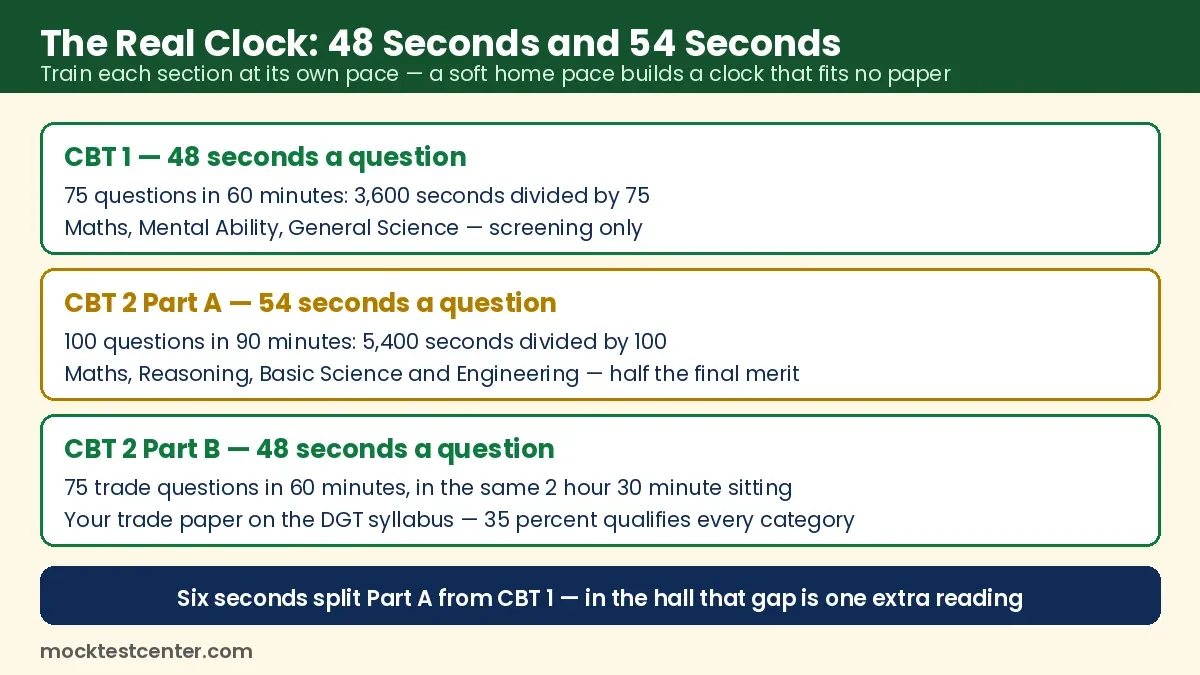
The Three CBT 1 Sections, One by One
CBT 1 holds Mathematics, Mental Ability and General Science. The notice fixes no subject wise question split for CBT 1, so do not build your plan on a split a seller prints. Build it on pace and on your own sectional scores, which tell you where your marks leak.
Mathematics at 48 seconds is a speed test wearing a maths coat. The CEN list runs from Number System and BODMAS through Percentage, Time and Work, Time and Distance, Mensuration, Algebra, Geometry and Trigonometry, Elementary Statistics, Age Calculations, Calendar and Clock and Pipes and Cistern. In a sectional sitting, maths questions split into fast sums and slow sums. Fast sums pay in 20 to 30 seconds. Slow sums, like a long Time and Distance set, can eat 2 minutes. Your job in the section is to harvest the fast sums first and let the slow ones wait for pass two. We teach that order in the two pass section below.
Mental Ability at 48 seconds is a reading test as much as a logic test. Analogies, Series, Coding and Decoding, Relationships, Syllogism, Venn Diagram, Data Interpretation and Sufficiency, Classification, Directions and Statement, Arguments and Assumptions all sit in this list. Series and coding questions pay fast once the pattern sense grows. Statement questions pay slow and punish rush. A sectional score here often rises when a candidate slows down on 5 statement questions and speeds up on 10 pattern questions. Same section. Two gears. Learn to shift.
General Science at 48 seconds is a memory test at Class 10 level, from Physics, Chemistry and Life Sciences. Most science questions ask for one fact: a unit, a colour, a law name, a body part work. You know it in 15 seconds or you do not know it at all. Long thought rarely saves a science fact. So the science sectional rule differs from maths: mark what you know, star what you half know, move on fast, and spend saved time only on the few sums science holds, like a speed sum in Motion or a circuit sum in Electricity. Candidates who sit and brood over a forgotten fact lose 3 other questions to win back half of one.
Rotate the three sections across the week in your RRB ALP Sectional Test plan. Maths on Monday, Mental Ability on Wednesday, General Science on Friday works for many. Keep the same days for a month, so scores compare cleanly. A girl in Kolkata kept science on Fridays for 6 weeks and watched her line climb from 18 to 31 of 40 in her practice sets. Same day, same hour, same pace. Clean lines teach. Messy lines flatter and confuse.
Old papers need a warning here. Papers from 2018, 2024 and 2025 held a General Awareness part in CBT 1. That part has left the paper under CEN 01/2026. When you train with the previous year papers, cut the old awareness questions out of your sectional timing, or your pace maths will train for a paper that no longer exists. The current affairs tests still serve you if you also sit NTPC or Group D, and the RRB NTPC full tests show why, since awareness carries 40 of 100 marks there. For ALP CBT 1 alone, the three sections above are the whole game.
The Three Part A Sections, and the One Left for Last
Part A holds Mathematics, General Intelligence and Reasoning, and Basic Science and Engineering, at 54 seconds per question. The maths and reasoning families match CBT 1 at a deeper level, so your CBT 1 sectional lines carry over as a base. The new weight in the room is Basic Science and Engineering. This page gives that section the most room, because it is the section candidates leave for last and lose.
Why do candidates leave it for last? Three reasons, and we hear all three every year. First, the name sounds like a diploma subject, so ITI candidates fear it and school candidates fear it more. Second, no school book carries that exact name, so candidates wait for a guide to tell them what it holds. Third, its topic list mixes drawing, units, electricity and safety, and a mixed list feels bigger than it is. A list you fear grows in the dark. A list you test shrinks in the light.
Read the list in full. Engineering Drawing with projections, views, drawing instruments, lines, geometric figures and symbolic representation. Units. Measurements. Mass Weight and Density. Work Power and Energy. Speed and Velocity. Heat and Temperature. Basic Electricity. Levers and Simple Machines. Occupational Safety and Health. Environment Education. IT Literacy.
Twelve heads. Most of them grow out of Class 9 and 10 science plus ITI first year basics, and the NCERT tests hold the school base under half of them.
Now the loss maths. Part A needs 40 percent for UR and EWS, which is 40 marks of 100. Say a candidate scores well in maths and reasoning but leaves Basic Science near zero in his practice sets. His strong sections must then carry the full floor alone, and one bad maths day in the hall ends his run. Worse, Part A marks form half the final merit. A thin Basic Science line does not just risk the floor. It drags the merit sum down for every candidate who clears it, post by post, RRB by RRB.
Train this section in two gears like the others. Fact topics, like Units, Heat and Temperature, Occupational Safety and Health, Environment Education and IT Literacy, pay fast when read well. A unit question takes 15 seconds for a prepared candidate. Sum topics, like Work Power and Energy, Speed and Velocity, Mass Weight and Density and Basic Electricity, pay at the full 54 seconds and need the short road drilled. Drawing sits apart. Projections and views test the eye, and eye skill grows only with pencil work across weeks.
Start Basic Science sectional tests early, while they still feel hard. A first score of 12 of 30 in a practice sectional hurts. Good. That hurt in month one costs nothing. The same hurt found in the last month costs the exam. A candidate in Siliguri started this section 4 months early with scores he hated, and by his last month it had become his second best section, because he had given it 4 months of small weekly sittings while others gave it 2 weeks of panic.
Part B sits beside Part A in the same sitting, at 48 seconds per question, with its 35 percent gate. Train trade sectionals too, at a lighter load: one a week keeps the gate safe. Use the PYQ PDF files to see old trade paper shapes, and keep your trade sectional pace at 48, not 54, because Part B allows no extra seconds for being a trade you know well.
The Sectional Test Loop: Four Steps From One Subject to a Stronger One
Maths and reasoning sectionals for Part A should run longer than your CBT 1 sets once CBT 1 ends. The level steps up, the sums grow a second step, and statement questions grow longer lines. Keep the pace at 54 and let the level rise. A score dip when you first step up is normal and honest. A score that never dips means your practice sets sit below the real level, and that comfort will break in the hall.
Two Pass Working Inside One Section
One rule runs every sectional sitting on this page. Work in two passes.
Pass one takes the questions you can finish fast and sure. Read the question once, and if the road to the answer stands clear in your head, walk it and mark the answer. If the road looks long or foggy, mark the question number on your rough sheet and move on. Pass one should sweep the whole section. No question in pass one gets a second full minute in CBT 1 sets, and no question gets much more in Part A sets.
Pass two takes what is left, in the time that is left. Start with the leftovers closest to done: the sum half worked, the statement half read. Leave pure blanks for the end. With 5 minutes left, stop opening new hard questions and use the time to check marked answers for silly slips, like a sign error or a unit read wrong.
Watch what two passes do to the cut. A candidate who works in paper order meets a hard sum at question 3, spends 3 minutes, panics, and rushes the next 6 easy questions, missing 2 by care. His wrong count climbs, and each wrong answer cuts 1/3. The two pass candidate meets the same hard sum, parks it, banks the 6 easy marks first, and returns with a calm head and time counted. Same brain. Same book. Very different score.
A trainee in Prayagraj raised his attempts in Maths sectionals from 31 to 42 of 50 in 3 weeks with two pass working alone. No new book. No new chapter. His right count rose because easy questions stopped dying behind hard ones, and his wrong count fell because panic guesses fell with them.
Keep a rough sheet habit in every RRB ALP Sectional Test sitting. Write parked question numbers in a row, and tick each one as pass two clears it. At the end, the unticked numbers are your true blanks. A blank cuts nothing, so a blank you chose beats a guess you forced, unless you can cut the options down to two. With two options left, a guess pays in the long run. With four options open, a guess loses in the long run, because one right mark in four tries still pays the 1/3 cut three times. One mark earned, one mark cut. A wash at best, and worse when the paper sets traps for guessers.
Practise the pass split by the clock, not by feel. In a 60 minute sectional, pass one should end near minute 35 to 40. In a 90 minute Part A sectional, pass one should end near minute 55. If pass one eats the whole sitting, your parking rule is too soft. If pass one ends in 15 minutes, you are skipping questions you could have banked. The split is a skill. Sectional tests are where you learn it, one subject at a time, without a full paper shouting at you.
Read Your Sectional Score the Right Way
A sectional score means two things at once, and you must read both. First, read it against the floors. Second, read it against your own last score. Mix those two reads up and you will feel proud of a failing line or sad over a growing one.
The floors for CBT 1 and for Part A stand at 40 percent for UR and EWS, 30 percent for OBC and SC, and 25 percent for ST. On a 75 mark CBT 1 paper, 40 percent means 30 marks. On a 100 mark Part A paper, 40 percent means 40 marks. Those floors apply to the whole stage paper, not to each subject alone, so a single sectional score below your floor line does not fail you by itself. But a section that sits below the floor line week after week pulls the whole paper toward the line, and it tells you where the pull comes from.
| Read | What to write | What it tells you |
|---|---|---|
| Score with cut | Right marks minus wrong count times 1/3 | Your honest sectional score |
| Floor line | 40, 30 or 25 percent for your category | How far the section sits from the pass line |
| Last score | Your score in this section last week | If the fix since then worked or failed |
| Wrong count | Number of wrong answers, apart from score | If guessing or care is eating your marks |
| Blank count | Questions left blank, apart from score | If pace or a weak chapter holds you back |
Two candidates can hold the same sectional score and need two very different weeks. One scores 26 of 50 with 30 right, 12 wrong and 8 blank. The other scores 26 of 50 with 28 right, 6 wrong and 16 blank. The first candidate guesses too much. His fix is care and parking. The second candidate knows more than his pace shows. His fix is speed drill and two pass order. Same score. Two roads. Your register must hold the wrong count and the blank count beside the score, or you will pick the wrong road.
Read growth over 4 sittings, not over 1. One sectional can run hard or easy, and a single dip means little. A line of 4 scores in one subject, taken on the same weekday at the same pace, tells the truth with no drama. Keep that line on one page per subject. When the line climbs, keep the method. When it flattens, change one thing at a time, so you know what worked.
Compare across subjects once a month only. Daily cross checks breed panic, because subjects grow at different speeds. Science lines often climb fast early, when fact gaps close, and maths lines climb slow and steady. Judge each subject against its own past. Judge the plan against all subjects once a month, and move hours from the strongest line to the weakest at that check, not before.
Candidates who also train for the RRB Group D tests or the RRB Technician tests should keep those registers apart. Floors, paces and subject mixes differ, and a score line that mixes exams reads like a fever chart in two seasons at once.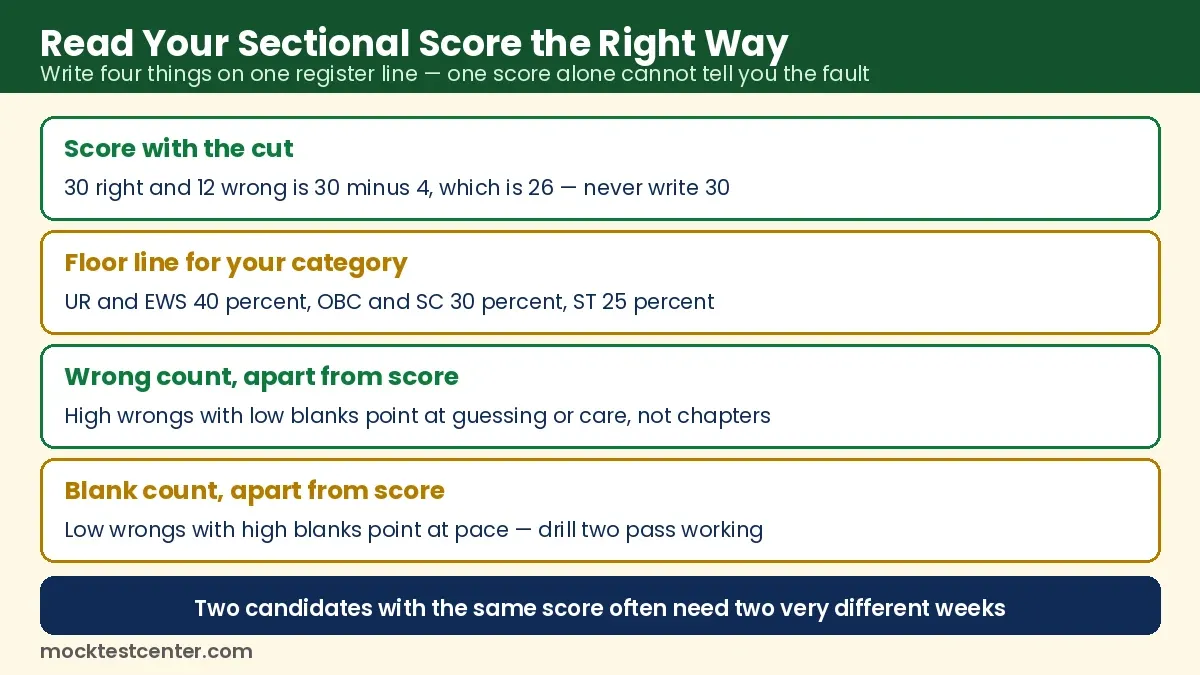
When a Sectional Score Stalls, Drop Back a Step
Every candidate meets a flat line. Three sectional sittings, same score, same wrong count. The flat line is a message, and the message is usually this: the fault sits below the section, inside one or two chapters.
A section is a mix of chapters. If your Mathematics sectional stalls, the stall may live in Mensuration alone, or in Time and Distance alone, while 8 other chapters sit fine. More sectional tests will keep mixing the weak chapter with the strong ones, and the score will keep hiding the address of the fault. Drop back. Open your error lines for the last 3 sittings and count chapter names. The name that repeats is the address.
Then give that chapter the chapter treatment: reread the part you miss, give its test the same day through the RRB ALP chapter wise tests, note the errors, and retest in 7 days. Return to the sectional test after the chapter score lifts. Most stalls break within 2 weeks of this drop back, because the fix finally lands on the right page of the right book.
One stall has a second cause: pace, not chapters. If your blank count stays high while your wrong count stays low, your chapters are fine and your clock work is weak. The fix there stays at sectional level: two pass drill, parking practice, and shorter timed sets of 10 questions at exam pace until the blanks fall. Read your counts before you pick the fix. Chapter fault and pace fault look the same in the total and very different in the counts.
A third stall comes from tired eyes. Scores fall in the last third of every sectional, across subjects, while the first two thirds hold. That pattern points at stamina, and the next section of this page takes it up. Do not buy a new book for a stamina fault. Books do not fix tired eyes. Sittings do.
Write the stall rule on your register cover. Two flat sittings: check the counts. Three flat sittings: drop to the chapter. It saves a month of blind sectional tests, and a month is a big share of an ALP plan when 8,40,944 candidates chase 11,127 posts.
Stamina for the 2 Hour 30 Minute CBT 2 Sitting
CBT 2 asks for 175 questions in one sitting of 2 hours 30 minutes. Part A takes 90 minutes. Part B takes 60. Your mind must still read with care at minute 140, when Part B questions near the end decide if you clear the 35 percent gate.
Stamina grows like pace grows: by sitting, not by reading about sitting. Build it in steps. Week one, sit one 60 minute sectional. Week two, sit a 90 minute Part A sectional. Week three, sit Part A and Part B back to back with a short gap of 5 minutes, the way a hall break may feel. By the last month, sit the full 2 hours 30 minutes once a week, at the same hour of day as your expected exam slot if you know it.
Food and sleep sound too plain for an exam page. They decide late paper marks all the same. A candidate who sleeps 5 hours before a long practice sitting loses marks in the last third that no chapter study can explain. We see it in registers every year: strong first hour, soft last half hour, sleep line short the night before. Write your sleep hours beside the score for long sittings. The link will teach you faster than we can.
Eye care counts too. Look away from the screen or page for a few seconds between sections. Blink. Breathe out slow once. Small things, done at fixed points, keep the last third of the paper clear. Do not save all your care for the end. Spend it in small parts across the sitting, the way a loco pilot checks signals across a whole run and not just near the station.
After CBT 2 comes the CBAT, which tests memory, following directions, depth perception, concentration and perceptual speed in its batteries, with a T-score of 42 needed in each one. Stamina helps there too, since a tired mind follows directions badly. Keep some weekly practice for calm focus even in the CBT months. Ten quiet minutes of direction following drill costs little and keeps the habit warm. The official exam pages on ncert.nic.in will not teach you that, but your own register will, the first time a tired sitting scatters your errors across every subject at once.
Sectional Mistakes We See Again and Again
Mistake one: training without the cut. A candidate counts only right answers for a month, feels rich, and meets the 1/3 cut for the first time in a full paper. Count the cut from your first sectional. No soft start.
Mistake two: changing the pace to feel good. A candidate gives himself 90 seconds per question at home because the sums feel hard, scores high, and learns a clock the hall will not give him. The hall gives 48 and 54. Train at those numbers, even when the early scores hurt.
Mistake three: one subject loved, one subject left. Maths daily, science never, Basic Science not at all till the end. Sectional registers expose this in one glance: pages full for one subject, blank for another. Fill the blank pages first. The exam will open those pages whether you did or not.
Mistake four: checking answers mid test. A candidate peeks at the key after 10 questions to calm himself, and the rest of the sitting runs soft, because no real risk stands behind his choices. Check only at the end. The hall offers no key at question 10.
Mistake five: reading a score once and moving on with no fix named. A sectional test with no error lines after it is half a test. The score is the start of the work, not the work. Name the leak, pick the fix, book the retest date. Then move on.
Your next step is one sitting. Pick your weakest subject tonight. Sit its sectional test at the true pace, 48 seconds if it is a CBT 1 or Part B subject and 54 if it is Part A, through the sectional tests for RRB ALP. Score it with the cut, write the three counts, and name one fix before you sleep. Keep an eye on the Latest Jobs page for board news, and let the official word on indianrailways.gov.in settle any doubt. One honest sectional score teaches more than a week of worry. Sit it.







