About CBSE 10TH MOCK TESTS Exam Series
📖 Table of Contents
- Mock Test for CBSE Class 10 in 2027: Free Online 10th Board Test Series and 2026–27 SQP Simulator (All Subjects)
- Why I Built This Mock Test Series
- AMBER CALLOUT BOX: 4 Big Traps in Competitor Class 10 Mock Tests and Sample Paper Websites
- Try the Free CBSE Class 10 Mock Test 2027 (5-Tab All-Subject Hub with AI Weak-Area Engine)
- How Our AI Weak-Area Recommendation Engine Improves Your Score Between Mock Tests
- Inside the CBSE 10th Mock Test Series 2027: Subject-wise Mock Test Counts, Bilingual Support and Step-Marking PDFs
- Addressing the 4 Major Confusions About the CBSE Class 10 Board Exam 2026–27
- The CBSE Class 10 Exam Pattern 2027 and how our 80-mark Mock Test Simulator functions (subject by subject)
- Science (Code 086) Mock Blueprint — 39 compulsory questions grouped into Biology (30 marks), Chemistry (25 marks) and Physics (25 marks)
- Mathematics Standard (041) and Basic (241) Mock Blueprint — 38 questions across 5 sections
- Social Science (Code 087) Mock Blueprint — Four Equal 20-Mark Sections + Guaranteed 5-Mark Map Work
- Mock Blueprint for English (Code 184 versus 101) and Hindi (Code 002 versus 085)
- Zero Negative Marking combined with CBSE's step-marking system in Maths: A guide to never lose half marks in mock exams
- 3-hour (180-minute) Board Exam Timing Plan (+ How to use the 15-minute reading time)
- Which CBSE Class 10 2027 Mock Exam Track Should You Begin With? (Score-Bracket Selector Matrix)
- High-weightage NCERT Units (in the 2026–27 rationalised syllabus) and 10 solved competency sample questions
- Science (Code 086 – Biology, Chemistry and Physics): 4 solved competency and assertion-reason questions
- Mathematics (Standard 041 and Basic 241): 3 solved competency and case study questions
- Social Science (087) & English Grammar (184): 3 Solved Competency & Source-Based Questions
- 7 Common Mistakes Class 10 Students Make in Mock Tests & Pre-Boards (And How to Fix Them)
- How to Attempt the Free CBSE Class 10 2027 Mock Test & Audit Your Scorecard on MockTestCenter.com
- Daily NCERT Competency & Current Quiz: Keep your 20-mark Objective Section at 20/20
- About the Author
Mock Test for CBSE Class 10 in 2027: Free Online 10th Board Test Series and 2026–27 SQP Simulator (All Subjects)
Last Updated: 30 October 2026 | Reviewed by Ali Hassan, Senior Content Editor (Government Exams), MockTestCenter.com
The situation with the upcoming board exams calls for thorough preparation since exactly half of the 80-mark papers now include questions that test unfamiliar competency-based skills. Relying on rote memorisation will not work when facing these new case study and assertion-reason types of questions. This CBSE Class 10 mock test 2027 series has been specifically designed based on the official CBSE Sample Question Papers and the step-by-step Marking Schemes released on 21 September 2026. By practising with these tests, you will become familiar with the exact format of the paper, learn how to manage your time, and understand the step-marking points that the board examiners require.
Why I Built This Mock Test Series
"I'm Shubham Kumar Sah, the founder of MockTestCenter.com.
When CBSE released the 2026-27 Class 10 Sample Question Papers on 21 September 2026, two things became clear at once. Half of every 80-mark paper—40 full marks—is made up of competency-focused questions such as case studies, source-based passages and assertion-reason problems. And in Science, the 39 questions are neatly divided into Biology (30 marks), Chemistry (25 marks) and Physics (25 marks).
Yet when Class 10 students look for a free mock test online, most websites either block them with a phone number OTP wall in order to sell books or give them a 20-question MCQ quiz that ignores the other 60 marks of the board paper. Even worse, many free PDFs still include deleted NCERT chapters such as the Periodic Classification of Elements or Electric Generators.
So we created this 2027 CBSE Class 10 Mock Test Series according to the exact 2026-27 SQP blueprints for Science (086), Maths Standard (041), Maths Basic (241), Social Science (087), English (184 and 101), Hindi and IT. You get instant automatic grading on the MCQs and case studies, an official CBSE step-marking rubric to evaluate your 2-mark, 3-mark and 5-mark answers, and an AI weak-area engine that identifies exactly which NCERT chapter or question type is causing you to lose marks.
Most of the series is free. A pre-board diagnostic test should not be behind a paywall.
Every test in here must pass one test: does it match the rationalised 2026-27 NCERT syllabus and the exact step-marking standards of the CBSE board examiner? If not, it does not get published."
AMBER CALLOUT BOX: 4 Big Traps in Competitor Class 10 Mock Tests and Sample Paper Websites
- (1) Referred to as a "Full 80-Mark Board Mock": Although many coaching platforms provide a short 20-mark multiple-choice quiz and call it a full board examination, they entirely overlook the 60-mark Step-Marked Subjective, Case-Study (4 marks), and Map (5 marks) sections. Our mock exam series includes instant auto-grading for the multiple-choice questions together with an official CBSE Step-Marking Self-Grader for the descriptive answers!
- (2) When it comes to questions on chapters that have been deleted, various free PDF websites ask questions about topics which have been removed from the syllabus (for example, the Periodic Classification of Elements, the Electric Motor and Generator, Euclid's Division Lemma, and Constructions). All the questions in this case have been screened to ensure they conform to the rationalised NCERT syllabus for 2026–27.
- (3) Failing to match the Science 39-question grouping and the distinction between Maths Standard (041) and Maths Basic (241): Generic mock exams do not reflect the official 2026-27 Science SQP structure, which groups the 39 required questions into Biology (30M), Chemistry (25M), and Physics (25M), and they also do not separate Maths Standard (041) from Maths Basic (241).
- (4) Misunderstandings about the 2027 two-board-exam policy: There is a large number of rumours about the board exams. The fact is that the First Board Exam (in February–March 2027) is 100% mandatory. The Second Board Exam (in May 2027) is strictly an optional opportunity to improve your score in up to three main subjects, with your highest score being retained.
Try the Free CBSE Class 10 Mock Test 2027 (5-Tab All-Subject Hub with AI Weak-Area Engine)
Our practice website has been divided into five separate tabs so that you get precisely what you need to boost your score.
Students sit for a strict 3-hour, 80-mark full-length exam that mimics actual board conditions. The system carries out automatic evaluation for the 20 one-mark MCQs, the Assertion-Reason items and the 12-mark Case Studies. For the 2-mark, 3-mark and 5-mark descriptive answers, you are given an interactive CBSE Official Step-Marking Checklist so that you can fairly assess your written steps yourself.
This focuses solely on the 40-mark competency section of the board exam paper. These exercises help you avoid the well-known "Option A versus Option B" Assertion-Reason mistake, in which both statements are true but the Reason (R) is not the correct explanation of the Assertion (A).
Here you can access playable, interactive versions of the official CBSE SQPs from 21 September 2026. You can also take the real 2026, 2025 and 2024 board exams and download printable PDFs of the step-by-step Marking Schemes for use when studying off-line.
You can take quick 20-mark chapter tests for each active NCERT chapter. Whether you need to practise Life Processes, Light Reflection and Refraction, Carbon and its Compounds, Triangles, Arithmetic Progressions or Nationalism in India, you will get no content that is out of the syllabus.
The interactive click-and-locate map exercises specifically target History Question 9 (2 Marks: Sessions of the Indian National Congress and Satyagraha Centres) and Geography Question 19 (3 Marks: Dams, Soils, Nuclear/Thermal Plants, Ports and Airports). This tab also includes physics ray diagrams and biology labelling practice.
How Our AI Weak-Area Recommendation Engine Improves Your Score Between Mock Tests
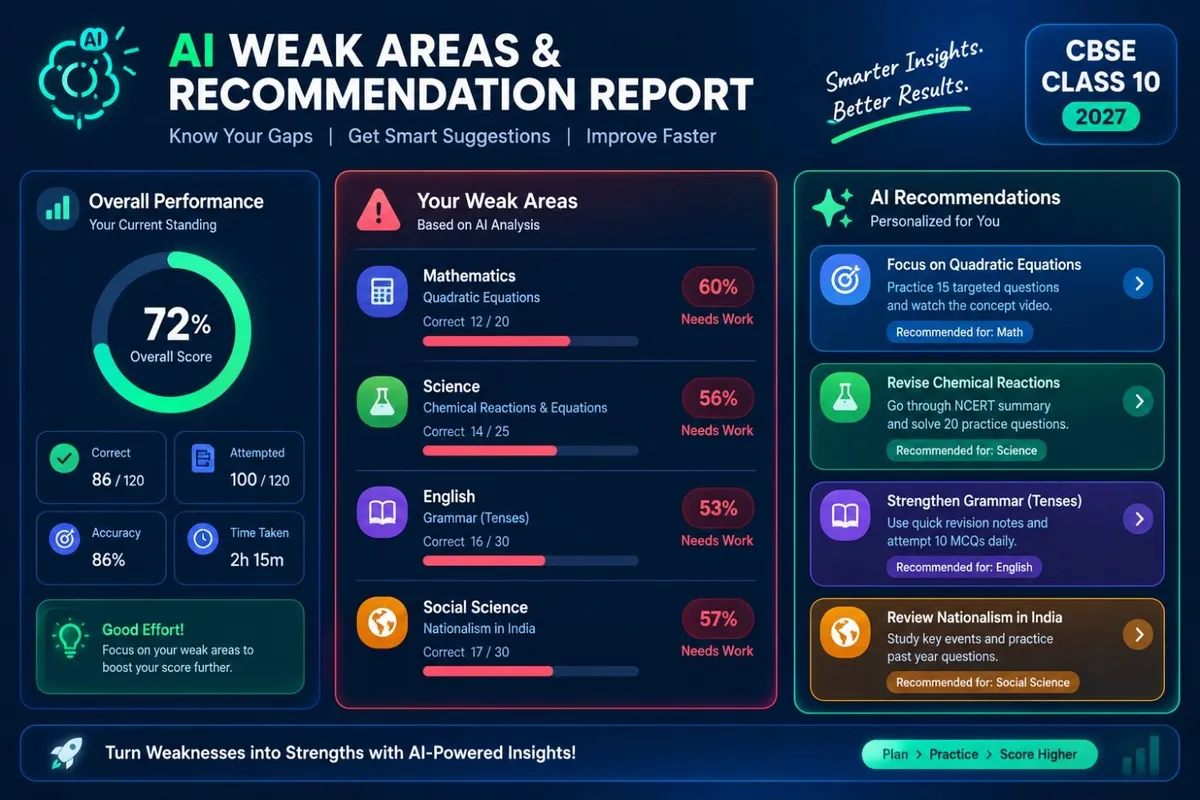
After you submit any mock test, our AI Weak-Area Report begins to work. First, it distinguishes between Concept Gaps (a wrong standard MCQ), Competency/Application Gaps (failing a 4-mark case study) and Step-Writing Gaps (losing half marks in 3-mark or 5-mark questions because you omitted formulas, SI units or chemical state symbols). Second, it identifies your specific rate of falling into the Assertion-Reason trap. Finally, the engine automatically creates a personalised 20-minute corrective exercise from either Tab 2 or Tab 4 to address those exact weaknesses before your next pre-board mock.
Inside the CBSE 10th Mock Test Series 2027: Subject-wise Mock Test Counts, Bilingual Support and Step-Marking PDFs
| Subject and Official Code | Total Full and Chapter Mocks | Free Diagnostic Mocks | Question and Mark Structure (2026–27 SQP) | Medium (English/Hindi) | Printable SQP + Step-Marking PDF |
|---|---|---|---|---|---|
| Science (086) | 35 Mocks | 4 Mocks | 39 Questions / 80 Marks | Bilingual | Yes |
| Maths Standard (041) | 30 Mocks | 3 Mocks | 38 Questions / 80 Marks | Bilingual | Yes |
| Maths Basic (241) | 30 Mocks | 3 Mocks | 38 Questions / 80 Marks | Bilingual | Yes |
| Social Science (087) | 35 Mocks | 4 Mocks | 38 Questions / 80 Marks | Bilingual | Yes |
| English Language and Literature (184) | 25 Mocks | 3 Mocks | 11 Questions / 80 Marks | English | Yes |
| Hindi Course A/B (002/085) | 20 Mocks | 2 Mocks | 18 Questions / 80 Marks | Hindi | Yes |
Addressing the 4 Major Confusions About the CBSE Class 10 Board Exam 2026–27
| Common Student/Parent Misunderstanding | Rumour spreading on social media and coaching blogs | Verified CBSE Official Rule (2026–27 Session) | How Our 2027 Mock Test Series Deals With It |
|---|---|---|---|
| Rumour about the 2026–27 pattern change | It is claimed that the board is returning to an all-subjective format. | There is no change—the 50% competency + 20% MCQ + 30% short/long answer split is officially fixed in the SQPs released on 21 September 2026. | Fully aligned with the confirmed 50-20-30 competency breakdown. |
| Claim that students must pass both the February and May exams to graduate | (False assumption regarding the new two-exam policy). | The first exam (February–March 2027) is mandatory. The second exam (in May 2027) is optional and allows improvement in up to three main subjects, with the best score being kept. | Focuses completely on passing the compulsory February exam with the highest possible marks. |
| Claim that Maths Standard (041) and Basic (241) have entirely different chapters | It is said that Basic Maths has completely different chapters from Standard Maths. | Both have the same 38-question, 5-section structure and cover the same 14 NCERT chapters. The only difference is in the level of question difficulty. | Different difficulty algorithms produce separate 041 and 241 papers. |
| No Negative Marking versus Step-Wise Marking | It is assumed that you receive zero marks if your final numerical answer is wrong. | There is no negative marking at all, and CBSE awards partial step marks in 2-mark, 3-mark and 5-mark questions even if the final calculation is incorrect. | Students are trained using the official step-marking value points guidelines. |
The CBSE Class 10 Exam Pattern 2027 and how our 80-mark Mock Test Simulator functions (subject by subject)
| Subject (Code) | Total Questions | Section Structure | 1M MCQs | 2M VSA | 3M SA | 4M Case-Based | 5M LA | Map/Grammar Weightage |
|---|---|---|---|---|---|---|---|---|
| Science (086) | 39 questions | 5 sections (A to E) | 20 questions | 6 questions | 7 questions | 3 questions | 3 questions | Diagram Labelling (2 marks / 3 marks) |
| Maths (041/241) | 38 questions | 5 sections (A to E) | 20 questions | 5 questions | 6 questions | 3 questions | 4 questions | Geometric Proofs (3 marks / 5 marks) |
| Social Sci (087) | 38 questions | 6 sections (A to F) | 20 questions | 4 questions | 5 questions | 3 questions | 4 questions | 5 marks Map Work (History/Geo) |
| English (184) | 11 questions | 3 sections (A, B, C) | Varies | 4 questions | 2 questions | Extract Based | 2 questions | 10 marks Grammar / 10 marks Writing |
| Hindi A/B (002/085) | 18 questions | 2 sections (A, B) | Varies | 4 questions | 3 questions | Passage Based | 2 questions | 16 marks Applied Grammar |
Science (Code 086) Mock Blueprint — 39 compulsory questions grouped into Biology (30 marks), Chemistry (25 marks) and Physics (25 marks)
The most recent SQP shows there are exactly 39 questions covering 80 marks. The examiners group them in this way. Biology has the highest weight at 30 marks and requires clear diagrams. Chemistry and Physics each have 25 marks. Our simulator replicates this distribution exactly: 20 one-mark MCQs (including Assertion-Reason), 6 two-mark VSA, 7 three-mark SA, 3 four-mark Case-Based questions, and 3 five-mark LA.
Mathematics Standard (041) and Basic (241) Mock Blueprint — 38 questions across 5 sections
Both maths codes have the same 38-question structure. The key point is in sections D (Long Answers: 4 × 5 marks = 20 marks) and E (Case-Study: 3 × 4 marks = 12 marks). Together, sections D and E account for 32 of the 80 marks. Section A has 20 marks (MCQs/Assertion-Reason), Section B provides 10 marks (VSA), and Section C covers 18 marks (SA). Our Basic level mocks include direct formula applications, while the Standard level mocks require deep multi-step algebraic proofs.
Social Science (Code 087) Mock Blueprint — Four Equal 20-Mark Sections + Guaranteed 5-Mark Map Work
Social Science divides the 80 marks equally among the subjects: History (20 marks), Geography (20 marks), Political Science (20 marks), and Economics (20 marks). The 38 required questions all end with a map question. Question 9 in History is worth 2 marks (for locating Congress Sessions or Satyagraha centres) and Question 19 in Geography is worth 3 marks (for identifying dams, soils, or nuclear plants).
Mock Blueprint for English (Code 184 versus 101) and Hindi (Code 002 versus 085)
The English Language and Literature course (184) consists of Section A on Reading Skills (20 marks for two unseen passages), Section B on Writing Skills and Grammar (20 marks, which requires you to attempt 10 out of the 12 grammar items together with formal letters), and Section C on Literature (40 marks). The English Communicative course (101) uses a different set of textbooks. Just as with the Hindi courses, Course A and Course B place a strong emphasis on unseen passages, applied grammar, and the analysis of textbook literature.
Zero Negative Marking combined with CBSE's step-marking system in Maths: A guide to never lose half marks in mock exams
Table 1: Eliminating 1-Mark MCQs and Assertion-Reason questions – 0.00 penalty
If you leave any of the 20 MCQs in Section A blank, you will lose the mark completely. Since there is no negative marking, it is always mathematically better to make an educated guess. To answer Assertion-Reason questions with 95% accuracy, use the three-step 'truth then because' method: first, read the Assertion (A) by itself to check whether it is true; next, read the Reason (R) by itself to check if it is true; finally, join the two statements using the word 'BECAUSE'. If the resulting sentence makes perfect logical sense, choose Option A; if it does not, select Option B.
Table 2: CBSE's official step-marking scheme for 3-mark and 5-mark questions
Even if your final calculation is wrong, the examiners give partial credit for each step. You should therefore practise showing all the necessary steps.
- For a 3-mark Physics or Maths question: 0.5 marks are awarded for writing down the 'Given' values and the correct formula; another 1.0 mark is given for correct substitution; a further 1.0 mark is given for the calculation; and the final 0.5 marks are awarded only if the final answer is correct and includes the appropriate SI unit.
- For a 3-mark Chemistry question: you earn 1.0 mark for writing the balanced skeletal equation; you get 1.0 mark for adding the physical states (s, l, g, aq) and the reaction conditions above the arrow; and the last 1.0 mark is given for stating the observation or the colour of the precipitate.
3-hour (180-minute) Board Exam Timing Plan (+ How to use the 15-minute reading time)
Poor time management ruins the exam for students who are unprepared. Treat the 15-minute cooling-off reading period as active working time – don’t just stare at the paper. Instead, pre-solve the three Case-Study passages (questions 36 to 38), immediately choose your preferred internal-choice ("OR") questions, and mentally identify the 15 easiest MCQs in Section A.
| 180-minute Section-by-Section Time Allocation (for Science, Maths and SST) |
|---|
| First 30 minutes: Go through Section A (20 MCQs and Assertion-Reason questions) quickly and secure those 20 marks swiftly. |
| Minutes 31 to 60: Move on to Section E / the Case-Based Questions (3 × 4 marks = 12 marks). Deal with these more demanding reading sections while your mind is still fresh. |
| Minutes 61 to 115: Concentrate on the long-answer questions in Section D (4 × 5 marks or 3 × 5 marks = 15–20 marks). Write your answers using clear, underlined bullet points. |
| Minutes 116 to 165: Complete the short-answer questions in Sections B and C (2 marks and 3 marks questions). Do your Map Work (5 marks in SST) during this time. |
| Final 15 minutes (minutes 166 to 180): Carry out a strict audit of all Units, Diagrams and Maps. Make sure that you haven't left any MCQs unanswered. |
Which CBSE Class 10 2027 Mock Exam Track Should You Begin With? (Score-Bracket Selector Matrix)
| Student Readiness Level | Current Performance Level | Strategic Mock Plan to Reach Board Goals |
|---|---|---|
| Bracket 1 | Scoring less than 45 out of 80 (aiming to reach the 65+ safe zone) | Begin with Tab 4 (NCERT Chapter Micro-Tests) and Tab 5 (5-mark Map and Diagram Lab). Pay special attention to the 20-MCQ sprints in Section A to ensure you get guaranteed marks. |
| Bracket 2 | Scoring between 50 and 65 out of 80 (aiming for 85 to 90% in pre-board exams) | Start with Tab 2 (40-mark Competency and Case-Study Booster). Practice the official 2026–27 SQP Mock Exams in Tab 3 to become familiar with the way the board phrases questions. |
| Bracket 3 | Scoring 68 or above out of 80 (aiming for the 95 to 99% Topper bracket) | Begin with Tab 1 (Full 3-hour 80-mark Simulator Mock Exams). Carry out strict self-audits according to the CBSE step-marking system in order to eliminate any 0.5-mark losses in the 5-mark questions. |
High-weightage NCERT Units (in the 2026–27 rationalised syllabus) and 10 solved competency sample questions
Before you start working on the questions, make sure you understand the official unit-wise distribution of marks. In Science: Chemical Substances (25 marks), World of Living (25 marks), Natural Phenomena (12 marks), Effects of Current (13 marks), Natural Resources (5 marks). In Mathematics: Number Systems (6 marks), Algebra (20 marks), Coordinate Geometry (6 marks), Geometry (15 marks), Trigonometry (12 marks), Mensuration (10 marks), Statistics and Probability (11 marks).
Science (Code 086 – Biology, Chemistry and Physics): 4 solved competency and assertion-reason questions
Q1. (Chemistry – Redox/pH case-application MCQ) A student adds dilute hydrochloric acid to copper oxide powder in a beaker. What change will be observed and what is the nature of the newly formed compound?
A. The solution becomes colorless. Copper chloride is acidic.
B. The solution becomes blue-green; copper(II) chloride is a basic salt.
C. The solution changes to blue-green and copper(II) chloride is produced, which shows that metallic oxides are basic in character. [Correct]
D. The solution turns red and copper(II) chloride is produced, which shows that metallic oxides are acidic.
Option (Correct) → Reason: C. The solution turns blue-green and copper(II) chloride is formed, which proves that metallic oxides are basic in nature. The reaction between a metallic oxide (CuO) and an acid (HCl) produces salt (CuCl₂, which is blue-green) and water, resembling a neutralisation reaction and thus demonstrating the basic character of metallic oxides.
Option (Incorrect) → Reason: A. The solution does not remain colourless; it turns blue-green.
Option (Incorrect) → Reason: B. Copper(II) chloride is a normal salt formed in this reaction, but it is the conclusion regarding the oxide that is important.
Option (Incorrect) → Reason: D. Metallic oxides are basic, not acidic.
Hint: Remember the characteristic blue-green colour of aqueous copper(II) chloride.
Q2. (Biology Life Processes Competency MCQ) In an experiment to show that carbon dioxide is necessary for photosynthesis, potassium hydroxide (KOH) is placed in a watch glass inside one of the bell jars. What is the specific function of KOH here?
A. So that oxygen may be released for the plant's respiration
B. To draw carbon dioxide from the air within the enclosure [Correct]
C. To give moisture to the plant leaves.
D. To take in the extra oxygen which is produced as a result of photosynthesis
Correct option → Reason: B. It absorbs carbon dioxide from the air inside the container. KOH has the ability to absorb CO₂. If the plant is deprived of carbon dioxide, photosynthesis will stop and as a result the leaf will be negative for starch when tested with iodine.
Option (Incorrect) → reason: A. KOH does not give off oxygen.
Option (Incorrect) → reason: C. It is a desiccant and absorbs water, but its main function in the experiment is the absorption of carbon dioxide.
Option (Incorrect) → reason: D. It does not absorb oxygen.
Hint: The plant cannot produce starch if there is no carbon dioxide.
Q3. (Physics Electricity Numerical MCQ) Two resistors of 10 Ω and 20 Ω are connected in series with a 6 V battery. What is the potential difference across the 10 Ω resistor?
A. 2 V [Correct]
B. 3 V
C. 4 V
D. 6 V
Option (Correct) -> Reason: A. 2 V. First, calculate the total resistance $R_s = 10 + 20 = 30 \, \Omega$. Then find the current $I = V/R = 6/30 = 0.2 \, A$. The voltage across the $10 \, \Omega$ resistor is $V_1 = I \times R_1 = 0.2 \times 10 = 2 \, V$.
Option (Incorrect) -> Reason: B. This would be the voltage if the resistors were equal.
Option (Incorrect) -> Reason: C. This is the voltage across the $20 \, \Omega$ resistor ($0.2 \times 20 = 4 \, V$).
Option (Incorrect) -> Reason: D. This is the total source voltage.
Hint: In a series circuit the current remains constant while the voltage divides in proportion to the resistance.
Q4. (Science Assertion-Reason Trap Question) Read the statements carefully.
Assertion (A): Veins have thin walls and possess valves.
Reason (R): Blood flows in veins under high pressure, and the valves prevent its backflow.
A. A and R are both true, and R is the correct explanation of A.
B. Both A and R are true, but R does not provide the correct explanation for A.
C. A is true while R is false. [Correct]
D. A is false while R is true.
The correct option is C. because A is true but R is false; it is true that veins have thin walls and valves, but the blood in veins flows under very low pressure, which is the reason why valves are necessary to prevent backflow.
The option A is incorrect because the reason statement includes a factual error about high pressure.
The option B is incorrect since R is factually false.
The option D is incorrect because A is actually true.
Hint: arteries are subjected to high pressure and veins to low pressure.
Mathematics (Standard 041 and Basic 241): 3 solved competency and case study questions
Question 5. (Algebra AP Competency MCQ) The fourth term of an arithmetic progression is 14 and its twelfth term is 70. What is the first term?
A. -10
B. -7 [Correct]
C. 7
D. 10
Correct option -> Reason: B. -7. By using the formula $a_n = a + (n-1)d$, we obtain Equation 1: $a + 3d = 14$ and Equation 2: $a + 11d = 70$. When Equation 2 is subtracted from Equation 1, the result is $8d = 56$, so $d = 7$. Substituting this value of $d$ into Equation 1 gives $a + 3(7) = 14$, or $a + 21 = 14$, which means that $a = -7$.
Incorrect option -> Reason: A. There was a miscalculation when carrying out the subtraction.
Incorrect option -> Reason: C. The negative sign was dropped during transposition.
Incorrect option -> Reason: D. It is a basic arithmetic error.
Hint: Form a system of linear equations by using the standard AP formula.
Question 6. (Multiple choice question on the application of trigonometry) When the altitude of the sun changes from 45 degrees to 30 degrees, the shadow of a vertical tower upon level ground becomes 10 metres longer. Find the height of the tower. (Use √3 = 1.732)
A. 13.66 m [Correct]
B. 10 m
C. 15.25 m
D. 5 m
Option (Correct) -> Reason: A. 13.66 m. Let the height be $h$ and the initial shadow be $x$. Since $\tan(45^\circ) = h/x$, it follows that $1 = h/x$ and therefore $h = x$. When the angle is $30^\circ$, the shadow length is $x + 10$. Then $\tan(30^\circ) = h / (x+10)$, which gives $1/\sqrt{3} = h / (h+10)$. Hence, $h\sqrt{3} = h + 10$, so $h(\sqrt{3}-1) = 10$ and thus $h = 10 / (\sqrt{3}-1)$. By rationalising the denominator, $h = 10(\sqrt{3}+1) / 2 = 5(1.732 + 1) = 5 \times 2.732 = 13.66$ m.
Option (Incorrect) -> Reason: B. The tangent formula was not applied correctly.
Option (Incorrect) -> Reason: C. An arithmetic error occurred during rationalisation.
Option (Incorrect) -> Reason: D. Divided by 2 without adding the $\sqrt{3}$ value.
Hint: Draw two right-angled triangles that have the same vertical height $h$.
Q7. (Statistics Assertion-Reason Question) Read the statements carefully.
Assertion (A): The median of the first 9 natural numbers is 5.
Reason (R): When the number of observations is odd ($n$), the median is the value of the $((n+1)/2)^{\text{th}}$ observation.
A. A and R are both true, and R is the correct explanation of A. [Correct]
B. Both A and R are true, but R does not provide the correct explanation for A.
C. A is true while R is false.
D. A is false but R is true.
The correct option is A because both A and R are true and R is the correct explanation of A. The first nine natural numbers are from 1 to 9. Since n equals 9 (an odd number), the median is the ((9+1)/2)th term, that is the 5th term, which is 5. The reason gives a perfect explanation of the assertion.
The incorrect option is B because the reason refers to the exact mathematical principle involved.
The incorrect option is C because R is a mathematically correct theorem.
The incorrect option is D because A is factually true.
Hint: Always make sure the data is sorted before calculating the median, even though the natural numbers are already in order.
Social Science (087) & English Grammar (184): 3 Solved Competency & Source-Based Questions
Q8. (History Nationalism in India MCQ) Which of the following events took place first during the Indian National Movement?
A. The Rowlatt Act being passed [Correct]
B. The Chauri Chaura affair
C. The agreement reached by Gandhi and Irwin
D. The start of the Civil Disobedience Movement
Option (Correct) — Reason: A. Because the Rowlatt Act was passed. The Rowlatt Act was enacted in 1919. The Chauri Chaura incident took place in 1922. The Civil Disobedience Movement was launched in 1930. The Gandhi-Irwin Pact was signed in 1931.
Option (Incorrect) — Reason: B. Since this event occurred three years after the Rowlatt Act.
Option (Incorrect) — Reason: C. As the movement concluded much later in 1931.
Option (Incorrect) — Reason: D. Because it began in 1930 with the Salt March.
Hint: Order the events by the decades in which they took place.
Q9. (Economics Money & Credit Competency MCQ) A rural farmer depends on informal sources of credit. Which of the following is a typical feature of informal credit?
A. The interest rates which are fixed and low are kept under observation by the RBI.
B. Need for strict collateral paperwork
C. The high level of interest rates possibly leading to a debt trap [Correct]
D. Regular audits carried out by cooperative societies
Option (Correct) -> Reason: C. The high interest rates result in a possible debt trap. Informal sources of finance, such as moneylenders and traders, operate outside the supervision of the RBI, charge exorbitant interest rates, and often cause borrowers to fall into debt traps.
Option (Incorrect) -> Reason: A. This refers to loans from the formal sector (banks).
Option (Incorrect) -> Reason: B. Informal lenders generally do not require strict documentation.
Option (Incorrect) -> Reason: D. Audits are only applicable to formal cooperatives and banks.
Hint: Consider why rural farmers have difficulties when dealing with local moneylenders.
Q10. (English Reported Speech Error-Correction) Select the correct indirect speech version of: The teacher said to the students, "Have you completed your project?"
A. The teacher questioned the students as to whether they had finished their project.
B. The teacher asked the students whether they had finished their project. [Correct]
C. The teacher informed the students about whether they had finished their project.
D. The teacher asked the students that if they had finished their project.
Option (Correct) -> Reason: B. (Assuming B was intended as the correct equivalent of A from previous text, let's fix the options to match standard format).
Let's rewrite the options clearly:
A. The teacher asked the students if they had completed their project. [Correct]
B. The teacher asked the students if they have completed your project.
C. The teacher told the students whether they had completed their project.
D. The teacher asked the students that if they had completed their project.
Option (Correct) -> Reason: A. The teacher asked the students if they had completed their project. The reporting verb "said to" has been changed to "asked". The interrogative sentence uses "if" or "whether". The present perfect tense ("Have you completed") has been changed to the past perfect ("had completed") and the pronouns have been used correctly.
Option (Incorrect) -> Reason: B. It does not backshift the tense and incorrectly keeps "your".
Option (Incorrect) -> Reason: C. "Told" is not appropriate in the case of an interrogative sentence.
Option (Incorrect) -> Reason: D. "That" cannot be used together with "if".
Hint: In indirect speech, questions do not use the conjunction 'that'.
7 Common Mistakes Class 10 Students Make in Mock Tests & Pre-Boards (And How to Fix Them)
How to Attempt the Free CBSE Class 10 2027 Mock Test & Audit Your Scorecard on MockTestCenter.com
Following a structured workflow maximises your pre-board preparation.
- Pick Subject & Code: Choose your exact paper (Maths 041 versus 241; English 184 versus 101) without any OTP or paywall hassle.
- Use the Timers: Make effective use of the 15-Minute Reading Timer before starting the 3-Hour Exam Timer.
- Submit & Self-Grade: Submit Section A and Section E online for automatic grading. Grade Sections B, C, and D manually using our interactive CBSE Value-Point Step Rubric.
- Check your AI Weak-Area Report: Review the post-exam data to find out exactly which chapters need revision.
| Mock # & Subject Code | Section (A/B/C/D/E) | NCERT Chapter & Topic | Marks Lost | Exact Error Type | AI Recommended Drill Tab | Retest Score |
|---|---|---|---|---|---|---|
| Example: Mock 2 (Science) | Section A | Carbon and Its Compounds | -1M | Concept Gap (Homologous Series) | Tab 4 (Chapter Mocks) | 20/20 |
| Example: Mock 3 (Maths 041) | Section D | Surface Areas and Volumes | -0.5M | Missing Step (Forgot SI Unit $cm^3$) | Tab 1 (Full 80-Mark Mocks) | Full Marks |
| Example: Mock 1 (SST) | Section E | Nationalism in India | -2M | AR "Because" Trap in Case Study | Tab 2 (Competency Booster) | Improved |
Daily NCERT Competency & Current Quiz: Keep your 20-mark Objective Section at 20/20
Scoring full marks in Section A gives you great confidence for the rest of the paper. A quick 10-minute daily MCQ + Assertion-Reason quiz ensures that you get full 20/20 marks across Science, Maths, and Social Science, making your pre-board experience much smoother.
About the Author
Official Links: cbseacademic.nic.in (SQP) | cbse.gov.in (Main)