
About RRB ALP (Assistant Loco Pilot) NCERT-based Tests
- 1.NCERT Books for RRB ALP: Key Facts First
- 2.Why Class 10 Science Sits at the Centre of CBT 1
- 3.The Class 10 Chapter Map, Chapter by Chapter
- 4.Class 9 Chapters That Hold Class 10 Up
- 5.How Part A Basic Science and Engineering Grows Out of the Same Books
- 6.Read the Chapter, Give Its Test the Same Day
- 7.How Lines and Tables in the Book Turn Into Questions
- 8.Maths NCERT, the Slow Base Under Fast Maths
- 9.A Six Day Reading Rhythm for a Busy Candidate
- 10.Mistakes Candidates Make With These Books
- 11.Where the Free Books Live, and Your Next Step
Quick Answer: NCERT Books for RRB ALP means the Class 9 and Class 10 NCERT Science books, because the General Science part of ALP CBT 1 is Physics, Chemistry and Life Sciences at Class 10 level, word for word from the CEN 01/2026 notice. The same school books also feed Basic Science and Engineering in CBT 2 Part A. Both books are free on the NCERT site, ncert.nic.in. This page maps each chapter to the paper it feeds, shows how a line or a table in the book turns into a question, and sets a six day reading rhythm that a working candidate or an ITI student can hold.
NCERT Books for RRB ALP: Key Facts First
Start with the paper, because the book list means nothing without it. RRB ALP means Assistant Loco Pilot, a post in the Indian Railways run by the Railway Recruitment Boards. The latest cycle is CEN 01/2026, with 11,127 posts in the detailed notice. Applications ran from 15 May 2026 to 14 June 2026 on rrbapply.gov.in, and 8,40,944 candidates applied. That is about 75 candidates for every single post.
CBT 1 of CEN 01/2026 held 75 questions for 75 marks in 60 minutes. The subjects were Mathematics, Mental Ability and General Science. The notice says General Science covers the syllabus of Physics, Chemistry and Life Sciences of Class 10 level. Read that line twice. It names the school class, and Class 10 science in India means the NCERT Class 10 Science book first of all.
One big change sits inside this cycle. General Awareness and Current Affairs went out of CBT 1 in CEN 01/2026. The 2024 and 2025 papers still had a 10 question part for them, in a split of Maths 20, Reasoning 25, General Science 20 and GA 10. That part is gone now. The hours you used to give to news now belong to science, and science at Class 10 level starts in a school book that costs you nothing.
CBT 2 Part A holds 100 questions for 100 marks in 90 minutes, with Mathematics, General Intelligence and Reasoning, and Basic Science and Engineering. Look at the Basic Science and Engineering list in the notice: Units, Measurements, Mass Weight and Density, Work Power and Energy, Speed and Velocity, Heat and Temperature, Basic Electricity, Levers and Simple Machines, Occupational Safety and Health, Environment Education, IT Literacy and Engineering Drawing. Half of that list grows straight out of Class 9 and Class 10 physics chapters. The other half grows out of ITI first year work.
The marking rule is hard and you should know it before you plan a single week. Each wrong answer in CBT 1 and in both parts of CBT 2 cuts one third of a mark. Three wrong answers eat one right answer. A blank answer cuts nothing. Final merit now stands at 50 percent of CBT 2 Part A marks plus 50 percent of CBAT marks, a change from the old 70 to 30 split. Pay for the post is Level 2 of the 7th CPC with a starting pay of Rs 19,900 plus allowances. Age for CEN 01/2026 was 18 to 30 years as on 01 July 2026.
| Fact | Detail |
|---|---|
| Exam | RRB ALP, Assistant Loco Pilot, Indian Railways, run by the Railway Recruitment Boards |
| Latest cycle | CEN 01/2026, detailed notice dated 14 May 2026, with 11,127 posts |
| Applications | 15 May 2026 to 14 June 2026 on rrbapply.gov.in; 8,40,944 candidates applied |
| CBT 1 shape | 75 questions, 75 marks, 60 minutes; Mathematics, Mental Ability and General Science |
| General Science level | Physics, Chemistry and Life Sciences at Class 10 level, as printed in the notice |
| Big change in 2026 | General Awareness and Current Affairs removed from CBT 1; the 2024 and 2025 papers had a 10 question GA part |
| CBT 2 Part A | 100 questions, 100 marks, 90 minutes; Maths, General Intelligence and Reasoning, Basic Science and Engineering |
| Negative marking | One third of a mark cut for each wrong answer in CBT 1 and CBT 2; no cut for a blank answer |
| Final merit | 50 percent CBT 2 Part A plus 50 percent CBAT under CEN 01/2026 |
| Book source | NCERT Class 9 and Class 10 Science books, free in PDF on ncert.nic.in |
| Pay and age | Level 2, starting pay Rs 19,900 plus allowances; age 18 to 30 years as on 01 July 2026 |
| Official railway sites | indianrailways.gov.in and rrbcdg.gov.in |
What This Page Covers
- Why Class 10 science sits at the centre of CBT 1
- The Class 10 chapter map, chapter by chapter
- Class 9 chapters that hold Class 10 up
- How Part A Basic Science and Engineering grows out of the same books
- Read the chapter, give its test the same day
- How lines and tables in the book turn into questions
- Maths NCERT, the slow base under fast maths
- A six day reading rhythm for a busy candidate
- Mistakes candidates make with these books
- Where the free books live, and your next step
Why Class 10 Science Sits at the Centre of CBT 1
Most candidates buy a thick guide book on day one and open the school book never. We see this every year. The guide book has its place, and we will come to it, but the notice itself points at the school level, and the paper setter works from that level. When a notice says Class 10 level, the safe base is the book that Class 10 students read in school.
Think of a boy in a village school near Gaya. He passed Class 10 three years ago, then did his ITI in the Electrician trade, and now he works in a small motor winding shop in the town. His school Science book is still in a steel trunk at home, under his mark sheets. For ALP, that trunk holds more marks than the new guide on his shop counter, because the guide writer also read the same school book before he wrote his chapters.
General Science is one of only three subjects in CBT 1 now. The notice fixes no subject wise split for the 75 questions, so no one can promise you an exact count for science. What we can say from the old printed pattern is this: in 2024 and 2025, General Science held 20 of the 75 questions when GA still took 10. With GA gone, the three subjects share the full 75, and science is too big a block to treat as a side subject.
CBT 1 is only a screen. Its marks never enter the final merit list. But a screen still decides who walks ahead, and RRB shortlists about 15 times the vacancies for CBT 2, RRB wise and community wise, on normalised marks. The minimum marks to clear CBT 1 are 40 percent for UR and EWS, 30 percent for OBC and SC, and 25 percent for ST. A weak science base can end the run at this first gate, months before Part A and CBAT get a chance to pay you.
So the order of work writes itself. Read the Class 10 Science book as the base. Read the Class 9 Science book under it, because Class 10 chapters stand on Class 9 ideas like motion, force and atoms. Then use tests to check each chapter while it is still fresh. The RRB ALP NCERT tests on this tab are built for that check, chapter by chapter, and the chapter wise tests take the same chapters one step deeper once the book work is done.
One more reason, and it is about money. The NCERT books are free. NCERT puts the full books in PDF on ncert.nic.in, chapter by chapter, in Hindi and in English. A candidate in Patna with a second hand phone and a weak signal can still pull down one chapter at a time from a cyber cafe for a few rupees of print cost. No costly book stands between him and the base of this exam.
The Class 10 Chapter Map, Chapter by Chapter
This is the long part of the page, and it earns the space. The Class 10 Science book holds the chapters that the CBT 1 science questions grow out of, and a few of them also feed Part A later. Read the map with your own book open beside you. Tick each chapter in pencil as you finish it, the way school boys do, because a ticked list on the first page of the book keeps you moving on the flat days.
| Class 10 chapter | Part of science | What the paper takes from it |
|---|---|---|
| Chemical Reactions and Equations | Chemistry | Types of reactions, balancing of equations, what happens when a metal meets air or water |
| Acids, Bases and Salts | Chemistry | pH in daily life, common salts like washing soda and baking soda, acids in food and in the stomach |
| Metals and Non-metals | Chemistry | How metals act with air, water and acids; the reactivity series; why some metals sit free in nature |
| Carbon and its Compounds | Chemistry | Bonds in carbon compounds, soaps and detergents, fuels and flames at a school level |
| Life Processes | Life Sciences | Food, breathing, blood flow and waste removal in plants and in the human body |
| Control and Coordination | Life Sciences | Nerves and hormones, how the body answers a touch, a smell or a sudden sound |
| Heredity | Life Sciences | How traits pass from parents to children, Mendel and his pea plants, sex determination |
| Light, Reflection and Refraction | Physics | Mirrors and lenses, image rules, the mirror formula and lens formula with signs |
| The Human Eye and the Colourful World | Physics | Defects of the eye and their correction, why the sky looks blue, rainbow and prism facts |
| Electricity | Physics | Current, voltage, resistance, Ohm law, series and parallel circuits, heating effect of current |
| Magnetic Effects of Electric Current | Physics | Field lines, the motor and the generator in simple words, domestic electric circuits and fuses |
| Our Environment | Life Sciences | Food chains, waste and its handling, the ozone layer and how it thins |
Twelve chapters. That is the whole load, and it is smaller than most candidates fear on the first day. A candidate who reads one chapter with care every two days holds the full book in about four weeks, and still has days left in the month for tests and for maths.
Now, how to read each chapter so the paper cannot surprise you. First, read the chapter text once, slowly, with a pencil in hand. Mark every line that carries a number, a unit, a formula or a named fact. The paper loves those lines. A line like the pH of the human stomach or the focal length rule of a mirror is a question waiting for its four options.
Second, do the in text questions and the chapter end questions in the book itself. NCERT wrote them to test the same lines the RRB setter reads. A girl in Ranchi who trains with us solved the book questions of Electricity on paper, in a copy, before she touched any test. When she met circuit questions in a mock later, her hand moved on its own, because the book had already asked her the same thing in other words.
Third, learn the tables by heart where a table carries facts side by side. The reactivity series table in Metals and Non-metals, the table of acids and bases in daily use, the sign rules for mirrors and lenses: these tables turn into match the pair and odd one out questions again and again. Past papers show this trend, and it is a trend, not a promise. RRB prints no chapter wise promise anywhere.
Fourth, keep the diagrams. Draw the human eye once. Draw a motor once. Draw the food chain of a pond once. A question with a diagram in the hall feels easy to the candidate who has drawn that diagram with his own hand, and it feels like a wall to the one who only saw it in print.
Physics chapters carry formulas, so keep a small formula copy for Light, Electricity and Magnetic Effects. Write each formula with its units: volt, ampere, ohm, watt. Part A will ask for the same units again under its Units and Measurements topic, so this copy pays you twice. Chemistry chapters carry reactions, so write each reaction once in words and once in symbols. Life Sciences chapters carry long fact lines, so read them in the morning when the head is fresh, and say the hard lines aloud once, like a school child. It sounds old. It works.
When a chapter ends, close the book and write five lines from memory on what it held. If a line will not come, that part of the chapter is still unread, whatever your eyes did. Then open the NCERT test for that chapter and give it the same day. The next section of this page sets that loop out in full.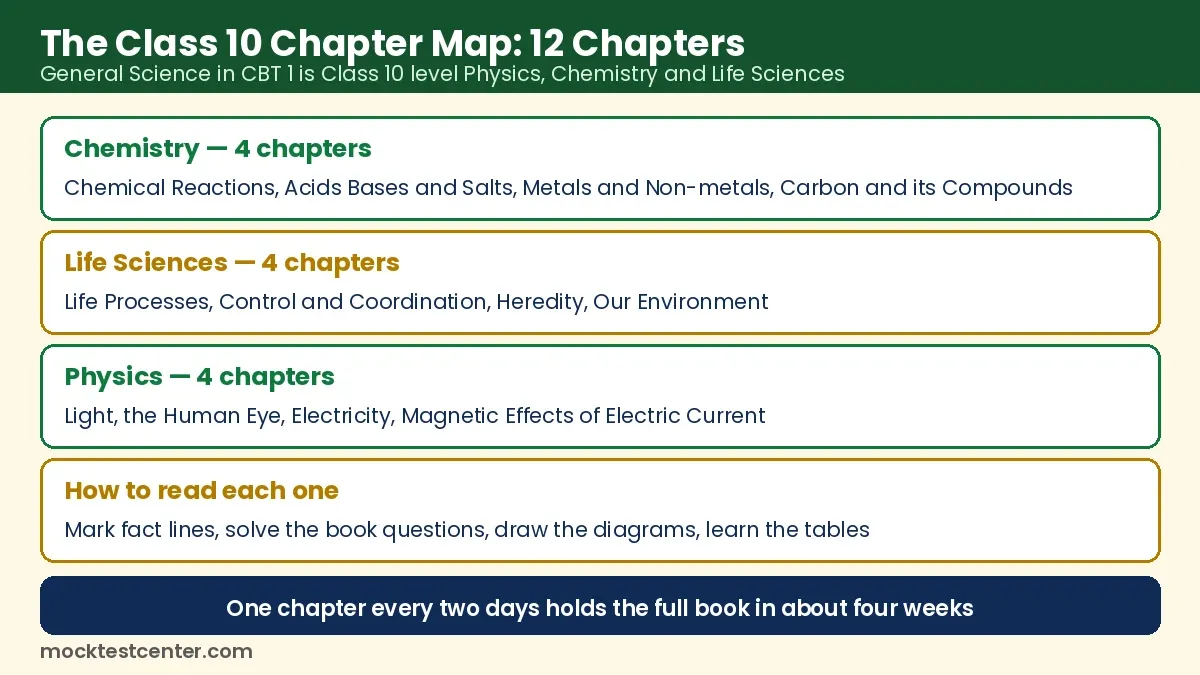
Class 9 Chapters That Hold Class 10 Up
Class 10 science does not stand alone. It stands on Class 9, and a candidate who left school five or six years ago often finds the Class 9 ideas rusty, not the Class 10 ones. If Motion feels hard in Class 10, the rust is in Class 9, where motion is taught first. Read these Class 9 chapters before or beside their Class 10 partners.
- Matter in Our Surroundings and Atoms and Molecules: states of matter, heat and change of state, then atoms, molecules and the mole idea in simple form. These two feed the start of Class 10 chemistry.
- Structure of the Atom: electrons, protons and neutrons, and how they sit inside the atom. Metals, acids and carbon all read easy once this chapter is clear.
- Motion, Force and Laws of Motion and Gravitation: speed, velocity, the three laws of Newton, and the pull of the earth. Part A takes Speed and Velocity from this ground later.
- Work and Energy and Sound: work, power, forms of energy, and how sound travels. Work Power and Energy is a named Part A topic, word for word.
- The living unit chapters: the cell as the unit of life, and tissues in plants and animals. Life Processes in Class 10 reads like a story once the cell chapter is in place.
- Improvement in Food Resources: crops, animal keeping and fish. It looks like a side chapter, and paper setters have picked plain fact lines from it in past cycles.
You do not need the full Class 9 book. These chapters, read once with care, are enough for most candidates, and a candidate strong in Class 10 can skim the Class 9 partners in a single sitting each. Judge by the test, not by a feeling. If your Class 10 chapter test shows physics errors again and again, drop down one class, read the Class 9 chapter under it, and climb back up. That drop and climb takes two days and saves weeks of blind drill.
Both books sit free on ncert.nic.in, and the Hindi medium books sit there too. ALP papers come in English, Hindi and 13 regional languages, with the English version final if two versions differ. Read the book in the language you will sit the paper in, so the words of the questions feel known on the day.
How Part A Basic Science and Engineering Grows Out of the Same Books
Here is the part most ALP pages skip, and it costs candidates real marks. CBT 2 Part A is half of your final merit now, 50 percent Part A and 50 percent CBAT, and its Basic Science and Engineering part scares candidates who think it needs an engineering degree. It does not. Read the topic list of the notice beside your school book and the fear shrinks.
Units and Measurements grows out of the first pages of school physics, where every quantity gets a unit. Mass Weight and Density sits in the same ground. Work Power and Energy is a Class 9 chapter name, almost word for word. Speed and Velocity comes from the Class 9 Motion chapter. Heat and Temperature grows out of Matter in Our Surroundings, where heat moves matter from solid to liquid to gas. Basic Electricity is the Class 10 Electricity chapter with workshop clothes on. A candidate who has read the school books with care has already met six of the twelve Part A topics at school level.
The rest comes from ITI first year work and from daily trade life. Levers and Simple Machines is workshop ground: a spanner, a pulley, a screw jack at a loco shed. Occupational Safety and Health is the safety drill every ITI student learns in the first months, helmets, earthing, fire points and first aid. Environment Education leans on Our Environment from Class 10, plus the green rules of a modern workshop. IT Literacy is basic computer use, files, mail and safe habits on a screen. Engineering Drawing is the one topic with no school book base, and it needs its own practice with projections, views, lines and drawing instruments, the way ITI students learn it in their first year.
So your book plan for Part A has two shelves. Shelf one is the NCERT shelf, already on your desk for CBT 1, read one level deeper this time. Shelf two is your ITI shelf: the first year trade theory book, the workshop safety notes, and drawing practice on paper. A diploma holder who never did ITI should borrow the first year ITI books from a friend or a book shop near the ITI, because Part A asks at that level, and his diploma books often run above it and past it at the same time.
Part B is a gate of its own and this page will say one line about it, because NCERT study must leave room for it. Part B holds 75 trade questions in 60 minutes and every category must score 35 percent, which is 26.25 marks, to stay in the race. Twenty seven sure answers keep you safe. Your trade book time is safe time, and the six day rhythm later in this page guards it.
When you are ready to test Part A ground chapter by chapter, the sectional tests let you sit one subject at a time at the real pace, and the full mock tests put Part A together with maths and reasoning in the full 90 minutes. Use the old papers on the previous year paper tab too, with one care: old Part A papers are fine for science, since science did not change, while old CBT 1 papers still carry the GA part that CEN 01/2026 removed.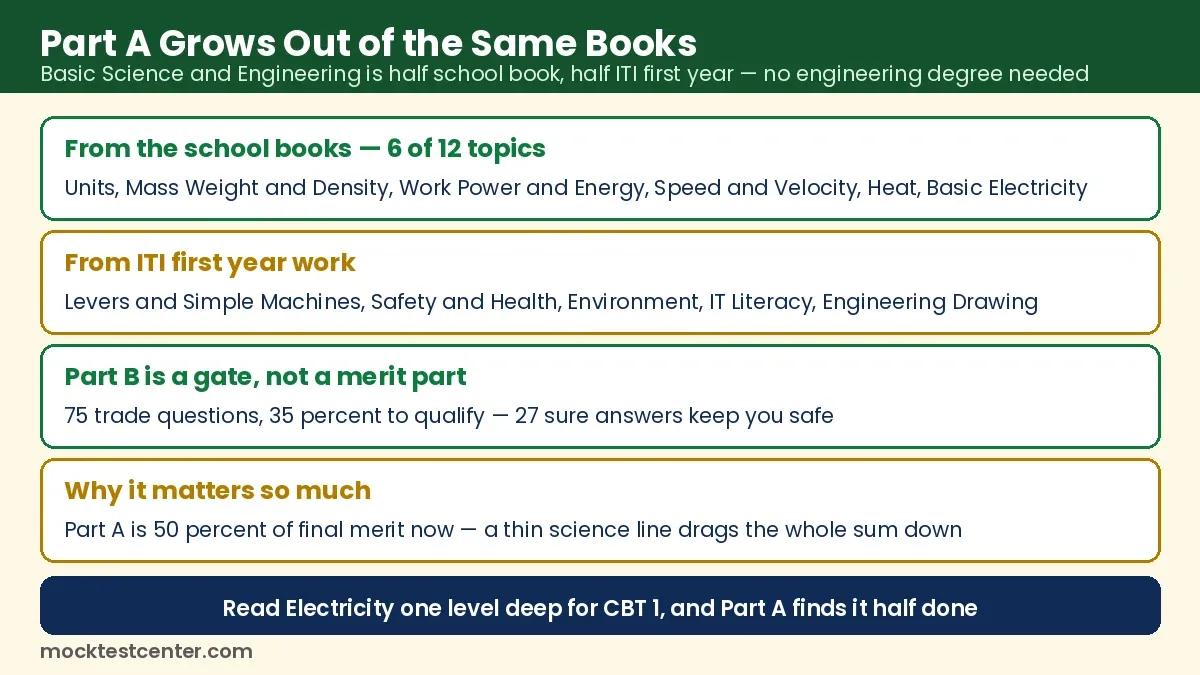
Read the Chapter, Give Its Test the Same Day
A chapter read on Monday and tested on Friday is half forgotten by Friday. The brain keeps what it uses at once. So the rule on this page is short: the test comes the same day as the reading, while the lines are still warm.
Follow these steps for every chapter, in this order.
- Read the chapter once with a pencil, marking number lines, unit lines, formulas and named facts.
- Solve the book questions of the chapter on paper, in text ones first, then the end questions.
- Close the book. Write five lines from memory on what the chapter held.
- Give the chapter NCERT test on this tab in one sitting, at a desk, with the phone in another room.
- Check every wrong answer against the book page, not against a guide. Write the book page number beside the error.
- Read the weak pages of the chapter once more that same evening, for ten minutes, no more.
- Note the chapter score in a register with the date. A score line you can see keeps the next week honest.
The Read, Test, Fix, Retest Loop: Four Steps
Why the same day? Take a real case. A candidate in Muzaffarpur read Light on a Sunday, felt good about it, and tested it the next Sunday. By then the sign rules for the lens had mixed in his head, and he lost marks he had owned a week back. He changed one habit only: test on the reading day itself. His chapter scores rose within three weeks, and the rise stayed, because each error met its book page on the day the page was read.
Watch the one third cut while you test. In a chapter test, three wild guesses can eat a sure answer. If a question sits fully outside what you read, leave it blank in practice too, and mark it in the register as a reading gap. A blank in practice is a map point. A guess in practice is fog.
And keep the loop small enough to hold on a work day. One chapter, one test, one fix round. On days when the shop or the fields eat your hours, shrink the loop to half a chapter and its book questions, and let the test come the next morning. A small loop done beats a big plan framed on the wall.
How Lines and Tables in the Book Turn Into Questions
Paper setters read the same book you read. They lift a line, hide one word of it, and set four options around the gap. Once you see this, your reading changes: you start reading like a setter, and every fact line starts to look like what it is, a future question.
Work three small cases with me, all from book ground. Case one: the Electricity chapter says the unit of resistance is the ohm, and it gives Ohm law as a relation between voltage, current and resistance. A setter turns that one line into a unit question, a formula question, or a small sum with two values given and the third asked. Three question shapes from one line. If you read the line as a story, you own one shape. If you read it as a setter, you own all three.
Case two: the Acids, Bases and Salts chapter holds a table of common things and their nature, and it talks of pH in daily life, in the stomach, in soil, in the mouth after food. A setter lifts the table and asks which pair is wrong, or lifts the stomach line and asks what too much acid in the stomach causes and what cures it. Tables are setter gold because one table holds six or eight facts in a small space, and each fact can stand alone as a question.
Case three: Life Processes walks through the human heart, chamber by chamber, and the path of blood through it. A setter asks the order of that path, or which chamber gets blood from the lungs, or what the valves stop. A candidate who drew the heart once, with arrows, answers in seconds. A candidate who read the page as a long para hunts for the line in his memory while the clock runs.
So read with a setter eye. After each part of a chapter, ask one thing: if I had to set two questions from this page, which lines would I pick? Write those two lines in the margin. When you later sit the old paper PDFs or a chapter test, you will meet your own margin lines again and again, wearing options. That meeting is the sweetest part of this method, and it tells you the method is working.
One care with old papers. The 2018, 2024 and 2025 CBT 1 papers carry a GA part that no longer exists, and their merit split was 70 to 30, not the 50 to 50 of CEN 01/2026. Use their science questions at full value. Rebuild their sitting rules to the new shape when you time yourself: 75 questions, 60 minutes, three subjects only.
Maths NCERT, the Slow Base Under Fast Maths
This page is about science books, and maths gets one short part, on purpose. The CBT 1 maths list in the notice runs long: Number System, BODMAS, Decimals, Fractions, LCM, HCF, Ratio and Proportion, Percentage, Mensuration, Time and Work, Time and Distance, Simple and Compound Interest, Profit and Loss, Algebra, Geometry and Trigonometry, Elementary Statistics, Square Root, Age Calculations, Calendar and Clock, Pipes and Cistern. The hall wants speed on these, 75 questions in 60 minutes across three subjects. Speed is built on a base, and the base is Class 9 and Class 10 NCERT Maths, read slow.
Slow here means one thing: learn what the method is before you learn the short cut. Percentage in the school book starts as a meaning, part of a hundred, and only then turns into tricks. A candidate who holds the meaning can bend a hard question. A candidate who holds only tricks breaks on the first new shape. Read the maths chapters the same way as science: pencil in hand, book questions on paper, then the maths chapter tests the same day or the next.
Do not let maths eat the science hours. In the six day rhythm below, maths gets its own fixed slots, and science keeps its own. The two subjects feed two different gates: maths sits in CBT 1 and again, deeper, in Part A. Science does the same. Both repay the school book twice.
A Six Day Reading Rhythm for a Busy Candidate
Most ALP candidates are not free all day. One works in a motor shop in Kanpur and studies after 8 at night. One helps on the family farm near Siliguri and reads before dawn. One is in his ITI final months at Ranchi, with classes till 4. A plan that needs six free hours a day dies in week one for all three. This rhythm needs about two hours a day, six days a week, with the seventh day light.
| Day | Book work | Test work |
|---|---|---|
| Day 1 | One Class 10 Science chapter, full read with pencil | Same chapter NCERT test in the evening |
| Day 2 | Class 9 partner chapter under it, or the next Class 10 chapter | Book questions on paper, error pages read again |
| Day 3 | One Maths NCERT chapter part, slow, with book sums | One maths chapter test |
| Day 4 | Next Class 10 Science chapter | Same chapter NCERT test, plus retest of the Day 1 chapter |
| Day 5 | Trade book for Part B, one unit, and safety notes | Trade questions from the unit, gate maths in mind: 27 sure answers |
| Day 6 | Weak pages from the week, formula copy, diagram practice | One sectional test of science or Part A ground |
| Day 7 | Light day: register review, next week chapters picked | No new test; one old chapter retest if the mind is fresh |
At this pace the Class 10 book ends in about five to six weeks, with its tests done beside it, and the Class 9 partners and maths base grow in the same weeks. A candidate who starts the week the form closes still holds a full round of the book before the paper season warms up. And when the next CEN comes, and no date for a 2027 notice has been announced as of 25 November 2026, this book round is already in the bank. It does not expire.
Guard two slots with your life. The same day test slot, because delay kills the loop. And the Day 5 trade slot, because Part B is a gate at 35 percent and gates do not care how good your science is. A report also speaks of an indent for 3,500 more ALP posts, which would take the CEN 01/2026 total to 14,627 after final approval. Treat that as expected only. RRB has printed no revised vacancy table for it, so plan on the 11,127 posts in the notice and let any rise be a gift.
Mistakes Candidates Make With These Books
Mistake one: reading the guide first and the school book never. The guide sums the book up, and a sum is a fine second read. As a first read it leaves holes exactly where the setter digs, in the small lines and tables the guide skipped.
Mistake two: reading without a pencil. Eyes move, pages turn, and nothing stays. The pencil forces the hand to stop at fact lines, and the stop is where learning sits.
Mistake three: testing a chapter a week after reading it, or not testing it at all. The fix is on this page already: same day test, seven day retest. A chapter with no test score beside it in your register is a chapter you hope you know. Hope is not a score.
Mistake four: reading science only for CBT 1 and meeting Part A science as a new subject in CBT 2 season. The same chapters serve both gates. When you read Electricity for CBT 1, read it one level deep, with units and sums, so Part A finds it half done.
Mistake five: buying three costly science books while the free book sits unopened. Money is tight in most homes that send a boy or a girl to an ITI. Spend it on print outs of the free PDF chapters and on a good register. The Latest Jobs page on this site will carry the next railway notice when RRB prints it, and the official word will sit on indianrailways.gov.in and your RRB site beside it.
Where the Free Books Live, and Your Next Step
The books live on ncert.nic.in, free, in PDF, chapter by chapter, in Hindi and in English. Download the Class 10 Science book first, then the Class 9 Science book, then the two Maths books as your slots reach them. If your phone is small and your signal is weak, pull one chapter at a time and print it at a shop near your ITI or your school. A printed chapter with your pencil marks on it beats a full book sitting as a file you never open.
Your next step fits in this evening. Open the Class 10 book at Chemical Reactions and Equations. Read it with a pencil. Solve its book questions on paper. Then give the chapter test on the NCERT tests tab before you sleep, and write the score and the date in a register. Tomorrow, do the same with the next chapter. The paper is built on this book. Build your days on it too, and let the costly books wait until the free one is fully yours.







