About SSC Selection Post 2027 Current Affairs
- 1.SSC Selection Post Current Affairs: Key Facts First
- 2.Where Current Affairs Sits Inside Part B
- 3.How Many Months of News Are Enough?
- 4.Safe Sources You Can Trust With Your Marks
- 5.The One Line Note Method
- 6.The Weekly Test Loop That Makes News Stick
- 7.How News Links Back to the Static Base
- 8.Mistakes That Eat Months and Give Nothing Back
- 9.A News Plan That Fits Your Level
- 10.The Last Weeks, and Your Next Step
Quick Answer: SSC Selection Post Current Affairs sits inside Part B, General Awareness, which holds 25 questions for 50 marks in the Selection Post paper. The same part also asks history, geography, polity, economy, sports and science, so news study has to share time with the static base. This page gives you a clear plan: how many months of news to cover, which sources are safe to trust, how to keep one line notes, and how to test yourself every week so the news you read turns into marks in a locked 15 minute part.
SSC Selection Post Current Affairs: Key Facts First
Start with the frame of the exam itself. The Selection Posts Examination is run by the Staff Selection Commission, and one notice holds hundreds of post categories in ministries, departments and offices of the Government of India. Phase-XIV of 2026 carried 3,003 vacancies across 382 post categories. Posts sit at three levels, set by the least study a post asks for: Matriculation, which means Class 10, Higher Secondary, which means Class 10+2, and Graduation and above.
The latest cycle we can check in full is Phase-XIV/2026. SSC printed Advertisement No. Phase-XIV/2026/Selection Posts on 13 April 2026 on ssc.gov.in. Applications ran from 13 April 2026 to 04 May 2026, and the fee was Rs 100 for each post category a candidate applied for. Women of all categories paid no fee, and SC, ST, PwBD and ex-servicemen who fit the rules paid no fee either.
The computer based exam ran from 16 September 2026 to 26 September 2026, and SSC put the tentative answer keys up on 09 October 2026. Each paper holds 100 questions for 200 marks in 60 minutes. Four parts hold 25 questions and 50 marks each: Part A General Intelligence, Part B General Awareness, Part C Quantitative Aptitude and Part D English Language.
Each part runs on its own timer of 15 minutes, so Part B gives you 15 minutes and not one second more. Each right answer pays 2 marks. Each wrong answer cuts 0.50 marks, and a blank answer cuts nothing. The least marks you must score in the paper are 30 percent if you are UR, 25 percent if you are OBC or EWS, and 20 percent for all other categories.
After the paper, SSC shortlists candidates post category by post category for scrutiny of papers, in the ratio of 1:30 where a post category holds up to 5 vacancies and 1:15 where it holds more than 5, with a floor of 150 candidates. There is no interview for any post. The User Department, the office that owns the post, checks the documents. Current affairs is a small slice of one part of this paper, but it is a slice that moves every single day, and that is why it needs a plan of its own.
One thing must stay plain on this page. The Selection Post 2027 cycle, Phase-XV, has no notice yet. SSC has printed no date for it as of 25 November 2026. A notice in 2027 is expected on the rhythm of past years, since Phase-XIII came in June 2025 and Phase-XIV came in April 2026, but expected is all it is. Every date and number here comes from the Phase-XIV notice, and the 2027 pattern is expected to follow it until SSC prints a new notice.
| Fact | Detail |
|---|---|
| Exam | Selection Posts Examination, run by the Staff Selection Commission |
| Latest notice | Advertisement No. Phase-XIV/2026/Selection Posts, dated 13 April 2026 on ssc.gov.in |
| Vacancies, Phase-XIV | 3,003 vacancies across 382 post categories and 9 SSC regions |
| Apply dates, Phase-XIV | 13 April 2026 to 04 May 2026; fee Rs 100 for each post category |
| Exam dates, Phase-XIV | Computer based exam from 16 September 2026 to 26 September 2026 |
| Answer keys, Phase-XIV | Tentative keys uploaded on 09 October 2026 |
| Paper shape | 100 questions, 200 marks, 60 minutes, 4 parts of 25 questions and 50 marks |
| Part B | General Awareness, 25 questions, 50 marks, own timer of 15 minutes |
| Negative marking | 0.50 marks cut for each wrong answer; no cut for a blank answer |
| Least marks to qualify | UR 30 percent, OBC and EWS 25 percent, all other categories 20 percent |
| After the paper | Scrutiny shortlist 1:30 up to 5 vacancies and 1:15 above 5, floor of 150; no interview; User Department checks documents |
| 2027 cycle | Phase-XV notice not released as of 25 November 2026; a notice in 2027 is expected, with no date printed by SSC |
| Official website | ssc.gov.in |
What This Page Covers
- Where current affairs sits inside Part B
- How many months of news are enough?
- Safe sources you can trust with your marks
- The one line note method
- The weekly test loop that makes news stick
- How news links back to the static base
- Mistakes that eat months and give nothing back
- A news plan that fits your level
- The last weeks, and your next step
Where Current Affairs Sits Inside Part B
Read the notice line for General Awareness once, slowly, because the whole plan of this page stands on it. SSC says Part B tests your general awareness of the world around you and its use in daily life, current events, and things of everyday watch in their science side. Then the notice names the ground: India and its neighbour countries, History, Culture, Geography, Economic scene, General Polity with the Indian Constitution, Sports, and Scientific Research.
Count what that means in marks. Part B holds 25 questions. News based questions take only a part of those 25, and the rest come from the static ground the notice names, the history dates, the river names, the articles of the Constitution, the sports cups and the science facts that do not change with the month. A candidate who reads news for two hours a day and never opens a history book is feeding one slice and starving the rest of the same 50 marks.
We see this every year. A boy in a town near Gaya read news on his phone from morning to night for four months before Phase-XIV. His Part B score still sat low, because the paper asked him about a freedom movement date, a folk dance of a state, and the article that covers the Finance Commission, and his phone had never shown him any of the three. News feels like study because it is new every day. The paper rewards wide reading, and newness alone earns nothing.
So fix the share before you fix the hours. In a sane week, news study takes about one third of your Part B time. The other two thirds go to the static base, and the NCERT tests for the static base on this site show you which part of that base is weak, topic by topic.
One more fact shapes the work. Part B runs on a 15 minute timer, and the part closes when the timer ends. News questions are, on the whole, fast questions. You know the fact or you miss it, and no long working will save you. Slow, deep news reading is a poor trade here. Read wide. Revise often. Move on.
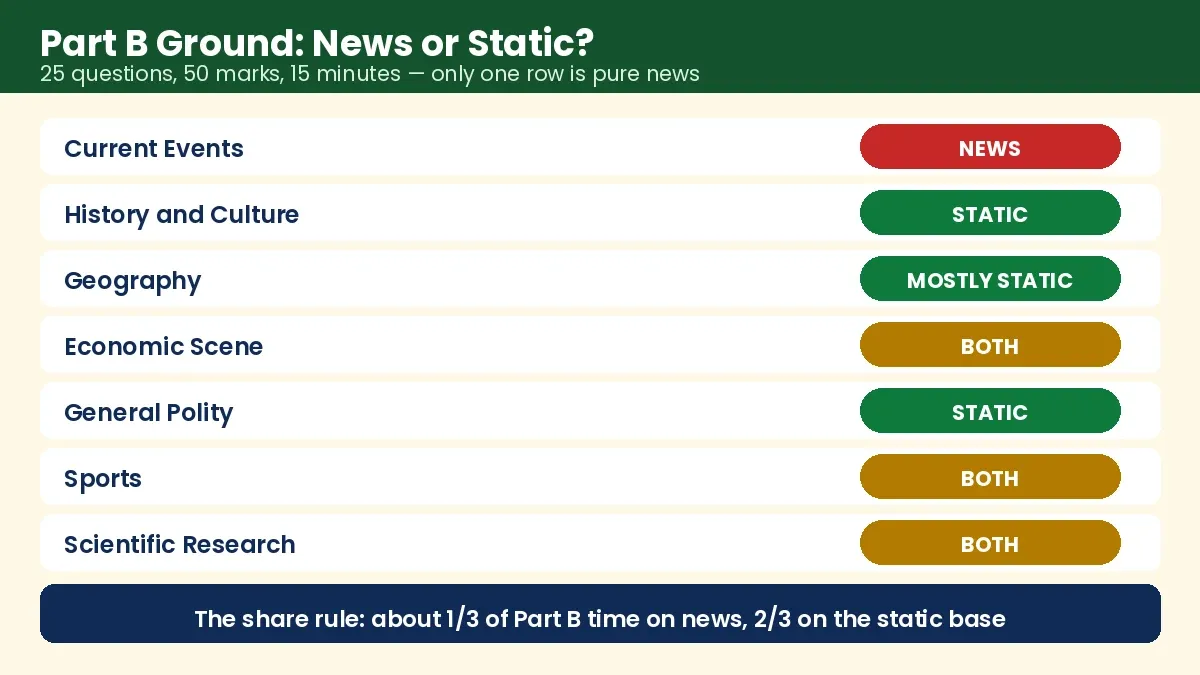
The table below puts the full Part B ground in one view, with the kind of question each area brings. Keep it near your desk for a week and mark the areas where your own base is thin.
| Part B area from the notice | What it asks | News or static |
|---|---|---|
| Current events | Recent awards, posts, schemes, reports, meets and sports results | News |
| History and Culture | Events, movements, books, dances, fairs and old sites of India | Static |
| Geography | Rivers, hills, crops, ports and the map of India and its neighbours | Mostly static |
| Economic scene | Budget words, banks, plans and how the money system works | Both |
| General Polity | The Constitution, its articles, the offices and how laws are made | Static |
| Sports | Cups, players, hosts of big games and recent results | Both |
| Scientific Research | Space work, health finds and science bodies of India | Both |
Look at the last column again. Only one row is pure news. Four rows lean static or mixed, and that is the honest shape of the part you are feeding.
How Many Months of News Are Enough?
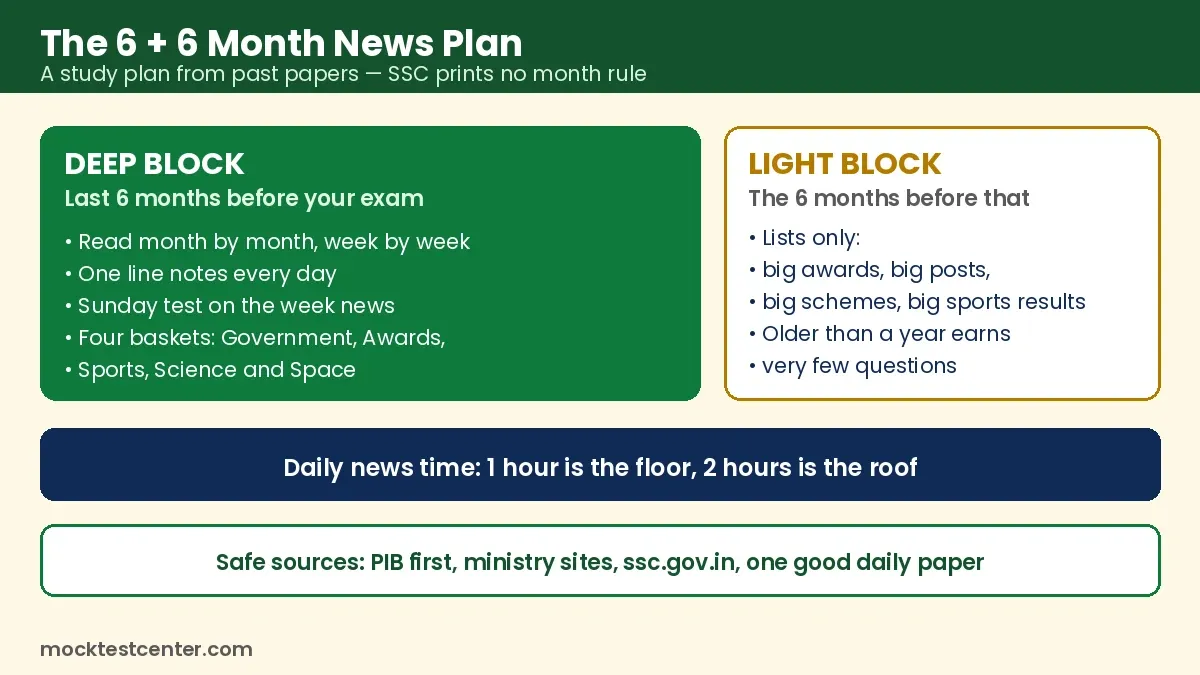
So how many months of news should you cover? First, the honest base: SSC prints no month rule anywhere in the Phase-XIV notice. The notice names current events as a topic and stops there. Any page that tells you SSC has fixed a set number of months is adding a rule the Commission never wrote. What follows in this section is a study plan, our plan, built from the way past papers ask news questions. Treat it as a plan, not as an SSC rule.
The plan runs like this. Cover the last 6 months of news well, month by month, before your exam month. Cover the 6 months before that in a light way, through lists of big awards, big posts, big schemes and big sports results, since those are the facts that stay alive in papers long after their month ends. News older than a year earns very few questions, and the hours it eats are better spent on the static base.
Say your exam falls in September, as the Phase-XIV exam did from 16 September 2026 to 26 September 2026. The deep block is then March to August of that year, read week by week as it comes, and the light block is the September to February stretch before it, read from short lists in the last two months. A girl in Lucknow who sat Phase-XIV kept exactly this shape. She told us the deep block felt long in April and short in August, which is how a good plan should feel.
Now, what counts as news worth your time inside those months? Keep four baskets and fill only those. Basket one: the Government of India, its new schemes, its big posts and the reports it puts out. Basket two: awards and honours, national and world level, with the field of the award named beside the winner. Basket three: sports, with hosts, winners and the place of the game. Basket four: science and space, with the body that did the work, like ISRO, named in the note itself.
What stays out matters as much. State level small news, party fights, film news and crime news fill phone feeds all day and fill almost no SSC questions. A death of a great person may come. A daily quarrel will not.
And give the plan a floor and a roof in hours. One hour a day on news is the floor for the deep months, and two hours is the roof. Past the roof, each extra hour steals from Part A, Part C or Part D, parts that also hold 50 marks each. The paper pays for balance
 .
Safe Sources You Can Trust With Your Marks
A wrong fact learned with full faith is worse than no fact at all, because in the hall you will mark it fast and sure, and the 0.50 cut will take its share before you ever know. Source choice is a marks choice. Keep your news diet small and official, and let other feeds go hungry.
Start at the top. The Press Information Bureau, the PIB, puts out the words of the Government of India itself: new schemes, new posts, award lists, cabinet choices and visit reports, each with a date on it. When a scheme name or a number matters, the PIB line is the line to trust, because SSC question setters read the same official words. After PIB come the sites of the ministries and bodies themselves, and ssc.gov.in for every notice, date and key of this exam. For the static side, the school books on ncert.nic.in hold the base lines that news questions grow out of.
- PIB releases for schemes, awards, posts and cabinet choices, read with the date on the release.
- Ministry and body sites for the facts of their own field, like the sports ministry for games and ISRO for space work.
- One daily paper of good name for the event of the day, read once, in the morning or the evening, never all day.
- One monthly current affairs book for the light block of old months, used for lists, not for deep reading.
- The tests on this tab for checking, since a fact you cannot pull out in a test is a fact you do not hold yet.
What you must keep out is just as clear, and the next sections will return to it. Forwards on phone groups carry no date and no source, and they mix a true line with a wrong year so well that the eye slides past the fault. News apps built for speed push alerts all day, and an alert is a shout, not a lesson. By the time a fact has passed through five forwards, the name of the award winner and the name of the award itself have traded places in half the copies in the group.
Keep a small rule on your desk. If a fact will go into your notes, it must carry a source you can name and a date you can write. No source, no note. No date, no note. The rule sounds hard for one week. Then it runs by itself.
The One Line Note Method
Notes fail in two common ways. Some candidates write pages and pages, copying whole reports into a copy book they will never open again. Some write nothing at all and trust the phone to hold the year for them. Both reach September with empty hands. The middle road is the one line note, and it works because the exam itself asks one line questions.
Here is the method, step by step.
- Read the day news once, from your fixed sources, and pick only the facts that fit the four baskets.
- Write each fact as one line with four parts: the thing, the name, the place or body, and the date or month.
- Keep the line in your own words, the way you would tell it to a friend at a tea shop.
- Close the day with five lines or fewer on most days. A day with ten lines is a rare day, not a habit.
- On Sunday, read the week lines once and mark the two or three you had already half lost. Those go to the top of the next week list.
Take a worked case so the shape is clear. A report says a new head has taken charge of a big bank, a sports meet has closed in a host city, and a space body has put a new satellite up. Three lines hold all three: the bank line names the bank, the person and the month; the sports line names the meet, the host city and the top winner; the space line names the body, the satellite and what it will watch. Each line takes under a minute to write.
Why does one line beat one page? Because revision is where news marks live. A candidate in Patna who kept one line notes told us he read his full six months of lines in two evenings before his exam. Two evenings. His friend with the fat copy books needed two weeks and still left the last two months unread, and the last two months are the months the paper loves most. Thin notes get read again. Fat notes get respect and dust.
Keep the notes by month, in one copy book or one file per month, and write the month name big on the first page. When the light block months come up for list reading in the last weeks, you will know at a look which months are deep and which are thin, and you can fill a thin month from a monthly book in one sitting.
And tie the notes to the tests from the start. The SSC Selection Post Current Affairs tests on this tab will show you, week by week, which of your lines you hold and which you only wrote. A line you miss in a test goes back into the Sunday list with a star. That star system, plain as it sounds, is the whole secret most toppers keep.
The Weekly Test Loop That Makes News Stick
Reading makes a fact known for a day. A test makes it known for a season. The loop below is the week shape we give every Selection Post candidate who asks us how to hold six months of news in the head at once, and it asks for one sitting of under an hour in the whole week.
The Weekly Current Affairs Loop: Four Steps
Run the loop like this. From Monday to Saturday, read and note, one hour at most each day. On Sunday, sit one test on the week news, in a quiet room, with a clock. Score it the hard way: 2 marks for each right answer, 0.50 cut for each wrong one, nothing for a blank. Write the score in a register with the week dates beside it, the same way you would write a full paper score.
Then do the part most candidates skip. Open the test again and pull out every fact you missed or guessed. Each one goes back into your notes with a star, and the starred lines open your reading on Monday. A fact missed twice gets a third star and a place in your last week revision list, because facts that beat you twice are the ones a paper setter loves.
Once a month, widen the loop. Sit a full Part B test with news and static mixed, in the true 15 minute box, from the sectional tests on this site. That sitting tells you the truth about your share: if your news score climbs while your static score falls, the one third share has slipped, and the next month must feed the base again. And once in two months, sit a full paper from the full mock tests, so Part B learns to live inside the full 60 minutes with the other three parts pulling at your head.
Keep the register honest for ten weeks and a pattern shows itself in your own hand: a fast climb for three weeks, a flat two weeks, then a second climb. Most people quit the loop in the flat weeks and go back to plain reading, right when the old months are sinking in. The second climb is the one that stays till exam day.
How News Links Back to the Static Base
Here is the thing weak candidates miss and strong ones use daily: a news fact rarely stands alone in a paper. It stands on a static fact, and the setter often asks the static half, not the news half. A new scheme makes the news. The ministry that runs it, the year of the older scheme it replaced, and the article or body behind it are static, and any of the four can carry the question.
So build a bridge every time a big news fact enters your notes. Ask three small questions of it. Which book chapter does this fact sit on? Which older fact does it grow out of? Which place, body or year will still be true when the news is old? Write the bridge as a half line under the note, in smaller hand if you like. The half line takes twenty seconds. It doubles the worth of the note.
Take the pattern with a plain case. A river project in the news sends you to the river system chapter, its states, its dams and its tributaries, and those are Class 6 to 10 geography lines that sit still for years. A new award in the news sends you to the full award family: who gives it, for which field, since which year. A space launch sends you to the science chapters on orbits and fuels at school level. News is the door. The base is the house. Walk through the door and into the house, every time.
This is where the school books earn their keep. The NCERT books on ncert.nic.in hold the history, geography, polity and science lines in the same easy words the paper loves, and the NCERT test series on this site turns those chapters into questions at your level. A Matriculation level candidate needs the Class 6 to 10 base strong. A Graduation level candidate needs that same base plus the Class 11 and 12 lines for polity and economy, since the higher paper pulls its static questions a step deeper.
Old papers prove the bridge works. Solve the Part B of a past paper from the previous year papers or read one as a file from the PYQ PDF tab, and mark each question N for news or S for static. Paper after paper, the S marks win. Then mark how many N questions stood on an S fact you could have bridged. That count, in your own hand, will change your reading more than any advice page can, this one too.
One caution, and it is a kind one. Skip the bridge for small facts. A daily post change in a small office needs no chapter hunt. Save the bridge for the big baskets: a scheme, an award, a games meet, a launch, a report of rank. Ten bridged facts a month, held well, beat a hundred loose facts held badly.
Mistakes That Eat Months and Give Nothing Back
We watch the same news mistakes every cycle. Each one is easy to fix once you see it. Seeing it from inside the habit is the hard part.
The first mistake is reading only news apps and forwards. The app wants your eyes all day, so it shouts every small thing in the same loud voice as the big things, and by night you hold forty alerts and no facts. The forward wants your trust, so it drops the date and the source, and a two year old award list walks into your group dressed as this week news. A candidate near Patna showed us a forward list of Padma awards he had learned by heart. Half the names were from an old year. He had spent a week feeding a dead list, and the week never came back.
The second mistake is the no test habit. Reading feels like progress because the page moves. But the hall asks you to pull a fact out of your head in under a minute, inside a 15 minute part, with three close options trying to pull you wrong. Only tests train that pull. If your week holds no test, your week holds no proof.
The third mistake is the copy book habit, pages of fair copy in neat hand that no one reads twice. The fourth is the other end: no notes at all, and a phone full of saved posts that the app will bury by next month. Both habits look like work. Neither survives September.
The fifth mistake is chasing news while the static base rots. It is the Gaya case from the start of this page, and it is the most costly of the five, because Part B pays the static rows more than the news row, paper after paper. Fix it with the share rule: one third news, two thirds base, checked every month with a mixed sectional test.
And the last mistake is a quiet one. Candidates guess news questions they half know and never count the cost. Do the maths once on your own register. Ten half known guesses in Part B, with half of them wrong, cut 2.5 marks by the 0.50 rule, and that cut can move you across the line of a post category shortlist, where each of the 382 post categories keeps its own cut off and its own crowd. A blank costs nothing. A wild guess costs real marks. In news, where you know a fact or you miss it, the blank is often the brave and right mark.
A News Plan That Fits Your Level
The three levels sit the same Part B shape, 25 questions in 15 minutes, but the depth of the ask shifts with the level, and your news plan should shift with it.
For the Matriculation level, keep the news plain and wide: big national events, big awards, big games, and the names of the heads of big bodies. Your static base is the Class 6 to 10 book set, and news that links to those chapters is the news that will pay you. Skip deep economy news. A Class 10 pass candidate gains little from bank rate debates and loses hours that polity and history would have paid for twice over.
For the Higher Secondary level, add the reports and lists: ranks of India in world lists, new posts in boards and banks, and the sports hosts for the next two years. For the Graduation level, add one layer more: the economy scene in the notice means budget words, survey lines and bank terms can carry questions, so your baskets gain a fifth small basket for economy facts with numbers in them, each with its official source line under it.
Whichever level is yours, the loop stays the same, and the chapter tests hold your static topics in place while the news months roll. Level changes the depth of the basket. It never changes the need for the Sunday test.
The Last Weeks, and Your Next Step
When the exam month comes close, stop adding new months. The last three weeks belong to your own lines: read the starred lines first, then the full deep block lines month by month, then the light block lists. Sit two Part B tests a week in the 15 minute box, and one full paper a week so the part learns its place in the hour. News of the exam month itself still counts, so keep the daily hour running till the last week, but let it feed the notes, not a panic.
The Latest Jobs page on this site will carry the Phase-XV notice the day SSC prints it, and ssc.gov.in will hold the official word itself. Till that day, the Phase-XIV facts on this page are your base, and the 2027 cycle stays expected, not fixed.
Your next step fits in this one evening. Pick your sources from the safe list, open a fresh copy book, and write today news as five one line notes with the month name on top. Then book your Sunday test now, in the diary, at a fixed hour. A plan that starts with five lines tonight beats a grand plan that starts next month, because the paper in the hall will ask what your head holds, and heads hold what weeks of small loops put there.