About SSC Stenographer Grade C & D 2027 Current Affairs
- 1.SSC Stenographer Current Affairs: Key Facts First
- 2.News Has One Home in This Exam, and It Is a Small One
- 3.The Topic Map for a 50 Question Part
- 4.How Many Months to Cover, and What Kind of Rule That Is
- 5.The Steno News Loop in Four Steps
- 6.Budget, Reports and the Numbers Page
- 7.Safe Sources and the Forward Trap
- 8.Link Every News Fact to One Fixed Fact
- 9.Awards and Sports: Two Shelves That Return Every Cycle
- 10.What One Week of the Loop Looks Like
- 11.The Last Weeks Before the CBE
- 12.Mistakes Candidates Make With News
- 13.How This Site Helps You Carry the Year
Quick Answer: SSC Stenographer Current Affairs is the news half of one part of this paper: the General Awareness part, 50 questions in 30 minutes, where current events stand first in the list of families the notice itself prints. There is no separate current affairs paper and no interview where news is asked. News pays inside those 50 questions, beside the fixed facts of history, geography and polity. This page gives you the topic map for this exam, how many months to cover as a study plan, the safe sources, and a daily loop of read, note, test and cut that fits beside English, reasoning and shorthand work.
SSC Stenographer Current Affairs: Key Facts First
The exam is the Stenographer Grade C and D Examination of the Staff Selection Commission. The written test holds 200 questions for 200 marks: Reasoning 50, General Awareness 50, English 100. From the 2026 cycle the parts run on locked timers of 30, 30 and 60 minutes, so the GA part gives you 36 seconds a question. Each wrong answer cuts 0.25 marks.
The 2026 notice came on 24 April 2026. Applications ran from 24 April 2026 to 15 May 2026, the CBE ran from 09 September 2026 to 15 September 2026, and the tentative answer key came on 23 September 2026. The SSC tentative vacancy list of 04 June 2026 counted 1,170 posts: 149 for Grade C and 1,021 for Grade D. After the CBE, the skill test waits: a dictation at 100 words per minute for Grade C or 80 words per minute for Grade D, qualifying only. Merit comes from the CBE, and a tie is broken by English marks first and General Awareness marks second.
The notice prints the GA families in order, and current events stand at the head of the list: current events, then India and its neighbouring countries, sports, history, culture, geography, economic scene, general polity, Indian Constitution and scientific research. Read that order as a hint about weight. The setters name news first because the part is built to test a candidate who lives in the present year, standing on a school base.
One more frame fact shapes this page. This exam has no interview and no second written paper. News work has exactly one place to pay: inside the GA part, in the minutes of one locked half hour. That focus is good news for your plan. You do not need the depth of a civil services candidate. You need the shape of the year, the big facts with their numbers, and the names that a 50 question part can ask.
| Fact | Detail |
|---|---|
| Exam | Stenographer Grade C and D Examination, Staff Selection Commission |
| Where news pays | Inside the General Awareness part: 50 questions, 50 marks, 30 minutes |
| First GA family in the notice | Current events, ahead of India and neighbours, sports, history, culture, geography, economic scene, general polity, Indian Constitution, scientific research |
| Full paper | 200 questions, 200 marks; English 100, Reasoning 50, GA 50; 0.25 cut per wrong answer |
| Tie break | Part III English marks first, then Part II General Awareness marks |
| Latest cycle | 2026 notice 24 April 2026; CBE 09 to 15 September 2026; key 23 September 2026; 1,170 tentative vacancies |
| Safe news source | PIB at pib.gov.in for official releases; exam facts only at ssc.gov.in |
| Skill test | Dictation at 100 wpm (Grade C) or 80 wpm (Grade D); qualifying only |
What This Page Covers
- News has one home in this exam, and it is a small one
- The topic map for a 50 question part
- How many months to cover, and what kind of rule that is
- The Steno news loop in four steps
- Budget, reports and the numbers page
- Safe sources and the forward trap
- Link every news fact to one fixed fact
- The last weeks before the CBE
- Mistakes candidates make with news
- How this site helps you carry the year
News Has One Home in This Exam, and It Is a Small One
Think of two candidates who reach the same CBE centre in September. Both hold the same school base. The first reads a newspaper for 20 minutes every morning and has done so for a year. The second bought 3 fat current affairs monthlies in the last month and read them at speed on the train. The GA part opens. Its news questions ask for the shape of the year: a scheme and its target, an award and its field, a sports win and its place, a report and the body that made it. The first candidate marks from stock. The second marks from fog, and fog at 36 seconds a question turns into guesses, and guesses pay the 0.25 cut.
The size of the home matters for your hours. News questions share one 50 question part with the fixed families. Even a strong news season cannot pay more than its share of those 50. So the news block in your day should be short and daily, 20 minutes, never the 2 hour reading marathons of exams where awareness holds 100 marks and an interview waits behind it. Here, English holds 100 marks and shorthand holds the second gate. News must earn its 20 minutes and then give the day back.
There is a second, quieter place where news sense pays: the English part. Comprehension passages in SSC papers often sit on present day themes: a scheme, a sports event, a science story, a place in the news. A candidate who reads news daily meets those passages as old ground and reads them faster. The marks are English marks. The speed came from the news habit. We count that as a bonus, never as the plan. The plan stays: news for the GA part, at GA size.
And one small line about the tie break, because it lifts the value of this part above its 50 marks. When two candidates hold equal totals, SSC reads English marks first, then General Awareness marks. A stocked GA part can win a post in a tie you will never hear about. News work is the only GA work that cannot be crammed from a book in the last month, which makes it the part of the GA stock your rivals are most likely to hold thin. A thin field is where steady daily work pays best.
The Topic Map for a 50 Question Part
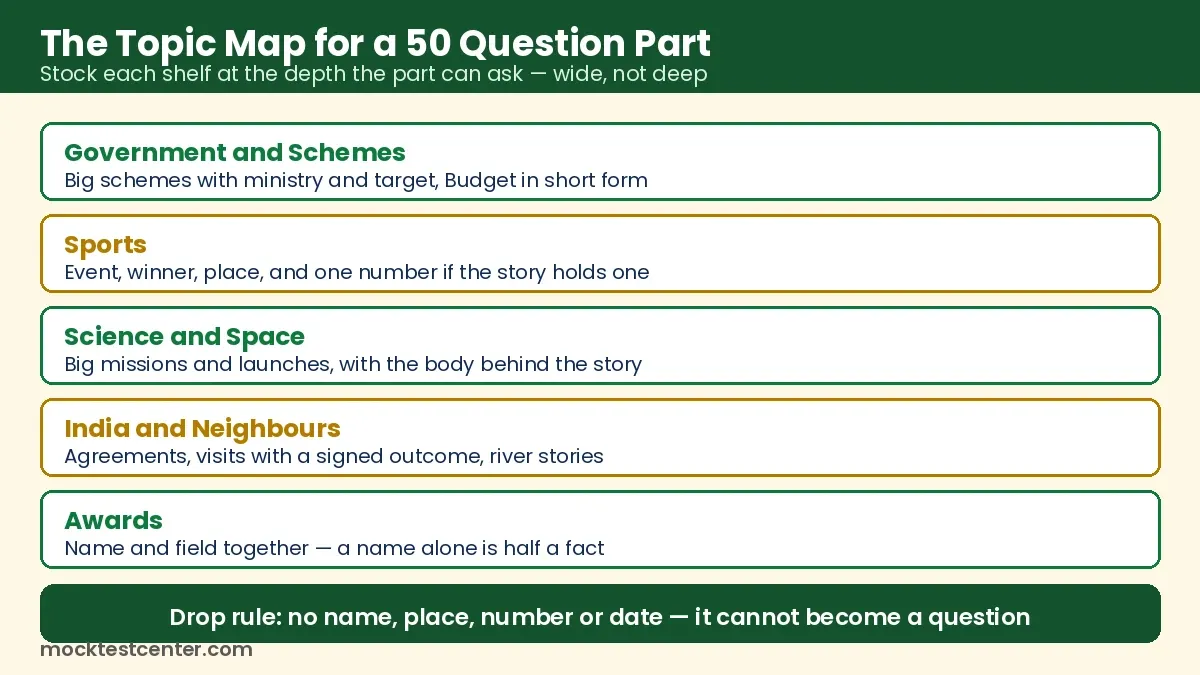
Read the families of the notice as shelves, and stock each shelf at the depth a 50 question part can ask. The part cannot ask deep. It can ask wide. One fact per item, held clean, beats a story half remembered.
Government and schemes shelf. Note big national schemes with their ministry and target lines, the Union Budget in short form, big appointments, and national awards with their fields. Give each item one line in the notebook. Give two lines and a star to any item that touches your home state, because state facts sit inside the India family of the notice and return often.
Sports shelf. Winners of the big events, records, and the places events were held. Sports stands as its own family in the notice, and its questions are among the most direct in the part: a name, a game, a place. Cheap marks for a stocked head, lost marks for an empty one.
Science and space shelf. Big missions, new launches, and the research stories the whole country talked about. The notice names scientific research as a family. Keep the shape of each story and the name of the body behind it: the agency, the mission name, the one fact that made the news.
India and neighbours shelf. Agreements that involve India, visits with a signed outcome, border and river stories in the open news. This family stands second in the notice list, right after current events, and it joins hands with your school geography base: a neighbour in the news sends you back to the map in your NCERT books.
Books, films and prizes shelf, kept thin. Big national prizes with fields, and the names that filled a full news week. Drop the rest. A 50 question part has no room for the long tail of daily noise, and your notebook should have no room for it either.
What to drop, said plainly: visits with no agreement, speeches with no number, stories that will die in a month, and every forward that no official source will stand behind. Keep items with a name, a place, a number or a date. If an item has none of those four, it cannot become a question, and it should not become a notebook line.
 How Many Months to Cover, and What Kind of Rule That Is
Cover the last 12 months before your exam month. Give the most weight to the last 6 months, because GA parts lean hard on recent events, and keep the older 6 months in shorter lines for the schemes, awards and sports results that stay in the news across a year.
Now hear what kind of rule this is. SSC prints no month rule for the GA part. The notice names the families and says nothing about 6 months or 12 months of news. The window on this page is a study plan drawn from how GA parts of past cycles were built, offered as a plan. Any page or video that sells you an official month rule for this exam sells a thing that has no home in any notice.
This honesty sorts your reading into two piles, and the sorting itself is a skill this exam pays for in a small way. Pile one: facts from official sources, with dates. Pile two: plans and views, yours and your teachers. A candidate who keeps the piles apart in his notebook keeps them apart in the hall, where a rumour marked as a fact costs 1 mark and the 0.25 cut together.
For the live season, the calendar gives the plan a shape. The 2026 cycle closed its CBE in September 2026, and the 2027 notice has not come as of 25 November 2026. A candidate starting today holds a gift: a rolling 12 month notebook started now will be a full year deep whenever the 2027 exam lands. Candidates who start news after a notice get 60 to 90 days of news. The part can hear the gap, even if it never says so.
The Steno News Loop in Four Steps
The Steno News Loop: Four Steps
Read Twenty Minutes
One newspaper and PIB, schemes and sports first
Note One Line Each
Name, place, number, date. Fact first, view never
Test Every Week
One current affairs set, score written with its date
Cut the Month
At month end, shrink the month to one page of askable facts
Step 3 is the step most candidates skip, and it is the step that turns reading into marks. Reading fills the notebook. Testing shows which lines stayed and which lines were only seen. Run the weekly test on a fixed day, with the sets on the current affairs tab of this sub-category, and write the score in the notebook with its date. A month of scores shows you your weak shelf, sports or schemes or science, while you still hold weeks to fix it. Feelings lie about weak shelves. Scores do not.
Keep the loop small enough to survive a job or a college day. Twenty minutes of reading, five or six lines of notes, one test a week, one page cut at month end. A loop that asks for 2 hours a day dies by the second month. A loop that asks for 20 minutes lives for a year, and a year is what this subject pays for.
Budget, Reports and the Numbers Page
Twice a year, news turns into a season. The Union Budget is one season. For this exam, read it in short form: the big totals, the lines for the big ministries, and any new scheme named in it with its target. Read those lines in the week they come, from the budget papers and PIB releases, and write the numbers on a numbers page the same day. A figure learned inside its own story stays in the head. A figure crammed from a list in the last week sits loose and falls out under a 36 second clock.
Reports and rankings follow a fixed note shape. Write 4 things in one line: the report name, the body that made it, the place of India, and the place of your state where the report gives one. Most report questions ask for one of those 4 things. A candidate who stores all 4, every time, has answered a family of questions before the paper even frames them.
Keep the numbers page thin and revise it twice a month. Growth lines, budget amounts, scheme targets, sports counts, award counts. Numbers are the best paid corner of this subject when you count marks per hour, because a story blurs in weeks and a number noted with care stays sharp for months.
Safe Sources and the Forward Trap
Wrong facts enter this subject daily. A forward gives a wrong scheme target with full faith. A short video gives a wrong award name with a loud voice. In the hall, a wrong fact marked with faith costs more than a blank, because the blank pays 0 and the wrong mark pays the 0.25 cut on top of the lost mark. A candidate who leaves a news question blank loses 1 chance. A candidate who fills it from a forward loses the mark and a quarter more.
Build your reading on safe ground. Use the Press Information Bureau at pib.gov.in for government and scheme releases. Use ssc.gov.in for every exam fact: notices, dates, keys, results. Use one good newspaper for the rest of the day news, read with the topic map of this page open beside you. Three sources, well used, beat forty sources half checked.
Treat a forward as a bell. A bell tells you a thing may have happened. A bell gives you no fact for the notebook. When a forward names a new scheme or a new record, go to a safe source, find the release, and only then write the line. If you find no release, write no line. This rule feels slow in week one. By month three it feels like armour, because your notebook holds no fact you need to doubt in the hall.
Link Every News Fact to One Fixed Fact
One habit joins this page to the NCERT page of this sub-category, and it doubles the life of every news line you write. With each news fact, add one fixed fact from your school base. A river in the news sends you to its origin and its states. A fort or a battle site in the news sends you to its century. A new scheme sends you to the ministry and the article or body that stands behind that work. A sports win sends you to the map: the city, the state, the country.
The habit pays twice. First, the fixed fact holds the news fact in place, the way a peg holds a tent. News lines with no peg blow away in weeks. Second, the GA part itself joins the two in its questions again and again: a current event standing on a fixed fact, asked as one question. The NCERT tests of this sub-category hold the base side of that join, chapter by chapter.
Keep the join short. One line for the news, one short line for the fixed fact under it. Two lines per item is the whole cost, and it is the cheapest memory tool on this page.
Awards and Sports: Two Shelves That Return Every Cycle
Some news families return to GA parts every single cycle, and two of them deserve shelves of their own in your notebook. The first is awards. National awards are announced on fixed days across the year, and their winners carry a field with them: a name with a game, a name with a book, a name with a film, a name with a science field. Note each name with its field in one line. An award name with no field beside it is half a fact, and half facts fall apart when the options place two winners of the same award side by side.
Read 2 or 3 award stories in full each season, slowly. A story of a player who came back from injury, or a writer who worked in a small town for 30 years, fixes the name in the head far better than a list does. Lists blur by the month. Stories stay.
The second shelf is sports results. Big events run on a calendar the whole country knows: cricket series and cups, the Olympics and Asian Games in their years, hockey, badminton, wrestling, shooting and athletics meets where India wins. For each big result keep 4 things in one line: the event, the winner, the place, and one number if the story holds one, a score, a medal count, a record. That shape answers most sports questions a 50 question part can ask.
One warning for both shelves, and it matters. Learn these facts from the news of the day or from PIB and award lists, never from forwards and fan pages. Award names are the most copied and most wrongly copied facts in the whole subject. A wrong name learned with faith costs the mark and the quarter cut, and it costs a second thing too: trust in the lines around it, which were right.
What One Week of the Loop Looks Like
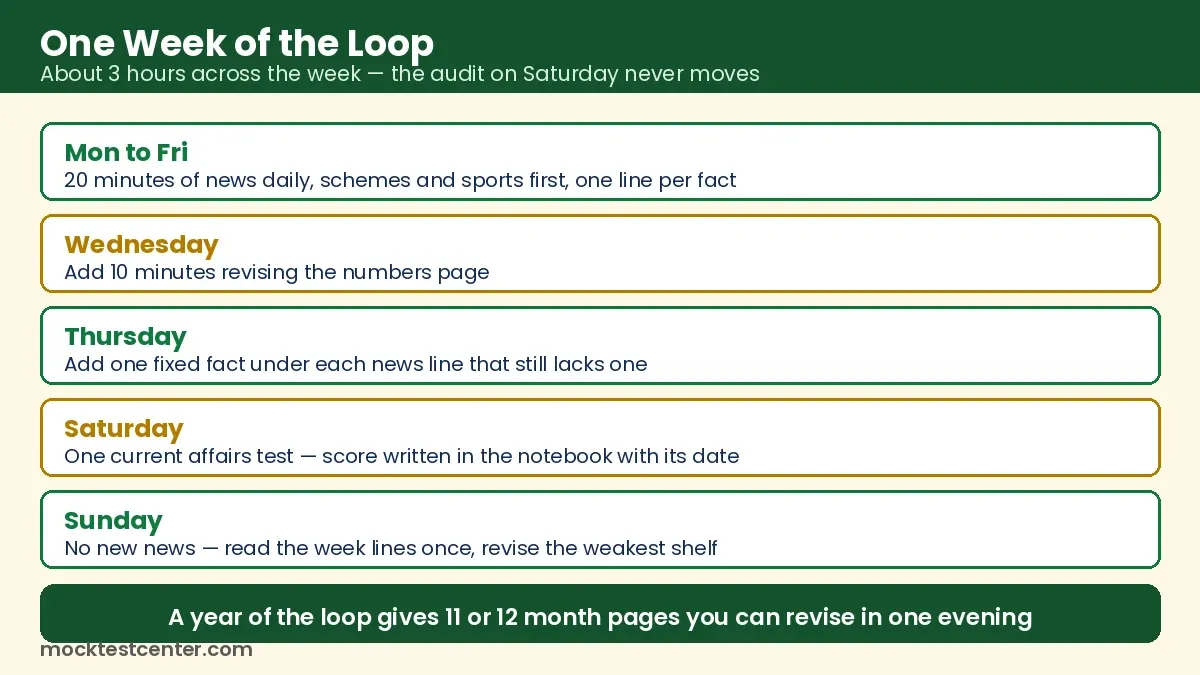
Plans die in the abstract, so here is the loop at ground level, one ordinary week. Monday: 20 minutes of news with the newspaper and PIB open, 6 lines noted, schemes first. Tuesday: the same, with the sports shelf given the first 5 minutes. Wednesday: the same, plus 10 minutes revising the numbers page. Thursday: news, then one fixed fact added under each of the week's lines that still lacks one. Friday: news, and the month page cut if the month turns this week. Saturday: one current affairs test from this tab, score written in the notebook with its date, and every missed item traced to its shelf. Sunday: no new news. Read the week's lines once, slowly, and revise the weakest shelf for 15 minutes.
Count the cost. About 3 hours across the whole week, most of it inside the daily 20 minutes. For that cost the week buys 30 to 40 noted facts, one tested score, and a notebook that grows in the shape of the part it serves. A candidate in Kanpur ran this loop through one full season beside a job. His GA scores in full papers moved from the low 20s to the low 30s, and his notebook at the end held 11 month pages he could revise in one evening. Eleven pages for a year of news. That thinness is the design. A notebook you cannot revise in an evening is a store room, not a tool.
Working candidates and college students can run the same week at half size: news on alternate days, the test kept on Saturday without fail. The test is the one step that may not move. Reading can bend around a hard week. The audit cannot, because the audit is what tells you the bending did no harm.
 The Last Weeks Before the CBE
When the exam month lands, the loop changes gear. Stop adding new shelves. The daily 20 minutes stays, because the freshest news is the most asked news, but the big hours move to revision: the month pages read again, the numbers page revised twice a week, the weak shelf named by your weekly scores given one extra test.
Hold your own exam facts tight in those weeks. The cycle, the dates, your centre, the part timers of 30, 30 and 60 minutes, the 0.25 cut. A candidate who walks in unsure of the shape of his own paper loses calm before the first question. Read the notice once more in your last week, from the official site, and carry its numbers like your own name.
And guard the shorthand block to the end. The CBE is the first gate, not the last. Candidates who drop dictation in the CBE month meet the skill test with a cold hand weeks later, when the call comes. Twenty minutes of dictation a day keeps the hand warm at almost no cost to the written work. Warm hands pass skill tests. Cold hands with high CBE scores watch others take the posts.
Mistakes Candidates Make With News
The first mistake is the pile: no news for months, then a year of news swallowed in a fortnight before the exam. The mind keeps the shape of that year and loses its facts, and the GA part finds the loss in its first 10 questions.
The second mistake is size. News gets 2 hours a day while English, which holds 100 marks and the first tie break, gets 40 minutes. The map of hours must match the map of marks. News at 20 minutes is a strong block. News at 2 hours is a theft from the part that pays half the paper.
The third mistake is learning from forwards. One wrong target learned in a study group can sit in the mind for months and walk into the hall with full faith behind it. Check each item at a safe source or drop the item.
The fourth mistake is notes with no tests. A notebook that grows for 6 months and is never tested is a diary of reading, not a stock of facts. The weekly test is the audit. Skip the audit and the first real audit is the exam itself.
The fifth mistake is dropping news after the admit card comes, as if awareness were a form to fill and close. The weeks before your exam are when the freshest questions are set. A notebook that stops in the notice month answers exam month questions with old facts, and the part marks the gap at 36 seconds a question.
The sixth mistake is a notebook written for a reader who does not exist. Lines copied in full sentences from a magazine cannot be revised in an evening, so they never get revised at all. Keep lines short enough to read at speed: a name, a place, a number, a date. If a line needs a second breath to read aloud, cut it in half and keep the half that can become a question.
How This Site Helps You Carry the Year
Mock Test Center gives this sub-category a full set of tabs, and each tab does one job. The current affairs tests on this tab carry the weekly step of the loop. The NCERT tests hold the school base that news stands on. The chapter tests repair one block at a time, the sectional tests join the GA part at its true 30 minute pace, the full tests dress the whole paper, and the previous year papers with the PYQ PDF tab show you how past GA parts mixed news with fixed facts. Exam news lands on the Latest Jobs page of this site as well as on ssc.gov.in.
Start today itself, with today's 20 minutes and this week's test. Read schemes and sports first each morning. Write one line per fact. Check each line at a safe source. Add one fixed fact under each news line. The year will build itself under your hand, page by page, and when the GA part opens on your screen, you will meet its news questions as a reader who never stopped, not as a crammer who started late. That meeting, calm and stocked, is what 20 honest minutes a day buys across a year.