About SSC MTS & Havaldar Current Affairs
- 1.SSC MTS Current Affairs: Key Facts First
- 2.General Awareness First: Why News Carries Merit Weight Here
- 3.The Topic Map for MTS News
- 4.How Many Months to Cover, and What Kind of Rule That Is
- 5.The News Loop in Four Steps
- 6.One Line Notes and the Numbers Page
- 7.News Tied to Static Facts: The Pair Rule
- 8.One Week of News, Shown as Notebook Lines
- 9.Safe Sources and the Forward Trap
- 10.The Last Weeks Before the Exam
- 11.Mistakes Candidates Make With News
- 12.How This Site Helps, and Your Next Step
Quick Answer: SSC MTS Current Affairs is the news layer of the General Awareness part, and General Awareness is where this exam is quietly decided. It holds 25 questions for 75 marks inside Session-II, the only session that makes the merit list, and when two candidates tie on Session-II marks, SSC compares General Awareness marks first. News read daily, in small lines, from safe sources like PIB, and tested every week, is how that part is built. This page gives the topic map for this exam, how many months of news to cover, the note method, and the loop that turns a year of news into marks.
SSC MTS Current Affairs: Key Facts First
This page serves one exam: the Multi-Tasking (Non-Technical) Staff and Havaldar (CBIC & CBN) Examination, run by the Staff Selection Commission for Group C posts at Pay Level-1, open to Class 10 pass candidates. The latest cycle is MTS 2025: notice dated 26 June 2025, applications from 26 June 2025 to 24 July 2025, fee Rs 100 with no fee for women, SC, ST, PwBD and ex-servicemen candidates. The tentative vacancy list later put the total at 7,948 posts: 6,078 MTS posts in the 18 to 25 age group, 732 MTS posts in the 18 to 27 age group, and 1,138 Havaldar posts.
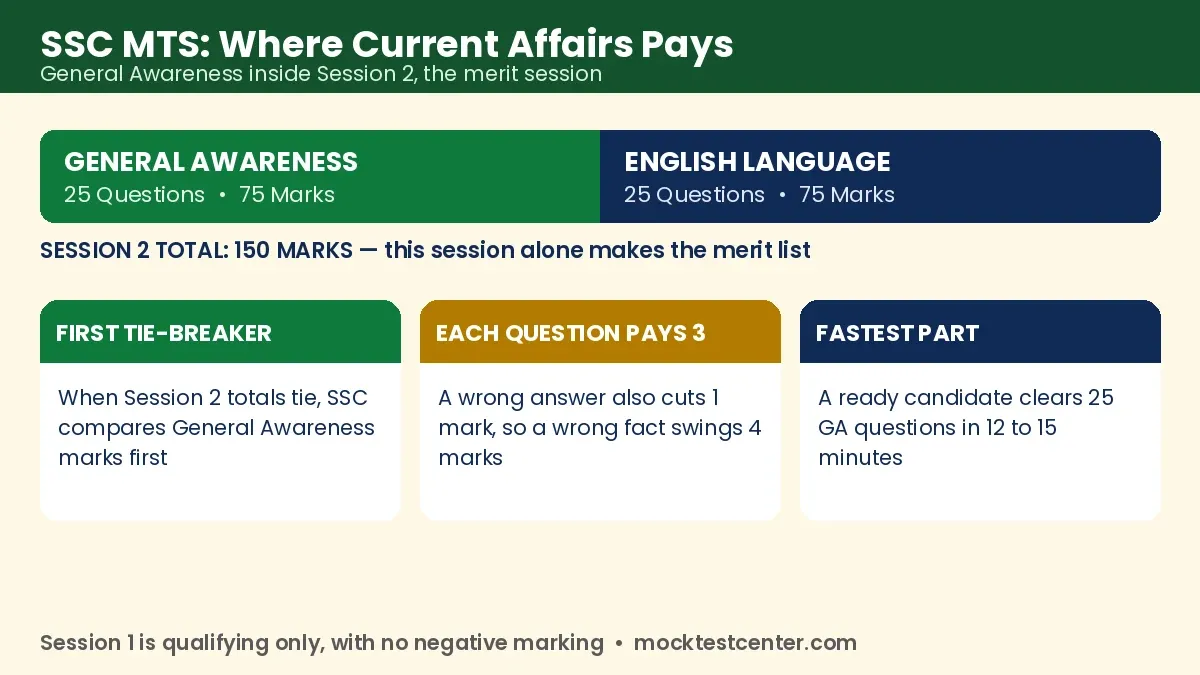
The computer test of the 2025 cycle ran from 04 to 20 February 2026, in many shifts. Its shape is the shape your news work must fit. Session-I holds Maths and Reasoning, 40 questions for 120 marks in 45 minutes, qualifying only, no negative marking. Session-II holds General Awareness and English, 50 questions for 150 marks in 45 minutes, with 1 mark cut for each wrong answer. Merit is made on normalised Session-II marks alone.
General Awareness is half of Session-II: 25 questions, 75 marks, each question paying 3 marks. Its printed field in the notice is Social Studies, General Science and Environmental Studies up to the 10th Standard, and inside that field the news of the year sits as one layer: awards, schemes, sports, appointments, books, reports and big events, most of them tied to a static fact the school books hold. The NCERT tests tab carries that static base. This page carries the moving layer on top of it.
Official exam word stays on ssc.gov.in. Official news releases of the Government of India sit on the Press Information Bureau site. Those two shelves, plus one good newspaper, are enough. Forty half checked sources only make the pile worse.
| Fact | Detail |
|---|---|
| Exam | Multi-Tasking (Non-Technical) Staff and Havaldar (CBIC & CBN) Examination, Staff Selection Commission |
| Latest notice | MTS 2025 notice dated 26 June 2025 on ssc.gov.in; MTS 2026 notice not released as of 24 November 2026 |
| Where news is asked | General Awareness, Part I of Session-II: 25 questions, 75 marks, inside a 45 minute session |
| Why GA leads | Session-II alone makes merit, and General Awareness marks are the first tie-breaker when Session-II totals tie |
| Negative marking | None in Session-I; 1 mark cut per wrong answer in Session-II, where GA sits |
| CBE, 2025 cycle | Held 04 to 20 February 2026 in many shifts; tentative keys 03 March 2026 |
| Vacancies, 2025 cycle | 7,948 tentative: MTS 6,078 (age 18 to 25) and 732 (age 18 to 27), Havaldar 1,138 |
| Safe news sources | PIB releases, ssc.gov.in for exam facts, one good newspaper read daily |
| Official website | ssc.gov.in |
What This Page Covers
- General Awareness first: why news carries merit weight here
- The topic map for MTS news
- How many months to cover, and what kind of rule that is
- The news loop in four steps
- One line notes and the numbers page
- News tied to static facts: the pair rule
- One week of news, shown as notebook lines
- Safe sources and the forward trap
- The last weeks before the exam
- Mistakes candidates make with news
- How this site helps, and your next step
General Awareness First: Why News Carries Merit Weight Here
Think of two candidates who reach the same February shift with the same English and the same maths. Their Session-I scores both clear the floor with room. Their merit now rests on 150 marks, and 75 of those marks sit in General Awareness. The first candidate has read news for twenty minutes every morning for a year. The second bought three fat current affairs monthlies in the last month and read them at speed on the train.
In the hall, the paper asks an award winner with the field of the award, a scheme with its ministry, a sports winner with the game, a report with the body that made it. The first candidate answers from stock, fast, and moves on with minutes saved for English. The second answers from fog. Some fog answers land right. More land wrong, and each wrong one hands back 1 mark on top of the 3 it failed to earn. By the end of the part, the gap between them is not talent. It is a year of small mornings against a month of big evenings.
There is a second, quieter reason this part leads. When two candidates finish with the same normalised Session-II total, SSC breaks the tie on General Awareness marks before it looks at Session-I. So GA marks work twice: once inside your total, and once as the first key that opens a tie. No other part of this paper holds that double duty.
And a third reason, about time. GA questions are the fastest questions in Session-II. A fact is known at sight or not known at all, so a prepared candidate clears 25 questions in 12 to 15 minutes and hands the saved minutes to English, where reading takes time. News work, done daily, buys marks in GA and minutes in English at the same time. Few study habits in this exam pay in two parts at once.
So treat this subject as a daily habit with a test at the end of the week, from the first month itself. The rest of this page gives you the map, the months, the notes and the loop.
The Topic Map for MTS News
Most current affairs lists are built for every exam at once, which means they are built for no exam in full. This exam is a Class 10 level paper for Group C posts. Its news questions stay close to the life of the country as a school book sees it: the nation, its states, its schemes, its honours, its games. Build your map in that shape.
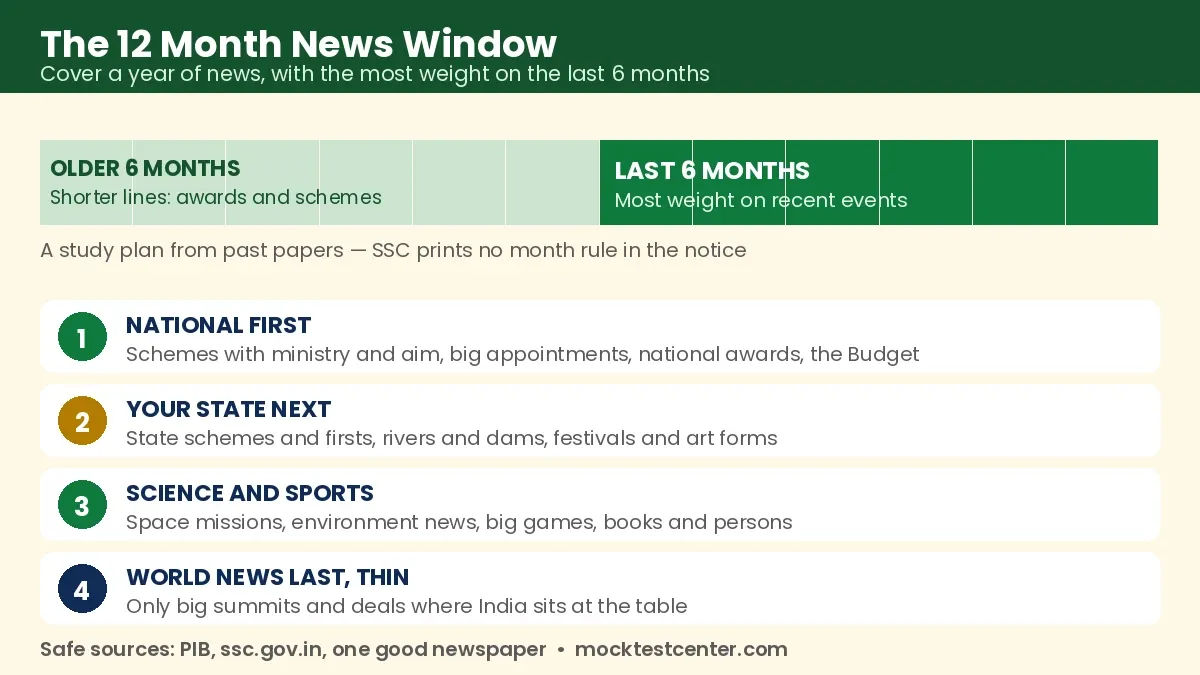
Start with national news of weight. Government schemes with their ministry and their aim line. Big appointments to posts a school book names: the heads of the forces, the RBI, the courts, the election body. National awards with their fields: the Padma awards, gallantry awards, sports awards, film and literature awards. The Union Budget in short form: the total size, the tax lines a common man feels, the big scheme amounts. Reports and rankings where India or your state holds a place worth one line.
Next, the states layer, with your own state first. State schemes, state firsts, your state in national news, its rivers and dams in the news, its festivals and art forms in the news. Papers are set for the whole country, but state facts enter through national stories, and a candidate who knows his own state cold holds a small sure shelf that costs him little to build.
Then science, space and environment in the news. Space missions and their dates. New records in weather, forests and wildlife counts. Environment days and their themes, environment summits where India sat at the table. This layer ties straight into the General Science and Environmental Studies line of the notice, and the paper loves the join: a news item on one side, a school fact on the other.
Sports and books and persons form the last layer. Winners of the big games and cups with the sport named. Books in the news with their writers. Persons in the news with the reason in one line. Keep this layer thin and exact. A name with no field beside it is half a fact, and half facts fall apart when the options place two similar names side by side.
World news sits at the edge of the map and stays thin. Big summits where India sat, agreements that name India, world sports events, Nobel Prizes. Drop visits with no agreement and speeches with no number. Depth in world news belongs to other exams with other papers. This paper asks for the shape of the story and India in it, and no more.
How Many Months to Cover, and What Kind of Rule That Is
Cover the last 12 months before your exam month. Give the most weight to the last 6 months, because paper setters lean on recent events, and keep the older 6 months in shorter lines for the awards, schemes and appointments that stay in the news across a year.
Now hear what kind of rule this is. SSC prints no month rule for current affairs. The MTS notice names the General Awareness field and stops there. The window on this page is a study plan drawn from how papers of past cycles behave, offered as a plan. Any page or video that sells you an official month rule for this exam sells a thing that has no home in any notice.
This honesty sorts your reading into two piles, and the sorting itself is a skill the paper rewards. Pile one: facts from official sources, with dates. Pile two: plans and views, yours and your teachers. A candidate who can hold those piles apart in his notebook will also hold them apart in the hall, where one question asks a fact and the next asks a fact again, and views earn nothing at all.
The 2025 cycle gives this plan a date shape worth learning from. The notice came on 26 June 2025 and promised a test window in the autumn, but SSC held the computer test from 04 to 20 February 2026. Candidates who stopped reading news in October, because the first window had passed, met February questions with October facts. The lesson is plain and a little hard: read until the hall, not until the first date printed. Exam dates move. The habit must not.
The News Loop in Four Steps
The Daily News Loop: Four Steps
Step two is where most loops die, so look at it closely. A line in the notebook rebuilds a fact in your own words; a copied headline does no such work. It holds its four legs: the name, the place, the number or date, and the field it belongs to. Winner, game, score line, month. Scheme, ministry, aim, year. Report, body, India place, state place. A line with four legs stands in the hall. A headline copied whole falls over the first time the options change its shape.
Run the weekly test on a fixed day, with the sets on this tab and the sectional tests when you want GA inside its full session. Write the score in the notebook with its date. A month of scores shows you your weak shelf, awards or schemes or sports, while you still hold weeks to fix it. Feelings lie about weak shelves. Scores do not.
And once a month, sit a full dress run from the full tests of this sub-category, so the news work learns to live inside a full paper, the way it must in the hall.
One Line Notes and the Numbers Page
Keep two notebooks, or two parts of one notebook. The first holds the daily lines, in date order, one line per fact. The second is the numbers page: budget amounts, scheme targets, award counts, record numbers, report places. Numbers are the best paid corner of this subject when you count marks per hour, because a story blurs in weeks and a number noted with care stays sharp for months.
Reports and rankings follow a fixed note shape. Write four things in one line: the report name, the body that made it, the place of India, and the place of your state where the report gives one. Most report questions ask for one of those four things. A candidate who stores all four, every time, has answered a family of questions before the paper even frames them.
Revise in layers. The daily lines get a light read at the week end. The week pages get cut at the month end to one page. The month pages get read whole once a month, and twice a month in the last two months. Revision is where news becomes stock. Reading alone makes a pile. Revision makes a shelf.
A candidate in Madhubani showed me his notebook once: 214 lines for one month, each line a headline copied whole, no dates. He had worked hard and held little, because a copied headline is the newspaper memory, not his. We rebuilt it in the one line shape, name and place and number and date, and his weekly test score rose by a third in six weeks on the same twenty minutes a day. The hours had never been the problem. The shape of the line was the problem.
News Tied to Static Facts: The Pair Rule
Here is the habit that parts this exam from a pure news test. SSC sets GA questions in pairs across time: a news fact on the surface, a static fact underneath. A river in the news sends the paper to the river origin and its states. A new national park in the news sends it to the state and the animal it guards. A scheme in the news sends it to the ministry and the year pattern of such schemes.
So note in pairs. With each news line, add one static line from your school base. The static base lives in the Class 6 to 10 books mapped on the NCERT tab of this sub-category, and its chapter tests sit on the chapter tests tab. News gives you the event. Books give you the ground the event stands on. The paper joins the two again and again, shift after shift.
The pair rule also protects you from the thinnest kind of news study: the name list. A list of 200 names with no ground under them collapses when the paper asks the second question, the one about the place or the field or the year. Pairs do not collapse. Each news fact stands on a static leg, and the leg was planted in a book you can open again any week you like.
Keep the pairs visible in the notebook: news line on the left, static line under it in a smaller hand. At month end, when you cut the month to one page, keep the pairs whole. A cut that keeps only the news half throws away the leg the question will stand on.
One Week of News, Shown as Notebook Lines
Methods stay vague until they are shown. Here is the shape of one week of lines, written the way the loop asks. The items are the kind this paper asks about; the form is the lesson, so copy the form onto your own week news.
Monday line: a scheme line. Scheme name, ministry, aim in five words, year of start. Under it, the static pair: the ministry place in the government frame, from the polity book. Tuesday line: an award line. Award name, winner, field, month. Pair: the award family and who gives it, Republic Day or a national day, from the static shelf. Wednesday line: a place line. A park, dam or river in the news, with its state. Pair: the river origin and states, drawn on the map page. Thursday line: a numbers line. A report or a record, with the body, the India place, your state place. This line goes to the numbers page as well. Friday line: a sports line. Event, winner, game, one record if the story holds one. Pair: the game home country or the cup name history, one line only.
Saturday is not a reading day in this shape. It is the test day: one weekly set, sat on a clock, scored, with every wrong line traced back to its notebook page. A wrong answer whose line exists in the notebook is a revision fault. A wrong answer with no line at all is a reading fault. The two faults have two different repairs, and the Sunday cut is where you apply them: the month page keeps only lines that passed or failed once, marked, and the failed ones move to the top of next week revision.
Count the week load. Five lines a day on five days, each line under a minute to write once the reading is done. One test. One cut. That is the whole machine, and it runs on twenty minutes a day because the lines are short on purpose. Candidates who write half page notes stop in week three. Candidates who write one line notes are still writing in month nine, and month nine is where the merit list is made.
Safe Sources and the Forward Trap
Wrong facts enter this subject daily. A forward gives a wrong award name with full faith. A short video gives a wrong scheme amount with a loud voice. In the hall, a wrong fact held with faith costs 4 marks of swing: the 3 you fail to earn and the 1 cut for the wrong mark. A blank costs only the 3. So a doubtful fact is worth less than no fact, and your sources decide how many doubtful facts you carry.
Build your reading on safe ground. Use the Press Information Bureau for government and scheme releases. Use ssc.gov.in for every exam fact: notices, dates, keys, results. Use one good newspaper for the rest of the day news, read with the topic map of this page open beside you. Use the Latest Jobs page of this site to catch exam notices the day they print.
Treat a forward as a bell. A bell tells you a thing may have happened. A bell gives you no fact for the notebook. When a forward names a new winner or a new amount, go to a safe source, find the release, and only then write the line. If you find no release, write no line. This rule feels slow in week one. By month three it feels like armour, because your notebook holds no fact you need to doubt in front of a question.
The Last Weeks Before the Exam
When the exam month comes, the loop changes gear. The daily twenty minutes stay, but the weight shifts to revision: the month pages first, the numbers page twice a week, the awards and schemes shelves once a week. New news still enters, because papers ask the freshest months hardest, but it enters in shorter lines and gets revised within the week, not the month.
Raise the weekly test to twice a week. Sit one GA sectional inside its full Session-II shape at least once a week, so the news work keeps its hall pace: 25 questions, fast, with the two option rule guarding every guess. A news base that cannot move at paper speed is a library, and the hall is not a library.
Hold your own exam facts tight in the same weeks. The cycle name, the post counts, your session rules, your floor marks. A candidate who states his own exam shape wrong in a study group has usually let rumour replace the notice, and rumour in small facts predicts rumour in big ones. Read the notice once more in your last week, from the official site, and carry its numbers like your own name.
If your exam sits in a later cycle, this season still teaches you. Watch how the February 2026 test of the 2025 cycle leaned on the months just before it. Then keep your own notebook rolling. Candidates who start news after a notice get the months since the notice. Candidates who never stopped get a year. Papers can feel the gap, even if no question ever names it.
Mistakes Candidates Make With News
The first mistake is the pile: no news for months, then a year of news swallowed in a fortnight before the exam. The mind keeps the shape of that year and loses its facts, and the paper finds the loss in the first five GA questions.
The second mistake is the headline notebook, lines copied whole with no date and no field. It grows fast and holds little. Rebuild the line: name, place, number, date, in your own words, or do not write it at all.
The third mistake is a world first map. A candidate in Kanpur who knew every summit of the season and no scheme of his own state reached the paper with a full head and an empty home shelf. For this exam, national news is the spine and world news is the garnish. Read in that order.
The fourth mistake is learning from forwards. One wrong date learned in a study group can sit in the mind for months and walk into the hall with full faith behind it. Check each item at a safe source or drop the item. Faith belongs in your work. It does not belong in a forward.
The fifth mistake is dropping news when the exam date first prints, as if the paper were already set. Papers lean on the months just before the test, and the 2025 cycle moved its test from the autumn window to February 2026. A notebook that stops early answers late questions with old facts, and the cut-off marks the gap.
How This Site Helps, and Your Next Step
Mock Test Center gives this sub-category a full set of tabs, and each tab does one job. The current affairs test series carries the weekly step of the loop on this page. The NCERT tests hold the static base that news stands on. The chapter tests repair one block at a time, the sectional tests join a part at session pace, the previous year papers show how past papers joined news to static facts, and the PYQ PDF tab holds the paper files for print sittings.
Use the tabs in a weekly rhythm. News daily. One current affairs set each week. One GA sectional inside a full session each fortnight. One full run each month. Write each score in the notebook with its date, and let the low lines choose your next week of reading.
Start today, with today twenty minutes and this week test. Read national news first. Write one line per fact, with its static pair under it. Check each line at a safe source. Then close the book and write the week page from memory on Sunday. The year will build itself under your hand, page by page, and when your shift is called, you will walk in holding the part of the paper that pays first in merit and first again in every tie.
One honest word about patience before you go. News work shows its marks late. The first month of lines feels like water poured on sand, because no single week of reading moves a test score by much. The marks come in the fourth month and the seventh, when the shelf is deep enough that new facts land on old pairs and stay. Candidates quit this subject in month two more than in any other month. The ones still writing lines in month nine are the ones the merit list seems to favour, and there is no favour in it at all. There is only a shelf, built daily, that the paper was always going to ask from.