
About SSC Selection Post 2027 NCERT-based Tests
- 1.SSC Selection Post NCERT Tests: Key Facts First
- 2.The Book Map by Level: 10th, 10 Plus 2, and Degree
- 3.Which Books Feed the Quant Part
- 4.History, Geography, Polity and Economics: the General Awareness Shelf
- 5.English and the Science Lines
- 6.Read One Chapter, Test It the Same Day
- 7.Free PDFs, Print Shops and the Second Hand Shelf
- 8.Where NCERT Stops
- 9.One Book at a Time: a Worked Start for Three Levels
- 10.How the NCERT Work Joins Your Other Tests, and Your Next Step
Quick Answer: An SSC Selection Post NCERT Test checks one school book chapter at a time, at the level of the post you want. The Selection Post exam runs three papers, for Matriculation level, Higher Secondary level and Graduation level posts, and the NCERT books under all three papers are the school books of Class 6 to 10, with Class 11 and 12 lines added at the higher levels. Class 6 to 10 Maths feeds the Quant part. The history, geography, polity and economics books feed General Awareness. This page maps the books level by level, shows the read and test same day method, and marks the line where NCERT books stop and other work must begin.
SSC Selection Post NCERT Tests: Key Facts First
The frame first, in short lines. The Selection Posts Examination is run by the Staff Selection Commission, and one notice holds hundreds of post categories in ministries, departments and offices of the Government of India. The latest cycle we can check fact by fact is Phase-XIV of 2026, under Advertisement No. Phase-XIV/2026/Selection Posts, dated 13 April 2026 on ssc.gov.in. An addendum came on 20 April 2026.
That notice carried 3,003 vacancies across 382 post categories. Applications ran from 13 April 2026 to 04 May 2026. The fee was Rs 100 for each post category applied for, and women of all categories paid no fee, and SC, ST, PwBD and ex-servicemen who were fit for reservation paid no fee either. The computer based exam ran from 16 September 2026 to 26 September 2026, and SSC put the tentative answer keys up on 09 October 2026.
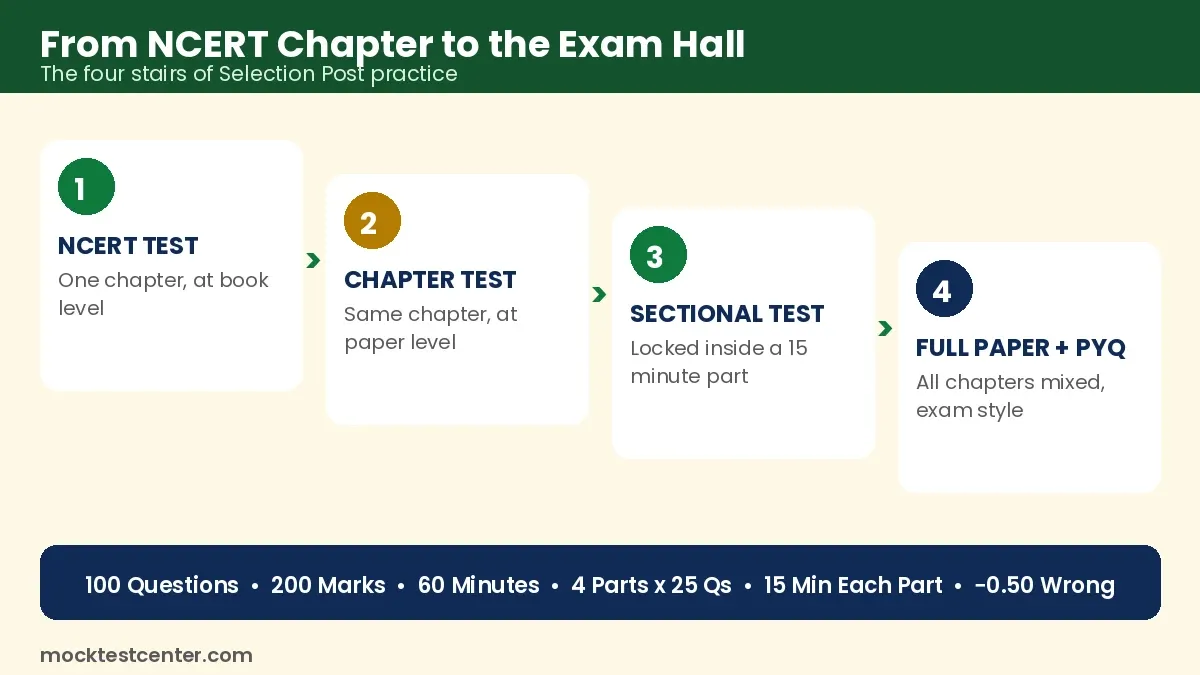
Each paper holds 100 questions for 200 marks in 60 minutes, in 4 parts of 25 questions and 50 marks each: Part A General Intelligence, Part B General Awareness, Part C Quantitative Aptitude and Part D English Language. Each right answer pays 2 marks. Each wrong answer cuts 0.50 marks. In Phase-XIV, each part ran on its own 15 minute timer.
The minimum qualifying marks in the paper are UR 30 percent, OBC and EWS 25 percent, and all other categories 20 percent. After the paper, SSC shortlists candidates post category wise for scrutiny of documents, in the ratio of 1 to 30 for a post category with up to 5 vacancies and 1 to 15 above 5 vacancies, with a minimum of 150 candidates. There is no interview. The User Department that owns the post checks the documents.
The 2027 cycle, Phase-XV, has no notice yet. SSC had printed no notice for it as of 25 November 2026, and no date stands on the official site. So the 2027 lines on this page are expectations, and the expectation is that the new cycle will follow the Phase-XIV shape until SSC prints a new notice. The books, though, do not wait for a notice. NCERT books change slowly, and the Class 6 to 12 shelf you build now will still be the right shelf when the notice lands.
One honest line before the map. SSC does not print an NCERT book list in its notice. The notice prints topics: History, Culture, Geography, Economic scene, General Polity, Scientific Research and the rest for General Awareness, and named maths topics for Quant. The NCERT map on this page is our teaching map, built by matching those printed topics to the school books that teach them. It is a study map, not an SSC promise. Hold it that way and it will serve you well.
| Fact | Detail |
|---|---|
| Exam | Selection Posts Examination, run by the Staff Selection Commission |
| Latest notice | Phase-XIV/2026, Advertisement No. Phase-XIV/2026/Selection Posts, dated 13 April 2026, addendum 20 April 2026 |
| Vacancies | 3,003 vacancies across 382 post categories in the Phase-XIV notice |
| Applications and fee | 13 April 2026 to 04 May 2026; fee Rs 100 for each post category applied for |
| Exam dates | Computer based exam 16 September 2026 to 26 September 2026; tentative keys on 09 October 2026 |
| Paper shape | 100 questions, 200 marks, 60 minutes, 4 parts of 25 questions and 50 marks, 15 minute timer for each part |
| Levels | Matriculation (Class 10), Higher Secondary (Class 10 plus 2), Graduation and above, one paper for each level |
| NCERT base by level | Matriculation rests on Class 6 to 10 books; Higher Secondary adds Class 11 and 12 lines; Graduation uses the same base, read deeper |
| Minimum qualifying marks | UR 30 percent, OBC and EWS 25 percent, all other categories 20 percent of the paper |
| Free book PDFs | NCERT books are free as PDFs on the official NCERT site, ncert.nic.in |
| 2027 cycle | Phase-XV notice not released as of 25 November 2026; pattern expected to follow Phase-XIV |
| Official websites | ssc.gov.in for the exam and ncert.nic.in for the books |
What This Page Covers
- The book map by level: 10th, 10 plus 2, and degree
- Which books feed the Quant part
- History, geography, polity and economics: the General Awareness shelf
- English and the science lines
- Read one chapter, test it the same day
- Free PDFs, print shops and the second hand shelf
- Where NCERT stops
- One book at a time: a worked start for three levels
- How the NCERT work joins your other tests, and your next step
The Book Map by Level: 10th, 10 Plus 2, and Degree
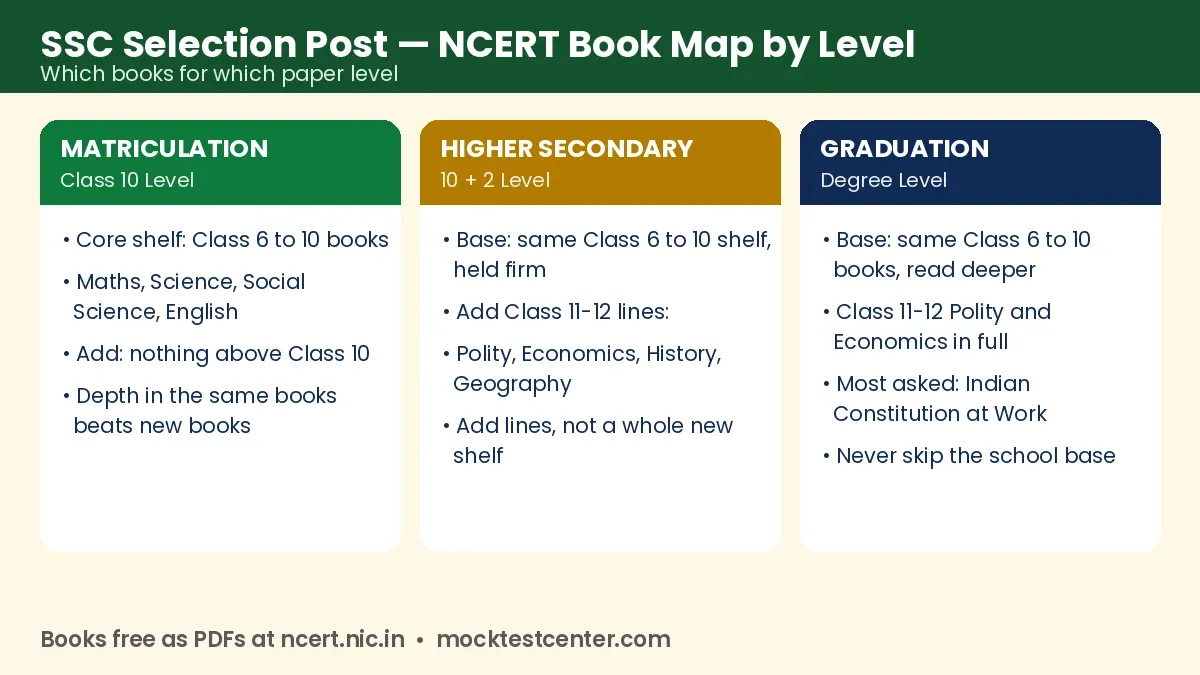
Most book lists for this exam print one flat list for all candidates, and that flat list is where the waste begins. A Matriculation level candidate who buys the Class 11 and 12 polity books on day one has spent money and shelf space on lines his paper will not ask at his level, while his Class 8 maths sits unopened. Levels exist in this exam for a reason. Let the books follow the levels.
| Your level | Core NCERT shelf | What to add | What to skip for now |
|---|---|---|---|
| Matriculation, Class 10 | Class 6 to 10 books: Maths, Science, Social Science and English | Nothing above Class 10; depth in the same books beats new books | Class 11 and 12 books, degree level books |
| Higher Secondary, 10 plus 2 | The same Class 6 to 10 shelf, held firm | Class 11 and 12 lines for polity, economics, history and geography where your school stream covered them | A full second shelf; add lines, not whole new sets |
| Graduation and above | The same Class 6 to 10 base, read deeper and faster | Class 11 and 12 books in full for polity and economy, plus the deeper reading your degree years gave you | Skipping the school base; degree pride loses easy marks here |
Read the middle row with care. Higher Secondary adds lines, not a new world. The Class 11 and 12 books deepen the same topics the notice names: the Constitution at work, the Indian economy, the land and its people. A candidate who passed Class 12 two years ago has met many of those lines in school. The job is to wake them up, chapter by chapter, not to buy a new library.
And read the last row twice if you hold a degree. We see this mistake every year. A graduate opens the Class 11 polity book, feels proud, and never goes back to Class 7 geography, and then the paper asks a plain question on rivers or soil types that a Class 10 child in Patna would answer in 10 seconds. The base is the base at every level. Graduation level papers ask from the same base, with a deeper twist in the question, not from a different planet.
A girl in a small town near Darbhanga put the map on her wall in a way we now copy for others. Three rows on one sheet of paper. Her row marked in yellow. Every book she owned ticked in its row, every book she still needed named in plain words. No book outside her row entered the house. Her shelf stayed small, her reading stayed deep, and her Part B score climbed from 21 to 33 in six weeks of this one rule.
Which Books Feed the Quant Part
Part C has a clean address. The Matriculation level Quant list in the notice reads like a table of contents of the Class 6 to 10 Maths books: Number Systems, Computation of Whole Numbers, Decimals and Fractions, Percentages, Ratio and Proportion, Averages, Interest, Profit and Loss, Discount, Mensuration, Time and Distance, Ratio and Time, Time and Work, and the use of Tables and Graphs. Open the school books and the chapters stand in almost the same order.
Start low, even if it feels too low. Class 6 Maths builds number sense: whole numbers, fractions, decimals, ratio in its first simple dress. Class 7 adds percentage work, simple interest in its early form, and the first algebra steps. Class 8 carries ratio and proportion deeper, compound interest in its first form, factorisation, and mensuration of cubes and cuboids. Class 9 and Class 10 take the same lines to paper level: real numbers, polynomials, linear equations, triangles and circles, surface areas and volumes, and the data chapters.
At the Higher Secondary and Graduation levels, the notice adds square roots, compound interest in full, Partnership Business, Mixture and Allegation, basic algebraic identities of School Algebra and elementary surds, Graphs of Linear Equations, elementary geometry with tangents, heights and distances, and fuller data work with bar graphs, pie charts, line graphs, histogram and frequency polygon. Note the address of those added lines. Most of them still live in the Class 9 to 12 maths shelf, in the same books, in the later chapters. The level rises. The shelf barely moves.
Here is the study rule for Quant, and it is hard but fair. A chapter is not read until its sums stand done on paper. Maths read with the eyes alone is a story, and stories fade by Friday. A boy in Gaya read the full Class 10 book in 9 days last winter and felt ready, then scored 14 out of 50 in his first Part C test. He had met every rule and solved almost nothing. We sent him back to Class 8 with a pen. Six weeks of sums, chapter by chapter, and the same boy crossed 30. The book was never the problem. The pen was missing.
Test each maths chapter the day you close it. The NCERT tests on this tab follow the book chapters, and the chapter tests take the same chapters at paper level, a step harder. Read in the book, test at book level, then test at paper level. Two steps up the same stair. Skip the first step and the second one wobbles.
History, Geography, Polity and Economics: the General Awareness Shelf
Part B scares candidates because it looks wide enough to hold the whole world. It does not. The notice names its ground: India and its neighbouring countries, History, Culture, Geography, Economic scene, General Polity with the Indian Constitution, Sports, Scientific Research, current events, and matters of everyday observation in their scientific side. Four of those named lines sit inside the school Social Science books, chapter after chapter, waiting.
History lives in the Class 6 to 12 history books. Class 6 opens with early man and the first cities. The middle classes carry the Sultanate, the Mughals, the freedom struggle in growing detail, and Class 10 holds the national movement in the form this exam loves to ask. At the higher levels, the Class 11 and 12 history lines add depth on the same road: themes in Indian history, the making of the Constitution era, the world wars in their Indian shadow. Read for names, dates, places and causes. A history chapter read as a story of people holds longer than a page of dates read as a list.
Geography lives in the Social Science books of Class 6 to 10 and the Class 11 and 12 geography books above them. Rivers, climate, soil, crops, minerals, industry, maps. This is the part of Part B where a map on the wall pays rent every day. A candidate in Patna kept a plain map of India above his desk and marked one river or one dam on it each morning with a pencil dot. By exam month the map was full of dots, and so was his Part B score sheet, in the good way.
Polity lives in the Social Science books of the middle classes and grows teeth in Class 11. The Class 11 book Indian Constitution at Work is the single most asked from book on this whole shelf at the higher levels: the making of the Constitution, fundamental rights, the Parliament, the President, the courts, federal relations. At the Matriculation level, the Class 9 and 10 polity chapters carry the same ground in simpler words, and simpler words are what a 36 second question rewards.
Economics lives in the Class 9 and 10 economics chapters and the Class 11 and 12 economics books. People as resource, poverty, food security, money and credit, the sectors of the economy, Indian economic development at the higher level. The notice calls this line Economic scene, and the school books teach that scene in plain order, year by year, scheme by scheme in their school form.
Science and Scientific Research sit on the next shelf, and Sports sits in the newspaper, so hold those two for the English and science section below and the limits section after it. For the four lines above, the rule stands firm. Book first, test second, notes third. And when a General Awareness chapter feels dry, test it before you judge it. The sectional tests will show you in 15 minutes which of these chapters the paper style favours, and a dry chapter that pays 4 marks a paper is not dry at all. It is a salary.
English and the Science Lines
Part D asks for the basics of the English language: vocabulary, grammar, sentence structure, synonyms, antonyms and their right use. At the higher levels the notice adds spot the error, fill in the blanks, idioms and phrases, one word substitution, improvement of sentences, active and passive voice, narration, a cloze passage and a comprehension passage.
Where do the NCERT English books fit in that list? In the reading half of it. The Class 6 to 12 English books, the readers and the grammar work inside them, build the base the passage questions stand on: reading speed, word sense, the feel of a right sentence. A candidate who reads one English chapter a day, aloud, in a low voice, at the kitchen table after dinner, builds that feel without knowing the name of a single grammar rule. We have watched it happen too many times to doubt it.
But be clear about the other half. Synonyms and antonyms at paper level, one word substitution, idioms: these come as lists and drills, and the school books carry them thinly. Your NCERT reading builds the ground. A word list book and daily drill build the fence on that ground. Both jobs are real. Do not ask one book to do both.
Science sits in a like place. The Class 6 to 10 Science books feed the everyday science and Scientific Research lines of Part B: light, sound, food, materials, the human body, force, electricity in its school form. At the Higher Secondary and Graduation levels, the Class 11 and 12 science books add depth for candidates whose posts lean that way, but the plain school science of Class 9 and 10 still carries most of the weight for most post categories. Read the chapters, draw the small diagrams in your copy, and test the chapter the same day. A science chapter without its diagram is a face without eyes. You can name it. You cannot quite place it later.
Read One Chapter, Test It the Same Day
Here is the method this whole page leans on, in one line. Read one chapter in the morning. Test that chapter the same day, before you sleep. Not tomorrow. Not on Sunday with 6 chapters at once. The same day, while the lines still sit warm in the head.
Why does the same day rule pay so well? Because a test taken at night sorts the morning reading into two piles while you can still fix the sorting. The lines you really hold come out as right answers. The lines you only met come out as wrong ones, and a wrong answer at 9 at night, with the book still on the desk, takes 4 minutes to repair. The same wrong answer found 3 weeks later takes a full chapter reread. Time is the fee. Pay the small fee.
One Chapter a Day: Read It, Test It, Fix It, Note It
Keep the unit small on purpose. One chapter a day feels slow in week one. By week six it has built 40 chapters, each one read, tested and repaired, and that pile beats the pile of the candidate who read 3 whole books in a rush and tested none of them. We see both piles every year at result time. The slow pile wins so often that we have stopped calling it slow. We call it the sure pile.
Set a floor for the chapter score, and hold it kindly but firmly. Under half marks in a chapter test means the chapter goes back on the list for the coming Sunday, to be read once more, only the weak parts this time. Half to three quarters means the chapter stands passed but its wrong lines go into your notes. Above three quarters, close the chapter and move on with a clear head. A chapter is a room. Sweep it, test the floor, and do not live in it.
On Sundays, change the mix. Take one previous year paper at your level and mark every question that came from a chapter you have closed. That count is the truest report card this method gives. When 30 of the 50 General Awareness and Quant questions in a real paper touch chapters on your closed list, the books stop feeling like school and start feeling like marks, because they are.
Free PDFs, Print Shops and the Second Hand Shelf
Money stops many candidates before the books do, so take this line home first. NCERT books are free as PDFs on the official site, ncert.nic.in. Every book named on this page, Class 6 to 12, subject by subject, chapter by chapter, stands there at no cost. A phone, a free PDF and a copy to write in: that is a full study set for the NCERT part of this exam.
Download wise, not wide. Pull one book at a time, the book of your current chapter, and keep the phone clean of the other 40 files that call for your eyes. A folder with 4 books you are reading beats a folder with 60 books you feel guilty about. Guilt is a poor teacher too.
Print helps for the heavy chapters. In most towns, a print shop near the station or the court will print and bind one book for less than the cost of a new guide, and a printed Maths book you can write sums inside is worth 3 PDFs you only scroll. For Social Science, second hand school books from the old book market work just as well, since these books change slowly. Check two things in a second hand copy: the class and subject on the cover match your list, and no full chapter stands torn out at the back. Old ink marks from a school child cost you nothing. Missing pages cost you marks.
One more route costs nothing at all. School libraries, coaching room shelves and elder brothers and sisters who kept their Class 10 sets: ask around before you buy. In a village near Madhubani, one candidate we know built her whole shelf from the almirah of a cousin who had passed Class 12 the year before. Her total spend on NCERT books was zero rupees. Her Part B score was 36. The books do not know what they cost. Neither does the paper.
Where NCERT Stops
Now the line every honest NCERT page must draw, and most pages never draw it. The school books end, and past their end, other work begins. Know the three clear stops.
Stop one: current events. Part B asks about the world of the last months: new schemes in their live form, awards, sports results, reports, appointments, the news of India and its neighbours as it stands near your exam date. No school book holds last month. That ground belongs to the newspaper habit and the current affairs tests, taken week by week. Read NCERT for the fixed world. Read the news for the moving one. A candidate who swaps the two reads a 2019 book for a 2026 award and a newspaper for the article numbers of the Constitution, and both swaps lose marks.
Stop two: reasoning speed. Part A at the Matriculation level is of the non verbal type, full of figures, series and visual memory work, and at the higher levels it turns verbal and non verbal with coding, Venn diagrams and word building. NCERT books hold almost none of this. Your Part A speed is built on timed practice alone: the sectional tests for the 15 minute part, and old papers for the feel of real figure questions. Reading about a series is like reading about swimming. At some point the body must enter the water.
Stop three: paper craft. NCERT chapters teach topics in school order, at school pace, with school questions at the chapter end. The exam asks mixed questions from many chapters at once, at 36 seconds a question, with a 0.50 cut waiting for a hasty guess. That craft, the mixing, the pace, the guess sense, comes only from full papers and part tests under a clock. Books build the house. Papers teach you to run through it in the dark, fast, without breaking a leg.
Hold the balance in one picture. For a Matriculation candidate in the first 3 months, NCERT work can rightly take half the study day. After that, its share should fall month by month, as chapter tests, sectional tests and papers take the front seats. In the last month, the books come off the desk except for quick looks at marked lines. A candidate still reading new NCERT chapters in the last 10 days is building a base for an exam that has, in a sense, already left the station.
One Book at a Time: a Worked Start for Three Levels
Advice stays light until it lands on a real desk, so here are three real starts, one for each level, each small enough to begin tonight.
For the Matriculation candidate, say a boy in Samastipur who left school 2 years ago and now wants a Class 10 level post. His first book is Class 10 Social Science, and his first chapter is the national movement chapter his paper level loves. Morning: read it with a pen, mark dates and names. Night: the chapter test on this tab. Sunday: the Class 9 book opens, one class down, to fill the road that leads to the chapter he just closed. His Quant starts in Class 8 Maths, not Class 10, because his sums need the lower stairs first. In 8 weeks at one chapter a day, his closed list holds about 50 chapters across 4 subjects. That is a base. That is real.
For the Higher Secondary candidate, say a girl in Kanpur who passed Class 12 last year. Her first book is Class 11 Indian Constitution at Work, because polity pays her level well and her school lines on it are still warm. She tests each chapter the same day, and beside the book work she runs one Class 10 Social Science chapter every second day, to keep the base under repair. Her Quant climbs from Class 10 Maths into the added lines: compound interest in full, mixture and allegation, heights and distances. Eight weeks. Same one chapter rule. A deeper shelf, built the same slow way.
For the Graduation candidate, say a young man in Delhi with a degree and a desk job. His risk is pride, so his first book is Class 7 Geography, taken on purpose, at speed, one chapter a night with its test, to prove to himself where his base stands in truth. It took him 9 days to close that book and his chapter scores told him the truth his degree had hidden: strong polity, weak physical geography, fair history. Then his plan wrote itself. Class 11 and 12 polity and economics in the mornings, geography repair in the evenings, and one full paper every Sunday from the PYQ PDF tab to keep the paper craft growing beside the books.
Three levels. Three desks. One rule under all of them: the book you are reading is the only book on the desk, and its test falls on the same day it closes. Everything else on this page is detail. That rule is the page.
How the NCERT Work Joins Your Other Tests, and Your Next Step
Place the tabs of this sub-category in one line in your mind, because each one takes the NCERT work one step further. The NCERT tests on this tab check the chapter at book level. The chapter tests raise the same chapter to paper level. The sectional tests lock it inside a 15 minute part with 24 other questions calling for your time. The full mock tests and the previous year papers mix all the chapters the way the hall will. Book, chapter, part, paper. Four stairs, climbed in that order, again and again.
And keep one eye on the notice line. The Latest Jobs page will carry the Phase-XV notice the day SSC prints it, the official word will stand on ssc.gov.in, and the books will stand free on ncert.nic.in as they do today. When the notice comes, check its topic lines against your shelf once, adjust one or two books if the print asks for it, and go back to the rule.
Your next step is small and it is tonight. Write your level at the top of a clean page: Matriculation, Higher Secondary, or Graduation. Under it, write the first book of your level from the map on this page, and the name of its first chapter. Download that one book free from the NCERT site, or pull the old copy off the shelf. Read the chapter in the morning, test it at night, and write the score beside the chapter name. One line in the register. Every big base we have ever seen began as exactly that: one line, written on an ordinary day, by a candidate who started before the notice came.







