
About SSC Stenographer Grade C & D 2027 NCERT-based Tests
- 1.SSC Stenographer NCERT Tests: Key Facts First
- 2.School Books Serve One Part of This Paper, and Serve It Well
- 3.The Book Map: Which NCERT Book Feeds Which GA Family
- 4.From School Books to the GA Part in Four Steps
- 5.Read One Chapter, Test It the Same Day
- 6.Where NCERT Stops: News, Reasoning and the Shorthand Room
- 7.Polity First: Why the Constitution Book Earns Four Days
- 8.Science and Economics: The Quiet Families
- 9.A 40 Day Base Plan
- 10.Mistakes We See Every Cycle
- 11.What a Good NCERT Score Line Looks Like
- 12.How This Site Fits Around the Books
Quick Answer: SSC Stenographer NCERT Tests exist for one part of this paper: the General Awareness part is set at school level, and the notice itself says no special study of any subject is needed for it. That part holds 50 questions in 30 minutes, and its fixed families, history, geography, polity, economics and science, are the very subjects of the Class 6 to 12 NCERT books. This page maps those books to the GA part, shows the read and test method, and draws the line where school books stop and news reading takes over.
SSC Stenographer NCERT Tests: Key Facts First
The exam is the Stenographer Grade C and D Examination of the Staff Selection Commission. Its written test holds 200 questions for 200 marks in 3 locked parts: Reasoning 50 questions in 30 minutes, General Awareness 50 questions in 30 minutes, and English 100 questions in 60 minutes. Each wrong answer cuts 0.25 marks. The part timers are new in the 2026 cycle; before that, the paper ran on one free block of 2 hours.
The 2026 notice came on 24 April 2026, applications ran to 15 May 2026, and the CBE ran from 09 September 2026 to 15 September 2026. The SSC tentative list of 04 June 2026 counted 1,170 vacancies: 149 for Grade C and 1,021 for Grade D. You need the 12th standard pass and stenography skill to apply. After the CBE comes the skill test, a dictation at 100 words per minute for Grade C or 80 words per minute for Grade D, qualifying only.
Now the part this page stands on. The notice prints the General Awareness families in its own words: current events, India and its neighbouring countries, sports, history, culture, geography, economic scene, general polity, Indian Constitution, and scientific research. And it adds a line most candidates read too fast: questions are set to test awareness of the world around the candidate, and no special study of any discipline is required.
Read that line right. The part is no shelf of free marks. The line says the level is the level of a good school base plus daily news. Fifty questions in 30 minutes is 36 seconds a question, with no time to think a fact into being. The facts must already be in the head, placed there by books read slowly across months. The NCERT set, free as PDFs on ncert.nic.in, is the cheapest and cleanest way to stock that base.
| Fact | Detail |
|---|---|
| Exam | Stenographer Grade C and D Examination, Staff Selection Commission |
| GA part | General Awareness: 50 questions, 50 marks, 30 minutes, 36 seconds a question |
| GA families in the notice | Current events, India and neighbours, sports, history, culture, geography, economic scene, general polity, Indian Constitution, scientific research |
| Level line in the notice | No special study of any discipline is required for the GA part |
| Full paper | 200 questions, 200 marks; English 100, Reasoning 50, GA 50; 0.25 cut per wrong answer |
| Latest cycle | 2026 notice 24 April 2026; CBE 09 to 15 September 2026; 1,170 tentative vacancies |
| Books | NCERT Class 6 to 12 books, free as PDFs at ncert.nic.in |
| Skill test | Dictation at 100 wpm (Grade C) or 80 wpm (Grade D); qualifying only |
| Official websites | ssc.gov.in for the exam, ncert.nic.in for the books |
What This Page Covers
- School books serve one part of this paper, and serve it well
- The book map: which NCERT book feeds which GA family
- From school books to the GA part in four steps
- Read one chapter, test it the same day
- Where NCERT stops: news, reasoning and the shorthand room
- A 40 day base plan
- Mistakes we see every cycle
- How this site fits around the books
School Books Serve One Part of This Paper, and Serve It Well
Be clear about the size of the claim, because a clear claim can be tested and a big claim cannot. NCERT books will not touch your Reasoning score, except through the small maths base under arithmetical reasoning. They will not fix your English grammar. They will not move your shorthand hand by one word per minute. What they do, they do for the General Awareness part, and inside that part, for its fixed half: the history, geography, polity, economics and science facts that stay fixed while the news moves.
That fixed half is bigger than it looks. Open the GA parts of the last few cycles and a pattern stands up. The Constitution articles return. The freedom movement years return. The rivers, the states, the crops and the passes return. The big science facts of daily life return. These are school book facts, word for word in many cases, because the paper is set for 12th pass candidates and the setters draw the fixed questions from the same shelf the schools teach from.
A candidate from Ranchi told us his GA score sat at 22 to 24 across 5 papers while his other parts climbed. His news reading was daily. His school base was a closed book from Class 10. We put him on the polity and geography books alone for 5 weeks, one chapter a day with a same day test. His GA line moved to 31, then 34. The news had been landing on sand. The books gave it ground to stand on.
So the order of this page is the order of the work. Books first for the fixed base. News on top of it, from the current affairs side of this sub-category. Tests at every step, because a base that is never tested is a base you only hope you have.
Put a number on the fixed half, so the work knows its size. In a 50 question GA part, the school families commonly hold the bigger share of the fixed questions: polity and Constitution lines, history years and names, geography facts of India, daily science, and the plain economics ideas. The news questions fill the rest. A candidate strong in books and weak in news can still hold a fair GA score. A candidate strong in news and weak in books holds a score that swings with the paper, high in a news heavy shift, low in a book heavy one. Swing is a risk you can remove. The base removes it.
The Book Map: Which NCERT Book Feeds Which GA Family
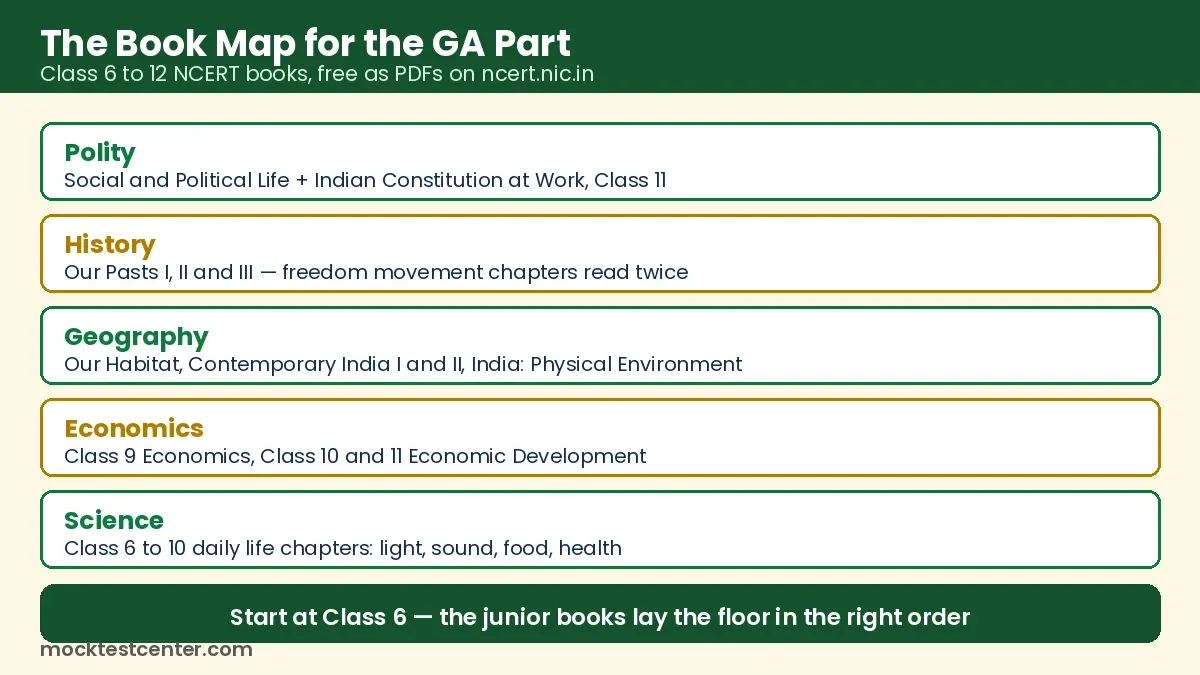
Here is the whole map on one screen. Read the right hand column first. It tells you why the book is open on your desk.
| Book family | NCERT books to read | The GA family it feeds |
|---|---|---|
| History | Our Pasts I, II and III of Class 6, 7 and 8; Themes in Indian History of Class 12 for the freedom movement years | History and culture questions: ancient and medieval India, the British years, the freedom fight and its dates |
| Geography | The Earth: Our Habitat; Our Environment; Resource and Development; Contemporary India I and II; India: Physical Environment of Class 11 | Geography questions: rivers, states, borders, climate, soils, crops, and India and its neighbouring countries |
| Polity | Social and Political Life I, II and III; Democratic Politics I and II; Indian Constitution at Work of Class 11 | General polity and Indian Constitution questions: articles, posts, Parliament, courts, Panchayati Raj |
| Economics | Economics of Class 9; Understanding Economic Development of Class 10; Indian Economic Development of Class 11 | Economic scene questions: banks, money, work, poverty, budgets in plain words |
| Science | Science books of Class 6 to 10: light, sound, force, food, health, the living world | Scientific research and daily science questions at school level |
Start at Class 6 even if it feels small. The junior books are thin and fast, and they lay the floor in the right order. A candidate who jumps to Class 11 polity on day one reads about the Constitution with no school story under it, and the facts float. Floors first. Walls later.
Two things stay off this map. Current events stay off it, because a book printed years ago cannot hold last month's news; that load sits on the current affairs tab. And your shorthand books stay off it, because the skill test is a hand skill, not a fact shelf. The map is for one part of one paper. Keep it that clean and it will serve you well.
 From School Books to the GA Part in Four Steps
From School Books to the GA Part: Four Steps
The steps hold because each one feeds the next. Polity first because its questions repeat the most and its book is the clearest. The India map next, because geography and history facts carry the biggest block of the fixed half. Testing at step three, not at the end, because a chapter read in week one and tested in week six has already leaked. And news last, on top, because news facts stick to a stocked mind and slide off an empty one.
Read One Chapter, Test It the Same Day
The method is small, and it is the same method this site uses on every NCERT tab. Read one chapter. Close the book. Write what you remember on a blank page, in your own words. Then give the chapter test that same day, under a clock, with no book open.
School facts feel easy while you read them. They feel known. Then the test asks for the one river, the one year, the one article number, and the feeling turns out to be a guest in the head. It never moved in. That small shock is the lesson, and it costs an evening at home. The same gap found in the hall costs marks in a part that allows 36 seconds a question and no second look. Test early, while the repair is cheap.
Keep one register for this work: book, chapter, date, score. When a chapter scores under half, star it and read it again inside the same week, with a different tool. If you read it as text, draw it as a map or a table this time. If it is a maths based science chapter, work the sums by hand. A chapter read twice in the same way fails twice in the same way.
Pace: one chapter a day is strong for a working candidate or a student in college. The junior books move fast; a Class 6 chapter can take one sitting. The Class 11 books are heavier and earn 2 days each. On heavy days, take a half chapter and its half test rather than skipping the day. Chains break at the skip. Slow days do not break them.
The tests for this method live on the NCERT-based Tests tab of this sub-category. Around it, the chapter tests press the same chapter harder, and the sectional tests join the whole GA part under its 30 minute clock when you want to feel the part as the hall will give it.
Where NCERT Stops: News, Reasoning and the Shorthand Room
Now the hard line of this page, drawn once, in full. NCERT books cover the fixed half of one part of this paper. That is 25 or so questions of 200, served well. The other 175 questions owe the school books nothing, and your week must be shared with open eyes.
Current events stop the books first. The GA part asks about the world of the last few months: awards, sports wins, new schemes, big reports, appointments. No book holds those. They come from daily news, noted in one line each and tested weekly, the loop this site runs on its current affairs tab. A candidate who reads only books walks into the GA part with half the part unstocked, however strong his base.
Reasoning stops them next. Series, coding, analogies and puzzles are method skills. They grow by solving, under a clock, not by reading. English stops them too: grammar rules live in grammar books and word lists, and reading speed lives in daily timed reading. Give those parts their own tools, from the chapter and sectional tabs.
And the skill test stops them last and hardest. Shorthand is a hand skill. Dictation at 100 or 80 words per minute, typed out in 40 to 65 minutes by grade and language, is built by daily practice with a pen and a keyboard. No book of facts shortens that road by one day. Keep the split in your week the way the exam holds it: one honest block a day for the school book base, the big hours for English, reasoning and shorthand, and a short daily block for news.
Polity First: Why the Constitution Book Earns Four Days
Of all the families on the map, polity pays the fastest and the surest. The reason is plain to see in old papers. Constitution questions repeat: the articles that give the big rights, the posts and who holds them, how a bill becomes a law, what the President can and cannot do, the shape of Panchayati Raj. The stock of such facts is small, fixed, and fully held in one book: Indian Constitution at Work of Class 11, standing on the Social and Political Life books below it.
Read it like a candidate, not like a student. A student reads for the exam at the end of the school year, where long answers pay. You read for 36 second questions, where one fact pays. So read for small, ready facts: an article number with its right, a post with its term, a body with its work. After each chapter, close the book and write 5 such facts from memory. Then check them. The writing is the learning. The reading alone is only the meeting.
Give the book 4 days in the 40 day plan, and give its chapters a second pass in the last 10 days of the plan. Polity facts are the kind that fade in a straight line: strong in week one, grey by week six. A second pass close to the test phase of your season pins them. And when you meet a polity question in a full paper that you cannot place, note its chapter in the register that same evening. The register will show you inside a month which 3 chapters of the book carry your losses, and those 3 chapters get the third pass.
A word on the junior polity books. Social and Political Life I, II and III look thin next to the Class 11 book, and candidates skip them to save days. Skip them and you lose more days than you save. They hold the floor facts in the order a mind keeps them: the village and the city bodies first, then the state, then the country. A candidate who knows the floor cold reads the Class 11 book at twice the speed, because every big idea lands on a small one already in place.
Science and Economics: The Quiet Families
Two families on the map get less talk and still pay their share. Science in this part is school science: light and sound, force and motion, food and health, the living world, simple machines, the water and air around us. The Class 6 to 10 science books hold all of it. The questions sit at that level and no higher, because the notice promises no special study. Read the daily life chapters well and let the deep chapters go. A candidate who spends 3 days on Class 10 physics depth for a 50 question part at school level has paid a degree price for a school mark.
Economics is the second quiet family. The economic scene questions ask for plain ideas: what a bank does, what a budget is, what poverty lines and work mean, the big schemes in short form. Economics of Class 9, Understanding Economic Development of Class 10 and Indian Economic Development of Class 11 cover that ground in easy words. Read them once, well, inside the plan. Twice is a luxury this part does not repay.
Together the two families may hold 8 to 12 questions of the GA part in a given paper. That is up to a quarter of the part, won from books most candidates never reopen. The GA part also breaks no tie in this exam, since the tie break reads English first and GA second, but a strong GA score still lifts the total that the tie break stands on. Quiet families, real marks.
A 40 Day Base Plan
Forty days of one block a day builds this base without touching the heart of your other practice. Here is a shape that works.
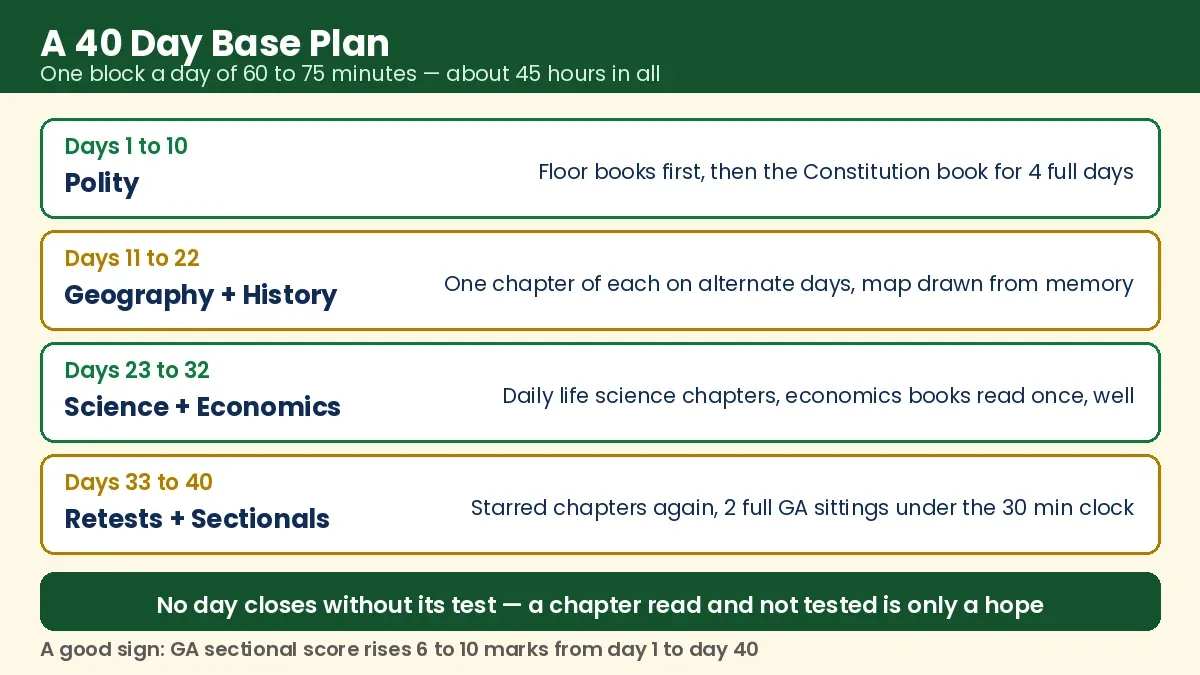
Days 1 to 10: polity. Social and Political Life books first for the floor, then Indian Constitution at Work, given 4 full days, because its facts return in paper after paper. Days 11 to 22: geography and history together, one chapter of each on alternate days, with a hand drawn map of India on day 18 that you fill from memory. Days 23 to 32: science from the Class 6 to 10 books, the daily life chapters first, and the 2 economics books read fast inside the same block. Days 33 to 40: every starred chapter in your register read again, 2 full GA sectional tests under the 30 minute clock, and one mixed NCERT test a day.
Two rules keep the plan on track. No day closes without its test, because a chapter read and not tested is a chapter you hope you know. And the plan bends around your other gates. In the last 2 weeks before the CBE, the books drop to a 15 minute revision of the error notebook each day, and papers and shorthand take the hours. A base is a servant. It should never eat the master's time in the master's busiest weeks.
If 40 days feels long, look at what it buys in hours. One block a day of 60 to 75 minutes is about 45 hours across the plan. For scale, that is less time than most candidates give to one English grammar book. And the 45 hours are spread across the exact families the GA part draws from, each one tested the day it was read. Time spent in a shape beats time spent in a pile, at every size of plan.
 Mistakes We See Every Cycle
The first mistake is reading the notice line about no special study as a promise of easy marks. Candidates skip the base, live on news alone, and meet a GA part where half the questions ask school facts they closed in Class 10. The line sets the level. It does not set the questions aside.
The second mistake is pride about junior books. A graduate in Patna laughed at the Class 7 geography book on his brother's desk. The GA part then asked him about the rivers of the Deccan and the states of the North East, and his pride scored what his memory could not. The part never asks which class a fact came from. It asks if the fact is in your head at 36 seconds a question.
The third mistake is reading with no test and no register. Facts read in silence stay in silence. The first time such a candidate meets his own gaps is inside a full paper, where the gap shows as 1 lost mark among 200 and teaches nothing about its home chapter.
The fourth mistake is letting the base eat the practice. NCERT work is one block a day. A candidate who gives it the whole day for a month has robbed the English hour, the reasoning drill and the dictation block, and those three hold 150 of the 200 marks plus the whole second gate.
The fifth mistake is a broken shelf: an old book with chapters missing, a PDF with pages cut, notes copied from a friend of a friend. Download the books fresh and free from ncert.nic.in and check the chapter list on the contents page before you begin. Two minutes of checking saves a season of quiet gaps.
What a Good NCERT Score Line Looks Like
Progress on the base has a look, and it helps to know it before you start, so a flat week does not scare you off a working plan. In the first 10 days, chapter scores swing wide: 8 of 20 in one history chapter, 15 of 20 in one polity chapter. The swing is the map drawing itself. It shows where your school years left ground and where they left air. Do not judge the plan by week one. Judge it by the starred list: a long starred list in week one is good news, because every star is a named repair.
By day 25 or so, the shape should change. First tests of new chapters should open higher than they did in week one, because the floor chapters under them are in place. Retests of starred chapters should cross two thirds. If a starred chapter fails its retest at the same score, the fault is the second reading, which came at the chapter the same way as the first. Change the tool: map, table, own sentences, sums by hand. The chapter is rarely too hard. The road into it is wrong.
By day 40, the sign that the base is built is not a chapter score at all. It is the GA sectional score. Sit the full GA part under its 30 minute clock at day 1 of the plan and again at day 40, on fresh sets. A rise of 6 to 10 marks across those 2 sittings is the base paying in the coin the hall uses. Candidates who skip the day 1 sitting have no line to read at day 40, and they end the plan on a feeling. Feelings are poor report cards. Numbers, even small ones, are good ones.
One caution on reading these lines. A chapter test score is a tool for steering, never a promise about the hall. Shift levels differ, and the GA part mixes your base with news you may or may not have caught. Read the line for direction: which family still bleeds, which book goes back on the desk. Direction is what a base plan owes you. The hall will do its own counting.
How This Site Fits Around the Books
The NCERT-based Tests tab of this sub-category is the home of school book practice for this exam on Mock Test Center: each SSC Stenographer NCERT Test there is built chapter wise on the book map of this page, so each chapter you read gets checked the same day. The rest of the sub-category stands around it in a set order. The chapter tests press one chapter harder. The sectional tests join the GA part at its true 30 minute pace. The full tests and the previous year papers show you the fixed questions as SSC truly asks them, and the PYQ PDF tab holds those papers as files. Official word on the exam stays on ssc.gov.in.
Start tonight. The Constitution book if polity scares you, one geography chapter if your map is faint, one history chapter if the years blur. Read it with a pen. Test it. Write the score in a fresh register with the date beside it. Forty such evenings will not win the exam alone, and this page never said they would. They will make sure the fixed half of the GA part pays you what it owes, at 36 seconds a question, on the one day it counts. And on the days when the junior books feel too small for a graduate, remember the Ranchi line from this page: the base moved a stuck score by 10 marks in 5 weeks, after a year of news alone had moved it by none.







