About SSC Selection Post 2027 PYQ PDF Downloads
- 1.SSC Selection Post PYQ PDF: Key Facts First
- 2.The Shelf: Real Papers for Every Phase
- 3.Where to Get the Real Files, Step by Step
- 4.The Two Minute Check for a Real File
- 5.Fake File Families to Throw Away
- 6.File Naming and Folder Habits That Save Hours
- 7.Sit a PDF Paper in Locked Parts of 15 Minutes
- 8.Score With the Final Key, Not the First Key
- 9.Pick the Paper of Your Own Level
- 10.Your Next Step This Week
Quick Answer: An SSC Selection Post PYQ PDF is a real question paper file from a real Selection Post exam, and such files exist for every phase from Phase VI of 2018 to Phase XIV of 2026, in Hindi and in English, for all three levels. SSC puts question papers and final answer keys on ssc.gov.in after each cycle, and this tab holds the papers in file form for print sittings. This page shows you where to get the real files, how to check a file in two minutes before you trust it, which fake files to throw away, and how to sit a PDF paper in locked parts of 15 minutes, the way the real exam now runs.
SSC Selection Post PYQ PDF: Key Facts First
Start with the exam frame, because a paper file means little till you know the paper it came from. The Selection Posts Examination is run by the Staff Selection Commission, and one notice holds hundreds of post categories in ministries, departments and offices of the Government of India. Phase-XIV of 2026 carried 3,003 vacancies across 382 post categories. Posts sit at three levels, set by the least study a post asks for: Matriculation, which means Class 10, Higher Secondary, which means Class 10+2, and Graduation and above. Each level gives its own paper, so each level has its own shelf of files.
The latest cycle we can check in full is Phase-XIV/2026. SSC printed Advertisement No. Phase-XIV/2026/Selection Posts on 13 April 2026 on ssc.gov.in. Applications ran from 13 April 2026 to 04 May 2026. The fee was Rs 100 for each post category a candidate applied for, and a candidate who applied at two levels gave two papers and holds two sets of files from the shelf.
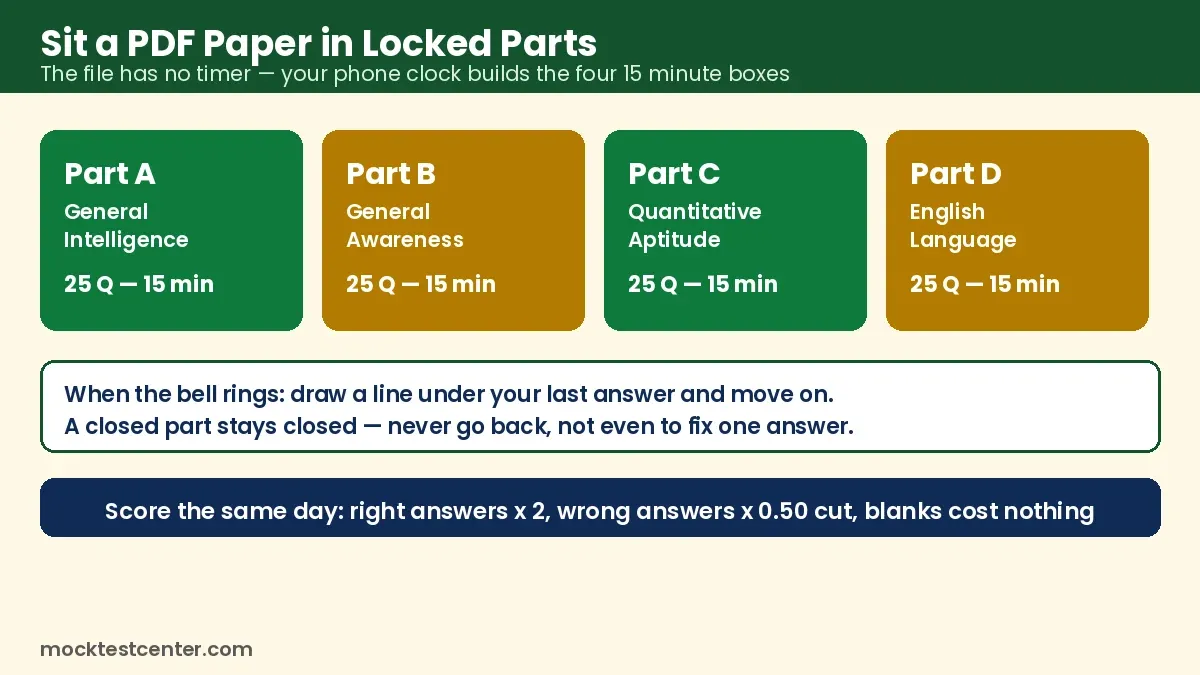
Each paper holds 100 questions for 200 marks in 60 minutes. Four parts hold 25 questions and 50 marks each: Part A General Intelligence, Part B General Awareness, Part C Quantitative Aptitude and Part D English Language. Each part runs on its own timer of 15 minutes. Each right answer pays 2 marks, and each wrong answer cuts 0.50 marks.
The Phase-XIV exam ran from 16 September 2026 to 26 September 2026, and SSC put the tentative answer keys up on 09 October 2026, with the challenge window closing on 12 October 2026. The least marks to qualify in that paper were 30 percent for UR, 25 percent for OBC and EWS, and 20 percent for all other categories. Phase-XIII, one cycle before, had higher floors of 35, 30 and 25 percent, so the key and the rules of a file belong to its own phase and no other.
After the paper there is no interview. SSC shortlists candidates post category by post category for scrutiny, in the ratio of 1:30 where a post category holds up to 5 vacancies and 1:15 where it holds more than 5, with a floor of 150 candidates. The User Department checks the documents. None of that changes the files, but it tells you why a real score matters: each post category keeps its own cut off.
One thing must stay plain. The Selection Post 2027 cycle, Phase-XV, has no notice yet, and SSC has printed no date for it as of 25 November 2026. A notice in 2027 is expected on the rhythm of past years, and the 2027 pattern is expected to follow the Phase-XIV pattern until SSC prints a new notice. The Phase-XIV final result and post wise cut offs were still awaited in late November 2026.
| Fact | Detail |
|---|---|
| Exam | Selection Posts Examination, run by the Staff Selection Commission |
| Latest notice | Advertisement No. Phase-XIV/2026/Selection Posts, dated 13 April 2026 on ssc.gov.in |
| Vacancies, Phase-XIV | 3,003 vacancies across 382 post categories and 9 SSC regions |
| Apply dates, Phase-XIV | 13 April 2026 to 04 May 2026; fee Rs 100 for each post category |
| Paper shape | 100 questions, 200 marks, 60 minutes, 4 parts of 25 questions and 50 marks |
| Part timers | Each part runs on its own timer of 15 minutes |
| Negative marking | 0.50 marks cut for each wrong answer; no cut for a blank answer |
| Exam dates, Phase-XIV | 16 September 2026 to 26 September 2026 |
| Tentative keys, Phase-XIV | Uploaded 09 October 2026; challenge window closed 12 October 2026; objection Rs 50 per question |
| Least marks to qualify, Phase-XIV | UR 30 percent, OBC and EWS 25 percent, all other categories 20 percent |
| Paper shelf | Real papers for every phase, Phase VI 2018 to Phase XIV 2026, Hindi and English, all three levels |
| After the paper | Scrutiny shortlist 1:30 up to 5 vacancies and 1:15 above 5, floor of 150; no interview; User Department checks documents |
| 2027 cycle | Phase-XV notice not released as of 25 November 2026; a notice in 2027 is expected, with no date printed by SSC |
| Official website | ssc.gov.in |
What This Page Covers
- The shelf: real papers for every phase
- Where to get the real files, step by step
- The two minute check for a real file
- Fake file families to throw away
- File naming and folder habits that save hours
- Sit a PDF paper in locked parts of 15 minutes
- Score with the final key, not the first key
- Pick the paper of your own level
- Your next step this week
The Shelf: Real Papers for Every Phase
Some exams on this site hold no written paper at all, so their file shelf stands empty and the page has to say so. Selection Post stands at the far end from that case. SSC has held this exam phase after phase, in many shifts, in Hindi and in English, at three levels, and the papers of those shifts fill a long shelf. A candidate who wants real files will never run out of them.
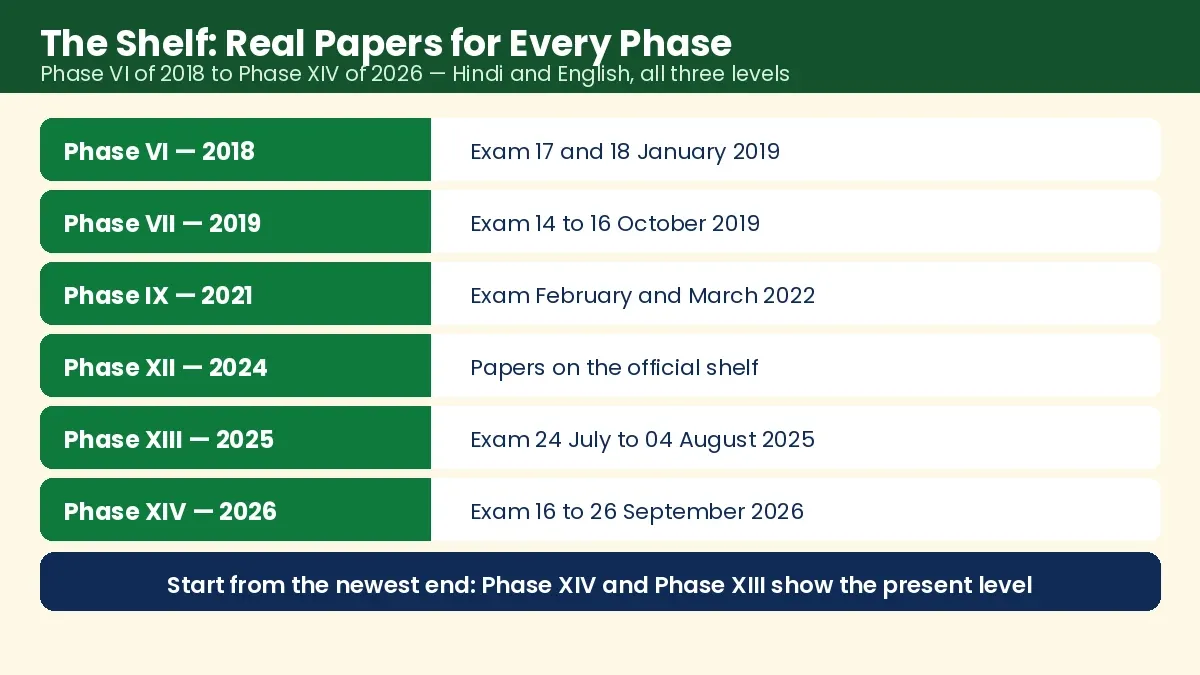
The shelf runs like this, phase by phase. Phase VI of 2018 held its exam on 17 and 18 January 2019. Phase VII of 2019 held its exam from 14 to 16 October 2019. Phase IX of 2021 held its exam in February and March 2022. Phase XII came in 2024. Phase XIII of 2025 held its exam from 24 July 2025 to 04 August 2025, under a notice dated 02 June 2025 with 2,423 vacancies across about 365 post categories. Phase XIV of 2026 held its exam from 16 September 2026 to 26 September 2026.
Each phase on that shelf holds papers at all three levels, and each level paper holds its own shifts. On an exam day in past phases, the Matriculation level often ran in an early shift, the Higher Secondary level in the middle shift, and the Graduation level in a later shift. So one exam date can hold three files with the same date and three level names, and all three can be real. The date alone never tells you whose paper you hold. The level name does.
Why does the shelf matter so much for this exam? Because the post list is huge and the crowd for each post is small and split. A Laboratory Attendant post and a Junior Engineer post sit in the same notice, but their crowds never meet, and each post category keeps its own cut off at the end. Only a real paper shows you the true level of words and the true mix of chapters at once.
Use this tab as the file room and the previous year paper tests as the sitting room. The files here suit print sittings and desk work with a pen. The test series suits timed sittings on a screen. Both stand on the same real papers, and a strong week uses both: one file sitting with a pen, one screen sitting with a clock.
Start from the newest end of the shelf. Phase XIV and Phase XIII papers show the present level, the present floors and the present part timer habit, since both cycles ran the same 100 question, 200 mark, 60 minute shape. Older phases still earn their place for chapter hunting and for volume.
Where to Get the Real Files, Step by Step
Two doors lead to real files, and both are safe. The first door is the official site itself. SSC puts question papers and final answer keys on ssc.gov.in after each cycle, and a file that comes from that site carries the Commission own stamp of truth. The second door is this tab, the SSC Selection Post PYQ PDF tab, where the papers sit sorted by phase and level so you can pick a file in seconds.
On the official site, walk in this order.
- Open ssc.gov.in and go to the area that holds answer keys and question papers of past exams.
- Find the Selection Posts entry for the phase you want, and read the phase number twice before you touch any link.
- Pick your level next: Matriculation, Higher Secondary, or Graduation and above. A file of the wrong level is a wasted evening, however real it is.
- Pick the exam date and the shift. Note both on a slip of paper before the download starts.
- Download the question paper and the final answer key as a pair. A paper with no key is a story with no end, and you will score it on a guess key from some group.
- Save the pair in your phase folder at once, with the naming habit from the folder section of this page, before you open any other file.
On this tab, the walk is shorter. Pick the phase, pick the level, pick the shift file, and take the key file that stands with it. The sorting work is done for you, and the files here suit a print sitting at a desk or a study table in a hostel room. A boy in a village near Arrah told us he prints one paper each Sunday at the shop near the bus stand and solves it on the roof after lunch. His shelf grows by one real paper a week, and his register grows with it.
One habit guards both doors. Download few files at a time. A folder stuffed with 90 papers in one night feels rich and reads poor, because no human sits 90 papers. Take 4 files for the week, sit them well, and come back for more. The shelf will still be there, and a small shelf sat well beats a full hard disk only scrolled.
And keep the medium fixed while you download. Papers come in Hindi and in English, and SSC sets both from one paper. Pick the medium you will sit in for the real exam and take your files in that medium, so your reading speed grows in the words you will face in the hall.
The Two Minute Check for a Real File
Files travel fast on phone groups, and a file name can lie with a straight face. Before any downloaded paper earns a sitting, give it the two minute check. Four things must line up inside the file itself, and the check takes less time than a cup of tea going cold.
The Two Minute Real File Check: Four Steps
First, the phase number. A real paper names its phase and year on the paper itself, in the head lines SSC prints. If the head lines name a phase that clashes with the file name on your phone, trust the paper and drop the file name. Second, the level name. The same head lines name the level, and the level must match the level you applied for.
Third, the exam date and shift. The date must fall inside the exam dates of that phase: Phase XIV files must carry a date from 16 September 2026 to 26 September 2026, and Phase XIII files a date from 24 July 2025 to 04 August 2025. A file dated outside its own phase window is a fake or a wrong label, and both earn the same fate. Fourth, the key. The key file that stands with the paper must be the final key, the fixed key SSC puts out with the result side of the cycle. A tentative key can hold one or two answers that SSC later fixed, and the key section below shows what that costs.
Run the check out loud the first few times, the way a shopkeeper counts notes. Phase, level, date and shift, key. Four words, two minutes. A girl in Patna learned the check after one bad month: she had sat three files that turned out to be papers of the level above hers, scored low on all three, and lost faith in her own maths for weeks. Her maths was fine. Her files were wrong. The check now opens every download at her desk, and her register has climbed since.
What if a file passes three checks and fails one? Drop it for sitting work. You can keep a doubtful file for chapter hunting if the questions look right, but never score yourself on it and never write its score in the register. A register line built on a doubtful file bends your whole plan.
Fake File Families to Throw Away
Fake files come in families, and once you know the family faces, you spot them in seconds. We see the same four families every cycle, passed hand to hand in groups with proud names on the file and weak truth inside it.
Family one: the renamed paper of another exam. A CGL paper or a GD paper gets a new file name that says Selection Post, and the name change fools the eye till the questions start. The head lines inside still name the old exam, or the paper shape gives it away, with marks and part names that sit wrong for a Selection Post file. The two minute check kills this family at step one, because the phase number inside the paper will name no Selection Post phase at all.
Family two: the memory based file sold as an official paper. After each exam day, some candidates write down the questions they recall, and coaching hands type them up. Such a file can help you smell the level of a fresh phase in the first week. But recall drops questions, bends words and swaps options, and a file built on recall will carry recall faults in the key as well. When a seller takes money for such a file and calls it official, close the chat. Official papers come free from SSC, and a paid memory file is a guess with a price tag.
Family three: the paper of the wrong level, shared with love. An elder brother sends his Graduation level file to a younger sister who applied at the Matriculation level, and she sits it in good faith and scores 61 and cries at the table. The file was real. The level was wrong. Check the level name before the first question, every time.
Family four: the right paper with the wrong key. The paper is real, the shift is real, and the key that travels with it is the tentative key from the first week, or worse, a key some group made on its own. You score 132 by that key and 126 by the final key, and the 6 mark gap sends you hunting for faults in chapters you never got wrong. Keys are half the file. A paper with a weak key is a weak file.
A real SSC paper file looks plain: the Commission head lines, the roll and name boxes of the exam page, clean print. A file stamped with a coaching name on page after page, or wrapped in shop banners and price lines, came from a shop shelf. Shops can pass real files too, but the stamp tells you the file took a long road to reach you, and long roads bend facts. When the same paper stands free on ssc.gov.in and sorted on this tab, the long road has no prize at its end.
Keep the rule short enough to say while the file loads. Real phase, real level, real date, final key. If one leg fails, the file falls.
File Naming and Folder Habits That Save Hours
A month into study, most candidates hold a downloads folder that looks like a flood hit it: paper1, paper final, paper final new, and forty files with names made of numbers. Hunting through that flood eats the first ten minutes of every sitting, and ten minutes is two thirds of a part timer. A plain naming habit, set on day one, pays you back every single week.
Name each file the same way, in this order: phase, level, date, shift, and the word key when the file is a key. A name like Phase14 Graduation 20Sep Shift2 tells you the whole story at a look, and a name like Phase13 Matriculation 28Jul Shift1 Key can never be mixed with its paper. Keep the words short and the order fixed.
Folders follow the same plain law. One folder for each phase. Inside it, one folder for each level you applied for, and no level folder you have no use for. Inside the level folder, paper and key sit side by side in date order.
- One phase folder per cycle, named with the phase and year.
- Level folders inside it, only for the levels you applied for.
- Paper and key saved as a pair, on the same day, in the same folder.
- A small text file or notebook line for each sitting: date sat, score, wrong count.
- A weekly clean up of ten minutes, where doubtful files leave the shelf for good.
A candidate in Kanpur held 63 files in one flat folder in his first month. He spent one Sunday noon building the phase and level folders and renaming each file by the law above. The work took 40 minutes. The next week, his sitting start time fell from twelve minutes of hunting to under one minute, and the saved time bought him one extra sectional test sitting. Small habits buy tests. Tests buy marks.
Keep one more folder, and guard it well: the sat folder. When you finish a paper and score it, move its file pair into the sat folder with the score added at the end of the name. Your fresh shelf then shows only unsat papers, which is what the last weeks of study need. A paper sat twice reads soft, because memory does half the work and the score lies with a smile.
Sit a PDF Paper in Locked Parts of 15 Minutes
A PDF file has no timer. Your phone clock and your own will must build the timer the real exam now builds for you, because the Phase-XIV paper runs each part on its own 15 minute clock and a closed part stays closed. A PDF sitting with one free hour teaches a habit the hall will punish. A PDF sitting in four locked parts teaches the habit the hall pays for.
Set the sitting up in this order, every time.
- Print the paper or open the file on a tablet, and keep the key file shut in another folder till the sitting ends.
- Mark the four part borders on the paper with a pen: questions 1 to 25, 26 to 50, 51 to 75 and 76 to 100.
- Set a timer for 15 minutes. Sit Part A. When the bell rings, draw a line under your last answer, even if five questions stand blank.
- Reset the timer and sit Part B the same way, then Part C, then Part D. Never go back to a closed part, even to fix an answer you now see was wrong.
- Star every guessed answer as you mark it, with a small pen star in the margin.
- When the fourth bell rings, close the paper. Open the key and score the sitting part by part.
Inside one part, work in two passes. Pass one takes the questions you can finish fast and sure. Pass two takes the rest with the time left. In Part B, a question you know pays its 2 marks in ten seconds, and a question you half know can eat two minutes and still pay nothing but the 0.50 cut when the guess lands wrong. Fast and sure first is the whole law of the 15 minute box, and a PDF sitting is where you drill that law.
Score the sitting the hard way, on the same day. Count right answers part by part and multiply by 2. Count wrong answers part by part and multiply by 0.50. Take the cut away from the earned marks and write three numbers in your register: the total, the wrong count and the blank count, with the phase, level, date and shift of the file beside them. Work one case with me. Say your Part C shows 16 right and 5 wrong, with 4 blank. Earned marks: 32. Cut: 2.5. Part score: 29.5 out of 50. A candidate who skips the cut writes 32 in the register and builds next week on a lie he told himself.
Then feed the sitting back into your week. Chapters that filled your wrong list go into the chapter tests the same week. A part that keeps falling behind its brothers gets a week of sectional tests in that part alone. News gaps in Part B go to the current affairs tests, and static gaps go to the NCERT tests. And once a week, sit a full screen paper from the full mock tests, so your PDF habit and your screen habit grow side by side.
Three sittings a week, done this full way, beat seven sittings done soft. A locked PDF sitting takes 60 minutes to sit and about 40 minutes to score and note well. Guard the 40 minutes. The scoring and the noting are where the next week gets built.
Score With the Final Key, Not the First Key
SSC runs its keys in stages, and a file is only as good as the stage its key comes from. Stage one is the tentative key, put up with the response sheets of candidates. For Phase-XIV, that upload came on 09 October 2026, and the challenge window closed on 12 October 2026. Tentative means open to challenge. An objection costs Rs 50 per question, so ten objections cost Rs 500, and wise candidates object only where a book or an official line backs them.
Stage two is the final key. SSC reads the objections, fixes the answers where the proof stands, and puts out the fixed key. That final key is the only fair base for scoring a practice file. One or two answers can change between the two stages, and each changed answer swings your score by 2.5 marks once you count the wrong answer cut on the old line. Two changed answers can swing a register line by 5 marks.
So hold every key file to the same test as its paper. The key name in your folder must say which stage it is, and a key with no stage in its name gets checked before it scores anything. Where did it come from? When was it put out? If the answers to those two questions stay foggy, score the sitting by the key on this tab or on ssc.gov.in and let the foggy file go.
One more stage sits behind the keys and shapes how you read every score: normalisation. The exam runs in many shifts across many days, and no two shifts hold the same level, so SSC balances scores across shifts before it shortlists. Your raw score on a file is a level mark for that shift. Read it as a level mark, never as a rank, and judge your growth across four or five files of mixed shifts, where the hard and easy days balance out in your own hand.
Keep the floors in view while you score, since they changed between cycles and old files carry old floors. Phase-XIII asked 35 percent of UR, 30 percent of OBC and EWS, and 25 percent of the rest. Phase-XIV lowered the floors to 30, 25 and 20 percent. When you sit a Phase-XIII file, its own floors judge it. Mixing the floors of two phases in one register makes both lines mean less.
Pick the Paper of Your Own Level
The shelf holds three levels, and your two hands should take files from your own level first, second and almost always. The three papers of one phase share the same shape, 100 questions and 200 marks, but the depth of the ask climbs with the level. Matriculation papers lean on the Class 6 to 10 base. Graduation papers pull polity, economy and maths a step deeper, and their English asks more of the reader.
A candidate fit for two levels gives two papers, holds two cut offs, and can pass the scrutiny line in one post family and miss it in the other. If that candidate is you, keep two shelves, two registers and two score lines, and never let a strong Graduation score hide a weak Higher Secondary week. Each level pays its own posts. Each level starves on its own gaps.
Can a lower level candidate sit a higher level file now and then, for reach? Yes, once a month, as a stretch sitting, marked plain in the register as a stretch. The score of a stretch sitting never enters your main line. It tells you where the ceiling sits, and a ceiling check has worth. A weekly diet of stretch files has none, since it trains depth you will not be asked for while your own level chapters sit half read. The school books behind the lower levels stand free on ncert.nic.in, and they repay reading far sooner than a shelf of higher level files does.
Your Next Step This Week
Here is the week plan, and it fits on one page of your diary. On day one, build the phase and level folders and download four files: two from Phase XIV, one from Phase XIII, and one from any older phase your weak chapters point to. Run the two minute check on each file as it lands. On day two, sit the first Phase XIV file in four locked parts of 15 minutes and score it by the final key the same evening.
On day four, sit the second file the same way, and give the chapters that hurt you a round of chapter tests between the two sittings. On day six, sit the Phase XIII file and write its line in the register under its own floors. On day seven, read the week register once, slowly, and pick next week four files from what the numbers say, not from what your mood says.
Watch for the 2027 door to open as you work. The Latest Jobs page on this site will carry the Phase-XV notice the day SSC prints it, and the official word will stand on ssc.gov.in itself. Till that day comes, the shelf from Phase VI to Phase XIV is your ground. Start with one real file, checked in two minutes and sat in four locked parts. A plan that starts with one honest sitting tonight beats a grand plan that starts next month.