
About RRB ALP (Assistant Loco Pilot) Chapter Tests
- 1.RRB ALP Chapter Tests: Key Facts First
- 2.The Same Day Chapter Loop, and Why It Works
- 3.Maths Chapters, From Number System to Pipes and Cistern
- 4.Mental Ability Chapters You Must Not Skip
- 5.General Science Chapters From Class 9 and 10 Books
- 6.Basic Science and Engineering, Topic by Topic
- 7.Part B Trade Chapters, Trade by Trade
- 8.When a Chapter Score Falls Under Half
- 9.A Sample Week That Mixes Chapters of Two Stages
Quick Answer: A RRB ALP Chapter Wise Test checks one chapter at a time, on the same day you read that chapter. Under CEN 01/2026, CBT 1 holds 75 questions for 75 marks in 60 minutes from Mathematics, Mental Ability and General Science, and CBT 2 Part A holds 100 questions in 90 minutes with Basic Science and Engineering added. This page maps every chapter from the CEN syllabus lists, shows the same day loop that makes a chapter stay in your head, and tells you what to do when a chapter score falls under half.
RRB ALP Chapter Tests: Key Facts First
Start with the cycle that counts now. The Railway Recruitment Boards run this exam for the post of Assistant Loco Pilot, and the latest notice is CEN 01/2026. The detailed notice came on 14 May 2026, and forms ran from 15 May 2026 to 14 June 2026 on the official portal at rrbapply.gov.in. The notice holds 11,127 posts. About 8,40,944 candidates applied, so each post drew a long line of rivals.
Age sits at 18 to 30 years as on 01 July 2026. A candidate needs Matriculation plus ITI in a named trade, or Matriculation plus Course Completed Act Apprenticeship, or Matriculation plus a diploma or degree in Mechanical, Electrical, Electronics or Automobile work. Pay starts at Level 2 with initial pay of Rs 19,900 plus allowances. You can check the board side of the exam on indianrailways.gov.in and on rrbcdg.gov.in.
Read the pattern change twice. General Awareness has left CBT 1 in CEN 01/2026. Old books still print it, and old papers still hold it, but the new CBT 1 paper holds only three subjects. CBT 1 took place from 3 to 5 November 2026 for this cycle.
Each wrong answer cuts 1/3 of a mark in CBT 1 and in both parts of CBT 2. Three wrong answers eat one right answer. A blank answer cuts nothing. Chapter tests teach you where that cut comes from, chapter by chapter, long before a full paper shows you the total damage.
Final merit now takes 50 percent from CBT 2 Part A and 50 percent from the CBAT. That split changed from the old 70 and 30 split. A chapter plan that only looks at CBT 1 misses half the story, so this page covers both stages and the trade paper too.
| Fact | Detail |
|---|---|
| Latest notice | CEN 01/2026, detailed notice 14 May 2026, forms 15 May 2026 to 14 June 2026 |
| Posts | 11,127 posts; UR 4,860, OBC 2,598, SC 1,746, ST 919, EWS 1,004 |
| Age | 18 to 30 years as on 01 July 2026 |
| Study need | Matriculation plus ITI, or Act Apprenticeship, or diploma or degree in Mechanical, Electrical, Electronics, Automobile |
| CBT 1 | 75 questions, 75 marks, 60 minutes; Mathematics, Mental Ability, General Science |
| CBT 1 pass floors | UR and EWS 40 percent, OBC and SC 30 percent, ST 25 percent |
| CBT 2 Part A | 100 questions, 100 marks, 90 minutes; Mathematics, General Intelligence and Reasoning, Basic Science and Engineering |
| CBT 2 Part B | 75 questions, 60 minutes, trade paper; 35 percent to qualify for every category |
| Wrong answer cut | 1/3 mark in CBT 1 and CBT 2; no cut for a blank answer |
| CBAT | T-score of 42 or more in each test battery; no minus marking |
| Final merit | 50 percent Part A plus 50 percent CBAT |
| Pay | Level 2, initial pay Rs 19,900 plus allowances |
What This Page Covers
- The same day chapter loop, and why it works
- Maths chapters, from Number System to Pipes and Cistern
- Mental Ability chapters you must not skip
- General Science chapters from Class 9 and 10 books
- Basic Science and Engineering, topic by topic
- Part B trade chapters, trade by trade
- When a chapter score falls under half
- A sample week that mixes chapters of two stages
The Same Day Chapter Loop, and Why It Works
We see the same habit every year. A candidate reads a chapter on Monday, likes the feel of it, and plans to test it on Sunday. Sunday comes with three more chapters on top, and the Monday chapter has gone soft at the edges. He scores low, blames his memory, and reads the chapter again from page one. Time dies in that circle.
The loop on this page cuts the circle at one point. Read the chapter. Give its test the same day. Note the errors that night. Retest the same chapter after 7 days.
Four steps. One chapter. No waiting for Sunday.
Take a real study day from Patna. Ravi, an ITI Fitter candidate, reads Percentage in the morning from 7 to 9. He eats, rests, and sits the RRB ALP Chapter Wise Test for Percentage at 4 in the evening, while the morning lines still sit fresh in his head. His score tells the truth about that one chapter and no other. A low score here points at one book and one set of pages. A low score in a full paper points at twenty places at once, and a tired mind picks the wrong one to fix first.
Why does the same day part matter so much? A chapter test on the same day checks if you can use the rule, not if you can recall the page. Reading gives you the rule in the book order. A test shuffles the order, hides the chapter name inside a train sum or a shop sum, and asks you to pick the rule yourself. That picking is the exam skill. CBT 1 gives you 75 questions in 60 minutes, so you get 48 seconds per question. Nobody picks a rule slowly at that pace.
Keep the test short and the check long. A chapter test may take 15 or 20 minutes. The check after it should take 30. Write each wrong answer in your error notebook with the chapter name, the cause in one word, and the right method in one line. Ravi wrote 6 lines for Percentage. Two lines said Method, because he knew the rule but took the long road. Three said Concept. One said Careless, because he read 40 as 4 in a rush.
Those 6 lines set his next 7 days. Concept errors sent him back to the book for one hour. Method errors sent him to timed drill. The Careless line cost him nothing but care, and it still went in the book, because a careless error in Percentage will come back in Profit and Loss if nobody names it.
The 7 day retest closes the loop. Give the same chapter again after a week, with fresh questions if you can. A score that jumps and stays high means the chapter has moved into long term hold. A score that jumps on day one and falls by day seven means you held the page, not the rule. That chapter goes back into the loop once more, with a shorter gap this time.
Use the other tabs as the loop grows. Once two or three chapters of one subject sit strong, pull them together in the sectional tests for that subject. Once a full subject feels steady, sit a paper from the previous year papers and watch how the chapters mix. And keep one eye on the full mock tests for the last stage, when the loop has covered most chapters at least twice. Chapter work comes first in the year. Full papers come first in the last month. Mixing those two orders up is a quiet way to waste both.
One more rule from our desk. Do not read a new chapter on a day when an old chapter waits for its 7 day retest and you have not given it. Retest first, new chapter after. Old chapters decay. New chapters can wait a day with no loss at all.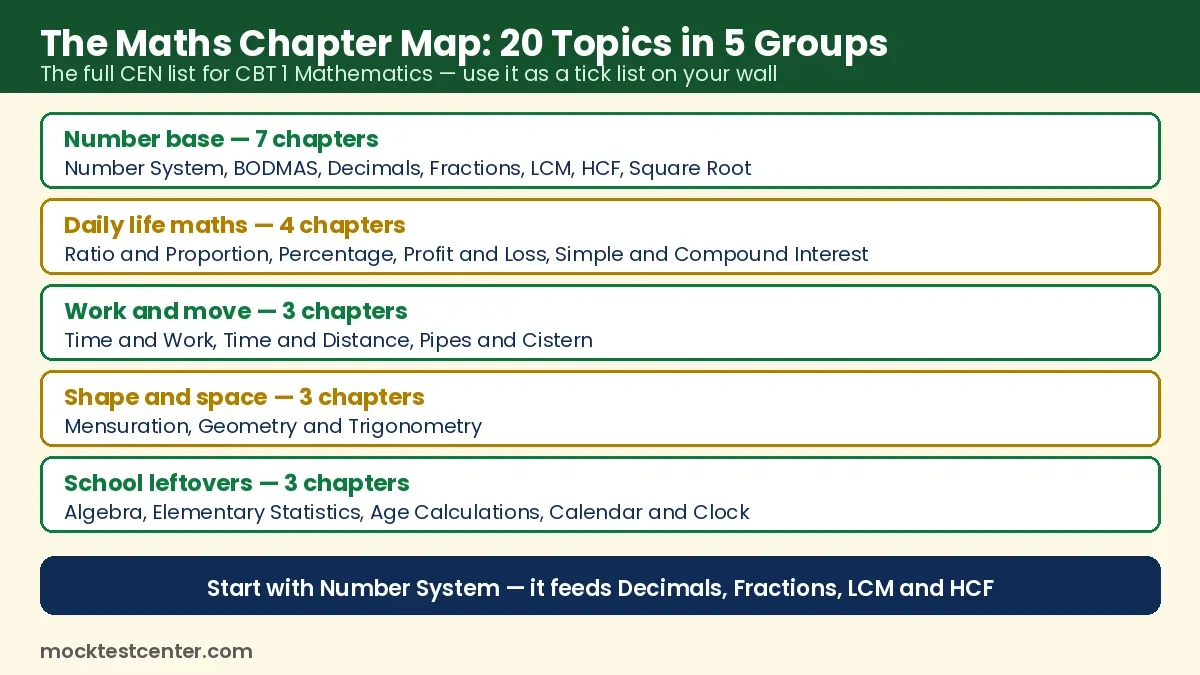
Maths Chapters, From Number System to Pipes and Cistern
The CEN list for CBT 1 Mathematics holds 20 named topics. Read that count again. Twenty. A candidate who says he has done maths and means only Percentage and Time and Work has done a small part of the list, and the paper will find the rest.
Here is the full map in the order most candidates meet the chapters in school books. Use it as a tick list on your wall.
| Group | Chapters in the CEN list | First move |
|---|---|---|
| Number base | Number System, BODMAS, Decimals, Fractions, LCM, HCF, Square Root | Start here; every later chapter uses these |
| Daily life maths | Ratio and Proportion, Percentage, Profit and Loss, Simple and Compound Interest | Test each chapter the same day you read it |
| Work and move | Time and Work, Time and Distance, Pipes and Cistern | Draw the work or the road on paper first |
| Shape and space | Mensuration, Geometry and Trigonometry | Learn the shape facts by heart, then drill |
| School leftovers | Algebra, Elementary Statistics, Age Calculations, Calendar and Clock | Short chapters; finish them early and retest late |
Number System looks easy and traps many. A girl in Gaya scored full marks in Percentage for a month and lost marks in her first full paper on Number System questions about unit digits and remainders, chapters she had skipped as too basic. Basic chapters carry easy marks. Easy marks lost hurt the most, because your rivals pick them up.
Give each maths chapter two passes in your RRB ALP Chapter Wise Test plan. Pass one is the same day test. Pass two is the 7 day retest. A chapter like Mensuration may need a third pass, because it holds many shape facts and one forgotten fact kills one full question. Trigonometry asks for the same care. Learn the table values cold, then test, then test again after a week.
Watch the link chapters. Percentage feeds Profit and Loss. Profit and Loss feeds Simple and Compound Interest in many mixed sets. Time and Work feeds Pipes and Cistern, which is work with taps in place of men. If your Pipes and Cistern score stays low while Time and Work sits high, your base is fine and your reading of tap words is the fault. That is a Method error, and 2 days of slow reading drill fixes it faster than a full reread.
Part A of CBT 2 uses the same maths families at a deeper level. So a chapter you close well for CBT 1 pays you twice. Keep your maths notebook from the CBT 1 months. You will open it again for Part A, and the error lines you wrote early will save you a week later.
Candidates who also sit other railway exams can carry this map across. The maths families on the RRB NTPC full tests and the RRB Group D tests overlap a lot with this list, so one honest chapter map serves more than one form. But keep the ALP clock and the ALP cut in your head when you practise here, because 1/3 is the cut that will judge you on ALP day.
Mental Ability Chapters You Must Not Skip
Mental Ability in CBT 1 and General Intelligence and Reasoning in Part A share one family. The CEN list names Analogies, Alphabetical and Number Series, Coding and Decoding, Mathematical Operations, Relationships, Syllogism, Jumbling, Venn Diagram, Data Interpretation and Sufficiency, Conclusions and Decision Making, Similarities and Differences, Analytical Reasoning, Classification, Directions, and Statement, Arguments and Assumptions.
That list is long. It also splits into two kinds, and the split should set your study order.
- Fast mark chapters: Analogies, Classification, Coding and Decoding, Directions, Relationships. Rules are short, and drill pays fast.
- Slow mark chapters: Syllogism, Statement, Arguments and Assumptions, Conclusions and Decision Making. You must read each line with care, and rush kills the mark.
- Chart chapters: Venn Diagram and Data Interpretation and Sufficiency. The picture or the table holds the answer, so your eye must learn where to look first.
- Series chapters: Alphabetical and Number Series and Jumbling. Pattern sense grows with daily short drill, not with one long sitting.
Give series chapters a daily slot of 10 minutes, even on days when your main chapter is maths or science. Series skill fades fast and grows slow. A boy in Muzaffarpur kept a small notebook of series patterns he had missed, page by page, and read it on the bus. Silly trick, he said. His series score rose all the same.
Syllogism needs a drawing habit. Draw the circles. Every time. Candidates who solve syllogism in the head save 20 seconds and lose the mark when two statements cross. At 48 seconds per question in CBT 1, a drawn answer in 50 seconds beats a guessed answer in 20, because the guess pays the 1/3 cut one time in three on pure chance, and more often when the options are built to trap a fast eye.
Statement chapters need a language habit. Read the statement once for the fact and once for the trap word. Words like only, always and never change the whole answer. Your chapter test for Statement, Arguments and Assumptions should be untimed the first time. Learn the shape first. Add the clock on the retest.
Data Interpretation sets punish candidates who start with the question. Look at the table first for 10 seconds. Note the units, the years and the totals. Then read the question. That small order change lifted many scores in our past batches, and it costs nothing but a habit.
When a reasoning chapter stays weak after two loops, do not push a third loop in the same week. Park it, finish a strong chapter, and come back after 4 or 5 days. Reasoning blocks often clear after a gap, because the mind keeps working on the pattern while you study other things. Parked is not dropped. Write the return date in the notebook the day you park it.
General Science Chapters From Class 9 and 10 Books
General Science in CBT 1 means Physics, Chemistry and Life Sciences at Class 10 level. The base books sit free on ncert.nic.in, and the NCERT tests on this site follow those same books chapter by chapter. Start there before you buy any thick guide.
Physics chapters to map first are Light, Electricity, Magnetic Effects of Electric Current, Motion, Force and Laws of Motion, Work and Energy, Sound, and Gravitation. Chemistry asks for Chemical Reactions and Equations, Acids Bases and Salts, Metals and Non Metals, Carbon and Its Compounds, and the Periodic Table chapter. Life Sciences covers Life Processes, Control and Coordination, How Do Organisms Reproduce, Heredity, Our Environment, and parts of Natural Resources.
Read that map with a teacher eye. One line in a Class 10 book often turns into one direct question. The colour of a salt, the unit of a quantity, the name of a hormone. Such questions take 15 seconds if you read the line and 48 seconds of pain if you did not. Chapter tests catch those lines while the book is still open on your desk.
A sample from Bhagalpur stays with me. Sunita read the Electricity chapter on a Monday morning and gave its chapter test that evening. She missed 4 questions, and all 4 came from one page about series and parallel circuits. One page. She reread that page on Tuesday, retested on the next Monday, and missed none. Without the same day test, that weak page would have hidden inside a full chapter score that looked fine.
Science chapters split by memory load. Carbon and Its Compounds and Metals and Non Metals hold long fact lists, so give them a written fact page of your own and test in two parts. Life Processes holds process steps, so draw the steps once, then test. Light holds ray diagrams, so draw each diagram by hand at least twice before you call the chapter done. A test score on a drawing chapter means little if your hand has never drawn the figure.
Do not study science only by reading. Read one part, close the book, say the facts aloud in your own words, then test. Saying the facts aloud feels slow. It finds gaps that silent reading hides, because your tongue stops at the exact line your eye jumped over.
And keep the science notebook apart from the maths notebook. Science errors are mostly Concept and fact gaps, so the fix is a page number to reread. Maths errors are often Method errors, so the fix is a shorter road. One notebook for both blurs that split and slows the fix.
The Same Day Chapter Loop: Four Steps That Hold a Chapter
One honest word about the Current Affairs tab belongs here. General Awareness and Current Affairs have left the ALP CBT 1 paper under CEN 01/2026, so daily news hours do not pay in this exam the way they did in older cycles. The current affairs tests still pay if you also sit NTPC or Group D, where general awareness carries big marks. Split your hours by the paper in front of you. For ALP alone, science chapters beat news hours, week after week.
Basic Science and Engineering, Topic by Topic
This is the section candidates meet late and fear most, so this page gives it the most room. Basic Science and Engineering sits only in CBT 2 Part A, with Mathematics and General Intelligence and Reasoning. Part A holds 100 questions for 100 marks in 90 minutes, and its pass floors are the same as CBT 1: 40 percent for UR and EWS, 30 percent for OBC and SC, and 25 percent for ST. Part A marks also form half of your final merit, with CBAT as the other half. A weak Basic Science score cuts your merit twice, once in the floor check and once in the merit sum.
The CEN list names these topics: Engineering Drawing with projections, views, drawing instruments, lines, geometric figures and symbolic representation; Units; Measurements; Mass Weight and Density; Work Power and Energy; Speed and Velocity; Heat and Temperature; Basic Electricity; Levers and Simple Machines; Occupational Safety and Health; Environment Education; and IT Literacy.
Twelve topic heads. Each one breaks into small chapters that a chapter test can hold on its own.
Start with Units and Measurements. This pair looks small and pays in every other topic, because a question on Work Power and Energy with the wrong unit reading is a lost mark in two topics at once. Learn the SI units for force, work, power, energy, pressure, current and voltage until you can write them half asleep. Test Units on day one of your Part A plan, even if you plan to study Drawing first. Units sit under the whole subject like a floor sits under a house.
Work Power and Energy and Speed and Velocity grow out of Class 9 Physics, so your CBT 1 science notes help here. The step up is the maths inside them. Part A questions ask you to work a sum with the fact, not just name the fact. So study these topics in pairs: read the science page in the morning and give a mixed chapter test with sums by evening. A pure fact test will flatter you. The real paper will not.
Basic Electricity rewards ITI candidates and still traps them. Your trade study covers circuits in depth, but the Part A paper asks school level electricity with neat, short sums. Candidates with deep trade skill lose marks here by taking the long road on a 54 second question. Practise the short road. Ohms law, series and parallel totals, power as voltage times current. Three roads, used again and again.
Levers and Simple Machines is a gift topic for a loco pilot candidate. You have seen levers at work since childhood, on a hand pump, on a crowbar, on a railway tool. Tie each machine name to a real tool you have held. Pulley, inclined plane, screw, wedge, wheel and axle. A picture in the mind holds longer than a line in a book, and this topic tests pictures as much as words.
Engineering Drawing scares book candidates and suits hand candidates. Projections and views ask you to see a solid block from the top, the front and the side. Draw with a pencil. Do not study Drawing by reading alone, because the paper tests your eye and your hand, and reading trains neither. Start Drawing early, two short sittings a week, because eye skill grows slow and panic grows fast when you start it in the last month. Drawing instruments, lines and geometric figures form the easy end of this topic, so bank those chapters first and let views and projections build on them.
Heat and Temperature holds a short fact list and a few scale sums. Mass Weight and Density holds the mass and weight split that traps many, plus density sums with water as the base case. Both topics fit in one week each for most candidates. Do not spend a month there while Drawing waits.
Occupational Safety and Health, Environment Education and IT Literacy read like soft topics, and soft topics get soft study. That is the trap. These three hold direct fact questions that a prepared candidate answers in 20 seconds. Safety signs, first aid steps, waste and pollution facts, basic computer words and parts. Read them in the last part of your plan if you must, but read them in full and test each one. A missed easy question in IT Literacy costs the same 1 mark as a missed hard sum in Mensuration, and it costs 1/3 more if you guess it wrong.
Plan the subject in this order. Units and Measurements first. Then Work Power and Energy with Speed and Velocity. Then Basic Electricity and Levers and Simple Machines. Then Heat and Temperature with Mass Weight and Density. Then Engineering Drawing in slow weekly parts across the whole plan. Then the three fact topics near the end, tested twice because fact lists fade.
Feed every weak topic here into the same loop as CBT 1 chapters. And when two or three topics sit strong, test them together through the RRB ALP sectional tests so the mix starts to feel like Part A. Candidates bound for the RRB JE tests or the RRB Technician tests will meet some of these topics again, but the ALP Part A level and clock stay your base here.
Keep one page in your notebook for this subject alone, headed with the 40, 30 and 25 percent floors. Below them, write your latest topic scores as parts of 100. A topic at 35 in a UR plan sits below the Part A floor line if the whole paper follows it, and that sight, in your own hand, moves study hours faster than any advice from us.
Part B Trade Chapters, Trade by Trade
Part B holds 75 questions in 60 minutes from your trade, on the syllabus of the Directorate General of Training. It only qualifies you. You need 35 percent, which is 26.25 marks, and the safe way to read that line is 27 sure answers with no guess damage. Every category faces the same 35 percent line. No lower floor for any group.
Gate, not goal. Read those words again. A candidate who chases 70 in Part B while Part A sits at 35 has the plan upside down, because Part A marks enter merit and Part B marks do not. But a candidate who ignores Part B and scores 34 percent goes home, merit or no merit. Chapter tests keep Part B at the right size: steady, covered, and safe above the gate.
The CEN names these ITI trades: Fitter, Electrician, Instrument Mechanic, Millwright and Maintenance Mechanic, Mechanic Radio and TV, Electronics Mechanic, Mechanic Motor Vehicle, Wireman, Tractor Mechanic, Armature and Coil Winder, Mechanic Diesel, Heat Engine, Turner, Machinist, and Refrigeration and Air Conditioning Mechanic. ITI and Act Apprentice candidates answer their own trade. Diploma and degree holders pick a trade mapped to their branch in the form.
Break your trade into chapters the way your ITI book breaks it. For Fitter, that means tools and fitting work, drilling, turning basics, limits and fits, and safety in the shop. For Electrician, wiring, circuits, motors, transformers and earthing form the big chapter heads. Mechanic Diesel splits into engine parts, fuel system, cooling, lubrication and fault finding. Electronics Mechanic splits into components, circuits, radio and TV basics, and digital basics. Wireman, Turner, Machinist and the rest each hold their own book chapters, and your trade book index is the best chapter map you own. Copy that index into your notebook and tick chapters off as the loop closes on each one.
Trade chapters in a RRB ALP Chapter Wise Test differ from school chapters in one way. Your hands know part of the trade already. A Fitter candidate has held the files and gauges his book names. Use that. When a chapter test asks about a tool you have held, picture the tool, not the page. When it asks about a step order in a job, walk the job in your mind at the bench. Hand memory is real memory, and trade papers reward it.
Give trade chapters a fixed weekly slot, two sittings a week across the plan, not a panic block at the end. Part B shares the CBT 2 sitting with Part A, in one sitting of 2 hours 30 minutes for 175 questions. A trade base built slowly will hold at the end of that long sitting. A trade base crammed in the last week fades by question 40 of Part B, when your mind is already tired from Part A.
Use the PYQ PDF files to check what old trade papers looked like, and keep the DGT syllabus as your map, since Part B follows it. If a chapter sits in your trade book and in the DGT list, it stays in your plan. If a seller book adds chapters the DGT list never names, let those chapters go.
When a Chapter Score Falls Under Half
Here is the rule we give every candidate who writes to us. A chapter score under half sends you back to the book. Not to a new test. To the book.
Under half means the base is not in place yet. More tests on a weak base teach you the test, not the chapter, and your score may rise on seen questions while the rule stays shaky. The next fresh paper will find the shake. We have watched that film many times.
Work the fix in steps.
- Open the error lines for that chapter and sort them by cause word. Count Concept, Method, Speed and Careless lines apart.
- If Concept lines lead, reread the chapter part that holds those errors. Read slow, with a pencil, and write the rule in your own words under each error line.
- If Method lines lead, keep the book shut. Drill 15 questions of that chapter with a clock and force the short road on each one.
- If Speed lines lead, your rule is fine and your hand is slow. Give timed sets of 10 questions until the pace fits the exam pace.
- If Careless lines lead, change the reading habit, not the book. Read each question twice, cover the options till you hold an answer in mind, then look.
- Retest the chapter after 2 days, not after 7. A weak chapter gets a short gap. A strong chapter earns the full week.
Two traps sit inside this rule. Trap one is shame. A candidate scores 4 of 10 in Calendar and Clock, feels small, and hides the chapter for a month. Small chapters grow teeth when hidden. Calendar and Clock holds few rules, and 2 honest days can close it for good. Trap two is pride. A candidate scores low in a chapter he likes, calls the test bad, and moves on. Tests do not need your love. Scores do not bend for pride.
Your error notebook from the paper work feeds this page too. When a previous year paper shows the same chapter name three times in one week, that chapter jumps the queue. It goes to the top of the chapter list, gets a book reread, and gets a chapter test within 2 days. Paper errors are orders. Treat them that way and the notebook starts to run your week better than any ready made plan.
Keep a simple mark in the notebook for each chapter: a tick for closed, a circle for open, a cross for under half. One glance on Sunday night shows the true state of your plan. No app needed. No chart needed. Just honest marks in your own hand.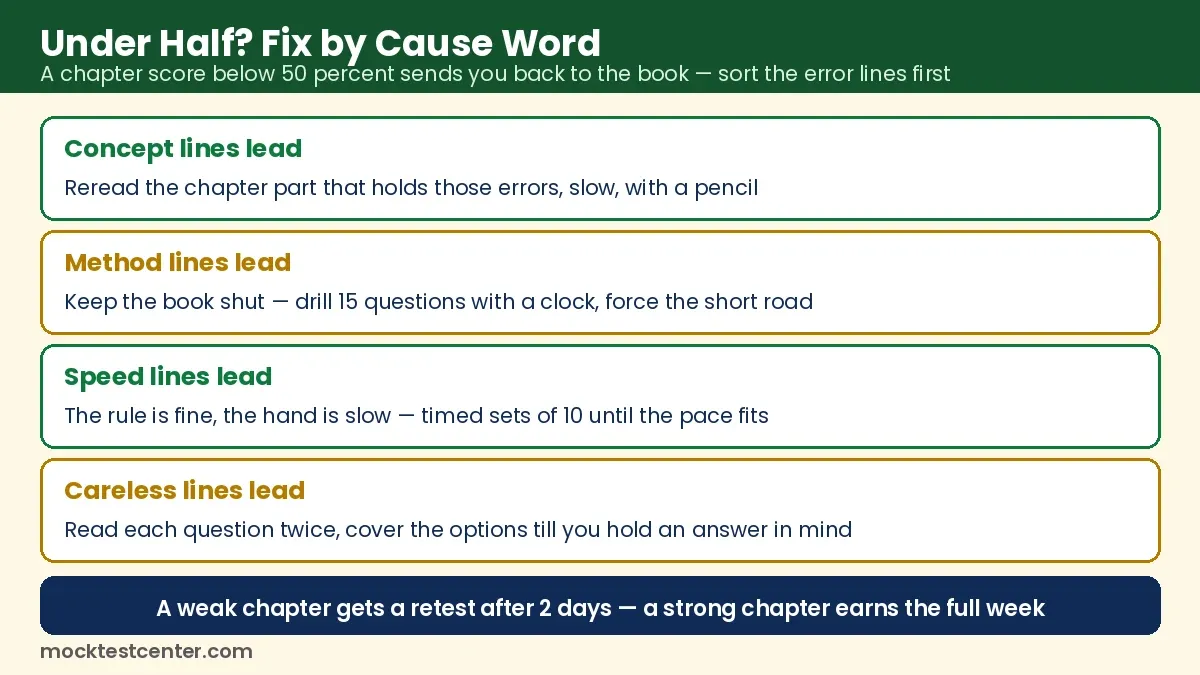
A Sample Week That Mixes Chapters of Two Stages
Close with a week you can copy. This plan mixes CBT 1 chapters with Part A and trade chapters, because most candidates now study for both stages in one run. It holds 6 study days and 1 light day. Adjust the chapter names to your weak list. Keep the shape.
| Day | Morning chapter | Evening test and check |
|---|---|---|
| Monday | Percentage (CBT 1 Maths) | Percentage chapter test, error lines, 10 minute series drill |
| Tuesday | Electricity (General Science) | Electricity test plus the 7 day retest of last Tuesday chapter |
| Wednesday | Units and Measurements (Part A) | Units test, then trade chapter reading for Fitter or your trade |
| Thursday | Syllogism (Mental Ability) | Syllogism test untimed first, error lines, trade chapter test |
| Friday | Time and Work (CBT 1 Maths) | Time and Work test plus the 7 day retest of Percentage |
| Saturday | Basic Electricity (Part A) | Basic Electricity test, notebook read back for the full week |
| Sunday | Light day: read error notebook only | One short mixed set or full rest; plan next week chapters |
Count what this week does. Six new chapters enter the loop. Two old chapters get their 7 day retest. One trade chapter gets read and one gets tested. The notebook gets a full read on Saturday and again on Sunday. No day holds more than one heavy new chapter, so each chapter gets a fair same day test while your mind still holds the morning work.
Swap the stage mix as your dates near. Far from CBT 1, a week like this one works well. In the last month before CBT 1, drop Part A chapters to one a week and give the freed days to CBT 1 retests and papers. After CBT 1, flip the mix: Part A and trade chapters lead, and CBT 1 chapters rest. The loop stays the same. Only the chapter list changes.
Your next step fits tonight. Pick the one chapter your last paper hurt most. Read it tomorrow morning, test it tomorrow evening through the chapter tests for RRB ALP, and write the retest date 7 days ahead in your notebook before you sleep. Check the Latest Jobs page once a week for board news, and keep the official word open on indianrailways.gov.in beside it. One chapter, closed well, beats five chapters read in a fog. Start with the one that hurt.







