
About RRB ALP (Assistant Loco Pilot) Previous Year Papers (PYQ)
- 1.RRB ALP Previous Year Papers: Key Facts First
- 2.Real ALP Papers Exist, and That Changes the Plan
- 3.How RRB Answer Keys Work, From First Key to Final Key
- 4.Solve a CBT 1 Paper in the True 60 Minute Shape
- 5.Score the Paper With the 1/3 Cut, Worked in Full
- 6.The Error Notebook That Pays You Back
- 7.Which Cycles to Solve First, and How to Rebuild Old Papers
- 8.CBT 2 Papers Train Depth, Part B Is a Gate, CBAT Has No Old Papers
- 9.Mistakes We See Every Year With Old Papers
- 10.Your Next Step This Week
Quick Answer: A RRB ALP Previous Year Question Paper is a real paper from a real Assistant Loco Pilot exam, and real papers do exist for this post. The Railway Recruitment Boards held ALP tests in 2018, in 2024, in 2025, and again for CBT 1 from 3 to 5 November 2026 under CEN 01/2026. This page shows you how to solve a CBT 1 paper in the true 60 minute shape, how to sit a full CBT 2 paper of 2 hours 30 minutes, how to score both with the 1/3 cut, and how to rebuild old papers to the new rules, because CEN 01/2026 took General Awareness out of CBT 1 and changed final merit to 50 percent Part A and 50 percent CBAT.
RRB ALP Previous Year Papers: Key Facts First
Start with the frame. RRB ALP means Assistant Loco Pilot, a post under the Railway Recruitment Boards of Indian Railways. The post sits at Level 2 of the 7th CPC, with first pay of Rs 19,900 plus allowances. The latest cycle is CEN 01/2026. You can read the official word on indianrailways.gov.in and on rrbcdg.gov.in, and the form portal is rrbapply.gov.in.
The detailed notice for CEN 01/2026 came on 14 May 2026. It carried 11,127 posts. Forms ran from 15 May 2026 to 14 June 2026. Age had to sit between 18 and 30 years as on 01 July 2026. About 8,40,944 candidates applied, which works out to near 75 candidates for each post. Secunderabad RRB alone held 1,420 posts, Ranchi held 1,300, and Mumbai held 1,193.
CBT 1 ran from 3 to 5 November 2026. The paper held 75 questions for 75 marks in 60 minutes. Subjects were Mathematics, Mental Ability, and General Science. Read that line twice. General Awareness has left CBT 1 in this cycle, and that one change breaks the way most old papers must be used.
CBT 2 runs in one sitting of 2 hours 30 minutes with 175 questions. Part A holds 100 questions in 90 minutes. Part B holds 75 trade questions in 60 minutes, and a candidate needs 35 percent in Part B to stay in the race. Each wrong answer cuts 1/3 mark in CBT 1 and in both parts of CBT 2. Three wrong answers eat one right answer. That maths runs this whole page.
After CBT 2 comes CBAT, the computer based aptitude test. A candidate needs a T-score of 42 or more in each test battery. Final merit now takes 50 percent of CBT 2 Part A marks and 50 percent of CBAT marks. Older cycles used 70 percent and 30 percent. The medical standard for this post is A-1, the top eye standard in the railways.
| Fact | Detail |
|---|---|
| Exam | RRB ALP, Assistant Loco Pilot, run by the Railway Recruitment Boards |
| Latest cycle | CEN 01/2026, detailed notice 14 May 2026 |
| Posts | 11,127 posts; UR 4,860, OBC 2,598, SC 1,746, ST 919, EWS 1,004 |
| Forms | 15 May 2026 to 14 June 2026 on rrbapply.gov.in; fee Rs 500, and Rs 250 for SC, ST, women and other listed groups |
| Age | 18 to 30 years as on 01 July 2026 |
| CBT 1 | 75 questions, 75 marks, 60 minutes; Mathematics, Mental Ability, General Science; held 3 to 5 November 2026 |
| Big change in CBT 1 | General Awareness and Current Affairs left CBT 1 in CEN 01/2026 |
| CBT 2 | One sitting, 2 hours 30 minutes; Part A 100 questions in 90 minutes; Part B 75 trade questions in 60 minutes |
| Part B gate | 35 percent for every category, which means 26.25 marks of 75 |
| Negative marking | 1/3 mark cut for each wrong answer in CBT 1 and CBT 2; no cut for a blank answer |
| CBAT | T-score of 42 or more in each battery; no negative marking |
| Final merit | 50 percent CBT 2 Part A plus 50 percent CBAT under CEN 01/2026; older cycles used 70 and 30 |
| Medical standard | A-1; distant vision 6/6, 6/6 without glasses, with fogging test |
| Real papers on record | 2018, 2024 and 2025 cycles, plus CBT 1 papers of November 2026 |
What This Page Covers
- Real ALP papers exist, and that changes the plan
- How RRB answer keys work, from first key to final key
- Solve a CBT 1 paper in the true 60 minute shape
- Score the paper with the 1/3 cut, worked in full
- The error notebook that pays you back
- Which cycles to solve first, and how to rebuild old papers
- CBT 2 papers train depth, Part B is a gate, CBAT has no old papers
- Mistakes we see every year with old papers
- Your next step this week
Real ALP Papers Exist, and That Changes the Plan
Some railway posts have thin paper records. ALP has a thick one. RRB held a big ALP and Technician exam under CEN 01/2018, with 26,502 posts for the two posts together. Then CEN 01/2024 carried 18,799 ALP posts, with CBT 1 in November 2024. CEN 01/2025 came with a notice on 11 April 2025 and 9,970 posts, a count that later rose to 10,970. And in November 2026, CBT 1 of CEN 01/2026 ran from 3 to 5 November. Four cycles. Four sets of real questions, real keys, and real cut off pressure.
That record changes your plan in one plain way. You do not need to guess what RRB asks. You can watch RRB ask it, year after year, shift after shift.
Take a boy from Patna who wrote to us last year. He had solved guide book sets for five months and felt ready. Then he sat a real 2024 CBT 1 paper with a clock. His score came low, and the shock was not the maths. The shock was the pace. Seventy five questions in 60 minutes means 48 seconds for each question, and his guide sets had let him take two minutes on a series question without any bell ringing in his head. A real paper rang that bell in week one. A guide book would have rung it in the exam hall.
What does a real paper teach that a made set cannot teach as well? Level, first of all. RRB maths sits near Class 10 level, with speed as the hard part, while many made sets push hard sums that RRB rarely asks. Mix, next. One shift leans on Time and Work and Percentage. The next shift leans on Mensuration and Pipes and Cistern. Only real papers show that swing. And the science part comes from Class 10 Physics, Chemistry and Life Sciences, so lines from the school books on ncert.nic.in turn into questions again and again.
We see candidates waste this gift in a set way. They download twenty papers. They solve three. The rest sit in a phone folder, and the folder feels like work done. A folder is not work. A solved, scored, noted paper is work.
Use each RRB ALP Previous Year Question Paper on the RRB ALP previous year papers tab as your main ground. Keep the RRB ALP full mock tests for new tricks and for weeks when you have used up a cycle. My rule for ALP candidates is simple to say and hard to follow. For every three sittings, two should be real papers. The third can be a mock.
One more thing before we move on. A real paper also carries a real story of numbers behind it. The 2024 cycle drew lakhs of forms for 18,799 posts. The 2026 cycle drew 8,40,944 forms for 11,127 posts. When you solve a paper from a heavy year, your score stands against that crowd in spirit, even in practice. Treat the score with respect. Score it with the final key, with the right clock, and with the cut taken out. We come to each of those three in turn.
And if you also sit other railway exams, keep the shelves apart in your head. Papers on the RRB NTPC 2027 tests carry a big General Awareness part, and papers for RRB Group D run a full 100 questions. ALP papers train ALP speed and ALP science. Borrowing a paper from the wrong shelf trains the wrong clock.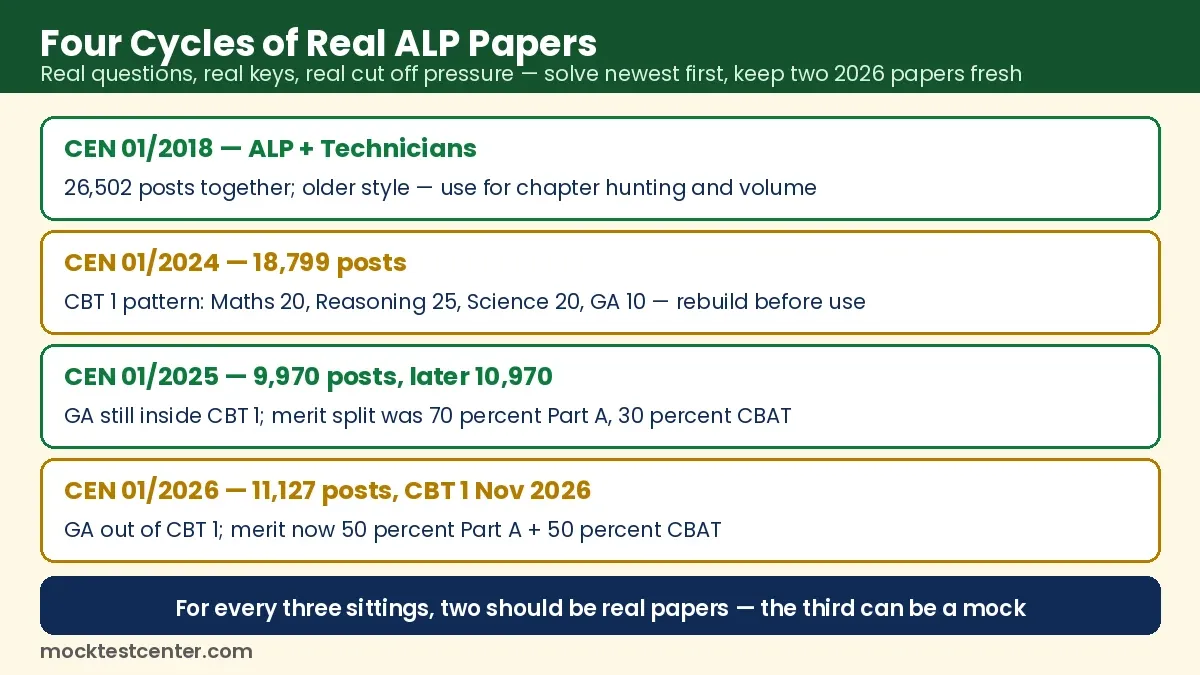
How RRB Answer Keys Work, From First Key to Final Key
Most old paper pages hand you a paper and a key and stop. That stop costs marks. A candidate who cannot read the key stages will score his own practice with the wrong key one day, and a wrong score bends the whole next week of study.
RRB runs the key in stages after each CBT. First, RRB opens a candidate login. Inside it, you get your question paper, the answers you marked, and the first key. RRB calls this stage the tentative key. Tentative means open to change. It does not mean final, and it does not mean wrong either. Most answers in it stand. One or two can move.
Then the objection window opens. You can file an objection on a question where you feel the key is wrong. In recent CENs, RRB charged Rs 50 for each question you challenged, and RRB paid that fee back when your objection stood. Do the maths before you file in anger. Eight weak objections cost Rs 400. A strong objection needs proof, a book line or an official source, not a feeling after a long day.
After the window closes, RRB studies the objections and puts out the final key. Scores come from the final key. On this site, the papers on the ALP PYQ tab use final keys as the checking base, so the score you get here matches the score RRB would give on that paper, before normalisation.
Normalisation sits behind the keys. CBT 1 ran across 3, 4 and 5 November 2026, in many shifts, and no two shifts hold the same level. So RRB balances scores across shifts before it shortlists anyone. RRB picks candidates for CBT 2 at about 15 times the posts, RRB wise and community wise, on normalised marks. Your practice score is a raw score. Read it as a level mark for that paper. Never read it as a rank.
| Key stage | What RRB gives | What you do |
|---|---|---|
| Tentative key | First key, with your own marked answers in the login | Match your answers; mark the ones you feel are wrong |
| Objection window | A set number of days; Rs 50 per question in recent CENs | File only with proof in hand; the fee comes back if you win |
| Final key | The fixed key after RRB studies all objections | Score every practice paper with this key only |
| Normalisation | Scores balanced across shifts | Judge your growth across four or five papers, not one |
Keep the qualifying floors beside the key story, because a paper score means little without them. In CBT 1, UR and EWS candidates need 40 percent. OBC and SC candidates need 30 percent. ST candidates need 25 percent. On a 75 mark paper, 40 percent means 30 marks. That floor only lets you stay in the count. The real shortlist line for CBT 2 sits far above it, since RRB calls only about 15 candidates per post and more than 8 lakh candidates applied in 2026.
A girl in Gaya once asked us why her friend with 41 marks in a practice paper should worry at all, since 41 beats 30 by a wide gap. The gap looks wide. It is not. The floor is the door of the hall. The shortlist is the front row, and the front row fills first.
Solve a CBT 1 Paper in the True 60 Minute Shape
Sit the paper once. One sitting, one clock, phone in the next room, door shut. CBT 1 gives you 75 questions in 60 minutes, and the only way to learn that shape is to sit inside it, again and again, until the pace sits in your hand and not just in your head.
Work in two passes. Pass one takes the questions you can close fast and sure. A BODMAS sum you know at sight. A series with a clear step. A science line you have read in the Class 10 book. Pass two takes the rest, with the time left. A question that eats three minutes in pass one has eaten the price of three or four easy questions, and each question pays the same one mark. That maths never changes.
The ALP Paper Loop: Sit, Score, Note, Retest
Star your guesses as you go. Put a small star beside any answer where you picked between two options on a feeling. At checking time, a guessed right answer counts in the score, but it earns no place in your trust list. A guessed wrong answer tells a harder story. It names a chapter where half knowledge keeps paying the 1/3 cut, paper after paper.
Subject order is your own call, and old papers are where you fix it. Many candidates start with Mental Ability, since series and coding questions close fast when they click. Some start with General Science, because a science question ends in seconds, right or wrong, and a fast first ten minutes calms the hand. Maths at the start suits a candidate whose sums stay cool under a fresh clock. Test two orders on two real papers each. Keep the order with the higher total. Totals pick orders well. Feelings pick them badly.
One pace number should sit on your desk all year. Forty eight seconds. That is the price of one CBT 1 question, 60 minutes cut into 75 parts. You will not spend 48 seconds on each one, of course. You will spend 15 seconds on a science fact and two minutes on a Time and Work sum. The mean must hold. When a single question crosses two minutes in pass one, mark it, move on, and let pass two decide its fate.
After the sitting, do not drift to tea and talk. The next thirty minutes decide what this paper pays you. Score it now, while the guesses and the near misses still sit fresh in your mind. Papers on the RRB ALP PYQ PDF tab suit a print sitting at a desk, while the online tab suits a screen sitting with the timer built in. Pick one shape per paper and finish the full loop in that shape.
Score the Paper With the 1/3 Cut, Worked in Full
Scoring takes ten minutes. Most candidates rush it in two, and then build a week of study on a number that never existed. Slow down here. This is the one part of paper work where soft maths costs real marks later.
Follow these steps in order, every time you finish a paper.
- Count your right answers. Each one pays one mark. Write that count down first.
- Count your wrong answers. Divide that count by three. That is your cut.
- Take the cut away from the right count. That is your score. Write it big.
- Count your blanks. A blank cuts nothing, but a blank in a chapter you have read twice should worry you.
- Write the paper year, the cycle and the date beside the score, plus your wrong count and blank count.
Now work one full example with me, on a RRB ALP Previous Year Question Paper from the November 2026 set. Say you solve a November 2026 CBT 1 paper and mark 52 right, 18 wrong, and 5 blank. Your right answers pay 52 marks. Your wrong answers cut 18 divided by 3, which is 6 marks. Your score is 46 out of 75. A candidate who skips the cut writes 52 in his register. He feels safe. He is six marks less safe than he thinks, and six marks at this level can hold hundreds of names in a shortlist.
See the rule inside the example. Three wrong answers cancel one right answer. Nine wrong answers cancel three. Eighteen wrong answers cancel six full questions that you solved right, with your own hard work, gone to pay for guesses and slips. When a candidate in Ranchi saw this maths on his own paper last cycle, he changed one habit the same evening. He stopped marking answers he could not back with a reason. His attempts fell by five in the next paper. His score rose by four marks.
Watch the wrong count as hard as the total. Two candidates can both land on 46. One reached it with 52 right and 18 wrong. The other reached it with 49 right and 9 wrong, and more blanks. The second boy stands closer to a jump. His knowledge runs clean, and his blanks can turn into attempts as his speed grows. The first boy must first fix a guessing habit that cuts six marks out of his own paper. Same score. Two very unlike weeks of work ahead.
Keep three numbers for every paper in your register: score, wrong count, blank count. One number tells a story with the plot cut out. Three numbers tell the whole tale.
Use the RRB ALP sectional tests when one subject keeps lagging behind the other two, since a sectional sitting gives that subject a full clock of its own. And place this week score beside the score from four weeks back, on a paper of the same cycle if you can. Growth you can see in a line of numbers carries you through the flat days. Flat days come for every candidate we have ever guided.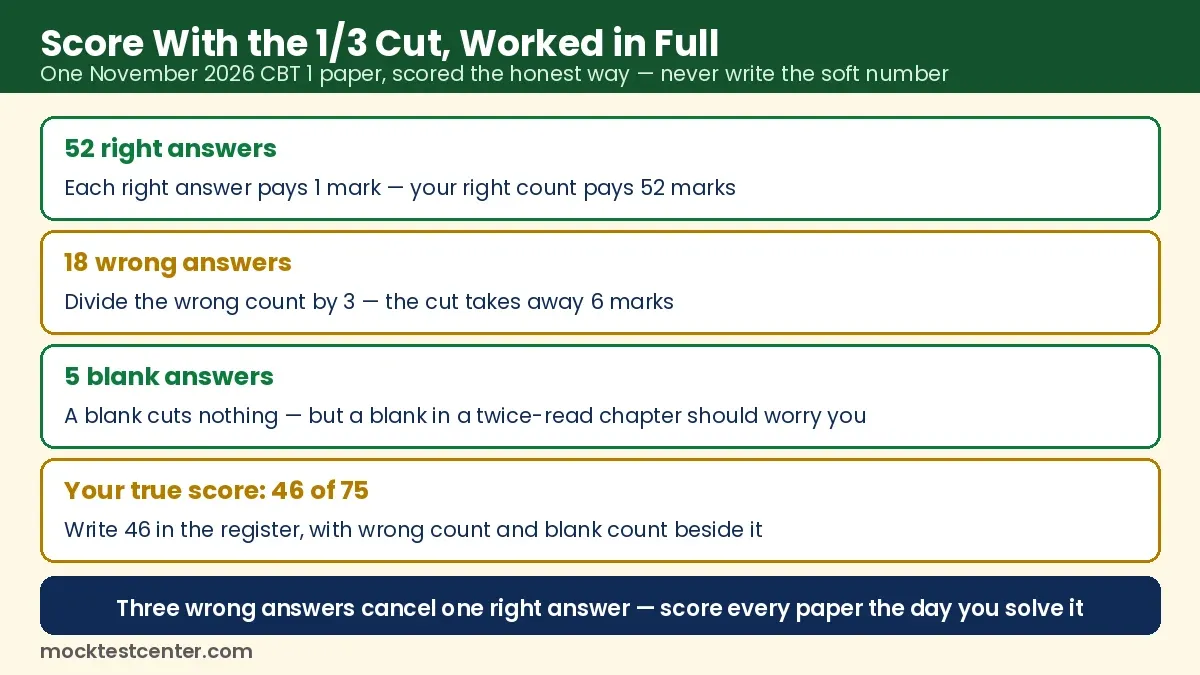
The Error Notebook That Pays You Back
A solved paper with no notebook is a walk you took and forgot by Sunday. The notebook is where one paper pays you twice. Once in the score. Once in the fixes. Keep it thin, keep it ruled, and keep it on the desk where you study, not in a bag under the bed.
Give each wrong or blank question one line with four parts. Part one is the chapter name, in plain words: Percentage, Venn Diagram, Heat and Temperature, Coding and Decoding. Part two is the cause, in one of four fixed words: Concept, Method, Speed, or Careless. Part three is the right method in one short line, in your own hand. Part four is a date, seven days later, when you will meet that chapter again in a test.
The cause words carry the weight here. Concept means you did not know the rule, so the book comes before more tests. Method means you knew the rule and took the long road round it, so you need short methods and timed drill. Speed means the method was right and the hand was slow. Only a clock fixes that. Careless means you knew it, you had time, and you still marked wrong, often after reading only half the question.
A boy in Muzaffarpur wrote Careless beside 8 of his 21 errors in one 2025 paper. Eight. His fix cost no money and no new book. He began reading each question twice before he looked at the options. His Careless count fell to 3 in the next paper, and those five saved questions paid him close to five marks, since few of them drew the cut.
Feed the notebook back into the week. Chapters that fill page after page go into the RRB ALP chapter wise tests first, on the same day you write the line if you can manage it. Chapters with Concept errors go back to the book first, and to a test only after the reading. Science errors go back to the Class 10 chapters, which you can line up with the NCERT test series for ALP so the book work and the test work pull in one line.
Do not copy full answers into the notebook. A full answer feels like work and reads like a book you will never open again. One line per error, in your own words, makes a page you will read ten times without pain. Read the week pages once each Sunday before you sit the next paper. You will meet four or five of the same traps in that paper. Papers repeat traps far more than they repeat questions.
Which Cycles to Solve First, and How to Rebuild Old Papers
You hold four cycles of real papers, and time to solve maybe thirty papers well before your next exam. Order matters, and so does repair work, because the old papers run under old rules.
Start with the newest. A RRB ALP Previous Year Question Paper from November 2026 comes first. Solve those CBT 1 papers first, across shifts, since they show the present shape with no General Awareness part at all. Then take the 2025 papers, then 2024. Keep two November 2026 papers unsolved for your last three weeks, so your final check runs on fresh real papers and not on papers your memory has softened.
Now the repair work, and this part matters more than the order. Old CBT 1 papers carry a General Awareness part that CEN 01/2026 has removed. The 2024 pattern, as printed, ran Maths 20, Reasoning 25, General Science 20, and GA 10, which makes 75 questions. If you solve a 2024 paper as it stands, you train a paper that no longer exists. You spend ten questions worth of time on a part that will not come, and you short change the three parts that will.
Rebuild the sitting like this. Cut the 10 GA questions out of the clock. Solve the other 65 questions, and set your timer by the same 48 second pace, which gives you about 52 minutes for the 65. Or add ten more questions from Maths, Mental Ability or General Science of the same cycle and keep the full 60 minutes. Either way works. What fails is the lazy way, solving the old paper whole and calling the score a 2026 score.
Do the GA questions at all? Yes, but in a split way, and here the split needs care. Many ALP candidates also sit NTPC and Group D, where General Awareness carries real weight, 40 of 100 marks in NTPC CBT 1 and 20 of 100 in Group D as per the facts we hold for those exams. For those papers, old GA questions still pay. For ALP alone, they pay nothing now. The RRB ALP current affairs tests page on this site tells that same split story in full, so read it before you cut news reading out of your day or keep it at full size. Your hours are few. Spend each hour where a mark waits for it.
The 2018 papers need one more repair. That cycle mixed ALP and Technicians in one CEN with 26,502 posts, and its papers run older in style. Use 2018 papers for chapter hunting and for volume in Maths and Science. Trust their level less than you trust 2025 and 2026. And if your trade sits close to the Technician side, the papers and tests under RRB Technician can add trade drill, while RRB JE tests suit the diploma holders among you who also aim higher on the same science base.
Build the week around three papers, done the full way. One paper takes 60 minutes to solve and about 40 minutes to score and note well. Three full papers beat seven rushed ones, every week of the year. On the days between papers, run chapter tests from the notebook list, and read the school science chapters your errors name.
CBT 2 Papers Train Depth, Part B Is a Gate, CBAT Has No Old Papers
CBT 1 papers train speed. That is their job, and they do it well. But a candidate who solves only CBT 1 papers walks into CBT 2 half ready, because CBT 2 asks for a unlike skill. It asks for depth over a long sitting.
The full CBT 2 sitting runs 2 hours 30 minutes. Part A gives you 100 questions in 90 minutes, which is 54 seconds per question, a touch more air than CBT 1. The subjects are Mathematics, General Intelligence and Reasoning, and Basic Science and Engineering. That third subject is new ground for most candidates. It holds Engineering Drawing, Units and Measurements, Work Power and Energy, Heat and Temperature, Basic Electricity, Levers and Simple Machines, and more. Old Part A papers show you how deep RRB digs in each of these. A made set often digs too deep or too shallow. A real paper digs at the true depth, because lakhs of candidates sat it and RRB set it to sort them.
Part A carries the merit weight, so score it with care. Its qualifying floors are 40 percent for UR and EWS, 30 percent for OBC and SC, and 25 percent for ST. But floors mislead here too. Under CEN 01/2026, half your final merit comes from Part A marks, so each Part A mark you gain in practice pulls your final rank up in a way no CBT 1 mark ever can. CBT 1 marks never enter final merit at all. Read that again. The paper that feels like the whole war is only the gate. Part A is half the war itself.
Part B is the other half of the sitting, and it plays a gate role, nothing more and nothing less. It holds 75 trade questions in 60 minutes from the DGT syllabus of your trade, Fitter, Electrician, Wireman, Mechanic Diesel, and the rest of the trades named in the CEN. You need 35 percent, which is 26.25 marks of 75. With the 1/3 cut in force, 27 sure right answers with no wrong ones clear the gate. Thirty right answers with nine wrong also clear it, since 30 minus 3 equals 27. Count it that way when you plan. Aim for a safe band near 35 to 40 net marks, not a hero score, and give the hours you save to Part A and CBAT, where merit lives.
Candidates fail Part B in two ways. Some ignore the trade paper for months, since it adds no merit marks, and then fall at a gate they could have cleared with steady small work. Some drown in it, reading trade books for weeks while Part A maths rusts. The gate needs respect, not fear. Two trade sittings a week from old papers, scored with the cut, will show you inside a month if you stand safe or shaky.
Then comes CBAT, and here the old paper shelf runs empty, for a fair reason. CBAT is a set of test batteries on a computer, built to check memory, following directions, depth perception, concentration and perceptual speed, as reports of the test name them. RRB does not put out CBAT question papers the way it puts out CBT papers. There is nothing real to download. Any file that claims to be a past CBAT paper should make you step back.
So how do you train for a test with no old papers? Battery practice. Short daily sets that copy the battery jobs: hold a list in memory and pick it out later, follow a set of directions in order, judge which object sits closer, keep count under time pressure. The notice points candidates to the RDSO website psychology pages for sample word on the test, and that is the official place to start. Shortlisting for CBAT runs at 8 times the posts, among candidates who clear the Part B gate, on Part A marks. Once you reach CBAT, the rule is stark. Score a T-score of 42 or more in each battery, or your run ends there, for every category, whatever your Part A marks say.
And CBAT now weighs half the final merit list, up from 30 percent in the 2018, 2024 and 2025 cycles. A candidate who treats CBAT as a formality trains for half an exam. Give it a daily slot from the month you start CBT 2 papers, small and steady, the way you would train a hand for a tool it must hold on one fixed day. Also keep the new medical side in mind. Under CEN 01/2026, candidates declared medical fitness while applying, and they must bring Self Screening Medical Declaration reports, signed by a General Physician and an Eye Specialist from a government hospital or medical college, on CBAT day, with a vision certificate. A-1 eyesight is no joke for this post. If your eyes have never had a full check, get one early, not in the week of CBAT.
Old CBT 2 papers from 2018, 2024 and 2025 also carry the old merit split in their story, 70 percent Part A and 30 percent CBAT. The questions stay gold. The weight story has changed. When you read an old guide line that tells you CBAT counts for less, that line belongs to a dead cycle. The full ALP mock tests on this site follow the new 50 and 50 split, and your own plan should too.
Mistakes We See Every Year With Old Papers
We read the same sad stories in mail after mail. A candidate works hard for months and still walks in under ready, and the paper work, not the book work, is where the leak sits. Here are the leaks we see most, with the fix beside each one.
The first leak is the soft score. A candidate counts right answers, skips the cut, and writes a fat number in the register. Six papers later, his plan rests on air. Fix: score every paper the day you solve it, with the final key and the 1/3 cut, no pardon for any paper.
The second leak is the solved paper with no notebook. The score goes in a register. The errors go nowhere. The same Percentage trap then bites in the next paper, and the next. Fix: one line per error, same evening, with the cause word written plain.
The third leak is solving old papers as they stand, GA part and all, and then feeling sad that the score dips under 2026 rules. The dip is fake. The paper was wrong for the cycle, not the candidate. Fix: rebuild each old sitting as the earlier section of this page shows, 65 questions at the 48 second pace or a full 75 with the GA part swapped out.
The fourth leak is shift pride. A candidate solves one easy shift, scores high, and tells the house he is ready. Shifts swing. One swallow does not make a season. Fix: judge yourself on the mean of four or five papers from mixed shifts, and keep the shift name written beside each score.
The fifth leak sits with the key. A free file carries the tentative key, a candidate checks against it, and two answers read wrong that are right in the final key. He then spends a week fixing a fault he never had. Fix: final keys only, and when a file key and the key here part ways, trust the final key line and move on with your week.
Your Next Step This Week
Here is a week that fits on one page of your notebook. On day one, sit one RRB ALP Previous Year Question Paper from November 2026 in full, 75 questions, 60 minutes, guesses starred. Score it with the final key and the cut. Write the three register numbers. On day two, work the notebook lines from that paper, chapter by chapter, and take one chapter test for the chapter that hurt you most. On day three, sit a 2025 paper rebuilt to the new rules, with the GA part cut out of the clock. On day five, sit one old Part A paper in 90 minutes and one Part B trade paper in 60, back to back, so your body learns the full 2 hours 30 minutes sitting before the hall asks for it. On day six, give twenty minutes to battery practice for CBAT. On day seven, read the week notebook pages once, slowly.
Keep an eye on the Latest Jobs page as you work, since RRB news for the next cycle will land there, and reports say an indent for 3,500 more ALP posts has been raised, which would take the CEN 01/2026 total to 14,627 if RRB gives final approval. That count is reported, not yet printed in a revised table in the CEN, so hold it as hope, not as a fact to plan by. The next ALP CEN has no date as of 25 November 2026 either. Paper skill grows week by week, and it does not wait for a notice. Start the loop now, and let the notice find you mid stride.







