
About RRB ALP (Assistant Loco Pilot) PYQ PDF Downloads
- 1.RRB ALP Paper PDF Files: Key Facts First
- 2.What a Real ALP Paper PDF Holds, Page by Page
- 3.The Two Minute Real File Check
- 4.Tentative Key or Final Key Inside Your File?
- 5.A Print Plan That Fits One Week
- 6.The PDF Tab and the Online PYQ Tab Do Different Jobs
- 7.Fake PDF Families and the Marks They Cost
- 8.How to Work a Printed Paper at the Desk
- 9.Your Next Step With the Files You Hold
Quick Answer: A RRB ALP PYQ PDF is a file that holds a real Assistant Loco Pilot paper, with the shift and date on it, 75 questions for a CBT 1 paper, and the answer key at the end. Real ALP papers exist from the 2018, 2024 and 2025 cycles, plus the CBT 1 papers of 3 to 5 November 2026 under CEN 01/2026. This page gives you a two minute check that tells a real file from a fake one, shows you how the tentative key and the final key differ inside PDF files, and sets out a print plan that fits one week of study.
RRB ALP Paper PDF Files: Key Facts First
Start with what a real file holds. A CBT 1 paper under CEN 01/2026 holds 75 questions for 75 marks, to be solved in 60 minutes. The subjects are Mathematics, Mental Ability and General Science. General Awareness left CBT 1 in this cycle. A CBT 2 paper holds two parts in one sitting of 2 hours 30 minutes: Part A with 100 questions in 90 minutes, and Part B with 75 trade questions in 60 minutes. Each wrong answer cuts 1/3 mark in CBT 1 and in both parts of CBT 2. A blank answer cuts nothing.
The cycle behind these files is CEN 01/2026. The detailed notice came on 14 May 2026 with 11,127 posts. Forms ran from 15 May 2026 to 14 June 2026 on rrbapply.gov.in. Age had to sit between 18 and 30 years as on 01 July 2026. About 8,40,944 candidates applied. CBT 1 ran from 3 to 5 November 2026. You can check official word at any time on indianrailways.gov.in and rrbcdg.gov.in.
Part B has a gate of 35 percent for every category, which is 26.25 marks of 75. After CBT 2 comes CBAT, where a candidate needs a T-score of 42 or more in each test battery. Final merit now takes 50 percent of CBT 2 Part A marks and 50 percent of CBAT marks. Old cycles used 70 percent and 30 percent, and old PDF files still carry that old story in their first pages. The medical standard for the post is A-1.
Fee facts sit in the same notice, and they help you date a file. The form fee was Rs 500 for most candidates, with Rs 400 paid back after the candidate sat CBT 1, and Rs 250 for SC, ST, women, ex servicemen and other listed groups, paid back in the same way. A file that talks of a Rs 400 form fee for all belongs to some other exam or some other year. Small facts like that are your first line of defence against bad files.
| Fact | Detail |
|---|---|
| Exam | RRB ALP, Assistant Loco Pilot, run by the Railway Recruitment Boards |
| Latest cycle | CEN 01/2026, detailed notice 14 May 2026, 11,127 posts |
| CBT 1 paper | 75 questions, 75 marks, 60 minutes; Mathematics, Mental Ability, General Science |
| CBT 1 dates, 2026 | 3 to 5 November 2026, in many shifts |
| CBT 2 paper | Part A 100 questions in 90 minutes; Part B 75 trade questions in 60 minutes; one sitting of 2 hours 30 minutes |
| Part B gate | 35 percent for every category, 26.25 marks of 75 |
| Negative marking | 1/3 mark cut per wrong answer in CBT 1 and CBT 2; no cut for blanks |
| Old cycles with real papers | CEN 01/2018 with 26,502 ALP and Technician posts together; CEN 01/2024 with 18,799 posts; CEN 01/2025 with 9,970 posts, later 10,970 |
| Old paper trap | Old CBT 1 files carry a 10 question General Awareness part that CEN 01/2026 removed |
| CBAT | T-score 42 or more in each battery; no old CBAT papers exist |
| Final merit | 50 percent Part A plus 50 percent CBAT now; 70 and 30 in old cycles |
| Science base | General Science at Class 10 level, Physics, Chemistry and Life Sciences; books free at ncert.nic.in |
What This Page Covers
- What a real ALP paper PDF holds, page by page
- The two minute real file check
- Tentative key or final key inside your file?
- A print plan that fits one week
- The PDF tab and the online PYQ tab do different jobs
- Fake PDF families and the marks they cost
- How to work a printed paper at the desk
- Your next step with the files you hold
What a Real ALP Paper PDF Holds, Page by Page
Open a real RRB ALP PYQ PDF and read it like a clerk reads a file, page by page, before you solve a single question. The first page tells you the stage, the date and the shift. A CBT 1 file from the 2026 cycle should name a date between 3 and 5 November 2026, or a date from its own cycle if the paper is older. A file with no date and no shift on it asks you to trust a stranger. Do not.
The question pages come next. For CBT 1, count them by the question numbers, not by the page count, since page counts swing with font size and print layout. The last question must read 75. For a CBT 2 Part A file, the last question must read 100. For Part B, the count is 75, and the trade name should sit on the file, Fitter or Electrician or Wireman or one of the other trades named in the CEN, like Mechanic Diesel, Turner, Machinist or Refrigeration and Air Conditioning Mechanic. A Part B file with no trade named on it is a file with its label torn off.
The key sits at the end in most good files. Read its head line with care. Some files print the tentative key, the first key RRB put out. Some print the final key, the fixed key that scores came from. The next sections of this page teach you to tell the two apart, because a score checked on the wrong key can sit two or three marks away from the truth, and a week of study built on that score leans the wrong way.
A real file also holds small marks of its birth. The questions run in English and Hindi side by side in many files, since RRB sets CBT questions in English, Hindi and 13 regional languages, with the English version final if two versions differ. The maths uses the topic names from the CEN list: Number System, BODMAS, LCM and HCF, Ratio and Proportion, Time and Work, Time and Distance, Pipes and Cistern, Calendar and Clock. The science questions sit at Class 10 level. If a file shows degree level physics in a CBT 1 paper, some other exam has crept into your folder.
Take the case of a boy in Bhagalpur who mailed us a file in a panic last cycle. The file cover said ALP CBT 1. Page nine held questions on current affairs of that year, ten of them, in a cycle where his own notice had cut that part out. Pages twenty to twenty six held Group D level science with a unlike mark style. Two exams had been stitched into one file, and the stitching was neat enough to fool a fast eye. His two minute check, once we taught it to him, caught the file in under a minute. Yours can too.
Keep your good files in order once you check them. Name each file with cycle, stage, date and shift, in that order, the way a record room names its bundles. A folder with names like paper1, final2 and newnew will waste your time in the last month, when time costs the most. The files on the RRB ALP PYQ PDF tab of this site come named and sorted by cycle and stage, which saves you that house work. Your own downloads from groups and channels need the same care from your own hand.
One more page level fact. A real paper file never holds a CBAT paper. CBAT is a set of test batteries on a computer, and RRB puts out no CBAT question papers. Any file that claims to hold one is fake at its root, whatever else it holds. Throw it out of the folder the day you spot it, and warn the group you got it from, if you can do so in one short line.
The Two Minute Real File Check
Run this check on every RRB ALP PYQ PDF before it earns a place in your folder. Two minutes now saves weeks later. A bad file does not just waste a sitting. It teaches wrong facts, wrong keys and a wrong sense of your own level, and those three stay with you long after the file is gone.
Do the check in this order, with a pen in hand.
- Read the cover and first page. The cycle, the stage and the date must agree with each other. A file that says CEN 01/2026 on the cover and shows a 2024 exam date inside fails at step one.
- Count the questions by their numbers. CBT 1 must end at 75. Part A must end at 100. Part B must end at 75, with the trade named.
- Look for the General Awareness part. In a 2024 or 2025 CBT 1 file, a 10 question GA part is right for that cycle, since the printed pattern of 2024 ran Maths 20, Reasoning 25, General Science 20 and GA 10. In a file that claims to be from November 2026, a GA part means the file is old stock with a new cover.
- Read the key head line. The file should say which key it carries. If it says nothing, treat the key as tentative until you match two or three answers against a final key source.
- Flip five pages at random. Every page must belong to the same exam, same stage, same style. Mixed pages from NTPC, Group D or Technician papers mark the file as stitched.
- Check one science answer against the Class 10 book. General Science sits at Class 10 level, and the books stand free on ncert.nic.in. If the file key fights the school book on a plain fact, the file loses.
Pass or fail, write the result on the file name itself. Add the word CHECKED and the date to the names of files that pass. Move files that fail to a side folder named BAD, and keep them there for one week before you delete them, in case a friend asks why you will not share them. Show him the failed step. That one act saves two candidates, not one.
The File to Marks Loop: Check, Print, Sit, Score
A word on price, since files come with price tags in many groups. A real paper costs RRB lakhs of rupees to set and hold, and candidates share the files free in most places. A seller who charges a high price for a RRB ALP PYQ PDF file owes you proof of its worth: cycle, shift, final key. Ask for the first page and the key page as samples before you pay a rupee. A seller who will not show two pages is telling you what his file is worth.
And keep the check short on purpose. Two minutes, six steps, pen in hand. A check that takes twenty minutes per file will die by the third file, and dead checks catch nothing. Short and done beats long and skipped, in file work as in revision.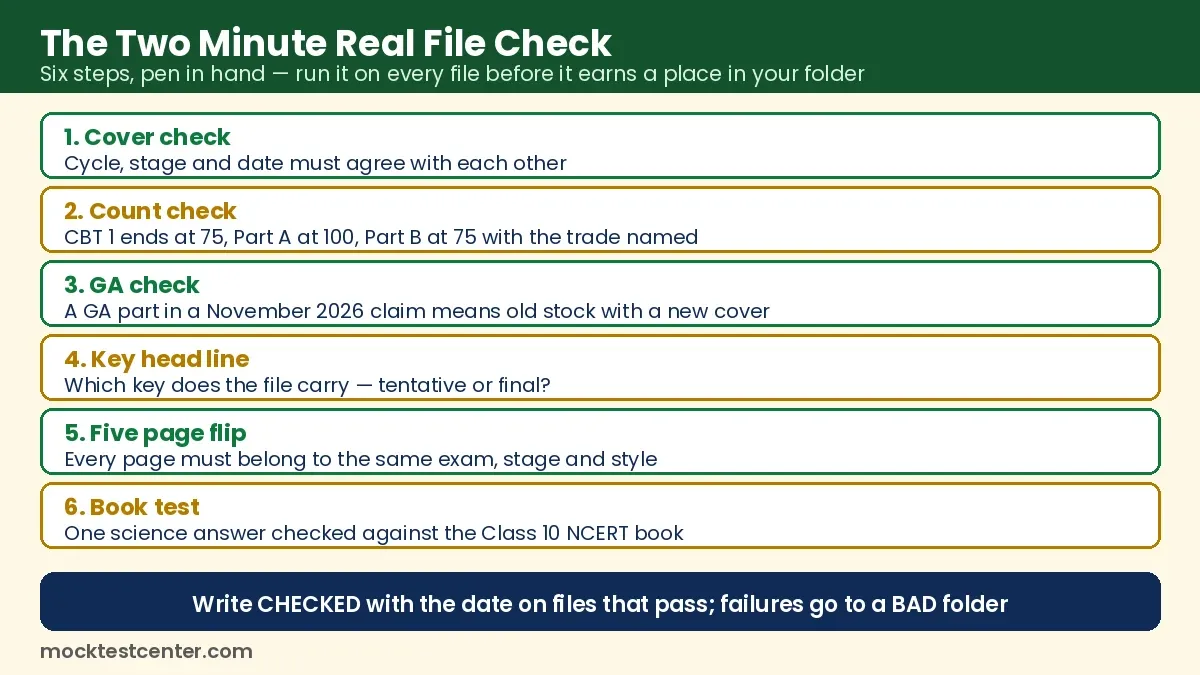
Tentative Key or Final Key Inside Your File?
This one point bends more practice scores than any other in the PDF world. After each CBT, RRB opens a candidate login with the question paper, the answers the candidate marked, and the first key. That first key is the tentative key. Candidates can file objections on it, at Rs 50 per question in recent CENs, with the fee paid back when the objection stands. RRB then studies the objections and puts out the final key. Scores come from the final key, with normalisation across shifts on top.
PDF files enter the world at every stage of that story. A file made in the first week after an exam can only carry the tentative key, since no other key exists yet. A file made after the result can carry the final key. Both files look the same on the cover. Both say answer key at the end. Only the head line and the date tell them apart, and many files print neither.
So test the key, do not trust the cover. Pick three questions where the answer is a plain fact you can check in a book: a science line from the Class 10 book, a maths answer you can work out in full, a series with one clear rule. If the file key agrees on all three, the key earns a pass for daily use. If it fights the book on one, hold the whole key as suspect and check your score against the papers on the online ALP PYQ tab, where final keys form the checking base.
How much can a wrong key cost? Work it in marks. Say a tentative key holds two answers that the final key later fixed. You marked both questions right by the final key. The file key marks you wrong on both. You lose two marks of score, and the 1/3 cut takes a bit more if you count them as wrong in your register maths. Your record shows a dip that never took place. Next week, you spend four days fixing a chapter that was never weak. That is the true cost of a bad key: not the two marks, but the four days.
The same trap runs the other way. A wrong key can mark a wrong answer as right, and lift your score by a mark or two. A lifted score feels good for a day. It feels far worse on result day, when RRB scores you with its own key and no kindness. We tell candidates to fear the lifted score more than the dipped one. A dip sends you back to the books. A lift sends you to rest, and rest at the wrong time is the costliest thing in this race of 8,40,944 candidates for 11,127 posts.
Old cycle files need the same care. The 2018 cycle ran with ALP and Technicians together at 26,502 posts. The 2024 cycle carried 18,799 posts and CBT 1 in November 2024. The 2025 notice came on 11 April 2025 with 9,970 posts, later 10,970. Files from each cycle hold keys of their own time. A key from the right cycle but the wrong stage, a CBT 2 key stitched to a CBT 1 paper, is a known fake family trick, and the two minute check catches it at the count step, since the counts will not match the paper.
A Print Plan That Fits One Week
Print is a tool, not a habit. Paper costs money, and a stack of forty printed papers on a desk can sit unsolved for a month and still look like work. So print with a plan, one week at a time, and let each print earn its place by the Sunday after it comes off the machine.
| Day | Sitting | |
|---|---|---|
| Day 1 | One CBT 1 paper, November 2026 cycle | 75 questions in 60 minutes, guesses starred |
| Day 2 | No new print. Use the error notebook pages. | Chapter work from day 1 errors, book plus tests |
| Day 3 | One CBT 1 paper, 2025 cycle, GA pages kept out | 65 questions at the 48 second pace, about 52 minutes |
| Day 4 | One Part B trade paper of your own trade | 75 questions in 60 minutes, gate score counted |
| Day 5 | One Part A paper, any past cycle | 100 questions in 90 minutes, depth sitting |
| Day 6 | No new print. Battery practice sheets if you use them. | Twenty minutes of CBAT style battery drill |
| Day 7 | Print nothing. Read the week notebook. | Slow read of all error lines of the week |
Read the shape of that week. Four prints. Three full sittings of papers, one trade sitting, and three days where old work gets fixed before new paper enters the house. A girl in Ranchi who prints by this plan spends her print money on four papers a week and solves all four. Her hostel mate prints in bulk at a fair price, solves half, and stores the rest under the bed, where they gather dust and guilt in equal parts.
Print the key pages apart from the question pages, and keep the key pages face down in a drawer until the sitting ends. A key that sits on the desk during a sitting will pull your eye at the first hard question. That pull is human. Remove the chance and the pull dies with it.
Print old CBT 1 papers with the GA part cut, for ALP only work. You can leave the GA pages out of the print run and save both paper and time, since those ten questions train a part that CEN 01/2026 took out. Keep one full old paper uncut in the folder, though, if you also sit NTPC or Group D. For those exams, GA pays real marks, and the same pages you skip for ALP earn their keep on the RRB NTPC PYQ tab style of work and on RRB Group D tests. One file, two uses, as long as your head keeps the two exams apart.
Two colour rules save money and teach at once. Print in black and white, always, since the exam screen gives you no colour help either. And mark the printed paper in two colours of pen: blue while you solve, red while you check. A page with red marks shows your error map at a glance when you open the file bundle a month later. That map is worth more than the print cost.
Bind the solved papers week by week with a simple tag or a clip, oldest at the back. When the folder grows to six weeks, you hold a record no app can match: your own hand, your own clocks, your own red marks, in order. On a low day, read the first week scores and the sixth week scores side by side. Growth on paper, in your own ink, talks louder than any rank guess from any group.
The PDF Tab and the Online PYQ Tab Do Different Jobs
Candidates ask us which one to use, the PDF files or the online papers, as if one must win. Each does a job the other does badly. Use both, for their own jobs, and the fight ends.
The PDF file wins at the desk. It gives you a print sitting with a pen, rough work in the margin, and no screen glow at night. It travels to a village home with weak net. It sits in a folder you own, and no server can take it away. For a candidate who shares one phone with two brothers, the printed paper is often the only full paper he can sit in peace. That is a real gain, and we respect it.
The online paper wins at the clock and the count. On the online PYQ tab, the timer runs the true 60 minutes, the score comes with the 1/3 cut worked out, and the final key checks each answer as you go. No hand maths, no key page hunting, no register slip. The online sitting also trains the screen habit the real CBT will test, since the hall gives you a screen and a mouse, not a pen and a bundle.
So split the week. Sit one paper online for the clock truth. Sit one or two papers in print for the desk work, the margin notes and the red pen map. Feed both sets of errors into one notebook. The notebook does not care where a paper came from. It cares that each error got its line.
The other tabs of this sub category feed the same loop. The chapter tests fix the chapters your printed papers name. The sectional tests give one subject a full clock. The NCERT tests rebuild the Class 10 science base that General Science and Basic Science and Engineering both draw from. The full mock tests test new tricks at no cost. And the current affairs tests hold the news work that ALP no longer asks for but your NTPC and Group D plans still need. Each tab has a job. The PDF tab job is the real paper, in your hand, on your desk.
One rule binds the two worlds. A paper you solved online should not come back as a print sitting in the same month, and a printed paper should not come back online either. Memory softens a seen paper, and a soft score lies to you in the kindest voice. Keep a list of solved papers with dates on the folder cover. When in doubt, pick the paper your list says you have not met.
Fake PDF Families and the Marks They Cost
Fake files travel in families, and once you know the families, you spot their children at sight. We name five here, from the files candidates send us each cycle.
The first family is the new cover family. An old paper, often from 2018 or 2024, gets a fresh cover page with the new cycle name and year. The inside gives it away: a GA part in a 2026 claim, old fee lines, the old 70 and 30 merit story. Cost to you: you train a dead paper shape and set your level by a dead scale.
The second family is the stitched family. Pages from two or three exams sit in one file, ALP maths, NTPC reasoning, Group D science, bound by one cover. The counts break first: 75 questions that end at 82, or a paper that restarts its numbers at page twenty. Cost to you: a sitting that no clock can judge, since no real exam ever held that mix.
The third family is the made paper in real dress. A coaching set or a fan made set wears a cover that says previous year paper. The questions run too hard or too neat, the science leaves Class 10 level, and no shift or date stands on the file. Made sets have their place as drill, and the full tests on this site play that role with their name worn openly. A made set that hides its birth is a lie with page numbers. Cost to you: a level sense built on questions RRB never set.
The fourth family is the wrong key family, met in the earlier section: right paper, tentative or foreign key. Cost to you: two to four marks of fake dip or fake lift, and days of study bent the wrong way.
The fifth family is the trade swap family, and it hunts Part B files. A Fitter paper wears an Electrician cover. A Technician trade paper wears an ALP label, a trick that works since the 2018 CEN held ALP and Technicians together, and old files from that year mix the two in many folders. Candidates with a trade paper doubt should cross check the trade list and the drill under RRB Technician tests, and diploma holders can line up their branch trade with the map in the CEN and the tests at RRB JE. Cost to you, if the swap fools you: a full trade sitting spent on a trade you will never face, while your own trade gate at 35 percent stands untested.
Add the costs up across a season and the bill runs high. A candidate who trains two months on fake files can lose more marks to bad paper than to weak study. The two minute check is the cheapest insurance in this whole exam. Pay it gladly, every file, every time.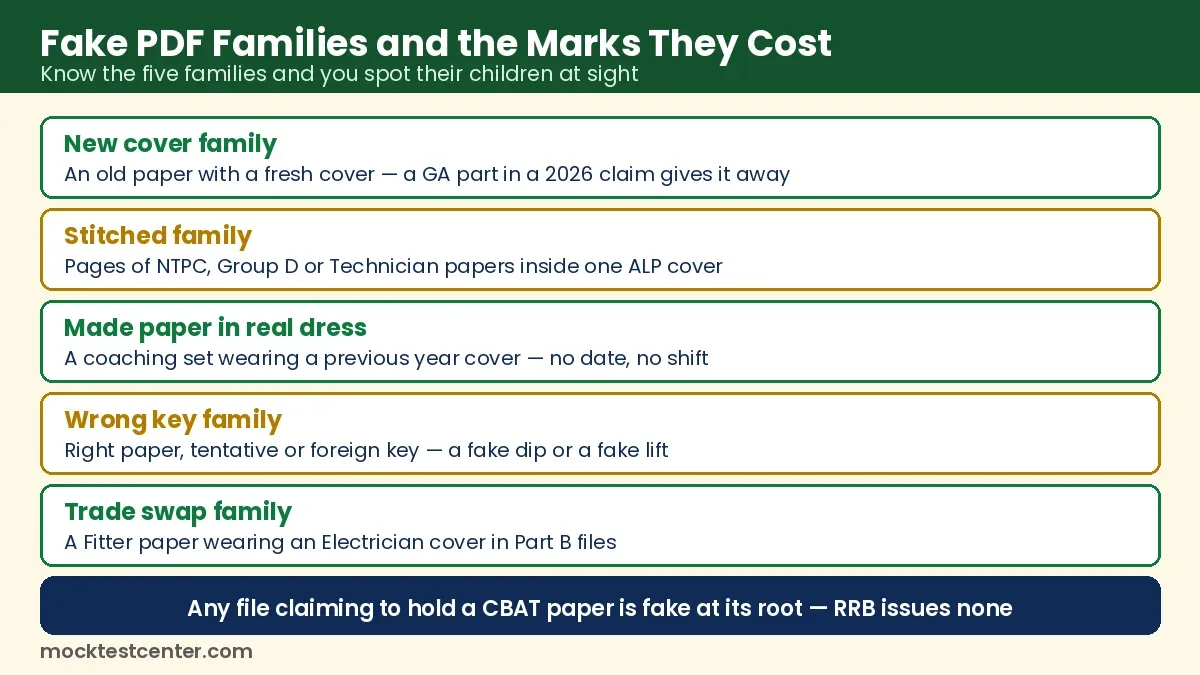
How to Work a Printed Paper at the Desk
A printed paper asks for desk rules, since no screen will police your time or your eye. Set a phone timer for 60 minutes and place the phone face down across the room. Keep the key pages in a drawer. Keep a rough sheet beside the paper, since margin space runs out fast in Mensuration and Time and Work sums. Star each guess with the pen as you mark it.
When the timer rings, stop mid line if you must. The hall will stop you mid line too. Score with the final key and the cut: count right answers, divide wrong answers by three, take the cut away. Say a printed 2025 paper, rebuilt with the GA part out, gives you 41 right and 12 wrong on 65 questions. The cut is 4. Your score is 37 on the 65 question base, and you note it as such, never as a score of 75. Honest labels keep honest plans.
Then the red pen work. One notebook line per error, chapter and cause word and right method, the same rule as the online papers follow. A Part B print sitting gets its own count: net marks against the 26.25 gate line, written in red at the top of the first page, so the next trade sitting starts with the last gate score in view.
File the paper the same day, in the week bundle, with the score on its first page. A paper left loose on the desk for a week joins the dust, not the record.
Your Next Step With the Files You Hold
Start tonight with the folder you have, not the folder you wish you had. Pick three files at random. Run the two minute check on each. Move the failures to a BAD folder. Rename the passes with cycle, stage, date and shift. Then print one passing CBT 1 paper and sit it tomorrow in the full shape, 75 questions, 60 minutes, key in the drawer.
Keep the Latest Jobs page in your weekly round, since the next railway notices will land there first on this site. Reports say an indent for 3,500 more ALP posts has been raised, which would lift the CEN 01/2026 count from 11,127 to 14,627 if RRB gives final approval. Hold that as a reported line, not a printed table, until RRB puts it in the CEN itself. The next ALP CEN has no date as of 25 November 2026. Your files, your clock and your notebook need no notice to start. They need one checked file, one print, and one honest score. Begin there.







