
About RRB Group D Previous Year Papers (PYQ)
- 1.RRB Group D Previous Year Papers: Key Facts First
- 2.Real Papers Exist for Four Cycles, and That Changes Your Plan
- 3.How the RRB Answer Key System Works, With Real Dates
- 4.Sit One Paper in the True CBT Shape
- 5.Score With the 1/3 Cut, Worked Out in Full
- 6.The Error Notebook That Turns One Paper Into Marks
- 7.Which Cycles to Solve First, and Which to Keep in Reserve
- 8.Why Bengaluru 70.29 and Kolkata 80.23 Can Both Be True
- 9.Your Next Step, Tonight Itself
Quick Answer: An RRB Group D Previous Year Question Paper is a real paper from a real Railway Recruitment Board exam for Level 1 posts, and this tab holds such papers with keys you can trust. RRB held the last CBT from 03 to 25 August 2026 under CEN 09/2025 for 22,195 posts, put out a provisional key on 07 September 2026, and declared the result on 12 November 2026. This page shows you how the RRB key system works, how to score a paper with the 1/3 mark cut, why a raw score is a level mark and never a rank, and which cycles you should solve first.
RRB Group D Previous Year Papers: Key Facts First
Start with the frame, because the frame decides how you read every old paper. RRB Group D means recruitment to Level 1 posts in Indian Railways, run by the Railway Recruitment Boards. Level 1 carries initial pay of Rs 18,000 per month, plus allowances as per rules. A candidate applies to one RRB only. The Railway Recruitment Cells run the Physical Efficiency Test, which people call the PET.
The biggest post in the newest cycle tells you where the crowd goes. CEN 09/2025 offered 11,032 posts of Track Maintainer Grade-IV and 5,053 posts of Pointsman-B, out of 22,195 posts in all. Assistant (S&T) held 1,509 posts. Assistant (C&W) held 1,000 posts, Assistant TRD held 800 posts, and Assistant Operations (Electrical) held 604 posts.
You can check the official word on indianrailways.gov.in and on a regional RRB site such as RRB Chandigarh. RRB printed the detailed CEN 09/2025 notice on 30 January 2026. Applications ran from 31 January 2026 to 09 March 2026. The fee stood at Rs 500 for General, OBC and EWS candidates, with Rs 400 back after bank charges once a candidate sat the CBT, and Rs 250 for the other listed groups, with the full Rs 250 back on sitting the CBT.
Age for CEN 09/2025 ran from 18 to 33 years as on 01 January 2026. The education line asked for Class 10 pass, or ITI, or a National Apprenticeship Certificate from NCVT. About 52.4 lakh candidates sat the CBT. Read that number twice. A paper that 52.4 lakh people sat gives you a far better level check than any set a small team wrote in one room.
Now the paper shape, because every old paper on this tab follows it. The CBT holds 100 questions for 100 marks in 90 minutes. PwBD candidates with a scribe get 120 minutes. Mathematics holds 25 questions, General Intelligence and Reasoning holds 30 questions, General Science holds 25 questions, and General Awareness and Current Affairs holds 20 questions. The CEN itself says this split is indicative, so the real paper can move a little from it.
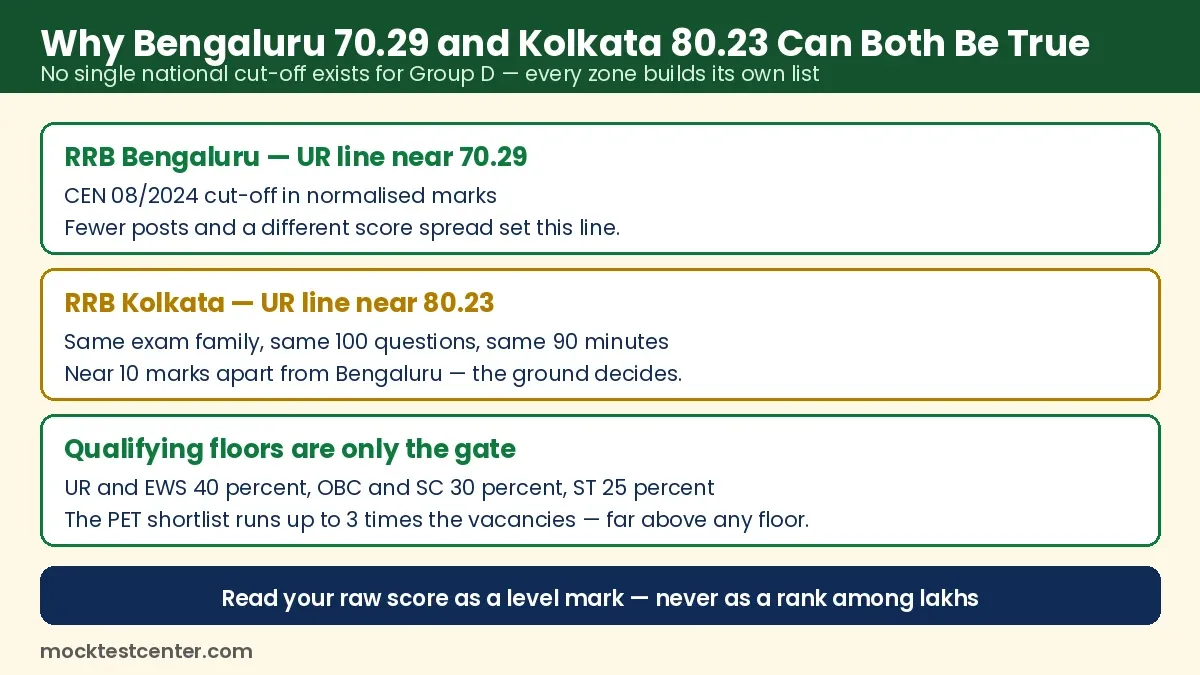
Each wrong answer cuts 1/3 of a mark. A blank answer cuts nothing. The qualifying floors sit at 40 percent for UR, 40 percent for EWS, 30 percent for OBC Non-Creamy Layer, 30 percent for SC and 25 percent for ST. Those floors only open the gate to the next count. RRB shortlists candidates for the PET at up to 3 times the community wise vacancies of that RRB, on normalised marks, and that line sits far above any floor.
| Fact | Detail |
|---|---|
| Exam | RRB Group D, Level 1 posts in Indian Railways, run by the Railway Recruitment Boards |
| Latest cycle | CEN 09/2025, detailed notice 30 January 2026, applications 31 January 2026 to 09 March 2026 |
| Vacancies, CEN 09/2025 | 22,195 posts; Track Maintainer Grade-IV 11,032; Pointsman-B 5,053; Assistant (S&T) 1,509 |
| Past cycle | CEN 08/2024, 32,438 posts, 1,08,22,423 applications, CBT 27 November 2025 to 16 January 2026, result 01 July 2026 |
| Older cycles | CEN 02/2018 with 62,907 posts; CEN RRC 01/2019 with 1,03,769 posts, CBT held in 2022 |
| CBT shape | 100 questions, 100 marks, 90 minutes; 120 minutes for PwBD candidates with a scribe |
| Section split | Mathematics 25, Reasoning 30, General Science 25, General Awareness and Current Affairs 20; the CEN calls the split indicative |
| Negative marking | 1/3 of a mark cut for each wrong answer; no cut for a blank answer |
| Qualifying floors | UR 40 percent, EWS 40 percent, OBC Non-Creamy Layer 30 percent, SC 30 percent, ST 25 percent |
| CEN 09/2025 CBT and result | CBT 03 to 25 August 2026; about 52.4 lakh sat it; provisional key 07 September 2026; result 12 November 2026 |
| PET shortlist | Up to 3 times the community wise vacancies of that RRB, on normalised CBT marks |
| Pay and base need | Level 1 initial pay Rs 18,000 per month; Class 10 pass, or ITI, or NAC from NCVT |
What This Page Covers
- Real papers exist for four cycles, and that changes your plan
- How the RRB answer key system works, with real dates
- Sit one paper in the true CBT shape
- Score with the 1/3 cut, worked out in full
- The error notebook that turns one paper into marks
- Which cycles to solve first, and which to keep in reserve
- Why Bengaluru 70.29 and Kolkata 80.23 can both be true
- Your next step, tonight itself
Real Papers Exist for Four Cycles, and That Changes Your Plan
Four cycles. Four real shelves.
CEN 02/2018 carried 62,907 Level 1 posts and its CBT ran in 2018. CEN RRC 01/2019 carried 1,03,769 posts, the biggest Level 1 count of the four, and its CBT ran in 2022 after a long wait. CEN 08/2024 carried 32,438 posts, drew 1,08,22,423 applications, and ran its CBT from 27 November 2025 to 16 January 2026. CEN 09/2025 carried 22,195 posts and ran from 03 to 25 August 2026.
Each cycle ran in many shifts, so the shelf holds far more than four papers. A candidate in Ara who solved shift papers from 2022 before his August 2026 sitting told me the book sets felt too clean. Real shifts felt rough at the edges. One shift leaned hard on time and work. The next shift leaned on series and coding. Books guess at that lean. Shift papers show it, shift by shift, with the date and the CEN number on top.
What does a real paper give you that a made set cannot? First, the true level of the Class 10 science questions, which often sits lower than coaching books claim, with one or two twists that no book prints. Second, the true wording. RRB words a percentage question in a short, dry way, and a candidate who trains only on long story questions reads the short one twice and loses 20 seconds each time. Third, the true clock feel, because lakhs of candidates met that same paper inside the same 90 minutes.
Use the RRB Group D previous year papers with answer key on this tab as your main ground. The full mock tests still earn a place, because a mock lets you try a new section order at no cost. But a new order that has never met a real paper stays a hope. Hopes break in the hall. My rule for candidates who write to us stays plain and a bit strict. For every 3 sittings in a week, at least 2 should use real papers from past cycles.
One warning belongs at the start, not at the end. Old papers carry the news of their own year in the General Awareness section. A 2018 paper asks about 2018. A 2022 paper asks about 2021 and 2022. Solve those sections for the fixed parts, such as history, polity, geography and science facts, and let the old news questions go without guilt. For fresh news practice, the current affairs tests carry that load in this sub-category.
Keep the crowd size in mind when you judge a score. CEN 08/2024 drew over 1.08 crore applications for 32,438 posts. CEN 09/2025 saw about 52.4 lakh candidates sit the CBT for 22,195 posts. A score on a paper from a heavy cycle means something only when you score it with the final key, inside 90 minutes, with the 1/3 cut taken out. Any softer count flatters you. The hall will not flatter you.
How the RRB Answer Key System Works, With Real Dates
Most pages on this topic hand you a paper and a key and stop. That gap costs marks. A candidate who cannot read the key system cannot score his own practice right, and a wrong practice score sends the whole next week in a wrong direction.
Stage one starts after the CBT ends. RRB uploads three things together: the question paper, your own response sheet, and a provisional key. Your response sheet shows the answers you marked, question by question. The provisional key shows the answers RRB holds right at that stage. Provisional means open to challenge. It does not mean final.
The CEN 09/2025 dates show the gap in hard numbers. The CBT closed on 25 August 2026. RRB released the provisional key on 07 September 2026, with question papers and candidate response sheets. The result came on 12 November 2026, and scorecards followed on 16 November 2026. So a candidate who scored himself in September held a working number, not a settled one, for more than two months.
Stage two is the objection window, and it runs short. A candidate who feels a key answer is wrong files an objection inside the window the key notice prints, and pays the fee that notice prints. In the recent cycles that fee stood at Rs 50 for each question. Ten objections cost Rs 500. Twenty cost Rs 1,000.
So object only where you hold proof. A line from an NCERT book counts as proof, and you can read those books free on ncert.nic.in. A feeling counts as nothing. In my years of reading candidate mail, the objections that won almost always carried a book page or an official line behind them, and the ones sent on mood alone died quiet deaths.
Stage three is the final key. RRB studies the objections, fixes the key where the proof stands, and issues the final key with the result. That final key is the checking base that counts. On this site, the papers on the previous year paper tab use the final keys as the checking base, so the score you see here matches the score RRB would give on that paper, before normalisation.
A free file from a random group often carries the provisional key and never says so. Your score on such a file can sit 1 or 2 marks away from the truth. You then chase a fault that lives in the key, not in you, and you waste a week fixing a chapter you never broke.
| Key stage | What RRB gives | What you do with it |
|---|---|---|
| Provisional key | First key with question paper and response sheet; 07 September 2026 for CEN 09/2025 | Match your marked answers; note the ones you feel are wrong |
| Objection window | A short window in the key notice; Rs 50 for each question in recent cycles | Object only with proof in hand; ten weak objections cost Rs 500 |
| Final key | Fixed key issued with the result; CEN 09/2025 result came on 12 November 2026 | Score all practice papers with this key only |
| Normalisation | Raw marks converted across many shifts before merit and cut-offs | Read your raw score as a level mark, never as a rank |
Stage four sits behind all the others, and the last section of this page gives it a full hearing. RRB runs the CBT in many shifts across many days, 03 to 25 August 2026 in the newest cycle, and no two shifts hold the exact same level. So RRB converts raw marks into normalised marks before it builds merit and cut-offs. Your raw score on a practice paper tells you your level on that paper. It cannot tell you your rank among 52.4 lakh candidates, and any tool that claims it can is selling you a story with a price tag.
Sit One Paper in the True CBT Shape
The sitting rule has no soft version. Sit the paper once, in one sitting, at a fixed time of day, with your phone in another room and a plain clock in front of you. Give yourself 90 minutes for 100 questions. Stop at 90, even if 6 questions stand blank, because the hall stops at 90 and your practice must learn the same hard edge.
The RRB Group D Paper Loop: Four Steps
Inside the 90 minutes, work in two passes across the whole paper. Pass one takes the questions you can finish fast and sure. Pass two takes the rest, in the time that remains. Do the maths of one stuck question before you forgive yourself for it. A reasoning question that eats 4 minutes has eaten the price of 4 quick science questions, because each question pays the same 1 mark in this exam. Same pay. Very different cost.
Section order is your own choice in this CBT, since the CEN prints no locked section timer for Group D, and old papers are where you fix that order. Many candidates open with General Science or General Awareness, because those 45 questions end fast, right or wrong, and a fast start calms the hand. Others open with Reasoning, the biggest block at 30 questions, while the mind stays fresh. Mathematics first suits only a candidate whose sums stay cool under a fresh clock, and I meet very few of those in Patna or in Kanpur or in any town you name.
Test each order on 2 real papers. Keep the order that gives the higher total across both papers. Feelings pick orders badly. Totals pick them well, and totals cost you nothing but 2 honest sittings.
Mark your guesses as you go. Put a small star beside any answer you guessed. At checking time, a guessed right answer counts in your score but not in your trust list, and a guessed wrong answer shows you a chapter where your half knowledge keeps paying the 1/3 cut. The star takes one second. It saves you from the oldest lie in practice, a score built on luck that you read as a score built on skill.
One more sitting habit, and it sounds small until you test it. Keep water and a rough sheet ready before you start, and sit at the same hour on paper days, close to the hour your real shift may fall. The body learns the hour. Candidates who sit papers at random hours often feel a strange dip in the first 15 minutes of a morning shift, and that dip costs easy questions in General Science, the section that should pay them fastest.
Score With the 1/3 Cut, Worked Out in Full
Scoring takes 10 minutes. Most candidates rush it in 2.
Slow down here, because the score you write in your register today is the number your whole next week will obey, and a soft score builds a soft week of study that fixes chapters you never broke and skips the ones that bleed marks in every paper.
Follow these steps in order, every single time.
- Count right answers section by section. Each right answer pays 1 mark. Write the earned marks for Mathematics, Reasoning, General Science and General Awareness apart.
- Count wrong answers section by section. Multiply the wrong count by 1/3. That product is your cut.
- Subtract the cut from the earned marks. Write the total, and write each section score beside it on the same line.
- Count blanks. A blank costs 0 marks, but a blank in a chapter you have read costs you trust, so star it for the notebook.
- Write the date, the CEN number, the cycle year and the shift on the same line. A score with no paper name beside it turns into a rumour within a month.
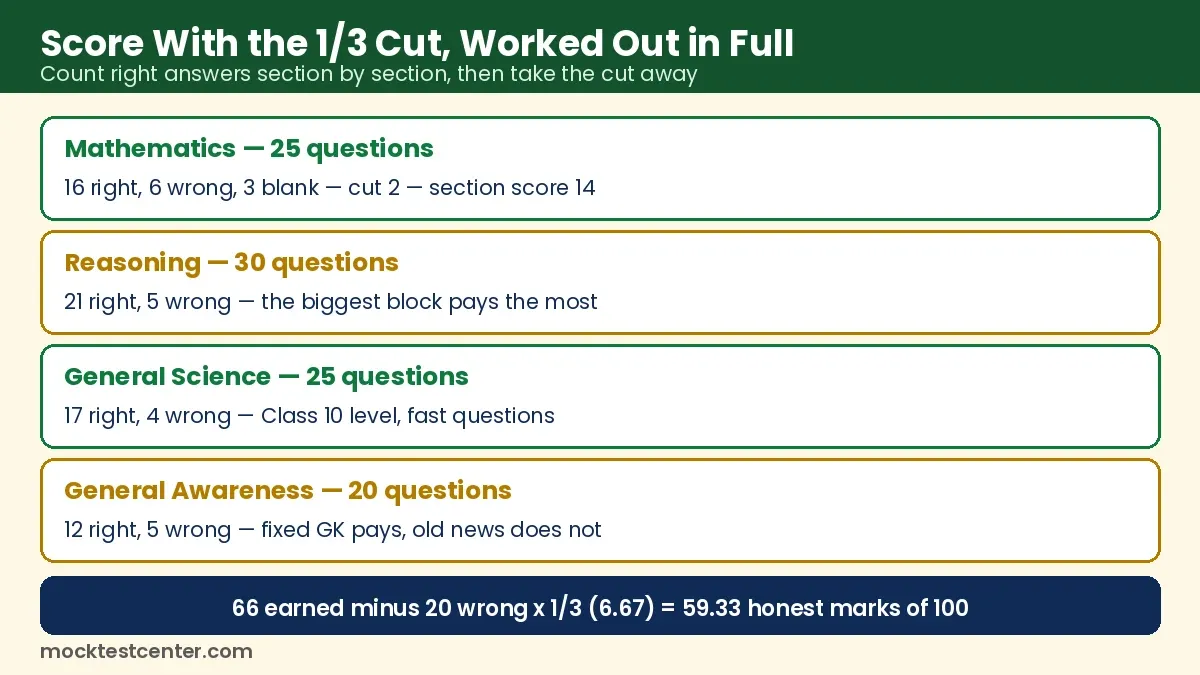
Work one example with me, slowly, with real Group D maths. Say your Mathematics section shows 16 right and 6 wrong, with 3 blank out of 25. Earned marks: 16. Cut: 6 times 1/3 equals 2. Section score: 14 out of 25. Now say Reasoning shows 21 right and 5 wrong out of 30, General Science shows 17 right and 4 wrong out of 25, and General Awareness shows 12 right and 5 wrong out of 20.
Add the earned marks first. 16 plus 21 plus 17 plus 12 equals 66. Now add the wrong count. 6 plus 5 plus 4 plus 5 equals 20 wrong answers. The cut comes to 20 times 1/3, which is 6.67 marks. Your honest total: 66 minus 6.67 equals 59.33 out of 100.
Feel the gap. A candidate who skips the cut writes 66 in his register, feels safe, and meets the truth for the first time on result day, the worst day to meet it. A candidate who rounds the cut down to 6 writes 60 and still lies to himself by 0.67 marks. Write the decimal. The decimal keeps you awake in the right way.
Watch the wrong count as hard as the total. Two candidates can both land on 59.33. One got there with 66 right and 20 wrong. The other got there with 62 right and 8 wrong, with more blanks standing beside his name. The second candidate stands closer to a jump, because his knowledge runs cleaner and his blanks can turn into attempts as his speed grows over the next 4 papers.
The first candidate must first fix a guessing habit that cuts 6.67 marks out of his own paper before any new chapter can help him. Same total. Very different next week, and only the 3 register numbers show you which week you need. So the register holds 3 numbers for every paper: total, wrong count, and blank count.
Use the sectional tests when one section score keeps falling behind the other three, and use the PYQ PDF tab when you want the paper and the key as files for a print sitting at a tea stall table or a library desk. Once a week, place your latest score beside your score from 4 weeks back on a paper of the same cycle family. Growth that you can see in one line of numbers keeps you going on the flat days. Flat days come for every candidate I have ever guided, even the ones who now wear the railway uniform.
The Error Notebook That Turns One Paper Into Marks
A solved paper with no notebook is a walk you took and forgot by Sunday. The notebook is where a paper pays you twice, once in the score and once in the fixes. Keep it thin. Keep it ruled. Keep it beside the desk, not inside a bag under old clothes.
- Give every wrong or blank question one line with 4 parts, and write the line on the same day you solve the paper.
- Part one: the chapter name in plain words, such as Percentage, or Time and Work, or Coding Decoding, or Blood Relations.
- Part two: the cause, in one of 4 fixed words: Concept, Method, Speed, or Careless.
- Part three: the right method in 1 short line, in your own hand and your own words.
- Part four: a date 7 days later, when you will meet that chapter again in a test.
A line takes about 1 minute to write. A paper with 21 errors takes about 21 minutes. Those 21 minutes are the best paid minutes of your week, and I say that after watching candidates spend 3 hours a day on fresh sets while their old errors sat unwritten and unpaid.
The cause words matter more than they look at first sight. Concept means you did not know the rule, so reading must come before more tests, and the NCERT tests and your Class 10 books carry that repair for science. Method means you knew the rule but took the long road, so you need short methods and timed drill. Speed means your method was right and your hand was slow, which only a clock can fix. Careless means you knew it, you had time, and you still marked wrong, often because you read the question only half way.
A boy in Gaya wrote Careless beside 8 of his 20 errors in one 2022 paper. Eight. His fix cost no money and no new book. He began reading each question twice before he touched the options, and his Careless count fell to 3 in the next paper. That fall means 5 more right answers and about 6.67 more marks in his pocket, from one habit and zero rupees.
Feed the notebook back into your week, or the notebook turns into a diary. Chapters that fill the notebook go first into the chapter tests, one chapter on the same day you note the error if you can manage it. Chapters with Concept errors go back to your book first and to a test second. Every Sunday, read that week notebook pages once, slowly, before you sit the next paper. You will meet 4 or 5 of those same traps inside the next paper. Papers repeat traps far more often than they repeat questions, and that one fact should shape your Sundays.
Do not copy full solutions into the notebook. A full solution feels like work and reads like a book you will never open again. One line per error, in your own words, gives you a page you will read 10 times without pain. Thin beats fat here, every week of the year.
Which Cycles to Solve First, and Which to Keep in Reserve
Order matters more than volume here, so let me put the order on the table and give you the reason for each step. Start with CEN 09/2025 papers. They show the present level, the present mix across the 25, 30, 25 and 20 split, and the present style of science and reasoning questions that RRB set for 52.4 lakh candidates in August 2026. Solve 4 to 6 shifts of this cycle first and let them set your base scores in the register.
Move next to CEN 08/2024 papers. That cycle ran from 27 November 2025 to 16 January 2026, close to the newest one in style, and its 32,438 posts drew the biggest application count of all, 1,08,22,423 forms. Its papers give you volume at the right level. After that, take the 2022 papers of CEN RRC 01/2019, which still match the present chapter families in Mathematics and Reasoning very well.
Keep the 2018 papers of CEN 02/2018 for chapter hunting and for extra sittings in a heavy week. Their Mathematics and Reasoning chapters still pay. Their General Awareness belongs to 2018, so treat that section as fixed GK practice only. A candidate in Samastipur who spent 2 weeks on 2018 news questions learned this the hard way, and his letter to us should save you those 2 weeks.
Hold 2 papers back. Keep 2 unsolved shifts of CEN 09/2025 in reserve for your last 3 weeks, so your final check runs on fresh real papers and not on papers your memory has softened through 2 earlier readings. A final check on a seen paper tells you about your memory. A final check on an unseen paper tells you about your exam.
Build the week around 3 papers, not 7. One paper takes 90 minutes to solve and about 45 minutes to check and note well. Three papers done this full way beat 7 papers solved fast and checked soft, every single week, and the gap grows wider as the exam comes closer. On the other days, run chapter tests from your notebook list and one sectional test for your weakest section. When the exam date comes close, raise papers to 4 or 5 a week and cut new chapter reading to near zero. The last month belongs to papers and revision. New chapters in the last month pay very few marks for the hours they eat.
The next Group D CEN has not come yet, and RRB has printed no date for it as of 25 November 2026. A fresh notice may follow the recent rhythm, since CEN 08/2024 came in January 2025 and CEN 09/2025 came in January 2026, but a rhythm is a guess and not a notice. That gap is a gift if you use it for papers now. Paper skill grows slowly, week by week, and the candidate who waits for the notice starts months behind you on the exact skill this exam pays for. Watch the Latest Jobs page for the notice day, and keep the official line open on Indian Railways beside it.
Why Bengaluru 70.29 and Kolkata 80.23 Can Both Be True
Here is the mistake I correct most often in candidate mail. A boy scores 74 raw marks on a practice paper, reads a cut-off list from another zone, and calls himself safe or lost on the strength of that one reading. Both calls are wrong, and the CEN 08/2024 cut-offs show why in two numbers you should pin above your desk.
In CEN 08/2024, the UR cut-off in normalised marks sat near 70.29 in RRB Bengaluru. In RRB Kolkata, the UR line sat near 80.23. Same exam family. Same 100 questions and same 90 minutes. Near 10 marks apart. The gap comes from the ground itself: each RRB holds a different count of posts, a different count of candidates, and a different spread of scores, and RRB builds each zone merit list on that zone ground alone. No single national cut-off exists for Group D. Anyone who quotes you one number for the whole country has not read a zone list.
Normalisation adds a second layer to the same lesson. Your practice score is a raw score on one shift paper. RRB converts raw marks across many shifts into normalised marks before it shortlists anyone for the PET, and the shortlist runs up to 3 times the community wise vacancies of that RRB. A raw 74 on an easy shift and a raw 74 on a hard shift do not carry the same weight after that conversion. So read every practice score as a level mark. It tells you where your preparation stands today. It tells you nothing exact about rank, and a rank guess built on a raw score will swing your mood, not your marks.
What should you hold your score against, then? Hold it against 3 things, in this order. First, your own last 4 paper scores, because that line shows growth or a stall with no zone noise in it. Second, the qualifying floor for your category, 40 percent for UR and EWS, 30 percent for OBC Non-Creamy Layer and SC, 25 percent for ST, because a score near the floor means your base needs repair before speed work. Third, the last cycle cut-off of your own RRB only, read as a rough sky line and not as a promise, since posts and crowds change in every cycle.
Remember what waits past the CBT, because paper marks buy you a place in that queue and nothing more. The PET asks male candidates to lift and carry 35 kg for 100 metres in 2 minutes in one chance, without putting the weight down, and to run 1000 metres in 4 minutes 15 seconds in one chance. Female and transgender candidates carry 20 kg for 100 metres in 2 minutes and run 1000 metres in 5 minutes 40 seconds. The PET gives no marks. It only qualifies you, and then Document Verification and the Medical Examination follow. A candidate who trains only his pen and never his legs can clear the CBT line and fall at the ground in Ajmer or in his own zone. Papers first, yes. Legs alongside, also yes.
If your aim sits higher than Level 1, keep one eye on the graduate level railway shelf as well. The RRB NTPC full tests show you the shape of that exam, and many Group D candidates with a degree sit both. But do not split a weak Group D base across two exams in the same month. One base first. Then the wider shelf.
Your Next Step, Tonight Itself
Place the tabs of this sub-category in one line in your mind, because each one feeds the paper work in a set order. The previous year papers give you the real test. The chapter wise tests fix the chapters your notebook names. The sectional tests train one section at a time inside its share of the 90 minutes. The NCERT based tests hold the Class 10 science base under your 25 science questions. The current affairs tests carry the fresh news load, the PYQ PDF files give you print sittings, and the full mock tests let you test a new section order at no cost.
Now the step itself, and it fits in one evening. Pick the newest CEN 09/2025 shift paper you have not solved. Sit it tonight for the full 90 minutes. Score it with the final key and take the 1/3 cut out before you write a single number in the register. Write the 3 register numbers. Give every error one notebook line with its cause word and a retest date 7 days later.
Then book one chapter test for tomorrow from the chapter that hurt you most in that paper. Do not wait for the next notice to start this loop, and do not trust any score that still holds its wrong answers at full value. The hall will cut them. Your register should meet the hall half way, starting tonight, with the pen in your own hand.







