
About RRB JE (Junior Engineer) Chapter Tests
- 1.RRB JE Chapter Tests: Key Facts First
- 2.Why Chapter Tests Beat Random Practice Sets
- 3.Your Branch Chapters Come First, Always
- 4.The CBT 1 Chapter Map, Part by Part
- 5.The CBT 2 Chapter Map and the Technical Block
- 6.The Same Day Rule and How These Tests Are Built
- 7.What Your Chapter Score Is Telling You
- 8.Which Chapters to Take First
- 9.Reading a Technical Chapter So the Test Pays
- 10.Three Mistakes Candidates Make With Chapter Tests
- 11.A Week Built on Chapters, and Your Next Step
Quick Answer: An RRB JE Chapter Wise Test is a short test on one single chapter of the Junior Engineer syllabus, given the same day you finish reading that chapter. The JE paper is built from named chapters: the CEN lists them for Maths and Reasoning, fixes General Science at Class 10 level, and puts a 100 question Technical Abilities block in CBT 2 that follows your own exam group. On this site, the Chapter Tests tab of RRB JE holds chapter tests for every part of CBT 1 and CBT 2, branch wise for the technical chapters. This page shows you which chapters to take first, why your own branch chapters come before all others, and what score in a chapter test should make you read the chapter again.
RRB JE Chapter Tests: Key Facts First
Start with the frame. The Junior Engineer recruitment of the Railway Recruitment Boards runs in two computer tests. CBT 1 holds 100 questions in 90 minutes: Maths 30, General Intelligence and Reasoning 25, General Awareness 15, General Science 30. CBT 2 holds 150 questions in 120 minutes, and 100 of them sit in Technical Abilities, from your own exam group at diploma level.
Each right answer pays 1 mark. Each wrong answer cuts one third of a mark. Three wrong answers cancel one right answer, in both tests.
The latest notice is CEN No. 04/2026, printed on 13 August 2026, with 4,487 posts after two raises, for Junior Engineer, Depot Material Superintendent and Chemical and Metallurgical Assistant. All three posts sit at Pay Level 6 with initial pay of Rs 35,400, and the age band was 18 to 33 years as on 01 January 2027. Its CBT 1 was held on 27 and 28 October 2026 and on 2 November 2026.
Now the part this page stands on. A chapter test is not a small mock test. A mock test mixes 100 questions from the whole syllabus and tells you one total. A chapter test asks questions from one chapter only, and it tells you one thing with no place to hide: this chapter is ready, or this chapter is not.
The CEN itself hands you the chapter lists. Maths and Reasoning come with printed topic lists in the notice. General Science is fixed at Physics, Chemistry and Life Sciences up to Class 10 CBSE. Technical Abilities follows the diploma syllabus of your group. So the full chapter map of this exam is public, printed, and finite. That is rare, and it is why chapter tests pay so well here.
| Fact | Detail |
|---|---|
| Exam | Junior Engineer, Depot Material Superintendent and Chemical and Metallurgical Assistant, run by the Railway Recruitment Boards |
| Latest notice | CEN No. 04/2026 dated 13 August 2026; 4,487 vacancies after two raises; no 2027 CEN announced as of 25 November 2026 |
| CBT 1 shape | 100 questions, 100 marks, 90 minutes: Maths 30, Reasoning 25, General Awareness 15, General Science 30 |
| CBT 2 shape | 150 questions, 150 marks, 120 minutes: Technical Abilities 100, General Awareness 15, Physics and Chemistry 15, Computers 10, Environment and Pollution Control 10 |
| Negative marking | One third of a mark cut for each wrong answer in both tests; no cut for a blank answer |
| Chapter lists | Maths and Reasoning topics are printed in the CEN; General Science is Class 10 CBSE level; Technical Abilities follows the diploma syllabus of your exam group |
| Merit | CBT 1 only shortlists, up to 15 times the vacancies; CBT 2 marks make merit through the Merit Index |
| Official websites | rrbcdg.gov.in and indianrailways.gov.in |
What This Page Covers
- Why chapter tests beat random practice sets
- Your branch chapters come first, always
- The CBT 1 chapter map, part by part
- The CBT 2 chapter map and the technical block
- The same day rule and how these tests are built
- What your chapter score is telling you
- Which chapters to take first
- Reading a technical chapter so the test pays
- Three mistakes candidates make with chapter tests
- A week built on chapters, and your next step
Why Chapter Tests Beat Random Practice Sets
A random practice set feels like study and behaves like a lottery. You answer 50 mixed questions, score 31, and learn almost nothing you can act on. Which chapter failed you? The set will not say. It mixed Percentage with Coding Decoding and Electric Circuits, and the one total hides all three stories.
A chapter test tells one story at a time. Twenty questions on Percentage. If 9 come back wrong, the story is short and clear: Percentage is not ready, and no other chapter can take the blame. A candidate in Bhagalpur who trains with us kept failing full papers by 4 or 5 marks and could not see why. We broke his last paper part by part, then chapter by chapter. Two chapters, Time and Work and Mensuration, held 11 of his 26 errors. Two chapters. He fixed them in ten days of chapter work, and his next paper rose by 9 marks.
There is a second reason, and it is about memory. A test taken the same day you read a chapter catches the gaps while the chapter is still warm in your head. Wait a month, and the test only tells you that you forgot, which you already knew. The same day test tells you what you never really learned, and that is a very different list.
And a third reason, about time. A chapter test takes 15 to 20 minutes. A full CBT 1 paper takes 90 minutes, plus 45 minutes of honest checking. On a work day or a college day, the chapter test is the unit that still fits. Small units, done daily, beat big units done on Sundays only.
Use the RRB JE chapter wise tests on this tab as the daily unit of your plan, and keep the full mock tests and the previous year papers for the weekly check. Each tool has one job. The chapter test finds the hole. The paper checks whether the patch holds under a full clock.
Your Branch Chapters Come First, Always
Read the CBT 2 numbers once more. Technical Abilities holds 100 questions of 150. That is two thirds of the paper that decides your merit, and every one of those 100 questions comes from your own exam group. A Civil candidate meets building materials, surveying, soil, hydraulics and transport chapters. An Electrical candidate meets circuits, machines, measurements and power system chapters. A Mechanical candidate meets strength of materials, thermal and production chapters. An Electronics candidate meets devices, circuits and signals chapters.
So the first rule of chapter work in this exam is branch first. Your branch chapters are not one subject among five. They are the paper. A week in which you gave 5 chapter tests and none of them was from your branch is a week that trained the small parts and starved the big one.
The trap is real, and we see it every year. Maths chapter tests feel friendly, because the questions are short and the wins come fast. Branch chapters feel heavy, because a Strength of Materials question can carry a diagram, a formula and two lines of working. Candidates drift to the friendly work. Then CBT 2 arrives, and the 100 question block they avoided decides the merit list without them.
Hold this split in your week. Of every 10 chapter tests, at least 5 should be branch chapters once your CBT 1 base is steady. Early in the plan, when CBT 1 is still new, 3 of 10 is fair. But the branch share must grow as the exam comes near, because CBT 1 only opens the gate. It does not write your name on the merit list.
DMS and CMA candidates, read your own map. The Depot Material Superintendent post takes a diploma in any engineering discipline, and its Technical Abilities paper follows the general group set for the post, so check which exam group your form carries and train those chapters. The Chemical and Metallurgical Assistant post rests on a B.Sc. with Physics and Chemistry at 45 percent or more, and its strength is the science side. Your chapter plan should lean harder on Physics and Chemistry chapters than a JE plan does.
And a note for the JE (Information Technology) candidates, who are easy to forget in a crowd of Civil and Electrical names. Your group runs on computer chapters: data structures in simple form, operating systems, networks, databases and programming basics, as Annexure A of the CEN maps them. The Basics of Computers part of CBT 2, with its 10 questions, is also closest to your home ground. A chapter plan that gives your own group chapters the first place works for you in the same way; only the chapter names change.
The CBT 1 Chapter Map, Part by Part
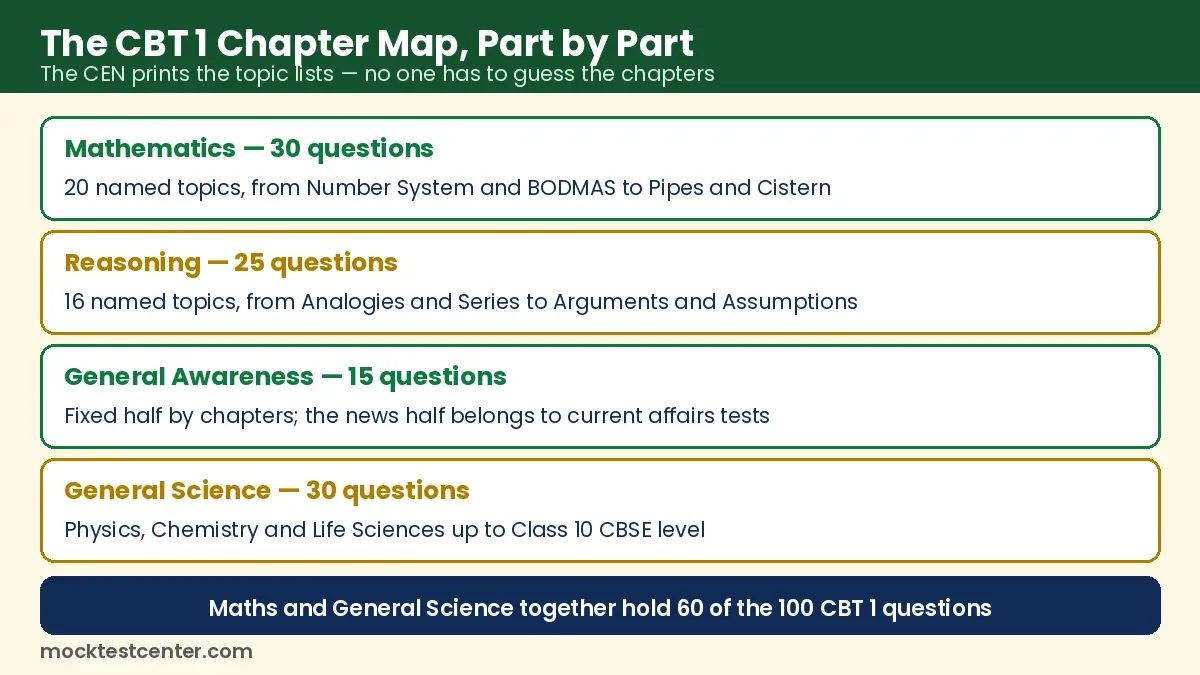
The CEN prints the CBT 1 topic lists, so no one has to guess. Here is the map in plain words, part by part. Keep it beside your desk. When a chapter test on this tab names a chapter, it is one of these.
| Part | Questions | Chapters named in the CEN |
|---|---|---|
| Mathematics | 30 | Number System, BODMAS, Decimals, Fractions, LCM and HCF, Ratio and Proportion, Percentages, Mensuration, Time and Work, Time and Distance, Simple and Compound Interest, Profit and Loss, Algebra, Geometry, Trigonometry, Elementary Statistics, Square Root, Age Calculations, Calendar and Clock, Pipes and Cistern |
| General Intelligence and Reasoning | 25 | Analogies, Alphabetical and Number Series, Coding and Decoding, Mathematical Operations, Relationships, Syllogism, Jumbling, Venn Diagram, Data Interpretation and Sufficiency, Conclusions and Decision Making, Similarities and Differences, Analytical Reasoning, Classification, Directions, Statement, Arguments and Assumptions |
| General Awareness | 15 | Current affairs, Indian geography, culture and history of India with the freedom struggle, Indian polity and constitution, Indian economy, environmental issues of India and the world, sports, general scientific and technological developments |
| General Science | 30 | Physics, Chemistry and Life Sciences up to Class 10 CBSE level |
Two things stand out in this map. First, Maths and General Science together hold 60 of the 100 questions, so their chapters carry the gate. Second, General Science at Class 10 level means the school books are the base text. The NCERT tests on this site map those Class 6 to 10 science chapters one by one, and a weak science chapter found there should be read in the school book first and tested here after.
General Awareness is the one part with no fixed chapter list beyond its areas, because its current affairs half moves with the news. Chapter tests still work for its fixed half: polity articles, history periods, geography families. The moving half belongs to the current affairs tests, which run on a weekly rhythm.
The CBT 2 Chapter Map and the Technical Block
CBT 2 adds 4 small parts around the technical block, and each small part has its own chapter list in the CEN.
Physics and Chemistry holds 15 questions, at a level past Class 10. Its chapters grow out of the school base: units and motion, work and energy, light and electricity on the physics side; atoms, reactions, acids and bases, metals and carbon compounds on the chemistry side. Basics of Computers and Applications holds 10 questions, on computer architecture, input and output devices, storage, networking, operating systems, MS Office, internet and email, websites and browsers, and computer virus. Basics of Environment and Pollution Control holds 10 questions, on the basics of environment, air, water and noise pollution and their control, waste management, global warming, acid rain and ozone depletion.
General Awareness repeats its 15 questions here, in the same areas as CBT 1. That is a gift. One GA chapter plan serves both stages.
Then the block. Technical Abilities holds 100 questions from your exam group at diploma level. The CEN maps each JE post to its group in Annexure A, and the group syllabus is the diploma syllabus of that branch. For a Civil candidate, the heavy families are building materials and construction, surveying, soil mechanics, hydraulics, irrigation, transportation and environmental engineering. For Electrical, they are electric circuits, machines, measurements, power systems, and utilisation. For Mechanical, engineering mechanics, strength of materials, theory of machines, thermal engineering, fluid mechanics and production.
Chapter tests for the block must be taken group wise. A Civil candidate who solves a Mechanical chapter test has spent 20 minutes on questions that can never appear in his paper. It sounds obvious. Mixed sets sell this waste every day, because a mixed set is easier to build than a group wise one. On this tab, the technical chapter tests sit under their group names, so check the group line before you start a test, the same way you would check it on the exam form.
The Same Day Rule and How These Tests Are Built
The rule is short. Read a chapter in the morning. Test it the same day. Not next week, not after the whole book. The same day.
Fresh reading hides soft spots. You close the book feeling that you know Mensuration, because every solved example made sense while the book was open. A test with the book closed tells the truth. Twenty questions, no help, one clock. What you really hold, you keep. What you only watched, falls away, and it falls the same day, while the fix is still cheap.
The Same Day Chapter Loop: Four Steps
The chapter tests on this tab are built to the paper's own habits. Questions carry 1 mark each, and the one third cut applies to wrong answers, so a test score reads like a small piece of the real paper. The level follows the stage: CBT 1 chapters sit at the school and basic level the CEN prints, and technical chapters sit at diploma level. Hindi and English both stand on the tab, so take the test in the medium you will sit in.
One habit makes the loop work. Keep an error notebook beside you, the same notebook you use for full papers. Every wrong or blank answer in a chapter test earns one line: chapter, cause word from Concept, Method, Speed or Careless, and the right method in short words. The notebook is the bridge between this tab and the previous year papers: chapters that fill its pages are the chapters your next paper will punish, and you will meet them first in a test instead.
What Your Chapter Score Is Telling You
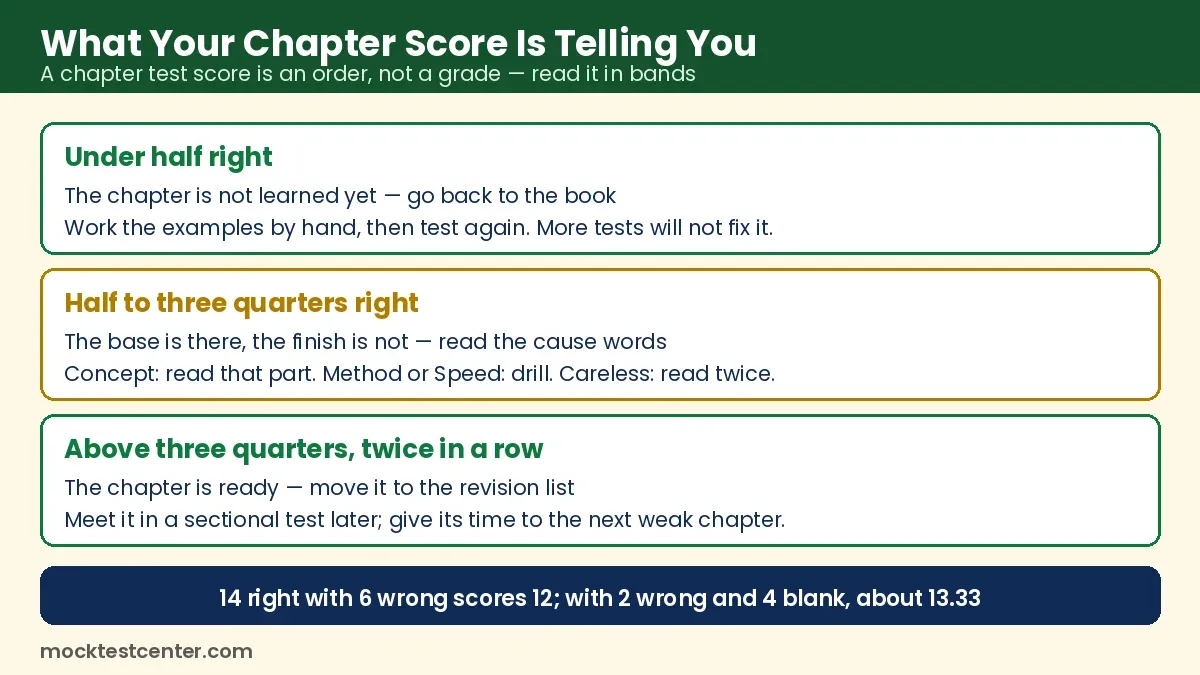
A chapter test score is an order, not a grade. Read it in bands.
Under half right. The chapter is not learned yet, and more tests will not fix it. Go back to the book. Read the chapter again, work the examples by hand, and only then test again. For a science chapter, that book is the Class 6 to 10 NCERT book. For a technical chapter, it is your diploma book or your class notes. Testing a chapter you have not read is like weighing yourself to lose weight. The number moves nothing.
Half to three quarters right. The base is there and the finish is not. Look at the cause words in your notebook. If most errors say Concept, one part of the chapter is missing; read that part only. If most say Method or Speed, the chapter is learned and the hand is slow; take the same chapter test again after 2 days of short drill. If most say Careless, read each question twice for one week and watch the band change.
Above three quarters right, twice in a row. The chapter is ready. Move it to the revision list, meet it once in a sectional test later, and give its study time to the next weak chapter. Ready chapters still need one visit every few weeks, because a ready chapter left alone for 2 months quietly becomes a half chapter again.
And watch the wrong count, not only the right count. In a 20 question chapter test, 14 right with 6 wrong gives 14 minus 2, which is 12. The same 14 right with 2 wrong and 4 blank gives 14 minus 0.67, which is about 13.33. Same knowledge, better judgement. Chapter tests are where guessing habits are cheapest to fix, because the lesson arrives in 20 minutes and not after a full paper.
Keep a small chapter register next to the error notebook. One line per test: date, chapter, group or part, right count, wrong count, band. After a month, that register is a map of your whole syllabus in your own hand. Chapters with two ready bands in a row stop asking for weekly time. Chapters that sit in the middle band for three tests running are telling you the reading method is wrong, not the effort. Change the method for those: read with a pen, work examples before theory, or study the chapter with a friend and teach it aloud. Teaching a chapter is the oldest test of holding it, and it costs nothing.
Which Chapters to Take First
Order your chapter work in three lines, and keep the lines apart.
Line one is the notebook line. Any chapter named in your error notebook from a paper or a sectional test jumps the queue. It has already cost you marks once, in writing. It goes first, this week, before any new chapter.
Line two is the weight line. In CBT 1, the heavy chapters are the ones that feed many questions across papers: Percentage, Time and Work, Ratio and Proportion in Maths; Series, Coding Decoding and Analogies in Reasoning; and the physics and life science families in General Science. In CBT 2, the weight line is your branch itself, family by family, biggest first. Weight is a trend read from past papers, not a promise by the RRBs, so hold it loosely. But a chapter that has fed questions in 2019, 2024 and 2025 will most likely feed questions again.
Line three is the new reading line: chapters you have never read, taken in book order, one a day, each closed with its same day test. This line moves slowest and matters most in the first half of your plan. In the last month, close this line. New chapters in the last month pay very few marks for the hours they eat, and the papers will tell you so.
A word for candidates who are starting late, with the 2026 cycle already at its key stage and a fresh CEN expected in 2027. Start with line two and line one together: the heavy chapters, tested first to find your true level, then read where the tests show holes. Reading the whole syllabus book by book is a plan for a candidate with a year. A candidate with months needs the test first, read second order. It feels backwards. It works.
Reading a Technical Chapter So the Test Pays
A technical chapter is read in a different way from a Maths chapter, and candidates who read both the same way waste half the branch work. A Maths chapter is mostly method: learn the short road, drill it, and speed comes. A technical chapter is three layers at once. There is the fact layer, like the grades of cement or the parts of a DC machine. There is the formula layer, with units that must match or the answer falls. And there is the picture layer: diagrams, curves and tables that the question setter can ask about without a single number.
So read a technical chapter in three passes. Pass one reads for facts and names, with a pen marking every value, grade and limit the chapter prints. RRB questions love printed values. Pass two works the formulas by hand, with units written beside every line, because half the wrong answers in technical tests are unit slips and not idea slips. Pass three studies the pictures: the stress strain curve, the motor parts diagram, the survey instrument sketch. Cover the labels and name the parts aloud. If you cannot name them with the book closed, the chapter is not read, whatever your eyes did.
Then take the test. A diploma student in Ranchi told us his chapter scores sat near half for a month while his Maths scores rose. His reading was one pass, eyes only. We changed nothing else, only the reading: three passes, pen in hand, labels covered. His next 4 branch chapter tests all crossed three quarters. The chapters were the same. The reading was the change.
One more rule for the block. Technical chapters lean on each other. Strength of Materials leans on Engineering Mechanics. Machines lean on basic circuits. If a chapter test shows Concept errors again and again, the missing chapter may be the one before it in the book. Go back one chapter, test that, and then return. Chapter tests make this visible in a way full papers never do, because a full paper mixes the two chapters and the weak base hides inside a fair total.
Three Mistakes Candidates Make With Chapter Tests
Testing without reading. A chapter test is a check on reading, not a place of reading. Candidates who open tests on chapters they never read score under half, feel low, and learn only that the chapter is hard. Read first. Test after. The order is the method.
Taking the same test again the next day. A repeated test measures your memory of yesterday's answers, not your hold on the chapter. Your score jumps, your chapter does not. Wait 7 days, and take fresh questions on the same chapter. If the score holds, the chapter is yours.
Only testing the easy chapters. It feels good to score 18 of 20. It pays nothing. The chapters that scare you are the ones holding your marks, and a week of chapter tests with no scary chapter in it is a week of comfort dressed as work. Put one hard chapter in every 3 tests. Your notebook will tell you which ones they are. It already knows.
A Week Built on Chapters, and Your Next Step
Here is a week that works for a candidate in study, and it bends for a candidate in a job. Five days carry one chapter test each: 2 from your branch, 1 from Maths, 1 from Reasoning or General Science, and 1 from your notebook line. One day carries a sectional test at full part size. One day carries a full paper from the previous year papers, checked the same evening, its errors fed back into next week's chapter list.
For a candidate in a job or in the final year of a diploma, cut the week to its bones and keep the order. Three chapter tests a week, branch first, notebook second, heavy chapters third, still teach you more than a Sunday of mixed sets. The plan bends. The order does not.
Place the other tabs in one line in your mind. Chapter tests find the hole. The NCERT tests hold the science base. The current affairs tests feed the 15 GA questions of both stages. The PYQ PDF files give you print sittings of real papers. And the Latest Jobs page will carry the next JE notice the day the RRBs print it, with the official word always open on rrbcdg.gov.in beside it.
Your next step fits in one evening. Open your last paper or your last sectional test. Find the chapter with the most errors. Read that chapter tonight, book closed at the end, and take its chapter test before you sleep. One chapter, read and tested in one day, teaches you the whole method of this page better than any plan written on paper. Start there tonight.







