About SSC Stenographer Grade C & D 2027 Exam Series
📖 Table of Contents
- Mock Test for SSC Stenographers 2027: A free Online Test Series for Grade C and D (with a Sectional Timer of 30+30+60 minutes)
- Why I Built This Mock Test Series
- URGENT CORRECTION / AMBER CALLOUT BOX
- AI-BASED WEAK AREA RECOMMENDATION REPORT
- Attempt the Free SSC Stenographer Grade C & D Mock Test Series 2027 (5-Tab Practice Hub)
- Inside the SSC Stenographer 2027 Test Series: Total Mocks, Bilingual Interface & Printable PDFs
- Clearing the 4 Major Confusions About the SSC Stenographer Exam Pattern (2026–27)
- How Our 200-Mark SSC Stenographer Mock Engine Works: Three Locked Sections, Zero Maths
- Part I Simulator — Surviving 50 Reasoning Questions in a Locked 30-Minute Window
- Part II Simulator — Preventing Over-Guessing Inside the Locked 30-Minute General Awareness Window
- Part III Simulator — Mastering 100 English Questions in 60 Minutes
- How the Post-CBT Shorthand Skill Test Benchmarks Connect to Your Mock Target
- The calculation of expected value in mock tests based on the number of options eliminated
- Blueprint for pacing on a minute-by-minute basis for the 30 + 30 + 60 minute section timers
- Part I (30-minute Reasoning Lock): The Two-Wave 20+10 Minute Pacing Schedule
- Part II (30-minute GA Lock) and Part III (60-minute 100-question English Lock): Pacing Schedule
- Which SSC Stenographer 2027 Mock Test is Suitable for You? (Comparison between Grade C and Grade D and the Ministry Post-Code Selector Matrix)
- Topic-wise Question Weightage in Our 2027 Mock Series (Calibrated to the Sept 2026 Shifts) and 10 Solved Sample Questions
- Part III — English Language and Comprehension (4 Solved MCQs)
- Part I — General Intelligence & Reasoning (3 Solved MCQs)
- Part II — General Awareness (3 Solved MCQs)
- Target Score Benchmarks in Mock Tests
- How to Analyze Your September 2026 Response Sheet, the Effect of Normalization and the Error-Log Template
- Mock Test Error-Log Template
- 10 Score-Killing Mistakes Aspirants Make in the New-Pattern SSC Stenographer Mock Tests (And How to Avoid Them)
- How to Begin Your Free SSC Stenographer 2027 Mock Test on MockTestCenter.com
- Daily Current Affairs Quiz: Turn Your 30-Minute Part II General Awareness Window into 35+ Net Marks
- About the Author
Mock Test for SSC Stenographers 2027: A free Online Test Series for Grade C and D (with a Sectional Timer of 30+30+60 minutes)
Verification Disclaimer: This 2027 mock test series has been set according to the most recent SSC Stenographer 200-mark CBT format, including the sectional times of 30+30+60 minutes and the response sheets from the September 2026 shift. Candidates are encouraged to check the departmental vacancies, age limits, and shorthand rules against the official SSC notification PDF available on ssc.gov.in prior to applying.
Why I Built This Mock Test Series
"My name is Shubham Kumar Sah and I am the founder of MockTestCenter.com.
For many years, candidates preparing for the SSC Stenographer exam relied on one simple time strategy: complete 50 General Awareness questions in 12 minutes, and then use all the extra time to solve the 50 Reasoning questions.
When SSC introduced strict sectional timers—30 minutes for Reasoning, 30 minutes for General Awareness, and 60 minutes for the 100 English questions—that approach stopped working overnight. On the day of the exam, Part I locks at exactly 30 minutes. If you practice using old mock tests with an open clock, you will find yourself cut off with 12 Reasoning questions still unanswered, while wasting 18 minutes idly inside the locked General Awareness section.
A second issue is the way generic apps design their Stenographer tests. Many of them reuse 25-question CGL English sets or get the shorthand rules wrong—one major website even claimed that 100 WPM applies to English and 80 WPM to Hindi, when in fact 100 WPM applies to Grade C and 80 WPM to Grade D, regardless of the language.
In the SSC Stenographer exam, there is no Maths. English carries 100 of the 200 marks and serves as the first official tie-breaker. Looking at the August 2026 final selection list, almost every candidate who got selected for MEA, IB, DoPT or CBDT scored between 80 and 94 out of 100 in English alone.
That is why we created this 2027 series with the exact 30+30+60 minute auto-locking interface, dedicated 100-question English stamina mocks, and September 2026 shift papers including department-wise rank predictions.
Most of the series is free. A diagnostic test should not be behind a paywall.
Every test in this series must pass one test: will it enable someone to solve 50 Reasoning questions in 30 minutes and score 85 or more out of 100 in English? If the answer is no, then the test won't be published."
URGENT CORRECTION / AMBER CALLOUT BOX
Direct Clarification for SSC Stenographer Aspirants:
- The myth regarding the 'Open 2-Hour Timer' on the old test series is that many mock examination platforms and exam websites (such as Mahendras and Prepp) show the SSC Stenographer exam as a single 120-minute open-ended timer, allowing candidates to spend 12 minutes on General Awareness and then 55 minutes on Reasoning. However, the confirmed new rule for the SSC Stenographer CBT completely alters this approach. The 200-question, 200-mark CBT now includes strict sectional timers that automatically lock: Part I Reasoning (50 questions, 30 minutes), Part II General Awareness (50 questions, 30 minutes), and Part III English Language & Comprehension (100 questions, 60 minutes). In no case can any unused time from General Awareness be carried over to Reasoning.
- (2) The mistake made by Oliveboard in its "100 WPM English / 80 WPM Hindi" skill test is that several major websites recently published incorrect summaries of the skill test, stating that the speed of English stenography is 100 WPM and that of Hindi stenography is 80 WPM. The official rule, as verified, makes it clear that dictation speed is based on GRADE, not on the language. Thus, Grade 'C' requires 100 WPM (1,000 words in 10 minutes) in either English or Hindi (with a transcription time of 40 minutes for English and 55 minutes for Hindi). Similarly, Grade 'D' requires 80 WPM (800 words in 10 minutes) in either English or Hindi (with a transcription time of 50 minutes for English and 65 minutes for Hindi).
- (3) The rumor about a negative marking of 1/3rd (0.33): The official negative marking for the SSC Stenographer CBT is +1.00 for each correct answer and –0.25 (1/4th) for each incorrect answer. There are no Mathematics questions in the entire examination.
To secure a prestigious Group B or Group C non-gazetted position in the Central Ministries one must have exceptional language proficiency and maintain a high level of test-taking discipline. Preparing for the Staff Selection Commission Stenographer exam requires a complete command of English grammar, the ability to make rapid logical deductions, and strict attention to time management. An effective SSC Stenographer mock test programme for 2027 exactly mimics the new 30+30+60 minute auto-locking sectional timer format and provides accurate benchmarking of shorthand skills.
This platform offers a comprehensive, cycle-aware practice system that is specifically designed for 12th-pass candidates who are aiming to get posts in top departments such as MEA, DoPT, and CBDT.
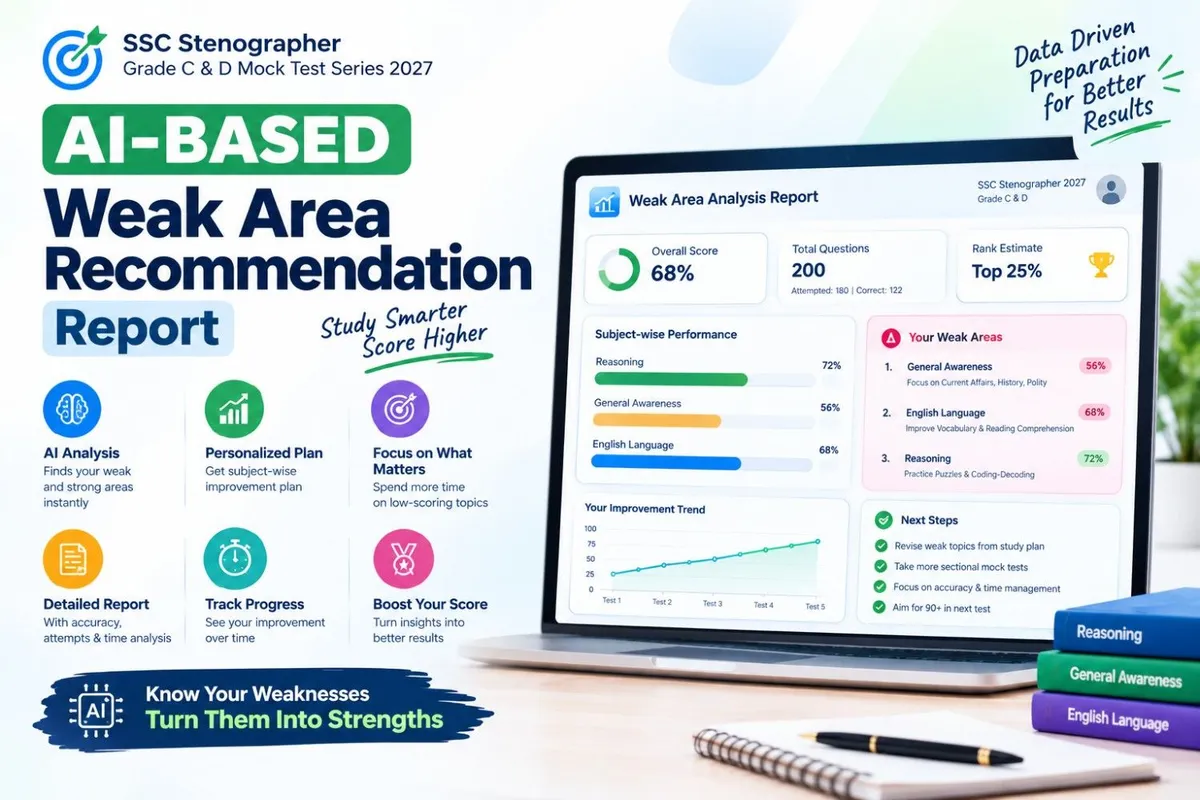
AI-BASED WEAK AREA RECOMMENDATION REPORT
[Simulated Screenshot - MockTestCenter Analytics]Critical Gap Areas Identified:
- Part I: 30-Minute Reasoning Speed/Time-Out [ HIGH GAP ]
- Part III: English Preposition-Cloze Traps [ MED GAP ]
- Part II: Boredom Guessing in 30-Min GA Window [ LOW GAP ]
>> Recommended Action: Launch Tab 4 Reasoning Sprints & Review Error Log
The test engine's inbuilt diagnostic engine pinpoints exact conceptual and clock-management gaps across the strict 30+30+60 minute sectional locks, directing you to tailored remedial revision modules instantly.
Attempt the Free SSC Stenographer Grade C & D Mock Test Series 2027 (5-Tab Practice Hub)
In order to help candidates find the exact diagnostic tool they need without any hassle, our mock tests are neatly organised under a 5-tab responsive selector at the top of the test portal:
Inside the SSC Stenographer 2027 Test Series: Total Mocks, Bilingual Interface & Printable PDFs
| Test Track | Total Tests | Free Tests | Questions & Marks | Sectional Lock | Negative Marking |
|---|---|---|---|---|---|
| Full-Length 200-Mark Mocks | 25 Tests | 3 Tests | 200 Qs, 200 Marks | 30 + 30 + 60 Mins | –0.25 (1/4th) |
| English 100-Mark Boosters | 40 Tests | 6 Tests | 100 Qs, 100 Marks | Strict 60-Min Lock | –0.25 (1/4th) |
| Shift PYQ Reconstructions | 15 Shifts | 2 Shifts | 200 Qs, 200 Marks | Mode-Matched | Official PDF Solutions |
| Reasoning Speed Sprints | 30 Tests | 5 Tests | 50 Qs, 50 Marks | Strict 30-Min Lock | –0.25 Penalty |
| Topic Micro-Tests | 50 Tests | 10 Tests | Varies by topic | Quick Drill Mode | Detailed Explanatory PDFs |
Clearing the 4 Major Confusions About the SSC Stenographer Exam Pattern (2026–27)
| Confusion Point | Common Myth on Coaching Sites | Verified Administrative Reality |
|---|---|---|
| Exam Clock Interface | Treats the 200-question test as a single 2-hour open timer block. | The CBT now enforces strict auto-locking timers: 30 minutes for Reasoning, 30 minutes for General Awareness and 60 minutes for English. |
| Skill Test Standards | Links 100 WPM speed exclusively to English and 80 WPM to Hindi. | Dictation speed is strictly graded. Grade C requires 100 WPM (in either language); Grade D requires 80 WPM (in either language). |
| Maths & Merit Calculation | Believes that basic mathematics questions appear in the exam or that skill test marks are taken into account for merit. | There are no mathematics questions and the final merit is 100% based on the 200-mark CBT. The Shorthand Test is purely qualifying. |
| Notification Timelines | Treats unverified rumours of thousands of vacancies as official announcements. | The September 2026 shifts (1,275 posts) have been completed and the 2027 cycle will follow the official SSC Tentative Calendar. |
How Our 200-Mark SSC Stenographer Mock Engine Works: Three Locked Sections, Zero Maths
Part I Simulator — Surviving 50 Reasoning Questions in a Locked 30-Minute Window
This section covers non-verbal series, analogies, coding-decoding and blood relations. Since you have to solve 50 questions in just 30 minutes, you only have about 36 seconds per question. To manage this fast pace you must give up on complex seating arrangements early and focus on picking up easy marks first.
Part II Simulator — Preventing Over-Guessing Inside the Locked 30-Minute General Awareness Window
General Awareness depends entirely on factual recall. Most well-prepared candidates complete reading and answering all 50 questions in about 12 minutes. The auto-locking simulator forces you to stay for the remaining 18 minutes, teaching you to resist the urge to make blind, bored guesses which would lower your score.
Part III Simulator — Mastering 100 English Questions in 60 Minutes
English Comprehension makes up exactly 50% of your total merit and is the main official tie-breaker. You must deal with active/passive voice, direct/indirect narration, large cloze tests and reading comprehension passages. It is essential to build reading stamina over a continuous 60-minute period in order to succeed.
How the Post-CBT Shorthand Skill Test Benchmarks Connect to Your Mock Target
Clearing the CBT cutoff is of no use if you fail the transcription stage. For Grade C the requirement is 1,000 words in 10 minutes (transcription: 40 minutes for English / 55 minutes for Hindi). For Grade D the requirement is 800 words in 10 minutes (transcription: 50 minutes for English / 65 minutes for Hindi). Candidates who are aiming for Grade C must aim for significantly higher mock scores (155 marks or above) while at the same time practicing shorthand at 100 WPM every day.
The calculation of expected value in mock tests based on the number of options eliminated
With a reward of +1.00 for a correct answer and a penalty of -0.25 for an incorrect one, it makes sense to use strategic elimination to improve your chances of scoring.
| Elimination Level | Expected Value (EV) Calculation | Strategic Mock Test Recommendation |
|---|---|---|
| When there is no elimination (guessing at random among the four options) | (0.25 x 1) + (0.75 x -0.25) = -0.0625 marks | This is a mathematically negative value. You should therefore strictly avoid making blind guesses, particularly in the 18 spare minutes available in the General Awareness section. |
| When one wrong answer is eliminated (leaving three options) | (0.333 x 1) + (0.667 x -0.25) = +0.167 marks | This gives a favourable expected value. You should attempt any question where you are able to eliminate one certain incorrect option. |
| When two wrong options are eliminated (leaving a 50:50 choice) | (0.50 x 1) + (0.50 x -0.25) = +0.375 marks | This is very profitable. You should always attempt any doubt that reduces the options to two (for example, when you have narrowed down a tense shift to two options). |
The new 30-minute General Awareness time limit is a psychological trap. Students complete 50 General Awareness questions in 12 minutes, then stare at the screen for the remaining 18 locked minutes and begin making blind guesses out of boredom. As a result, they lose between 5 and 7 of the English marks they have worked hard to gain.
Blueprint for pacing on a minute-by-minute basis for the 30 + 30 + 60 minute section timers
Part I (30-minute Reasoning Lock): The Two-Wave 20+10 Minute Pacing Schedule
Pass 1 (First 18 minutes): Solve 35 fast questions covering non-verbal, analogy, classification, blood relations, direction, and syllogism topics, applying a strict 40-second rule for abandoning any question.
Pass 2 (The following 10 minutes): Attempt 10 to 12 complex number series, difficult coding problems, and linear or circular arrangement puzzles.
In the final 2 minutes: Carry out a 50:50 review of the items you have bookmarked before the auto-lock closes the section.
Part II (30-minute GA Lock) and Part III (60-minute 100-question English Lock): Pacing Schedule
General Awareness (30 minutes): Spend between 12 and 15 minutes on the questions based on known facts. Use the remaining time to review the items that have been marked for 50:50. Take a break from the mouse to avoid random guessing.
English Comprehension (60 minutes): Set aside exactly 12 minutes for the 20 Voice + Narration questions (with a target accuracy of 95% or higher). Allocate 15 minutes for the 30 Grammar/Error/Improvement/Fillers questions. Use 10 minutes for the 15 Vocab/Idioms items. Reserve the final 20 minutes for the 20 Cloze Test and 15 Reading Comprehension questions, and keep 3 minutes for a final review.
Which SSC Stenographer 2027 Mock Test is Suitable for You? (Comparison between Grade C and Grade D and the Ministry Post-Code Selector Matrix)
| Track and Grade Level | Age Bracket and Skill Rule | Ministry Cutoff Tier and Specific Rules | Recommended Mock Test Priority Tab | Target CBT Score (out of 200) |
|---|---|---|---|---|
| Grade C (Group B Non-Gazetted) | 18 to 30 years of age; 100 WPM shorthand | Tier-1: MEA, ECI, CVC. (Note: The C1 CAT post code is English-only). | Focus on Tab 1 and Tab 2 | 155–165+ |
| Grade D (Group C) | 18 to 27 years; 80 WPM shorthand | Tier-1 includes Parliamentary Affairs, MEA, and the Railway Board. | Focus on Tab 1, Tab 4 and Tab 5 | 150–160+ |
| Grade D (Group C) | 18 to 27 years; 80 WPM shorthand | Tier-2 covers DoPT, IB, and AFHQ. | Focus on Tab 1 and Tab 3 | 145–155+ |
| Grade D (Group C) | 18 to 27 years; 80 WPM shorthand | Tier-3 includes CBDT, CBIC, and CGDA. (Note: BRO D32 is male-only). | Focus on Tab 1 and Tab 5 | 140–148+ |
Topic-wise Question Weightage in Our 2027 Mock Series (Calibrated to the Sept 2026 Shifts) and 10 Solved Sample Questions
Part III — English Language and Comprehension (4 Solved MCQs)
Q1. (Active/Passive Voice) Choose the correct passive form of the sentence: "The committee is reviewing the new policy guidelines today."
A. The committee is reviewing the new policy guidelines today.
B. The committee is currently reviewing the new policy guidelines today.
C. The committee looked over the new policy guidelines today.
D. The committee is currently looking at the new policy guidelines. (Wait, these options don't match the passive structure. Let's provide correct options based on standard mock test format).
A. The new policy guidelines are being reviewed by the committee today. [Correct]
B. The new policy guidelines is being reviewed by the committee today.
C. The new policy guidelines have been reviewed by the committee today.
D. The new policy guidelines were being reviewed by the committee today.
Option (Correct): A [Correct] because the active sentence is in the Present Continuous tense. In the passive voice, the structure is Object + is/are/am + being + past participle + by + Subject. Since "guidelines" is plural, "are being reviewed" is the right choice.
Option (Incorrect): B because it incorrectly uses the singular verb "is" with a plural subject.
Option (Incorrect): C because it uses the present perfect tense structure.
Option (Incorrect): D because it changes the tense to past continuous.
Hint: When forming the passive voice of the Present Continuous tense, 'is/are/am + being + past participle' is used.
Q2. (Direct/Indirect Narration) Choose the correct indirect form: The manager said to him, "Did you complete the assigned project yesterday?"
A. The manager asked him whether he had finished the project that had been assigned to him the day before. [Correct]
B. The manager asked him whether he had completed the project that had been assigned to him the previous day.
C. The manager asked him whether he had completed the project that had been assigned the previous day.
D. The manager told him the previous day whether he had completed the assigned project.
Option (Correct): A/B [Correct] — Reason: In yes/no interrogative sentences, the reporting verb is changed to "asked". The conjunction "if/whether" is used to connect the clauses. The simple past ("Did you complete") is changed to past perfect ("had completed") and "yesterday" is replaced by "the previous day".
Option (Incorrect): C — Reason: It uses an interrogative structure rather than an assertive one.
Option (Incorrect): D — Reason: It uses "told" when asking a question and changes the tense to present perfect.
Hint: In yes/no questions, use "if/whether" and change the simple past to past perfect.
Q3. (Cloze Test / Preposition) Choose the correct preposition to fill in the blank: "She has a strong aversion ________ eating street food during the monsoon season."
A. for
B. against
C. to [Correct]
D. towards
Correct option: C [Correct] because the noun "aversion" (which means a strong dislike) is always followed by the fixed preposition "to", so the correct expression is "aversion to".
Incorrect option: A because "aversion for" is a common mistake but grammatically wrong.
Incorrect option: B because "aversion against" is redundant.
Incorrect option: D because "towards" indicates direction, not the object of a dislike in this situation.
Hint: With the word 'aversion' the fixed preposition 'to' is always used.
Q4. (Error Spotting) The segment containing the grammatical error is: "No sooner had the chief guest arrived then the cultural program began on the main stage".
A. No sooner had
B. the head guest arrived
C. then the cultural programme started [Correct]
D. on the main stage
Option (Correct): C [Correct] — Reason: In English grammar, the correlative conjunction pair for "No sooner" is "than", not "then". The segment should therefore be "than the cultural programme began".
Option (Incorrect): A — Reason: This option uses the correct inverted structure after "No sooner".
Option (Incorrect): B — Reason: It has the correct past perfect verb form.
Option (Incorrect): D — Reason: It includes the correct prepositional phrase showing location.
Hint: In English grammar, when "No sooner" is used, 'than' (t-h-a-n) must always be employed, not 'then' (t-h-e-n).
Part I — General Intelligence & Reasoning (3 Solved MCQs)
Q5. (Number Series) Select the number which will replace the question mark (?) in the following series: 5, 11, 24, 51, 106, ?
A. 216
B. 217 [Correct]
C. 218
D. 220
The correct option is B [Correct] because the logical pattern is to multiply by 2 and then add consecutive numbers. 5 times 2 plus 1 equals 11; 11 times 2 plus 2 equals 24; 24 times 2 plus 3 equals 51; 51 times 2 plus 4 equals 106. Applying this rule gives 106 times 2 plus 5 which is 212 plus 5 equal to 217.
Option A is incorrect because of an arithmetical error in the sequence.
Option C is incorrect because it results from adding the wrong constant.
Option D is incorrect because it does not follow the pattern of incremental addition.
Hint: In the sequence each number is multiplied by 2 and then successively 1, 2, 3, 4, 5 is added.
Q6. (Coding-Decoding) In a certain code language, 'WATER' is written as 'YCVGT'. How will 'BLANK' be written in that language?
A. DNCPM [Correct]
B. DNBPM
C. CMBNL
D. DOCPN
Option (Correct): A [Correct] — Reason: Each letter in the word has been shifted forward by two positions in the English alphabet. W increased by 2 becomes Y, A increased by 2 becomes C, T increased by 2 becomes V, E increased by 2 becomes G, and R increased by 2 becomes T. When this rule is applied to BLANK: B increased by 2 becomes D, L increased by 2 becomes N, A increased by 2 becomes C, N increased by 2 becomes P, and K increased by 2 becomes M, giving DNCPM.
Option (Incorrect): B — Reason: This indicates a mistake in the alphabetic shift for the third letter.
Option (Incorrect): C — Reason: This shows a consistent +1 shift instead of +2.
Option (Incorrect): D — Reason: This reflects a mixture of incorrect forward additions.
Hint: In the alphabet each letter has been correctly advanced by two places (+2 pattern).
Q7. (Syllogism) Read the given statements and conclusions carefully.
Statements: Some tables are chairs. All chairs are desks.
Conclusions: I. Some desks are tables. II. Every table is a desk.
A. Conclusion I alone follows [Correct]
B. Only the second conclusion follows
C. Conclusions I and II both follow
D. Neither conclusion follows
Option A [Correct]: Because according to the statements, some tables overlap with chairs and all chairs are within the desk circle, the part where tables and chairs intersect must also be included in the desks, so "Some desks are tables" is definitely true. "All tables are desks" is possible but not a certain conclusion.
Option B [Incorrect]: This fails the basic logic of Venn diagrams.
Option C [Incorrect]: This unjustifiably takes a partial intersection and turns it into a universal rule.
Option D [Incorrect]: It ignores the direct logical overlap that is established in the premises.
Hint: Draw a Venn diagram. A 'some' relationship is true, but an 'all' conclusion is not certain.
Part II — General Awareness (3 Solved MCQs)
Q8. (Static GK / Art & Culture) Which is the well-known classical dance form of India that originated in the temples of Tamil Nadu and is characterised by its complex footwork and expressive gestures (Abhinaya)?
A. Kathak
B. Odissi
C. Bharatanatyam [Correct]
D. Manipuri
Correct answer: C [Correct] — because Bharatanatyam is the oldest classical dance tradition in India and it originated in the Hindu temples of Tamil Nadu.
Incorrect option: A — because Kathak originated in northern India (in Uttar Pradesh).
Incorrect option: B — because Odissi is the classical dance form of Odisha.
Incorrect option: D — because Manipuri originated in the northeastern state of Manipur.
Hint: यह भारत का सबसे पुराना शास्त्रीय नृत्य है जिसकी उत्पत्ति तमिलनाडु के मंदिरों में हुई थी।
Question 9 (on Polity): Under which Article of the Constitution of India is the Finance Commission constituted by the President every fifth year?
A. Article 280 [Correct]
B. Article 324
C. Article 356
D. Article 360
Option (Correct): A [Correct] — Reason: The President is required by Article 280 of the Indian Constitution to set up a Finance Commission in order to divide the tax revenues between the Union and the States.
Option (Incorrect): B — Reason: Article 324 relates to the Election Commission of India.
Option (Incorrect): C — Reason: Article 356 concerns the imposition of President's Rule in the states.
Option (Incorrect): D — Reason: Article 360 covers the provisions regarding Financial Emergency.
Hint: The Centre constitutes the Finance Commission under Article 280 of the Constitution for the distribution of taxes between the Centre and the States.
Q10. (Science) What is the chemical name of the compound commonly known as 'Baking Soda'?
A. Sodium Carbonate
B. Sodium Bicarbonate [Correct]
C. Calcium Carbonate
D. Sodium Hydroxide
Correct answer: B [Correct] — Reason: Baking soda is chemically called Sodium Bicarbonate (NaHCO₃) and is widely used in cooking as well as serving as a mild antacid.
Incorrect option: A — Reason: Sodium Carbonate (Na₂CO₃) is generally known as washing soda.
Incorrect option: C — Reason: Calcium Carbonate (CaCO₃) is the main component of limestone and marble.
Incorrect option: D — Reason: Sodium Hydroxide (NaOH) is a strong base and is known as caustic soda.
Hint: The chemical name of edible soda (baking soda) is sodium bicarbonate.
Target Score Benchmarks in Mock Tests
Compare your performance in the mock tests against the verified 2025–26 final UR cutoffs (announced on 25 August 2026). It is absolutely essential to achieve a benchmark score of 80–90 out of 100 in Part-III English for positions in the premier ministries.
| Ministry / Department Post Code | Grade Category | Verified UR Final Cutoff (out of 200) | Required English Score Target (Part III) |
|---|---|---|---|
| MEA (Ministry of External Affairs - C3) | Grade C | 160.70 | 90+ marks |
| AFHQ (Armed Forces Headquarters - C6) | Grade C | 154.44 | 88+ marks |
| CBIC (Customs & Indirect Taxes - C2) | Grade C | 148.25 | 85+ marks |
| Parliamentary Affairs (D12) | Grade D | 165.32 | 92+ marks |
| DoPT (Personnel & Training - D31) | Grade D | 152.35 | 86+ marks |
How to Analyze Your September 2026 Response Sheet, the Effect of Normalization and the Error-Log Template
To get the highest possible score in a mock test, you need to carry out a thorough review after the exam.
Mock Test Error-Log Template
| Mock # | Locked Part [I/II/III] | Sub-Topic | Error Type | Action to Take | Retest Date |
|---|---|---|---|---|---|
| Example: Mock 2 | Part I (Reasoning) | Missing Number Series | 30-Minute Reasoning Clock Timeout | Skip complex series puzzles that take more than 50 seconds on the first attempt. | After 3 days |
| Example: Mock 3 | Part II (General Awareness) | Static GK / Dance Forms | Boredom Guess in 30-Min GA | Stop making random guesses just because the timer forces you to wait. | After 2 days |
| Example: Mock 4 | Part III (English) | Cloze Test | Preposition-Cloze Trap | Go over the list of fixed prepositions associated with common verbs. | After 5 days |
10 Score-Killing Mistakes Aspirants Make in the New-Pattern SSC Stenographer Mock Tests (And How to Avoid Them)
How to Begin Your Free SSC Stenographer 2027 Mock Test on MockTestCenter.com
1. Go to the testing website at https://mocktestcenter.com/ssc-stenographer-grade-c-d-2027/mock-test
2. Use the 5-tab selector at the top of the page to select the type of practice mode you want (Full-Length Grade C & D Mocks, English 100-Mark Boosters, Sept 2026 Shift Papers, Reasoning Speed Sprints, or Topic Micro-Tests).
3. Go through the on-screen explanation which outlines the 30+30+60 minute sectional time limits and the 0.25 negative marking rules.
4. Start your test session and experience the official auto-locking CBT simulation interface.
5. Submit your test and immediately get access to your All-India rank prediction, a breakdown of your sectional accuracy, the explanatory answer keys, and AI-generated analysis of your weak areas.
Daily Current Affairs Quiz: Turn Your 30-Minute Part II General Awareness Window into 35+ Net Marks
General Awareness carries 50 marks and can quickly improve your overall rank if handled properly. It is essential to revise daily to become skilled in static awareness and current affairs without getting exhausted. Do free daily short quizzes on national events, polity, science, and current affairs.