About BPSC Tre 4 Teacher Recruitment Exam Series
📖 Table of Contents
- BPSC TRE 4.0 Mock Test 2027: Practice PRT (1-5), Middle (6-8), TGT & PGT Full Length Series & PYQs
- Why I Built This Mock Test Series
- What you get in the BPSC TRE 4.0 Mock Test 2027 Series (PRT, 6–8, TGT & PGT)
- Level Wise Test Series Inventory Table (PRT 1–5, Middle 6–8, TGT 9–10 & PGT 11–12)
- Dual Mode Marking Toggle: Advt. 15/2026 (-0.33 Negative Marking) v Historical PYQ (0.00 Mode)
- Custom Subject Combination Selector for Social Science (History/Geography + Polity/Economics) & Language Papers
- BPSC TRE 4.0 Exam Pattern & 120 mark merit calculation architecture (Advt. No. 15/2026)
- Complete 150 Question Paper Structure: PRT (30+120) vs Middle, TGT & PGT (30+40+80)
- Why BPSC TRE Cut-Offs are calculated out of 120 Marks (not 150) and there are Statutory Qualifying Floors?
- The Official 5 Tier Tie Breaking Hierarchy: Why Part-III (80 Marks) and Part-I Language still matter?
- High Weightage Syllabus & SCERT/NCERT Topic Blueprint for Mock Test Practice
- Part-I Qualifying Language (30 Marks): Score 15+ safely in 15 minutes (8 English + 22 Hindi/Urdu/Bangla)
- Part-II General Studies (40 Marks for 6-12 | 120 Marks for PRT): Indian National Movement, Bihar GK, Elementary Maths & Science
- Part-III Domain Subject (80 Marks): SCERT Bihar (BTBC) vs NCERT Class 6-12 Depth Mapping
- How to attempt the BPSC TRE 4.0 Mock Test 2027: 150 minute time and accuracy strategy?
- Solving the 5 Option (A-E) Trap: How to handle Option D ("More than one") and Option E ("None / Skip") under -0.33 negative marking?
- Risk-Reward Matrix: When to attempt 50-50 eliminations vs when to bubble Option E (skip)
- Daily NCERT Competency & Current Quiz: Keep your 20-mark Objective Section at 20/20
- 7 Costly Mistakes Students Make in Bihar Teacher Mock Tests (and how to fix them)
- How our AI Weak-Area Recommendation Engine boosts your 120-mark merit score
- Post Mock Scorecard Audit & 7 Column Error Log Template for TRE 4.0 aspirants
- BPSC TRE 3.0 Official Cut-Off Benchmarks vs TRE 4.0 Safe Target Scores (out of 120 marks)
- 10 Solved BPSC TRE 4.0 Sample Questions (5 option pattern with step by step explanations)
- About the Author
BPSC TRE 4.0 Mock Test 2027: Practice PRT (1-5), Middle (6-8), TGT & PGT Full Length Series & PYQs
By Ali Hassan, Senior Content Editor for Government Exams
For the CTET/BTET Paper 1 & 2 and the Bihar STET Paper 1 & 2 aspirants, the battle for the 33,320 School Teacher posts under the BPSC Revised Advertisement No. 15/2026 is going to be incredibly tough. The only way you're going to have any hope of getting through is to take the highly targeted BPSC TRE 4.0 Mock Test 2027. You simply can't get a government teaching job in Bihar by just going through a few one liner guides. You need to be absolutely up on the SCERT textbooks.
Why I Built This Mock Test Series
"I'm Shubham Kumar Sah, founder of MockTestCenter.com.
Following on from our extensive interviews with the BPSC TRE 1.0, 2.0 and 3.0 candidates from Patna, Muzaffarpur, Darbhanga, Gaya and Bhagalpur we identified two very painful gaps. The first was that the students who were practicing on the generic 4 option CTET portals were completely unaware of the 5 option (Option D / Option E) traps that BPSC is so fond of and the sheer depth of the SCERT textbooks. The second was that the mock scorecards which simply added on 30M for Language to make a total of 150M gave the students a very false sense of security prior to the actual 120M merit list coming out.
We built this series specifically for the Revised Advt. No. 15/2026 cycle. It's a pure 120 Mark Merit Engine with no fluff and it strictly enforces the new 1/3rd (-0.33) penalty tracking. If a mock test doesn't exactly replicate the SCERT chapter depth and the very strict OMR rules of Advt. 15/2026 then it simply doesn't belong here."
To all of you who are using this page you will have immediate access to a full range of Full Length 150 Question Dual Gate Simulators for PRT (Class 1-5), Middle School (Class 6-8), Secondary TGT (Class 9-10) and Higher Secondary PGT (Class 11-12). You'll also be able to go through the highly targeted SCERT/NCERT Chapter-wise Drills and you will have the full set of fully solved TRE 1.0, 2.0 and 3.0 Official PYQ Shift replays.
Understanding the mechanics of the exam is what will see the successful candidates through and the others continue to fail. The Amber Verification Callout Box just below this section explains in full detail why your final merit is out of 120 and the 30 mark Language paper is in no way at all part of the final é¤ð¾ æ¯¾è¯ (Merit List). We also go into exactly how you're going to have to 'survive' the new 1/3rd (-0.33) negative marking and the very difficult 5 option (A-E) OMR which has been introduced under Advt. No. 15/2026.
33,320 posts available: The Commission has formally notified 3,847 PRT, 8,563 Middle, 4,370 TGT and 16,540 PGT posts for this huge cycle.
120 Mark Merit List: Merit ranking is calculated purely out of 120 marks. Part I (Language) requires a minimum of exactly 9 marks (30%) to qualify and is in no way added to the final é¤ð¾ 毾è¯.
1/3rd (-0.33) negative marking and 5 option format: there is a very severe 1/3rd negative marking for every wrong answer. You will have to go through the 5 options (A to E) and if you want to skip a question you must bubble in option E.
Part III Subject (80M) is the #1 Tie Breaker: in the event of a tie on the 120 mark scale the one with the higher marks in their particular 80M subject section will be the one selected.
What you get in the BPSC TRE 4.0 Mock Test 2027 Series (PRT, 6–8, TGT & PGT)
This very specific BPSC TRE 4.0 Mock Test 2027 pack provides teaching aspirants with a full set of PRT, Middle, TGT and PGT simulators. It has dual mode negative marking toggles, targeted SCERT sectional drills and an intelligent subject combination selector to ensure you're fully prepared to perform in the exam hall at all 4 levels.
Level Wise Test Series Inventory Table (PRT 1–5, Middle 6–8, TGT 9–10 & PGT 11–12)
Candidates get a massive database of 20 PRT tests, 25 Middle School papers, 30 TGT papers, 35 PGT domain modules, 45 SCERT/NCERT chapter drills and 18 official TRE PYQ shifts to cover the entire revised 150 mark syllabus.
| Mock Test Category | Target School Level | Full Length Tests | Sectional Drills | PYQ Official Shifts | Total Practice Assets |
|---|---|---|---|---|---|
| PRT | Classes 1-5 | 20 Simulators | 15 GS Drills | 4 Shifts (TRE 1.0-3.0) | 39 Assets |
| Middle School | Classes 6-8 | 25 Simulators | 10 NCERT Drills | 4 Shifts (TRE 2.0 to 3.0) | 39 Assets |
| Secondary (TGT) | Classes 9-10 | 30 Simulators | 10 NCERT Drills | 5 Shifts (TRE 1.0 to 3.0) | 45 Assets |
| Higher Secondary (PGT) | Classes 11 & 12 | 35 Simulators | 10 Domain Drills | 5 Shifts (TRE 1.0 to 3.0) | 50 Assets |
| SCERT/NCERT Core | Classes 6–12 Base | Not Applicable | 45 Chapter Drills | Embedded in Drills | 45 Assets |
Dual Mode Marking Toggle: Advt. 15/2026 (-0.33 Negative Marking) v Historical PYQ (0.00 Mode)
Our advanced test engine has a dedicated marking toggle which will allow you to switch between the new strict 1/3rd (-0.33) penalty under Advt. 15/2026 and the historical 0.00 negative marking (i.e. no negative marking) which was the case for the TRE 1.0, 2.0 and 3.0 exams.
Doing the papers in the historical format gives you the opportunity to see what the previous crop of aspirants would have done with all 150 questions, without the fear of negative marking. The modern penalty toggle will then go through those same papers and tell you precisely how many of them would have failed under the new 1/3rd penalty rule.
Custom Subject Combination Selector for Social Science (History/Geography + Polity/Economics) & Language Papers
The intelligent subject combination selector will make sure that the middle & secondary level aspirants are only selecting the valid combinations as per the rules. You will have to select either History or Geography as your first Social Science paper before you can go on to select Polity or Economics for the other 40 marks.
An invalid combination on the actual BPSC OMR sheet will result in disqualification. Our portal exactly replicates the BPSC subject combination matrix so your 80 mark Part III section will be precisely as the Bihar Education Department require it to be.
BPSC TRE 4.0 Exam Pattern & 120 mark merit calculation architecture (Advt. No. 15/2026)
The BPSC teacher recruitment is a 150 question objective type exam to be completed in 150 minutes. The 30 mark Language paper is a completely separate qualifying paper and is in no way part of the 120 mark merit calculation.
Complete 150 Question Paper Structure: PRT (30+120) vs Middle, TGT & PGT (30+40+80)
Primary teachers have the 30+120 structure with a very heavy emphasis on broad General Studies. The Middle, TGT and PGT candidates have the 30+40+80 structure with a very heavy emphasis on their specific 80 mark graduation/post-graduation domain subject.
| Paper Component | PRT (Classes 1-5) Pattern | Middle, TGT & PGT (Classes 6-12) Pattern | Qualifying Nature |
|---|---|---|---|
| Part-I (Language) | 30 Qs (8 English + 22 Hindi/Urdu/Bangla) | 30 Qs (8 English + 22 Hindi/Urdu/Bangla) | Qualifying (Minimum 9 marks required) |
| Part-II (General Studies) | 120 Qs (Math, MAT, GS, EVS, Movements) | 40 Qs (Math, GS, Movements, Geography) | Merit Component A |
| Part-III (Subject Specific) | Not applicable (blended into Part-II) | 80 Qs (SCERT/NCERT Subject Specialisation) | Merit Component B (#1 Tie Breaker) |
| Total Duration / Marks | 150 Minutes / 150 Marks | 150 Minutes / 150 Marks | Merit generated out of 120 Marks |
Why BPSC TRE Cut-Offs are calculated out of 120 Marks (not 150) and there are Statutory Qualifying Floors?
The BPSC strictly calculates the final cut-offs out of 120 marks as the 30 mark language section is purely a qualifying section. It is a basic proficiency section and candidates are required to meet a statutory percentage floor. For UR it is 40% (i.e. 48/120).
If you fail to score 9 marks in Part-I, your 120 marks are completely discarded. If you do qualify, you are required to achieve the statutory qualifying thresholds of 48 marks for UR, 44 marks for BC (36.5%), 41 marks for EBC (34%) and 39 marks for SC/ST/Women/PwD (32%).
The Official 5 Tier Tie Breaking Hierarchy: Why Part-III (80 Marks) and Part-I Language still matter?
When multiple candidates score the same 120 marks, BPSC follows a 5 tier tie breaking sequence. The sequence is as follows:
1. Part-III (80 marks)
2. Part-II (General Studies)
3. Part-I (Language)
4. Older age
5. Devanagari alphabetical name order
Scoring equal marks does not mean you are joint selected. If you score 65 in Part-III and your rival scores 60 in Part-III, you will be selected even if you both have an identical 85/120 total. The Part-III subject score is the key factor in such cases. The language marks are the crucial third tie breaker.
High Weightage Syllabus & SCERT/NCERT Topic Blueprint for Mock Test Practice
The syllabus for the BPSC is such that you need to dominate across the 30 mark language qualifier, the 40 mark general studies and the 80 mark SCERT/BTBC domain subject which is based on deep textbook reading.
Part-I Qualifying Language (30 Marks): Score 15+ safely in 15 minutes (8 English + 22 Hindi/Urdu/Bangla)
You must score 15+ in the Part-I language section in 15 minutes. This is done by targeting the fundamental English grammar and the basic Hindi Sandhi, Samas and Muhavare. You must not waste time on the complex reading comprehension passages.
Treat the language section as a scoring section. Answer the simple vocabulary and basic grammar questions immediately. A safe 15 mark score will protect you from the disaster of negative marking and the 9 mark disqualification trap.
Part-II General Studies (40 Marks for 6-12 | 120 Marks for PRT): Indian National Movement, Bihar GK, Elementary Maths & Science
This is the merit deciding section and it is the ultimate equaliser for the Middle, TGT and PGT candidates. You must be very well versed in the Indian National Movement (with a heavy emphasis on 1857 Kunwar Singh and 1917 Champaran). You must be familiar with the elementary SCERT mathematics, general science and the basic Bihar geography with current affairs.
For the PRT candidates this is the 120 question version and it is a massive stamina test in terms of elementary maths and environmental studies.
Part-III Domain Subject (80 Marks): SCERT Bihar (BTBC) vs NCERT Class 6-12 Depth Mapping
The 80 mark domain section is strictly drawn from the verbatim lines and the "Do You Know?" boxes in the official SCERT Bihar (BTBC) and NCERT textbooks. The difficulty level is at the graduation level.
Relying on generic competition guide books is a fatal error. The BPSC examiners will be constructing multi statement questions directly from the 9th and 10th NCERT science activities and the 11th grade history source boxes. You have to read your specific 80 mark domain textbook line by line.
How to attempt the BPSC TRE 4.0 Mock Test 2027: 150 minute time and accuracy strategy?
The perfect execution of the BPSC TRE 4.0 Mock Test 2027 requires a disciplined 18-32-100 minute time split across Part-I (30 Qs), Part-II (40 Qs) and Part-III (80 Qs) with a strict elimination of 5 option traps and a knowledge of when to use Option E to skip a question in the negative marking environment.
| Paper Section (Qs) | Target Completion Time | Strategy Focus | OMR Bubbling Buffer |
|---|---|---|---|
| Part-I Language (30 Qs) | 18 Minutes | Secure 15 safe marks quickly. Do not spend time on the difficult English vocabulary. | Bubble immediately after the section. |
| Part-II Gen Studies (40 Qs) | 32 Minutes | Attack the factual history and geography first. Leave the complex maths for the end. | Bubble in batches of 10. |
| Part-III Subject (80 Qs) | 90 Minutes | Read the multi statement NCERT/SCERT questions twice before you make your final decision. | Bubble continuously per page. |
| Final Review & Skip Protocol | 10 Minutes | Identify the questions you have not answered and bubble Option E (None / Skip). | Final OMR sheet audit. |
Solving the 5 Option (A-E) Trap: How to handle Option D ("More than one") and Option E ("None / Skip") under -0.33 negative marking?
The 5 option OMR in the BPSC requires you to be aware that Option D (More than one of the above) is often the correct answer in the factual Bihar GK and that Option E (None of the above) is now the option you have to bubble to skip a question without triggering the penalty.
The examiner will deliberately place a partially correct statement in Option A to tempt you into making a hasty decision. You must always check Options B and C before you finalise your answer. If both A and C are factually correct as per NCERT, you must select Option D to avoid the 1/3rd negative marking deduction.
Risk-Reward Matrix: When to attempt 50-50 eliminations vs when to bubble Option E (skip)
The maths of a 1/3rd penalty is that you have to be absolutely certain that you've eliminated at least 3 options before you even contemplate guessing. If on the other hand the question is completely outside your knowledge base (i.e. a SCERT textbook question you've never seen before) then you just have to go straight for E to protect your accumulated merit marks.
Guessing blindly across 15 such unknowns will of course statistically cost you 5 marks out of your 120. If you can reduce it to just 2 options then the EV becomes positive and the risk is acceptable. Under the Advt. 15/2026 rules you will NEVER be in a position to attempt a blind 1-in-5 guess.
Daily NCERT Competency & Current Quiz: Keep your 20-mark Objective Section at 20/20
Scoring full marks in Section A gives you great confidence for the rest of the paper. A quick 10-minute daily MCQ + Assertion-Reason quiz ensures that you get full 20/20 marks across Science, Maths, and Social Science, making your pre-board experience much smoother.
7 Costly Mistakes Students Make in Bihar Teacher Mock Tests (and how to fix them)
How our AI Weak-Area Recommendation Engine boosts your 120-mark merit score
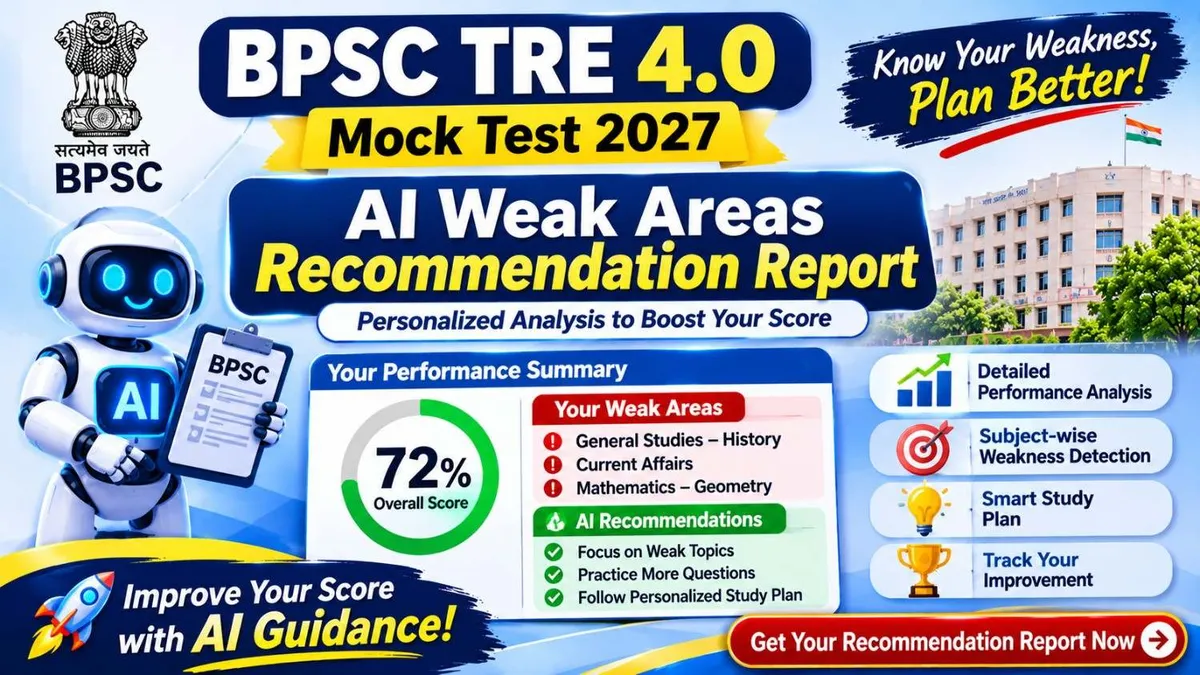
Our post-test diagnostic engine gives you a very detailed SCERT/NCERT chapter level heatmap, your vulnerability to Option D traps, your tie breaker readiness and then throws a targeted 48 hour remedial micro quiz at you to systematically take your 120 mark score up.
- SCERT/NCERT Chapter Level Heatmap: tells you precisely whether your errors are arising from the Class 9-10 NCERT Science modules, the Bihar Freedom Struggle (1857-1942) or the Elementary Mensuration.
- Option D / Option E Trap Sensitivity Index: works out exactly how many marks you've lost in the case of the correct answer being Option D (more than one) or in the case of you not having skipped via Option E.
- Tie Breaker Readiness Gauge: compares your Part-III (80M) domain accuracy directly against your Part-II (40M) general studies to make sure you're in a position to win the automatic tie breakers at the most horrific of the cutoffs.
- Automated 48 hour remedial micro quizzes: a very targeted 20 question custom drill is generated immediately after every full mock test to plug the identified knowledge gaps.
Post Mock Scorecard Audit & 7 Column Error Log Template for TRE 4.0 aspirants
A very strict 30 minute post-mock audit using this 7 column error log will force the aspirant to confront their actual conceptual gaps and turn raw errors into textbook revision which will in itself guarantee better scores in the next test.
| Mock No. & Level | Part & Q.No. (I/II/III) | SCERT/NCERT Chapter & Topic | Error Type (Concept / Trap / Misread) | Net Marks Lost (-1.33 Swing) | Golden Rule / Textbook Line | Re-Test Status |
|---|---|---|---|---|---|---|
| Mock 3 (TGT) | Part-III, Q.85 | Class 9 NCERT Geo (Drainage) | Option D trap | 1.33 mark swing | Narmada and Tapi both flow west | Cleared |
| Mock 3 (TGT) | Part-II, Q.42 | SCERT Class 8 History (1857) | Concept Gap | 1.33 Mark Swing | Kunwar Singh led from Jagdishpur | Cleared |
| Mock 4 (Middle) | Part-I, Q.12 | Basic Hindi (Sandhi) | Misread Question | 0.00 (Qualifying only) | Check difference in Swar/Vyanjan | Pending |
BPSC TRE 3.0 Official Cut-Off Benchmarks vs TRE 4.0 Safe Target Scores (out of 120 marks)
On the analysis of the verified TRE 2.0 and 3.0 cut-offs against the projected TRE 4.0 safe target scores it's absolutely clear how the introduction of the 1/3rd negative marking penalty has completely shifted the 120 mark goalposts.
| Teacher Level & Subject | Category | TRE 2.0 / 3.0 Historical Cut-Off (out of 120) | TRE 4.0 Safe Target Score (with -0.33 penalty) |
|---|---|---|---|
| PRT (Classes 1-5) | UR Male | 75 - 80 / 120 | 72 - 78 / 120 |
| PRT (Classes 1-5) | UR Female | 68 - 72 / 120 | 62 - 68 / 120 |
| Middle (6-8) | Math/Sci | BC / EWS | 74 - 78 / 120 | 69 - 76 / 120 |
| TGT (9-10) | Social Sci | UR Male | 78 - 82 / 120 | 75 - 82 / 120 |
| PGT (11-12) | History | SC / ST | 58 - 62 / 120 | 50 - 56 / 120 |
10 Solved BPSC TRE 4.0 Sample Questions (5 option pattern with step by step explanations)
These 10 exam realistic 5 option questions are precisely the same in terms of difficulty, historical depth and the presence of the D/E traps as the actual BPSC papers. They show you how to use your SCERT textbook knowledge to safely eliminate the distractors.
Q1 (Part I - Qualifying Language): Select the correct sentence in terms of English grammatical structure.
A) The Committee have submitted their report.
B) The committee has tabled its report. [Correct]
C) The Committee have submitted their report.
D) उपर्युक्त में से एक से अधिक (More than one of the above)
E) उपर्युक्त में से कोई नहीं (None of the above)
Correct Answer: B
Why it's right: 'Committee' is the collective noun and is therefore taking the singular verb 'has' and the singular pronoun 'its'.
Why the others are wrong: A has the plural verb 'have'. C has the singular verb 'has' with the plural pronoun 'their'.
Exam Hall hint: collective nouns when acting as a single unit will take a singular verb.
Q2 (Part-I Qualifying Language): 'यथाशक्ति' शब्द में कौन सा समास है?
A) तत्पुरुष समास
B) कर्मधारय समास
C) अव्ययीभाव समास [Correct]
D) उपर्युक्त में से एक से अधिक
E) उपर्युक्त में से कोई नहीं
Correct Answer: C
Why it is right: 'यथाशक्ति' (शक्ती के अनुसार) में प्रथम पद 'यथा' अव्यय है और पूरा पद क्रियाविशेषण की तरह काम करता है, अतः यह अव्ययीभाव समास है।
Why others are wrong: A (तत्पुरुष) and B (कर्मधारय) apply to different word structures.
Exam Hall Hint: जिन शब्दों के शुरू में यथा, प्रति, भर, आ, नि, हर आदि उपसर्ग या अव्यय हों, वहाँ अव्ययीभाव समास होता है।
Q3 (Part-II General Studies): 1857 के विद्रोह के समय बिहार में बाबू कुंवर सिंह ने किस स्थान से नेतृत्व संभाला था?
A) पटना
B) दानापुर
C) जगदिशपुर (आरा) [Correct]
D) उपर्युक्त में से एक से अधिक
E) उपर्युक्त में से कोई नहीं
Correct Answer: C
Why it is right: SCERT Bihar History confirms that Kunwar Singh was leading the revolt from his place in Jagdishpur (Arrah).
Why others are wrong: Patna (A) was under Pir Ali. Danapur (B) was the cantonment where the sepoys mutinied before joining up with Kunwar Singh.
Exam Hall Hint: Jagdishpur is the Rajput chief's forte.
Q4 (Part-II General Studies): As per the Bihar Economic Survey 2026-27, which of the following rivers has a very significant impact on the Agro-Climatic Zone II (North Eastern Bihar)?
A) Kosi
B) Mahananda
C) Gandak
D) उपर्युक्त में से एक से अधिक [Correct]
E) उपर्युक्त में से कोई नहीं
Correct Answer: D
Why it is right: Option D (More than one of the above) is correct as both the Kosi (A) and the Mahananda (B) pass through and have a major impact on Zone II.
Why others are wrong: Gandak (C) is primarily a North-Western Zone I affair.
Exam Hall Hint: If two of the northern rivers are listed for the eastern zone then bubble D.
Q5 (Part-II General Studies): The difference between compound interest and simple interest on a certain sum for 2 years at 10% per annum is Rs.50. What is the principal sum?
A) ₹4,000
B) ₹5,000 [Correct]
C) ₹6,000
D) उपर्युक्त में से एक से अधिक
E) उपर्युक्त में से कोई नहीं
Correct Answer: B
Why it's right: the formula for the 2 year difference is D = P(R/100)². 50 = P(10/100)². 50 = P(1/100). Hence P = 5000.
Why others are wrong: A and C both fail the simple mathematical formula.
Exam Hall Hint: Always learn and memorise the 2 year difference formula D = P(R/100)² to save yourself a lot of calculation time.
Q6 (Part-II General Studies): Which of the following organelles possess their own DNA and ribosomes?
A) Mitochondria
B) Plastids
C) Endoplasmic Reticulum
D) उपर्युक्त में से एक से अधिक [Correct]
E) उपर्युक्त में से कोई नहीं
Correct Answer: D
Why it is right: As per Class 9 NCERT Science both mitochondria (A) and plastids (B) are semi-autonomous organelles having their own DNA and ribosomes.
Why others are wrong: the ER (C) has ribosomes on its rough surface but does not possess its own independent DNA.
Exam Hall Hint: The 'powerhouse' and the 'kitchen' of the cell both have this one particular genetic quirk.
Q7 (Part-III Social Science): With reference to the Indian Constitution, which of the following features were taken over from the Government of India Act, 1935?
A) Federal Scheme
B) Office of the Governor
C) Directive Principles of State Policy
D) उपर्युक्त में से एक से अधिक [Correct]
E) उपर्युक्त में से कोई नहीं
Correct Answer: D
Why it is right: both the Federal Scheme (A) and the Office of the Governor (B) are derived from the 1935 Act.
Why others are wrong: DPSP (C) was taken from the Irish Constitution.
Exam Hall Hint: The 1935 Act provided the massive structural and administrative framework for the Constitution.
Q8 (Part-III Math & Science): A concave mirror produces a real, inverted and same size image. Where is the object placed?
A) At the focus (F)
B) Between the pole (P) and focus (F)
C) At the center of curvature (C) [Correct]
D) उपर्युक्त में से एक से अधिक
E) उपर्युक्त में से कोई नहीं
Correct Answer: C
Why it's right: Class 10 NCERT Light chapter makes it very clear that if you place the object at C you get a real, inverted image of the same size at C.
Why others are wrong: At F (A) produces an image at infinity. Between P and F (B) produces a virtual, erect and magnified image.
Exam Hall Hint: "Same size" always means the Centre of Curvature.
Q9 (Part-III Literature/Hindi): 'रामचरितमानस' की रचना तुलसीदास ने किस भाषा में की थी?
A) ब्रजभाषा
B) अवधी [Correct]
C) खड़ी बोली
D) उपर्युक्त में से एक से अधिक
E) उपर्युक्त में से कोई नहीं
Correct Answer: B
Why it is right: Tulsidas composed the Ramcharitmanas in the Awadhi dialect of Hindi.
Why others are wrong: Surdas mainly wrote in Braj Bhasha (A). Khari Boli (C) came to the fore much later in the modern period.
Exam-Hall Hint: Awadh is the region of Ayodhya so Awadhi is the natural choice of the literary language.
Q10 (Part-III PGT Physics): Which of the following principles strictly governs the working of an optical fibre?
A) Dispersion
B) Interference
C) Polarization
D) उपर्युक्त में से एक से अधिक
E) उपर्युक्त में से कोई नहीं [Correct]
Correct Answer: E
Why it's right: the working principle of an optical fibre is Total Internal Reflection. That's not one of A, B or C so E (none of the above) is the only possible correct answer.
Why others are wrong: Dispersion (A), Interference (B) and Polarisation (C) are all phenomena which have nothing at all to do with the containment of a signal in a fibre.
Exam Hall Hint: if the most obvious fundamental law is simply not there in the options, go with E.