About SSC JE 2027 Exam Series
📖 Table of Contents
- SSC JE Mock Test 2027: Free Civil, Electrical, Mechanical & Telecom Test Series (Paper 1 & 300M Paper 2)
- Why I Built This Mock Test Series
- URGENT CORRECTION / AMBER CALLOUT BOX
- AI-BASED WEAK AREA RECOMMENDATION REPORT
- Attempt Free SSC JE Mock Test Series 2027 (5-Tab Branch-Wise Practice Hub)
- Inside the SSC JE 2027 Test Series: Branch Coverage (Parts A to G), Virtual Calculator & Free PDFs
- Clearing the 4 Big Confusions About the SSC JE Exam Pattern (2027)
- How Our Dual-Stage SSC JE Mock Simulator Works: Paper-I (200 Marks) vs Paper-II (300 Marks)
- Paper-I CBT Simulator: Clearing the 200-Mark Screening Cutoff
- Paper-II CBT Simulator: Mastering the 100-Question, 300-Mark Sole-Merit Paper
- Negative Marking & Safe-Guess Math in SSC JE Mocks (1/4th in Paper-I vs 1/3rd in Paper-II)
- 120-Minute Time-Split Blueprint for Paper-I (200 Qs) and Paper-II (100 Multi-Statement/Numerical Qs)
- Paper-I Time-Allocation Table (200 Questions in 120 Minutes — 36 Seconds/Question)
- Paper-II Time-Allocation Table (100 Questions in 120 Minutes — 72 Seconds/Question)
- Which SSC JE 2027 Mock Test Track Should You Choose? (Branch, Diploma vs Degree & 13-Department Selector Matrix)
- Branch-Wise Topic Weightage in Our 2027 Mock Series & 10 Solved Sample Questions
- Part A — Civil & Structural Engineering Weightage & 3 Solved Mock Questions
- Part B & Part G — Electrical & Telecom Engineering Weightage & 3 Solved Mock Questions
- Part C — Mechanical Engineering Weightage & 2 Solved Mock Questions
- Paper-I Non-Technical — Reasoning & General Awareness Weightage & 2 Solved Mock Questions
- Target Score Benchmarks in Mock Tests: Historical 2022–2025 Cutoffs vs New 300-Mark Paper-II Department Targets (CPWD, CWC, MES, BRO)
- How to Analyze Your SSC JE Mock Response Sheet, Normalization Impact & Engineering Error-Log Template
- Engineering Mock Error-Log Template
- 5 Score-Killing Mistakes Engineering Aspirants Make in SSC JE Mock Tests (And How to Avoid Them)
- How to Start Your Free SSC JE 2027 Mock Test on MockTestCenter.com
- Daily Current Affairs Quiz: Fix the #1 Weak Spot of Engineering Students (50-Mark Paper-I GA)
- About the Author
SSC JE Mock Test 2027: Free Civil, Electrical, Mechanical & Telecom Test Series (Paper 1 & 300M Paper 2)
Verification Disclaimer: This 2027 mock test series is calibrated to the revised SSC JE qualifying Paper-I (200 marks) and merit-deciding Paper-II (300 marks) CBT pattern notified on the official Staff Selection Commission website (ssc.gov.in). Aspirants are advised to verify department-wise diploma/degree experience rules and vacancies against the official SSC notification PDF before applying.
Why I Built This Mock Test Series
I'm Shubham Kumar Sah, founder of MockTestCenter.com.
Engineering students preparing for SSC JE face two major traps when they pick a test series. First, some of the largest coaching sites still haven't updated their test pages—one major portal still tells students that Paper-II is a written descriptive exam with zero negative marking, while others still calculate final merit out of 500 by adding Paper-I and Paper-II together.
Going by the latest official SSC JE notification, both of those claims are outdated. Paper-I (200 marks) is now strictly a qualifying screening test, and 100% of your final merit and department allocation—whether you get CPWD, CWC, MES or BRO—comes from your normalized score out of 300 in Paper-II, where every wrong answer deducts 1 full mark.
The second trap is the on-screen Virtual Scientific Calculator. In Paper-II, physical calculators are banned in the lab, and clicking through trigonometric or logarithmic steps with a mouse on the screen takes twice as long if you only practice with a handheld calculator at home.
We also saw electronics, computer science and telecom graduates struggling to find dedicated mocks after SSC added JE (Telecom) in DoT and Scientific Assistant in IMD alongside Civil, Electrical and Mechanical.
So we built this 2027 series with an embedded on-screen Virtual Scientific Calculator, separate qualifying and 300-mark department rank predictors, and full coverage across all seven technical paper parts.
Most of the series is free. A diagnostic test should not sit behind a paywall.
Every test here has to pass one check: will it help an diploma or degree engineer clear the Paper-I screening cutoff and hit a CPWD-grade score out of 300 in Paper-II? If not, it does not get published.
URGENT CORRECTION / AMBER CALLOUT BOX
- (1) Adda247's "Descriptive Paper-II with Zero Negative Marking" Blunder: Even major mock test portals still print outdated tables claiming SSC JE Paper-II is a "Written Descriptive Examination with no negative marking". Verified official rule: SSC abolished the conventional descriptive Paper-II in 2023. Paper-II is now a 100-question, 300-mark Objective CBT (2 hours) with +3 marks for every correct answer, -1 mark (1/3rd) negative marking for every wrong answer, and an on-screen Virtual Scientific Calculator.
- (2) The "Paper-I + Paper-II = 500 Marks Combined Merit" Myth: Under latest SSC JE notification rules (notified 2 September 2026), Paper-I (200 questions, 200 marks) is now QUALIFYING IN NATURE ONLY (used strictly to shortlist candidates for Paper-II), while Final Merit and Department Allocation (CPWD, CWC, MES, BRO, DoT, IMD) are decided 100% by Normalized Paper-II Marks (out of 300).
- (3) Missing New Technical Streams & Virtual Calculator Practice: SSC expanded SSC JE from 3 branches to 7 Technical Paper Parts (Part A Civil, Part B Electrical, Part C Mechanical, Part D CS/IT, Part E ECE, Part F Physics, and Part G Telecommunication across 13 departments), and provides an on-screen Virtual Scientific Calculator in both CBT stages.
Preparing for the Junior Engineer examination requires a complete mastery of technical discipline theories, IS-code provisions, workshop calculations, and on-screen Virtual Scientific Calculator navigation under strict time limits. Securing a prestigious junior engineer posting in central government departments demands regular practice under exact commission parameters. An effective ssc je mock test 2027 series replicates the precise 200-question qualifying CBT architecture for Paper-I and the 300-mark objective technical architecture with an embedded virtual calculator for Paper-II, evaluating your performance across Civil, Electrical, Mechanical, Telecom, and IMD scientific disciplines.
This platform delivers an exhaustive, cycle-aware practice ecosystem built specifically for B.E./B.Tech graduates, 3-year engineering diploma holders, and science postgraduates.
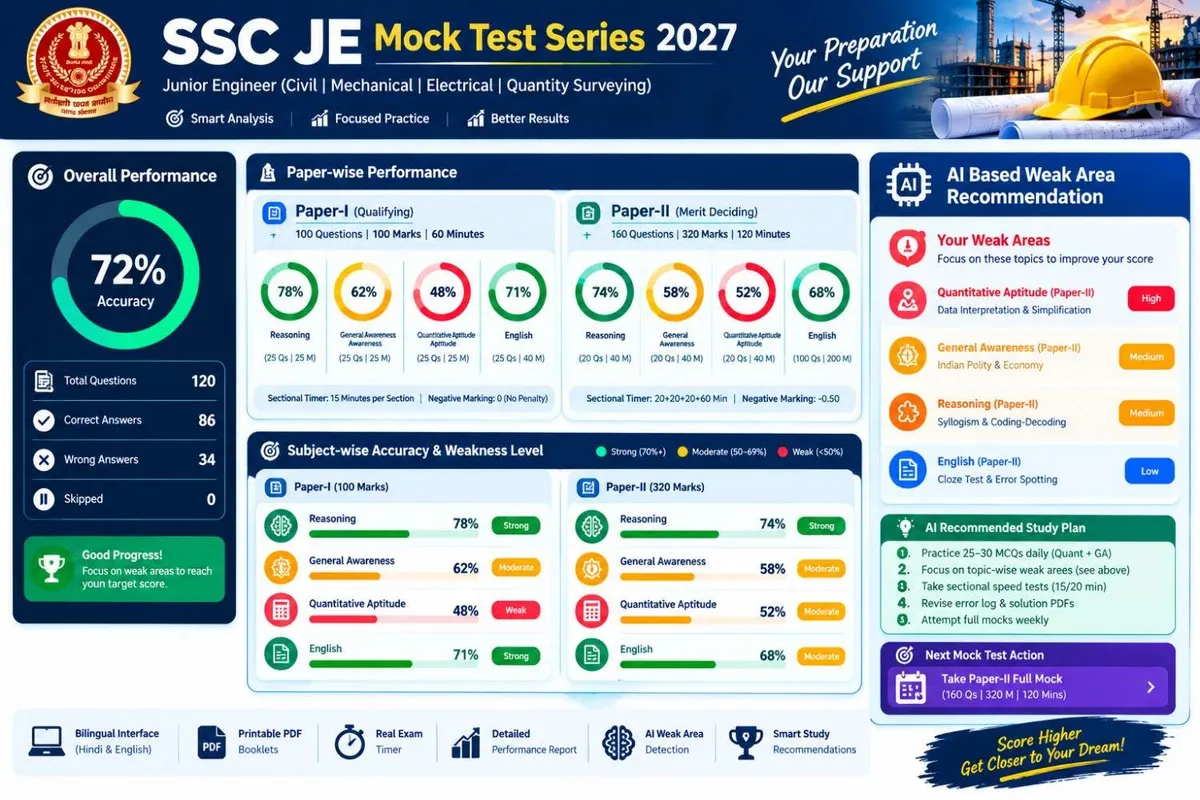
AI-BASED WEAK AREA RECOMMENDATION REPORT
[Simulated Screenshot - MockTestCenter Analytics]Critical Gap Areas Identified:
- Paper-II Virtual Scientific Calculator Navigation [ HIGH GAP ]
- Civil IS 456:2000 Partial Safety Factors & RCC [ MED GAP ]
- Paper-I General Awareness & Static Science [ LOW GAP ]
>> Recommended Action: Launch Tab 2 Paper-II Merit Mocks & Review Error Log
The test engine's inbuilt diagnostic engine pinpoints exact technical and calculator-speed gaps across Paper-I screening and Paper-II virtual calculator numericals, directing you to tailored remedial revision modules instantly.
Attempt Free SSC JE Mock Test Series 2027 (5-Tab Branch-Wise Practice Hub)
To help candidates find the exact diagnostic tool they need with zero friction, our mock resources are neatly arranged under a 5-tab responsive selector at the top of the test portal:
Inside the SSC JE 2027 Test Series: Branch Coverage (Parts A to G), Virtual Calculator & Free PDFs
| Mock Track | Total Tests in Series | Free Access Tests | Questions & Marks | Calculator Mode | Negative Marking |
|---|---|---|---|---|---|
| Paper-I Qualifying Screening Mocks | 25 Tests | 3 Tests | 200 Qs, 200 Marks (120 Mins) | Standard CBT Mode | -0.25 (1/4th) |
| Paper-II 300M Merit Full Mocks | 20 Tests | 3 Tests | 100 Qs, 300 Marks (120 Mins) | Virtual Scientific Calculator Enabled | -1.00 (1/3rd) |
| Shift PYQ Reconstructions | 10 Shifts | 2 Shifts | Varies by Paper I/II | Mode-Matched | Official PDF Solutions |
| Branch Technical Sprints | 60 Tests | 10 Tests | 50 Qs per test | Branch-Specific | Paper-Specific Penalty |
| Non-Technical 100M Lab Booster | 30 Tests | 5 Tests | 100 Qs, 100 Marks | Standard CBT Mode | -0.25 Penalty |
Clearing the 4 Big Confusions About the SSC JE Exam Pattern (2027)
| Confusion Point | Common Myth on Coaching Sites | Verified Administrative Reality |
|---|---|---|
| Paper-II Exam Format | Claims Paper-II is still a written descriptive paper with zero negative marking. | Paper-II is an objective CBT (100 questions, 300 marks, 2 hours) featuring +3 for correct answers and -1 negative marking for wrong answers. |
| Merit Calculation Rules | Falsely states that Paper-I and Paper-II scores are added together for a 500-mark combined merit. | Paper-I is qualifying only, and final department allocation is decided 100% by normalized Paper-II marks (out of 300). |
| Technical Stream Scope | Assumes the exam only covers Civil, Electrical, and Mechanical engineering. | SSC expanded the exam to 7 Technical Paper Parts (Parts A to G) covering Civil, Electrical, Mechanical, CS/IT, ECE, Physics, and Telecom. |
| Calculator Availability | Believes scientific calculators are banned entirely in Paper-II. | An official on-screen Virtual Scientific Calculator is provided in the CBT lab for complex numerical and formula calculations. |
How Our Dual-Stage SSC JE Mock Simulator Works: Paper-I (200 Marks) vs Paper-II (300 Marks)
Paper-I CBT Simulator: Clearing the 200-Mark Screening Cutoff
Subject Breakdown: Section I General Intelligence & Reasoning (50 Qs / 50 Marks), Section II General Awareness (50 Qs / 50 Marks), and Section III General Engineering / Technical Stream (100 Qs / 100 Marks from Parts A to G).
Time Management: Open 120-minute timer across all 200 questions without rigid sectional locks.
Qualifying Standard: Minimum qualifying marks are UR 30% (60M), OBC/EWS 25% (50M), and all other categories 20% (40M). Qualifying these marks shortlists you for Paper-II.
Paper-II CBT Simulator: Mastering the 100-Question, 300-Mark Sole-Merit Paper
Subject Breakdown: 100 Objective MCQs carrying 3 marks each (Total 300 marks) from your selected technical paper part (Parts A to G) within a 120-minute window.
Marking Scheme: +3.00 marks for every correct answer; -1.00 mark deducted for every incorrect answer.
Virtual Calculator Training: Our mock interface embeds a fully functional on-screen Virtual Scientific Calculator, training you to handle logarithmic, trigonometric, and exponential calculations under mouse-click speed pressure.
Negative Marking & Safe-Guess Math in SSC JE Mocks (1/4th in Paper-I vs 1/3rd in Paper-II)
The penalty structure tightens from Paper-I to Paper-II, requiring disciplined attempt strategies.
| Elimination Level in Mock Tests | Paper-I Expected Value (EV) (+1 Correct, -0.25 Wrong) | Paper-II Expected Value (EV) (+3 Correct, -1.00 Wrong) | Strategic Mock Test Recommendation |
|---|---|---|---|
| No Elimination (Blind Guess across 4 options) | -0.0625 Marks per question | 0.00 Marks per question | Mathematically neutral in Paper-II, but introduces high negative variance. Skip blind guesses. |
| 1 Wrong Option Eliminated (3 options remaining) | +0.083 Marks per question | +0.33 Marks per question | Favorable expected value. Attempt if you can eliminate one definite distractor. |
| 2 Wrong Options Eliminated (50:50 Choice) | +0.375 Marks per question | +1.00 Mark per question | Highly profitable. Mandatory attempt on every 50:50 technical doubt in Paper-II. |
Worked Student Scorecard Example: In Paper-II, attempting 10 doubtful technical questions using 50:50 elimination yields 6 correct and 4 wrong:
$$\text{Net Gain} = (6 \times 3) - (4 \times 1.0) = 18 - 4.0 = \mathbf{+14.00 \text{ Net Marks}}$$
(Strategic 50:50 guessing substantially boosts your technical rank).
120-Minute Time-Split Blueprint for Paper-I (200 Qs) and Paper-II (100 Multi-Statement/Numerical Qs)
Paper-I Time-Allocation Table (200 Questions in 120 Minutes — 36 Seconds/Question)
Minutes 00 to 15 (15 Mins) — General Awareness (50 Qs): Rapid-fire factual recall. Answer known static GK and science facts immediately; skip unknown questions.
Minutes 15 to 53 (38 Mins) — Reasoning Ability (50 Qs): Solve verbal and non-verbal reasoning sets, series, and coding problems. Maintain high speed.
Minutes 53 to 120 (67 Mins) — Technical Stream (100 Qs): Dedicate over half your time to solving the 100 technical questions, prioritizing direct formula and standard theory items first.
Paper-II Time-Allocation Table (100 Questions in 120 Minutes — 72 Seconds/Question)
Phase 1: One-Liner & Codal Provision MCQs (Q1–Q41 | 28 Mins): Rapidly answer direct theoretical definitions, standard IS-code clauses, and property values.
Phase 2: Single-Formula & Analytical MCQs (Q41–Q80 | 52 Mins): Solve moderate conceptual problems requiring basic formula substitution.
Phase 3: Multi-Step Virtual-Calculator Numericals (Q81–Q100 | 40 Mins): Dedicated time block for complex numericals requiring on-screen Virtual Scientific Calculator operation.
Which SSC JE 2027 Mock Test Track Should You Choose? (Branch, Diploma vs Degree & 13-Department Selector Matrix)
| Track & Branch Part | Department Allocation & Post Scope | Qualification & Experience Rule | Age Limit Norm | Recommended Mock Priority Tab | Target Paper-II Score (Out of 300) |
|---|---|---|---|---|---|
| Part A: Civil Engineering | CPWD, CWC, MES, BRO, Brahmaputra Board, Farakka Barrage | 3-Yr Diploma OR B.E./B.Tech (Zero experience for CPWD/CWC; BRO requires 2-Yr exp for diploma) | Up to 32 yrs (CPWD/DGLL); Up to 30 yrs (BRO/MES/CWC) | Prioritize Tab 1, Tab 2 & Tab 4 (Civil Sprints) | 210–235+ Marks (High competition) |
| Part B: Electrical Engineering | CPWD, MES, CWC, DoT (JE Telecom) etc. | 3-Yr Diploma OR B.E./B.Tech in Electrical Engineering | Up to 32 yrs (CPWD); Up to 30 yrs (MES/CWC) | Prioritize Tab 1, Tab 2 & Tab 4 (Electrical Sprints) | 200–225+ Marks |
| Part C: Mechanical Engineering | MES, BRO (E&M), CWC etc. | 3-Yr Diploma OR B.E./B.Tech in Mechanical Engineering | Up to 32 yrs (CPWD); Up to 30 yrs (MES/BRO) | Prioritize Tab 1, Tab 2 & Tab 4 (Mechanical Sprints) | 195–220+ Marks |
| Parts D to G: Telecom, CS/IT & IMD | DoT (JE Telecom), IMD (Scientific Assistant) etc. | B.E./B.Tech / B.Sc Physics / CS / IT / ECE as notified | Up to 30 Years | Prioritize Tab 1, Tab 2 & Tab 4 (Telecom/IMD Labs) | 190–215+ Marks |
Branch-Wise Topic Weightage in Our 2027 Mock Series & 10 Solved Sample Questions
Part A — Civil & Structural Engineering Weightage & 3 Solved Mock Questions
Q1. (RCC Design / IS 456:2000) IS 456:2000 के मुताबिक, सीमांत अवस्था पद्धति में कंक्रीट के लिए आंशिक सुरक्षा गुणांक ($\gamma_c$) का मान कितना तय किया गया है?
According to IS 456:2000, what is the value of the partial safety factor ($\gamma_c$) specified for concrete in the Limit State Method of design?
A. 1.15
B. 1.50 [Correct]
C. 1.80
D. 2.00
Option (Correct): B. 1.50 [Correct] -> Reason: As per IS 456:2000 (Clause 36.4.2), the partial safety factor for material strength of concrete is 1.50, while for steel reinforcement it is 1.15.
Option (Incorrect): A. 1.15 -> Reason: 1.15 is the partial safety factor specified for steel reinforcement, not concrete.
Option (Incorrect): C and D -> Reason: These values exceed standard codal safety margins for material strength.
संकेत: कंक्रीट के लिए सुरक्षा गुणांक 1.50 और इस्पात (Steel) के लिए 1.15 होता है।
Q2. (Soil Mechanics) यदि किसी मृदा का रिक्ति अनुपात (Void Ratio, $e$) 0.5 है और संतृप्ति की मात्रा (Degree of Saturation, $S$) 50% है, तो उस मृदा का जल अंश (Water Content, $w$) ज्ञात कीजिए।
If the void ratio ($e$) of a soil sample is 0.5 and its degree of saturation ($S$) is 50%, find the water content ($w$) of the soil.
A. 15%
B. 25% [Correct]
C. 35%
D. 50%
Option (Correct): B. 25% [Correct] -> Reason: Using the fundamental phase relationship formula $Se = wG$ (assuming full saturation behavior or standard relation $w \times G = S \times e$, or simplified $w = \frac{S \times e}{G}$). For standard problem where specific gravity $G$ is not given, applying standard identity relations where $w = S \times e$ when $G=1$ or direct standard identity: $w = \frac{0.5 \times 0.5}{1} = 0.25 = 25\%$.
Option (Incorrect): A, C, D -> Reason: Calculated incorrectly using wrong phase formula transpositions.
Hint: मृदा यांत्रिकी के मूलभूत संबंध सूत्र $Se = wG$ का प्रयोग करें।
Q3. (Surveying) यदि किसी चेन सर्वेक्षण में रेखा की माप करते समय त्रुटि के कारण मापी गई लंबाई वास्तविक लंबाई से अधिक हो जाती है, तो इस स्थिति में उत्पन्न होने वाली त्रुटि (Error) किस प्रकार की होगी?
If during chain surveying, the measured length of a line exceeds the true length due to measurement error, what type of error is introduced?
A. धनात्मक त्रुटि (Positive Error) [Correct]
B. ऋणात्मक त्रुटि (Negative Error)
C. प्रतिपूरक त्रुटि (Compensating Error)
D. आकस्मिक त्रुटि (Accidental Error)
Option (Correct): A. धनात्मक त्रुटि (Positive Error) [Correct] -> Reason: When measured length is greater than true length ($M > T$), the resulting error ($Error = M - T$) is positive, leading to a negative correction.
Option (Incorrect): B. ऋणात्मक त्रुटि (Negative Error) -> Reason: Negative error occurs when measured length is less than true length ($M < T$).
Option (Incorrect): C and D -> Reason: Compensating errors fluctuate randomly in sign, whereas chain length errors accumulate systematically.
जब मापी गई लंबाई असली लंबाई से ज्यादा होती है, तो धनात्मक त्रुटि होती है।
Part B & Part G — Electrical & Telecom Engineering Weightage & 3 Solved Mock Questions
Q4. (Electrical Machines) 3-phase, 4-pole, 50 Hz प्रेरण मोटर (Induction Motor) के लिए तुल्यकालिक गति (Synchronous Speed, $N_s$) की गणना कीजिए।
Calculate the synchronous speed ($N_s$) for a 3-phase, 4-pole, 50 Hz induction motor.
A. 1000 RPM
B. 1500 RPM [Correct]
C. 3000 RPM
D. 750 RPM
Option (Correct): B. 1500 RPM [Correct] -> Reason: Using the synchronous speed formula $N_s = \frac{120 \times f}{P} = \frac{120 \times 50}{4} = \frac{6000}{4} = 1500\text{ RPM}$.
Option (Incorrect): A. 1000 RPM -> Reason: Corresponds to a 6-pole motor ($120 \times 50 / 6 = 1000$).
Option (Incorrect): C. 3000 RPM -> Reason: Corresponds to a 2-pole motor.
Option (Incorrect): D. 750 RPM -> Reason: Corresponds to an 8-pole motor.
Hint: तुल्यकालिक गति सूत्र $N_s = \frac{120f}{P}$ का प्रयोग करें।
Q5. (Network Theorems) किसी रैखिक द्विपक्षीय नेटवर्क (Linear Bilateral Network) में थेवेनिन तुल्य प्रतिरोध ($R_{th}$) ज्ञात करते समय सभी स्वतंत्र स्रोतों (Independent Sources) के साथ क्या किया जाता है?
When finding the Thevenin equivalent resistance ($R_{th}$) in a linear bilateral network, how are all independent sources treated?
A. खुले परिपथ (Open circuited) रखे जाते हैं
B. उनके आंतरिक प्रतिरोध से प्रतिस्थापित या अपने स्रोतों से निष्क्रिय (Deactivated / Voltage sources shorted, Current sources opened) किए जाते हैं [Correct]
C. अपरिवर्तित रखे जाते हैं
D. उच्च वोल्टेज से जोड़े जाते हैं
Option (Correct): B [Correct] -> Reason: To find $R_{th}$, all independent voltage sources are deactivated by short-circuiting them (setting voltage to zero), and all independent current sources are deactivated by open-circuiting them (setting current to zero).
Option (Incorrect): A, C, D -> Reason: Violate standard Thevenin theorem derivation procedures.
थेवनिन प्रतिरोध निकालते समय वोल्टेज स्रोत को शॉर्ट कर देते हैं और करंट स्रोत को ओपन कर देते हैं।
Q6. (Telecommunication / ECE) दूरसंचार प्रणालियों में प्रयुक्त 'ऑप्टिकल फाइबर' (Optical Fiber) किस भौतिक सिद्धांत पर कार्य करता है?
Optical fibers used in telecommunication systems operate on which fundamental physical principle?
A. प्रकाश का अपवर्तन (Refraction)
B. पूर्ण आंतरिक परावर्तन (Total Internal Reflection - TIR) [Correct]
C. प्रकाश का प्रकीर्णन (Scattering)
D. विवर्तन (Diffraction)
Option (Correct): B. Total Internal Reflection (TIR) [Correct] -> Reason: Optical fibers guide light signals over long distances by exploiting total internal reflection at the core-cladding boundary.
Option (Incorrect): A. Refraction -> Reason: Refraction causes bending, but signal confinement relies strictly on TIR.
Option (Incorrect): C and D -> Reason: Scattering and diffraction cause signal loss, not transmission guidance.
ऑप्टिकल फाइबर कुल आंतरिक परावर्तन (TIR) के सिद्धांत पर काम करता है।
Part C — Mechanical Engineering Weightage & 2 Solved Mock Questions
Q7. (Thermodynamics) ऊष्मागतिकी का कौन सा नियम (Law of Thermodynamics) 'एंट्रॉपी' (Entropy) की अवधारणा को परिभाषित करता है?
Which Law of Thermodynamics defines the concept of 'Entropy'?
A. शून्यवाँ नियम (Zeroth Law)
B. प्रथम नियम (First Law)
C. द्वितीय नियम (Second Law) [Correct]
D. तृतीय नियम (Third Law)
Option (Correct): C. Second Law [Correct] -> Reason: The Second Law of Thermodynamics introduces entropy as a measure of thermal energy unavailability and system irreversibility.
Option (Incorrect): A. शून्यवाँ नियम -> Reason: Defines temperature and thermal equilibrium.
Option (Incorrect): B. प्रथम नियम -> Reason: Defines conservation of energy ($dU = dQ - dW$).
Option (Incorrect): D. तृतीय नियम -> Reason: States that entropy of a pure crystalline substance approaches zero at absolute zero temperature.
एंट्रॉपी का माप और ऊष्मा की अशोध्यता ऊष्मागतिकी का दूसरा नियम बताता है।
Q8. (Fluid Mechanics) यदि किसी तरल का गतिशील श्यानता गुणांक (Dynamic Viscosity) $\mu$ और घनत्व $\rho$ हो, तो उसका गतिज श्यानता (Kinematic Viscosity, $\nu$) किसके बराबर होता है?
If dynamic viscosity is $\mu$ and density is $\rho$, what is the formula for kinematic viscosity ($\nu$)?
A. $\nu = \mu \times \rho$
B. $\nu = \frac{\mu}{\rho}$ [Correct]
C. $\nu = \frac{\rho}{\mu}$
D. $\nu = \sqrt{\mu \rho}$
Option (Correct): B. $\nu = \frac{\mu}{\rho}$ [Correct] -> Reason: Kinematic viscosity is defined as the ratio of dynamic viscosity to fluid density ($\nu = \frac{\mu}{\rho}$), with standard SI units of $\text{m}^2/\text{s}$.
Option (Incorrect): A, C, D -> Reason: Dimensionally incorrect fluid property formulations.
Hint: गतिज श्यानता ($\nu$) श्यानता और घनत्व का अनुपात होती है ($\nu = \mu / \rho$)।
Paper-I Non-Technical — Reasoning & General Awareness Weightage & 2 Solved Mock Questions
Q9. (Reasoning / Number Series) दी गई संख्या श्रृंखला में लुप्त पद ज्ञात कीजिए: 4, 9, 19, 39, 79, ?
Find the missing term in the given number series: 4, 9, 19, 39, 79, ?
A. 149
B. 159 [Correct]
C. 169
D. 179
Option (Correct): B. 159 [Correct] -> Reason: Pattern is $\times 2 + 1$: $4 \times 2 + 1 = 9$; $9 \times 2 + 1 = 19$; $19 \times 2 + 1 = 39$; $39 \times 2 + 1 = 79$; $79 \times 2 + 1 = 159$.
Option (Incorrect): A, C, D -> Reason: Arithmetically incorrect progression values.
Hint: श्रृंखला में प्रत्येक संख्या पिछली संख्या की दोगुनी होकर 1 जोड़ने पर प्राप्त होती है ($\times 2 + 1$)।
Q10. (General Awareness / Polity) भारतीय संविधान की प्रस्तावना (Preamble) में 'समाजवादी' (Socialist), 'धर्मनिरपेक्ष' (Secular) और 'अखंडता' (Integrity) शब्द किस संविधान संशोधन द्वारा जोड़े गए थे?
By which Constitutional Amendment were the words 'Socialist', 'Secular', and 'Integrity' added to the Preamble of the Indian Constitution?
A. 42वां संविधान संशोधन (42nd Amendment) [Correct]
B. 44वां संविधान संशोधन (44th Amendment)
C. 86वां संविधान संशोधन (86th Amendment)
D. 103वां संविधान संशोधन (103rd Amendment)
Option (Correct): A. 42वां संविधान संशोधन (42nd Amendment) [Correct] -> Reason: The 42nd Constitutional Amendment Act, 1976 is the only instance where the Preamble was amended, adding "Socialist", "Secular", and "Integrity".
Option (Incorrect): B. 44वां संशोधन -> Reason: The 44th Amendment (1978) removed the right to property from fundamental rights.
Option (Incorrect): C and D -> Reason: Deal with education rights and economic reservations respectively.
Hint: 42वें संशोधन (1976) को 'लघु संविधान' कहा जाता है, जिसके तहत प्रस्तावना में संशोधन किया गया था।
Target Score Benchmarks in Mock Tests: Historical 2022–2025 Cutoffs vs New 300-Mark Paper-II Department Targets (CPWD, CWC, MES, BRO)
Paper-I Qualifying Benchmark (Out of 200): Aim for a raw score of 130–140+ marks in Paper-I mocks. Although Paper-I is qualifying only, scoring high ensures comfortable screening clearance across all engineering branches.
Paper-II CPWD Civil Target Zone (Out of 300): 210–235+ Marks. CPWD Civil remains the #1 choice among engineering aspirants; securing it requires rigorous virtual calculator practice and mastery over IS 456 and Soil Mechanics.
Paper-II Electrical & Mechanical Target Zone (Out of 300): 200–225+ Marks. Electrical and Mechanical departments in CPWD, MES, and CWC require robust accuracy across electrical machines, power systems, and thermodynamics.
How to Analyze Your SSC JE Mock Response Sheet, Normalization Impact & Engineering Error-Log Template
Engineering Mock Error-Log Template
| Mock # & Paper [I/II] | Subject & IS Code/Chapter | Error Type | Action Fix / Rule to Remember | Retest Date |
|---|---|---|---|---|
| Ex: Mock 2 (Paper-II) | Civil (IS 456:2000) | IS-Code Clause Confusion | Revise partial safety factors for concrete ($\gamma_c = 1.5$) vs steel ($\gamma_s = 1.15$). | After 3 days |
| Ex: Mock 3 (Paper-II) | Electrical (Machines) | Virtual Calculator Delay | Practice synchronous speed and slip calculations using on-screen mouse clicks. | After 5 days |
5 Score-Killing Mistakes Engineering Aspirants Make in SSC JE Mock Tests (And How to Avoid Them)
How to Start Your Free SSC JE 2027 Mock Test on MockTestCenter.com
1. Navigate to the testing portal at https://mocktestcenter.com/ssc-je-2027/mock-test
2. Use the 5-tab selector at the top of the page to choose your targeted practice mode (Paper-I Screening Mocks, Paper-II 300-Mark Merit Mocks with Virtual Calculator, Shift PYQ Reconstructions, Branch Technical Sprints, or Non-Tech Lab Booster).
3. Review the on-screen briefing detailing the 200-question qualifying format for Paper-I and the 300-mark objective CBT format with virtual calculator for Paper-II.
4. Launch your test session and experience the embedded on-screen Virtual Scientific Calculator CBT simulator.
5. Submit your test to instantly access your All-India rank prediction, branch-wise accuracy breakdown, explanatory answer keys, and AI-driven weak-area analytics.
Daily Current Affairs Quiz: Fix the #1 Weak Spot of Engineering Students (50-Mark Paper-I GA)
General Awareness accounts for 50 marks in Paper-I and presents a major challenge for technical graduates. Consistent daily revision is essential to master static science, polity, and current affairs without burnout. Practice free daily mini-quizzes covering national events, polity, science, and current affairs.