About SSC JE 2027 NCERT-based Tests
- 1.SSC JE NCERT Tests: Key Facts First
- 2.Where School Books Really Work: Two Jobs
- 3.The Science Shelf: GA Marks and Branch Basics
- 4.The Maths Shelf: The Base Under Your Sums
- 5.From School Books to the JE Paper in Four Steps
- 6.The India Shelf: History, Geography, Polity
- 7.Where NCERT Stops and the Diploma Books Take Over
- 8.Read One Chapter, Test It the Same Day
- 9.One Chapter Under the Knife: Class 10 Electricity
- 10.School Books for the New Parts: Telecom and IMD
- 11.A 30 Day Base Plan
- 12.Mistakes Candidates Make With NCERT for JE
- 13.Revision Loops: The Base Comes Back in Month Three
Quick Answer: SSC JE NCERT Books sound like an odd shelf for an engineering exam, but the paper itself points at them. The General Awareness part of Paper-I tests everyday science, history, geography and polity at a school level, and the engineering parts are set at about diploma level, which stands on Class 9 and 10 maths and science. This page maps the NCERT books of Class 6 to 10 to the two jobs they do in SSC JE, and draws the line where school books stop and your diploma books take over.
SSC JE NCERT Tests: Key Facts First
The exam frame in short lines. SSC JE is the Junior Engineer Examination of the Staff Selection Commission. Its latest notice is dated 2 September 2026 on ssc.gov.in, with 1,699 posts in the SSC vacancy list of 8 October 2026. Paper-I holds 200 questions for 200 marks in 2 hours and is qualifying in nature. Paper-II holds 100 branch questions for 300 marks, and its normalised marks alone decide the final merit.
Now the two lines that give school books their place. The notice says the General Awareness questions test the world around the candidate, with everyday observation in its scientific aspect, and India and its neighbours in history, culture, geography, the economic scene, general polity and scientific research. That is the Class 6 to 10 social science and science shelf, asked in adult words. And the notice says the standard of the engineering questions is about the level of a diploma in engineering. A diploma course itself starts from Class 10 maths and science: units, mensuration, heat, light, sound, basic electricity.
So NCERT books do two jobs here. They carry the fixed base of the 50 GA questions. And they repair the school base under the branch chapters, for the candidate whose Class 10 maths went cold during three years of diploma classes that assumed it.
All NCERT books from Class 1 to 12 are free as PDFs on the official NCERT site, ncert.nic.in. Download fresh copies and check the chapter list before you study. The SSC JE 2027 notice has not come yet. A notice in 2027 is expected on the yearly rhythm of this exam, and base work is exactly the work to do while you wait.
| Book family | NCERT books to read | The job it does in SSC JE |
|---|---|---|
| Science, Class 6 to 10 | Science books of Class 6, 7, 8, 9 and 10: motion, force, heat, light, sound, electricity, magnetism, metals, carbon, the living world | Everyday science questions in GA; the base under Electrical and Mechanical basics |
| Maths, Class 6 to 10 | Mathematics books of Class 6 to 10: number work, percentage, ratio, mensuration, triangles, circles, basic trigonometry | Speed maths for reasoning; area, volume and angle base under Civil and Mechanical sums |
| History | Our Pasts I, II and III; India and the Contemporary World I and II | History questions in GA: ancient, medieval and modern India in one line each |
| Geography | The Earth: Our Habitat; Our Environment; Resource and Development; Contemporary India I and II | Rivers, states, climate, crops, resources: the map questions of GA |
| Polity | Social and Political Life I, II and III; Democratic Politics I and II | Constitution, Parliament, courts, Panchayati Raj: the polity frame of GA |
| Economics | Economics of Class 9; Understanding Economic Development of Class 10 | Plain money ideas: banks, work, sectors of the economy, in the words GA uses |
What This Page Covers
- Where school books really work: two jobs
- The science shelf: GA marks and branch basics
- The maths shelf: the base under your sums
- From school books to the JE paper in four steps
- The India shelf: history, geography, polity
- Where NCERT stops and the diploma books take over
- Read one chapter, test it the same day
- One chapter under the knife: Class 10 electricity
- School books for the new parts: Telecom and IMD
- A 30 day base plan
- Mistakes candidates make with NCERT for JE
- Revision loops: the base comes back in month three
Where School Books Really Work: Two Jobs
Job one is the GA part of Paper-I. Fifty questions, 50 marks, and the gate maths of this exam give those marks real weight. In the 2025 cycle the general shortlisting line sat at 127.22748 out of 200 on the Civil list. A candidate whose branch part gives 65 and reasoning gives 40 needs about 25 from GA to stand near that line. Twenty-five GA marks do not come from news alone. The fixed half of the part, science, history, geography and polity, comes from school books or it does not come at all.
Look at what the notice asks for. Everyday observation in its scientific aspect: why a metal vessel feels cold, what a fuse does, how sound travels, what happens to light in water. History, culture, geography, polity, scientific research. A candidate who read his Class 6 to 10 books well already holds most of this. A candidate who left them in a trunk in Class 11 holds a hole shaped exactly like the GA part.
Job two is quieter. The branch parts are set at about diploma level, and diploma books assume your school base is warm. Civil sums stand on mensuration and trigonometry from Class 9 and 10. Electrical basics stand on the Class 10 chapters of electricity and magnetism. Mechanical basics stand on motion, force, work and heat from Class 9 science. When a diploma holder fails a branch question, the cause is often not the diploma chapter. It is the school step inside it: a unit changed wrong, an area formula half remembered, a ratio turned upside down.
A diploma holder in Bhopal told his study group that his Fluid Mechanics was weak. His chapter tests told a different story. His Fluid Mechanics errors were unit errors and area errors, Class 9 and 10 ground. Two weeks of school maths repair raised his branch scores more than a month of new diploma reading had. The base is not below the exam. The base is inside the exam.
Two jobs. That is all. A book that serves neither job does not belong in your JE week, whatever a book list on the internet says. The tests on this tab, the SSC JE NCERT based tests, check the base chapter by chapter, the same way the chapter tests check your branch chapters.
The Science Shelf: GA Marks and Branch Basics
Read the science books of Class 6 to 10 in order, and read them like a JE candidate, not like a school child. The school exam asked for long answers. This exam asks for one right option among four close ones. So read for small hard facts: a unit, a range, a cause, a name.
Class 6 to 8 science gives the ground floor: food and materials, motion and measurement, light and shadows, simple electricity, air and water. Class 9 gives motion, force and gravitation, work and energy, sound, and the matter chapters. Class 10 gives light, electricity, magnetic effects of current, metals and non-metals, carbon compounds, and life processes. That Class 10 electricity chapter is the single most JE book on the whole shelf: current, potential difference, resistance, series and parallel, heating effect. Part-B candidates meet its children in their first diploma year, and GA asks its facts directly.
Give each chapter the same treatment: read it, close it, and give its test the same day. Facts read in silence stay in silence. The score tells you which chapters were warm and which were only familiar. A chapter under half goes back on the desk within the week.
Keep a small facts notebook beside the books. One line per fact that a test caught you on: the SI unit of pressure, the metal that stays liquid, the acid in a lemon. GA questions repeat fact families year after year, and a notebook of your own misses is the shortest book you will ever revise from.
The Maths Shelf: The Base Under Your Sums
Maths first among equals, because it serves both jobs at once. It feeds the arithmetical reasoning inside the reasoning part: number series, percentage, ratio, average, simple interest, time and work, speed and distance. And it feeds the branch sums, where mensuration, triangles and basic trigonometry sit inside Surveying, Estimating, Strength of Materials and half the Mechanical chapters.
Open the Class 6 to 8 books and fix the number base: fractions, decimals, percentage, ratio and proportion. Then Class 9 and 10 for the shapes: areas of triangles and circles, surface areas and volumes, heights and distances, and the first trigonometry. You do not need the full chapters at school depth. You need the formulas warm in the hand and the unit changes clean, because a JE sum that starts with a wrong unit ends with a wrong option, however strong the engineering idea was.
Practise this shelf with a clock. Reasoning questions pay 1 mark and close in under a minute when the base is warm. A candidate in a hostel in Patna did one timed maths set with his morning tea for 5 weeks and raised his reasoning attempts from 34 to 44 of 50. His maths had not grown. His hand had.
And do the sums the hall way: with a screen calculator for the heavy ones. The notice gives a scientific calculator on the computer screen for the full exam. School maths practised only by hand leaves the mouse slow, and mouse speed is part of the branch part's 39 seconds a question.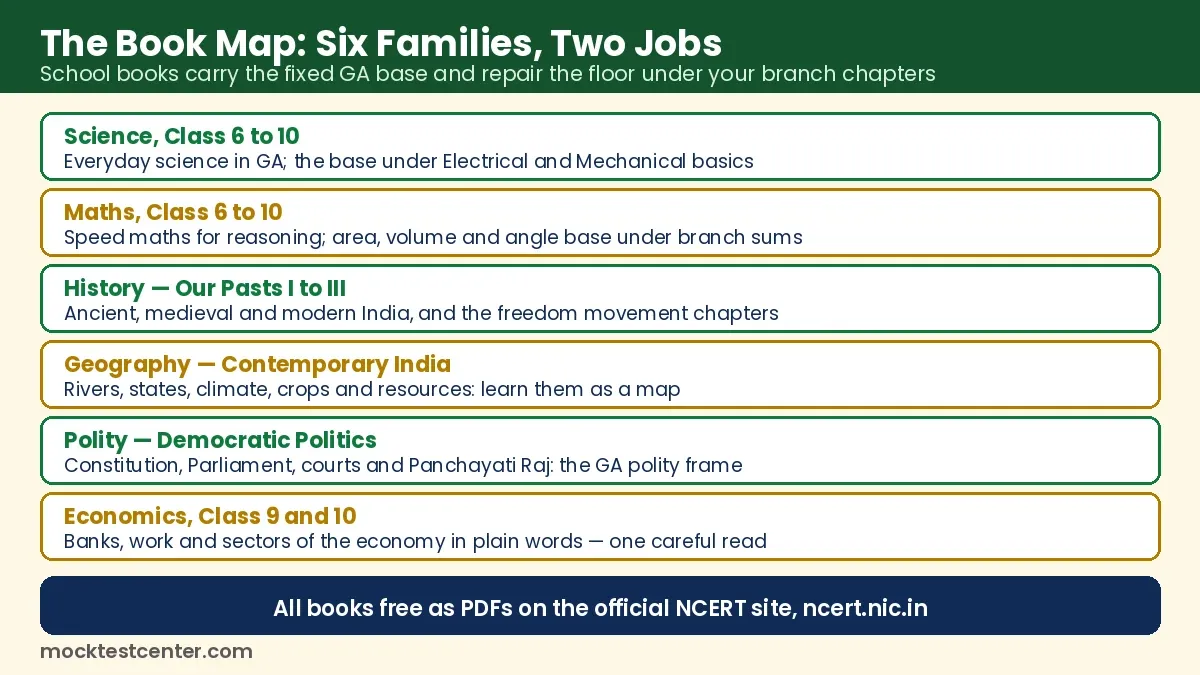
From School Books to the JE Paper in Four Steps
From School Books to the JE Paper: Four Steps
The steps hold because each one feeds the next. Science without the maths base gives you facts you cannot use inside sums. A fine India map with cold science loses the other half of GA. And a base that is never tested is a base you only hope you have. Step 4 is where hope ends and the register begins.
The India Shelf: History, Geography, Polity
History in this paper is a line, not a library. Our Pasts I, II and III carry the main story: early kingdoms, the Sultanate and the Mughals, the British years and the freedom fight. Read the freedom movement chapters twice, because GA returns to them in every cycle: movements, years, places, names. India and the Contemporary World of Class 9 and 10 adds the world frame around it.
Geography is the most asked of the three. The Earth: Our Habitat, Our Environment, Resource and Development, and Contemporary India I and II give you the physical map: rivers and their states, climate and monsoon, soils, crops, minerals, power plants, ports. Learn it as a map, not as lines. A question that names a river wants the state or the dam or the tributary, and a mind that holds the map answers in seconds.
Polity is the frame book set: Social and Political Life I, II and III, then Democratic Politics I and II. The Constitution in short, Parliament, the President, the courts, fundamental rights and duties, Panchayati Raj. GA polity questions stand on this frame and rarely step outside it at this level.
Economics stays short: Economics of Class 9 and Understanding Economic Development of Class 10. Sectors of the economy, banks and money, work and poverty in plain words. One careful read is enough for this paper.
News sits on top of this shelf, and it has its own home on this site, the current affairs tests. A map from a school book cannot tell you what the government opened last month, and last month cannot tell you where the river rises. GA needs both layers, and the sectional tests of the GA part will show you which layer is leaking.
Where NCERT Stops and the Diploma Books Take Over
Now the hard line of this page, drawn once, in full. NCERT books will not teach you Concrete Structures, DC Machines or Theory of Machines. Paper-II, the paper that decides your post, is branch depth from diploma books and the official syllabus, and no school book stands in for it. A candidate who spends his last two months only on NCERT has polished the gate and left the race unread.
Hold the split the way the marks hold it. GA is 50 of the 200 Paper-I marks, and only the fixed part of GA belongs to school books. The branch parts hold 100 marks in Paper-I and all 300 in Paper-II. So the week splits in that shape: branch chapters take the big hours, school base takes one honest block a day, and news takes its own short block.
There is one more place school books quietly stop. They do not teach exam craft: the screen calculator, the IS 456:2000 table on the console, the 0.25 and 1 mark cuts, the two pass method inside a part. Craft comes from papers and tests, the previous year papers and the full tests of this sub-category. Base, craft, depth: a full plan holds all three, and no one of them can do the work of the other two.
Read One Chapter, Test It the Same Day
The method is small, and it is the same method this site uses on every NCERT tab. Read one chapter. Close the book. Write what you remember on a blank page, or say it aloud once, standing, like a teacher. Then give the chapter test that same day, timed, with no book open.
School facts feel easy while you read them. They feel known. Then the test asks for the one unit, the one river, the one article, and the feeling turns out to be a guest in the head. It never moved in. That small shock is the lesson, and it costs an evening at home. The same gap found inside the real GA part costs gate marks, and gate marks now guard your whole Paper-II chance.
Keep one register for this work: book, chapter, date, score. When a chapter scores under half, star it and read it again inside the same week, with a different tool. If you read it as text, draw it as a map or a table this time. If it is a science chapter, work its diagrams by hand. A chapter read twice in the same way fails twice in the same way.
Pace: one chapter a day is strong, and the junior books move faster, so two small Class 6 or 7 chapters can share a day. The Class 10 books are heavier and earn their own days. On heavy diploma days, take a half chapter and its half test rather than skipping the day. Slow days do not break chains. Skips do.
One Chapter Under the Knife: Class 10 Electricity
Look at one chapter closely, to see how much of this exam one school chapter carries. The Class 10 science chapter on electricity holds: electric current and its unit, potential difference, Ohm's law, resistance and the things it depends on, resistors in series and in parallel, the heating effect of current, and electric power.
In the GA part, this chapter pays directly. Questions on units, on the fuse, on the kilowatt hour, on why a bulb glows, stand on these lines. In Part-B, it pays again, one floor down: the diploma subject Fundamentals of Electrical Engineering opens with the same ground, circuit elements, voltage, current, power and energy, and the candidate who holds the school chapter cold reads the diploma chapter at twice the speed. In the reasoning part it pays a third time, quietly, because the number habits of this chapter, ratios of resistances, shares of power, are the same habits the arithmetical questions test.
One chapter, three payments. That is why the base plan gives this chapter 2 full days: one to read and test, one to work its sums with a screen calculator and retest the misses. A chapter that pays three times earns two days. A chapter that pays once, like a single history topic, earns its one day and no more. Spend days by payments, not by page counts.
The same knife work fits other chapters. Class 9 motion pays in GA science, in Engineering Mechanics, and in reasoning speed sums. Class 10 light pays in GA and in the optics corners of diploma physics. Mensuration pays in GA maths questions, in Surveying and Estimating, and in half the area and volume work of Civil. When you plan the base month, mark each chapter with its payment count in the register margin: 1, 2 or 3. The 3 payment chapters go first and get the retests. The 1 payment chapters fill the light days.
School Books for the New Parts: Telecom and IMD
The 2026 cycle widened this exam, and the new parts have school shelves of their own. If your form carries one of them, your NCERT map changes shape.
Scientific Assistant candidates in IMD choose one of Part-D, Part-E or Part-F. Part-F is Physics, and its notice syllabus runs at graduation level: mechanics, oscillations and waves, optics, electricity and magnetism, thermodynamics, modern physics, solid state and electronics. The floor under that degree-level list is the Class 11 and 12 Physics books. A candidate whose Class 12 optics and modern physics are cold will feel it in Part-F long before he feels it anywhere else. For this part, the NCERT plan runs one class higher: Class 11 and 12 physics first, with the Class 9 and 10 science books as the repair shelf beneath them.
Part-D, Computer Science and Information Technology, and Part-E, Electronics and Telecommunication, also stand at graduation level in the notice. School books feed them lightly: Class 10 electricity and magnetism under Part-E, number systems and basic maths under Part-D. Their real base is their degree and diploma books, and this page will not pretend otherwise. What NCERT still gives these candidates in full is the common ground: the GA part and the maths base, which every part of Paper-I shares.
Telecom candidates, Part-G, hold a degree-level list too: network analysis, signals and systems, electronic devices, analog and digital circuits and communication, electromagnetics. Again, the school shelf serves the GA part and the maths habits, and the branch depth belongs to their own books.
The rule that survives every part is the split. School books carry the fixed base of GA for all candidates, and the floor under the branch for the diploma-level parts. They carry no branch depth for any part. Hold that line and the shelf will serve you. Cross it, by asking school books to do a diploma book's work, and the shelf will fail you in the one paper that decides your post.
A 30 Day Base Plan
Thirty days of one block a day builds this base without touching the heart of your branch study. Days 1 to 10: science, Class 6 to 10, one or two chapters a day with their tests, Class 10 electricity and light given 2 days each. Days 11 to 18: maths, the number base first, then mensuration and basic trigonometry, with one timed reasoning set every second day. Days 19 to 27: the India shelf, history and geography on alternate days, polity in the last 3 days of the block. Days 28 to 30: every starred chapter in your register read again, and one full GA sectional sitting to count what the month bought.
Two rules keep the plan honest. No day closes without its test, because a chapter read and not tested is a chapter you hope you know. And the plan bends around your branch work, never over it. On a heavy diploma day, take half a chapter and its half test rather than skipping. Chains break at the skip, not at the slow day.
Mistakes Candidates Make With NCERT for JE
The first mistake is pride about junior books. A degree holder laughs at the Class 8 science book, then meets a GA question on the heating effect of current and a branch question that turns on a Class 10 idea, and loses both. The paper does not ask which class a fact came from. It asks if the fact is in your hand.
The second mistake is reading the India shelf like novels, cover to cover, with no test. Facts read in silence stay in silence. Test each chapter the day it closes, and write the missed facts in the notebook.
The third mistake is letting the base eat the depth. NCERT work is one block a day. A candidate who gives it the whole day for a month has robbed Paper-II, where his post will be decided. Guard the split.
The fourth mistake is a broken shelf: an old book with chapters missing, a PDF with pages cut. Download the books fresh and free from ncert.nic.in and check the chapter list on the contents page before you begin. Two minutes of checking saves a season of quiet gaps.
Revision Loops: The Base Comes Back in Month Three
The base month builds the floor. It does not keep it. School facts fade on a curve like every other fact, and a candidate who reads NCERT in month one and never returns will meet month six with a floor full of soft spots.
So the base comes back, in loops. In month three, run the register backwards: every starred chapter, the ones that scored under half, gets a fresh read and a fresh test. Unstarred chapters get a test only, no read. Most will hold. The ones that fail the test join the starred list and earn their read. A loop of this kind takes about 10 days at the base pace, and it is the cheapest 10 days of the season, because every fact it saves is a fact the GA part would have taxed at 0.25 a guess.
In the last month, run one final pass, tests only, at speed: the whole register in about a week. This pass has one job, to find the 5 or 6 facts that still slip, and to fix those on the last page of the notebook, in your own hand, in your own words. Candidates carry that last page into the hall week and read it the night before. It works because it is short, personal and true: it holds only what you, in fact, kept missing.
Notice the shape of the whole NCERT plan across a season: one building month, one repair loop, one speed pass. Three touches, spread wide. That is how school books are meant to be used by a grown candidate: not as a course to finish, but as a floor to keep swept.
The loops also protect the branch work. Every soft spot the loops close is one less guess inside the GA part, and every guess closed is gate margin earned without touching a single diploma page.
Start tonight with the shelf your register fears most: Class 10 electricity if you are an Electrical candidate, mensuration if your Civil sums leak units, the geography book if your GA sectional score sits under 20. Read one chapter with a pen, test it, and write the score down. Thirty such evenings will not win you a post on their own, and this page never said they would. They will make sure the school base does not betray you at the gate, and that your diploma chapters stand on ground that holds. The Latest Jobs page will carry the 2027 notice when SSC prints it, and the official word will stand on ssc.gov.in. Meet that notice with the base already built. Keep the real papers beside the base as you go: the PYQ PDF shelf holds the files whose GA parts show, year after year, how deep the school base is asked.