
About SSC JE 2027 Chapter Tests
- 1.SSC JE Chapter Tests: Key Facts First
- 2.What a Chapter Test Does in This Exam
- 3.The Chapter Map of the Three Branch Parts
- 4.The Chapter Test Loop in Four Steps
- 5.One Chapter, Two Depths: Paper-I and Paper-II
- 6.A Worked Week: One Chapter From Book to Retest
- 7.The Heavy Chapters of Each Part
- 8.Chapters That Meet the Hall Tools
- 9.The Order in Which to Clear Chapters
- 10.When a Chapter Stalls: The Two Pass Repair
- 11.Mistakes Candidates Make With Chapter Tests
- 12.Start Tonight With One Chapter
Quick Answer: An SSC JE Chapter Wise Test checks one chapter of your branch on the same day you read it, before the chapter goes cold. In this exam a chapter has two depths. Paper-I asks it wide and fast, inside a 100 question branch part. Paper-II asks the same chapter deep, at 3 marks a question, and Paper-II marks alone now decide your merit. This page gives you the full chapter map of Part-A, Part-B and Part-C from the official syllabus, shows how the two depths differ on one real chapter, and sets the order in which to clear the chapters.
SSC JE Chapter Tests: Key Facts First
The frame first. SSC JE means the Junior Engineer Examination of the Staff Selection Commission, for Junior Engineer posts in Civil, Electrical and Mechanical branches. The latest notice, dated 2 September 2026 on ssc.gov.in, showed 1,748 tentative vacancies, and the SSC vacancy list of 8 October 2026 put the count at 1,699 posts. Civil holds 867 of them, so Civil chapters carry the biggest crowd. Electrical and Mechanical together hold 291, with 183 posts on their common list.
Paper-I holds 200 questions for 200 marks in 2 hours: 50 of reasoning, 50 of general awareness, and 100 of your branch part. It is qualifying in nature now. It only shortlists you for Paper-II. Paper-II holds 100 questions of your branch part alone, for 300 marks in 2 hours, and only its normalised marks decide the final merit. Each wrong answer cuts 0.25 marks in Paper-I and 1 mark in Paper-II.
The notice prints the syllabus chapter by chapter, and that list is the map for every chapter test on this tab. Part-A for Civil names 15 chapter heads. Part-B for Electrical names 11. Part-C for Mechanical names 11. The standard of the engineering questions is about the level of a diploma in engineering. So a chapter test stays at diploma level: a check at exam speed, given on the day the chapter is read.
The SSC JE 2027 notice has not come yet. A notice in 2027 is expected on the yearly rhythm of this exam. Chapter work does not wait for notices. The syllabus of 2026 is the map in hand, and chapters take months to clear well.
| Fact | Detail |
|---|---|
| Exam | Junior Engineer Examination, Staff Selection Commission |
| Latest notice | 2 September 2026 on ssc.gov.in; 1,699 posts in the SSC vacancy list of 8 October 2026 |
| Paper-I | 200 questions, 200 marks, 2 hours; branch part 100 questions; qualifying only |
| Paper-II | 100 questions, 300 marks, 2 hours; branch part only; decides final merit alone |
| Negative marking | 0.25 marks in Paper-I, 1 mark in Paper-II, for each wrong answer |
| Chapters in Part-A, Civil | 15 heads, from Engineering Mechanics to Transportation Engineering |
| Chapters in Part-B, Electrical | 11 heads, from Fundamentals to Power Electronics |
| Chapters in Part-C, Mechanical | 11 heads, from Engineering Mechanics to Advanced Manufacturing Processes |
| Question standard | About diploma level in engineering, as the notice states |
| Hall tools | On-screen scientific calculator; IS 456:2000 table and steam table on the console |
| Official website | ssc.gov.in |
What This Page Covers
- What a chapter test does in this exam
- The chapter map of the three branch parts
- The chapter test loop in four steps
- One chapter, two depths: Paper-I and Paper-II
- A worked week: one chapter from book to retest
- The heavy chapters of each part
- Chapters that meet the hall tools
- The order in which to clear chapters
- When a chapter stalls: the two pass repair
- Mistakes candidates make with chapter tests
- Start tonight with one chapter
What a Chapter Test Does in This Exam
A chapter test is a small test on one chapter, given the same day you finish reading that chapter. Twenty to thirty questions. Fifteen to twenty minutes. No book open.
Reading a chapter gives a warm feeling. The lines look known, the formulas look friendly, and the worked examples nod at you. That feeling is a guest in the head. It has not moved in. The test finds out in 15 minutes what the reading hid for 3 hours: the formula you can read but cannot use, the code line you can repeat but cannot place, the definition that slips when the options stand close together.
In SSC JE this check matters more than in most exams, for one hard reason. Your merit paper, Paper-II, is only your branch. There is no reasoning part and no general awareness part in it to hide behind. One hundred questions, all engineering, all at 3 marks. A weak chapter in Paper-II is not a small leak. If a chapter gives 8 questions in your shift and you hold it half ready, you can drop 12 to 16 marks there, after the cut. Chapter tests are how you find that leak in October at home, not in the exam hall.
The SSC JE chapter wise tests on this tab are built on the notice syllabus, chapter by chapter, for Part-A, Part-B and Part-C. Around them, the previous year papers show you how SSC words the same chapters in a real shift, and the full tests join all chapters back into the 200 question and 100 question shapes.
Keep one register for the chapter work: chapter name, date, score, and the count of wrong answers by cause. We will use that register in every section below.
The Chapter Map of the Three Branch Parts
The notice prints the syllabus as chapter heads. Here is the full map, in the notice words, because a test plan built on a guessed list will miss real chapters and chase false ones.
Part-A, Civil and Structural. Engineering Mechanics. Solid Mechanics. Structural Analysis. Construction Materials and Management. Estimating, Costing and Valuation. Concrete Structures. Steel Structures. Surveying. Soil Mechanics. Fluid Mechanics and Hydraulics. Hydrology and Irrigation Engineering. Environmental Engineering. Transportation Engineering. That is the Paper-I list of 13 heads, and Paper-II prints the same ground in deeper parts, with Hydraulics standing on its own and Environmental split into water, sewerage, air and solid waste parts. Count the Paper-II heads and you reach 15 study blocks.
Part-B, Electrical. Fundamentals of Electrical Engineering. Magnetic Circuits. A.C. Fundamentals. Measurement and Measuring Instruments. Electrical Machines. Special Electric Machines and Synchronous Generators. Generation, Transmission and Distribution. Estimation and Costing. Utilization of Electrical Energy. Basic Electronics. Power Electronics. Eleven heads, and Electrical Machines is the heavy one, with transformers, DC machines and induction motors inside it.
Part-C, Mechanical. Engineering Mechanics. Strength of Materials. Theory of Machines. Machine Design. Materials Science and Engineering. Thermal Engineering. Fluid Mechanics and Hydraulic Machinery. Industrial Engineering. Manufacturing Engineering. Metrology and Measurement. Advanced Manufacturing Processes. Eleven heads again.
Read the map once more with the vacancy list beside it. Civil candidates fight for 867 posts, and their map is the longest. Mechanical candidates hold the shortest direct list, only 10 JE (Mechanical) posts, but 183 Electrical and Mechanical posts stand behind the common list, and the Part-C chapters feed that list. A chapter is never just a chapter. It is a door to a named set of posts.
One warning about the map. The subject part you chose in the application form cannot be changed later, the notice says so in plain words. So your chapter plan must match the part on your form. A candidate who filled Part-B and spends a month on Part-C chapters has spent that month outside his own exam.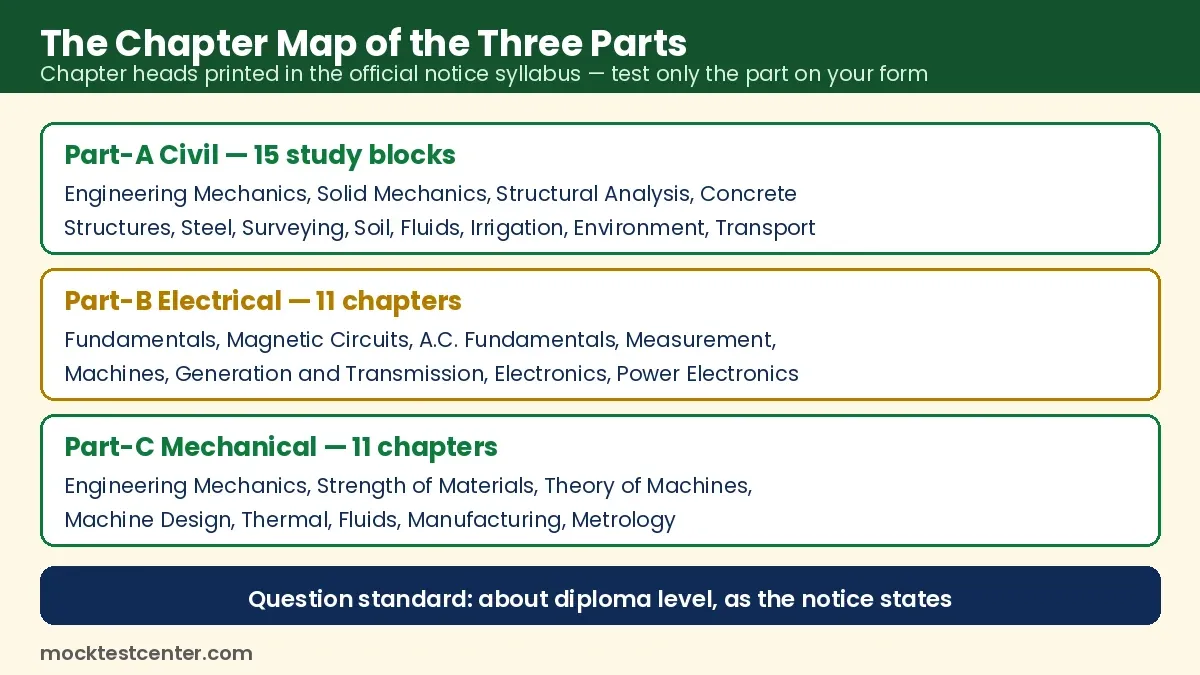
The Chapter Test Loop in Four Steps
The Same Day Chapter Loop: Four Steps
The loop is small on purpose. Step 1 keeps the reading honest: one chapter, not a whole subject. Step 2 puts the test on the same day, while the repair is cheap. A chapter found weak in the same evening costs an hour. The same chapter found weak inside a full paper costs you a week of doubt about the whole subject.
Step 3 is where most candidates cheat themselves. They count the score and move on. The score is the least useful part. The cause is the useful part. Concept means the rule is not known, so go back to the book. Method means the rule is known but the road was long, so drill short methods. Speed means the hand is slow. Careless means the eyes skipped a word, and in Paper-II each such skip swings 4 marks.
Step 4 closes the loop. Seven days later, meet the same chapter again with fresh questions. If the score does not rise, the chapter was only visited, never repaired. Mark it in the register and give it a second repair week. Chapters that pass the retest leave the repair list and join the revision list, where the sectional tests will keep them warm in bigger blocks.
One Chapter, Two Depths: Paper-I and Paper-II
Take one chapter and look at it twice. Soil Mechanics, for a Civil candidate.
In Paper-I, the chapter comes wide. Index properties, soil classification, permeability, compaction, shear strength: the questions ask for the right term, the right formula, the right range. One mark each. A candidate with clean basics takes most of them in under a minute each. The chapter test for Paper-I depth should feel like this: short questions, mixed subtopics, a hard clock.
In Paper-II, the same chapter comes deep. The notice syllabus for Paper-II names the ground in full: three-phase relations, flow nets, uplift pressure and piping, effective stress and the quicksand condition, one-dimensional consolidation and its time rate, Mohr's circle, stress and strain behaviour of clays and sand. Questions here carry 3 marks and often chain two ideas: a seepage sum that needs the flow net idea first, a consolidation sum where the time factor must be read right. The chapter test for Paper-II depth must carry such chained questions, or it is training you for the wrong paper.
The same split runs in the other branches. In Electrical, Paper-I asks what a wattmeter measures and how a transformer is rated. Paper-II asks you to work through armature reaction, parallel running of generators, and transmission line behaviour with numbers. In Mechanical, Paper-I asks the parts of a governor. Paper-II asks you to size, compare and compute inside Theory of Machines and Thermal Engineering.
So set two pass marks in your register. For Paper-I depth, a chapter is ready when you score 75 percent or more at speed. For Paper-II depth, ready means 65 percent or more on the chained and numerical questions, with guesses marked and counted apart. The Paper-II bar looks lower and is in fact higher, because its questions are longer and its cut is 1 mark, not 0.25.
A girl in Lucknow who studies with us kept one pass mark for both papers and kept calling her Strength of Materials chapter weak, because her Paper-II depth sets sat near 60 percent while her Paper-I sets sat at 85. The chapter was not weak. Her ruler was wrong. Two depths need two rulers.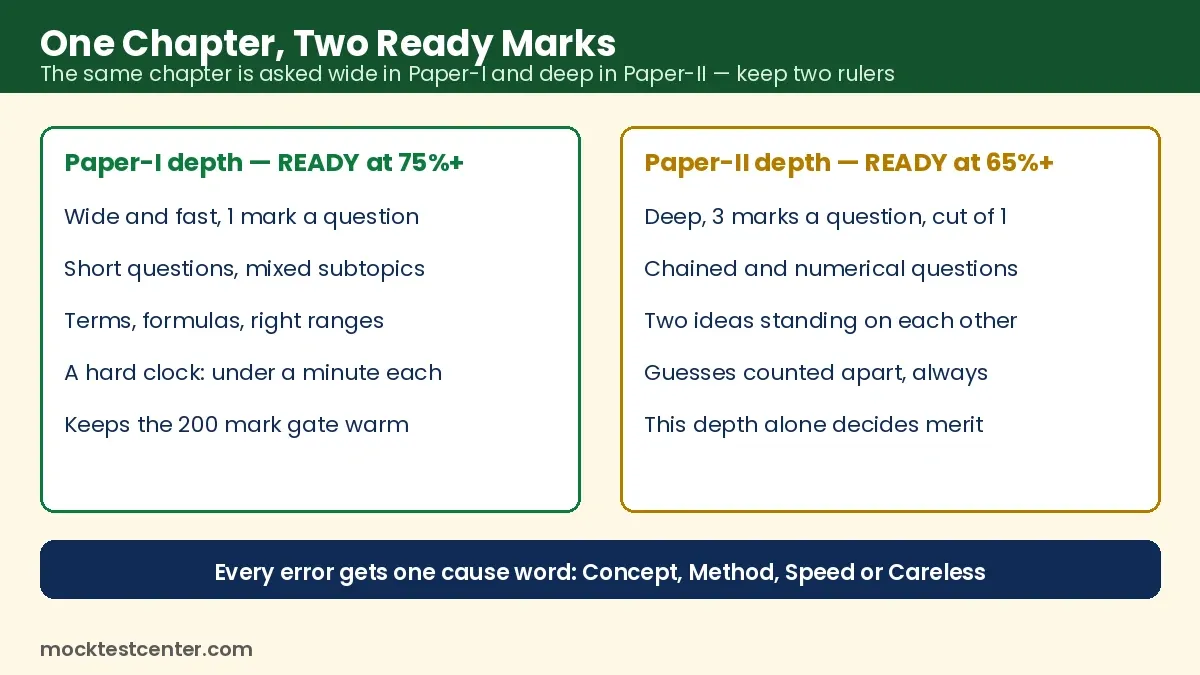
A Worked Week: One Chapter From Book to Retest
Take a real week and walk it. The chapter is Surveying, for a Civil candidate in his second month.
Monday: he reads the levelling part of the chapter, with a pen, and marks every formula and every term the notice syllabus names: levelling and trigonometric levelling, traversing, tacheometric surveying, theodolite work. Reading takes about 2 hours. In the evening he gives the chapter test at Paper-I depth: 25 questions, 18 minutes, book shut. Score: 15 of 25. The register shows the cause split: 4 Concept, 3 Method, 2 Speed, 1 Careless.
Tuesday: repair day, driven by the causes, not by feelings. The 4 Concept errors go back to the book for one hour: rise and fall method, height of instrument method, the checks that close a levelling run. The 3 Method errors get worked examples, done by hand, slowly. No new chapter opens today. A repair day that opens a new chapter repairs nothing.
Wednesday and Thursday: the chain and compass part and the plane table part of the same chapter, read and tested the same way, in smaller sittings. Scores: 17 of 25 and 19 of 25. The chapter is rising, and the register shows Speed errors growing as Concept errors fall, which is the normal shape of a chapter being learned: first you do not know, then you know slowly, then you know fast.
Friday: a Paper-II depth set on the whole chapter: 20 chained and numerical questions in 30 minutes. Score: 11 of 20. This is not a failure. It is the second ruler doing its work. The errors name the deep ground: curvature and refraction sums, tacheometric constants. Those go into the notebook with a retest date.
The next Monday, 7 days after the first test, the retest lands: fresh questions at Paper-I depth. Score: 21 of 25. The chapter leaves the repair list and joins the revision list, where a monthly sectional sitting of the branch part will keep it warm. One chapter, fully owned, in 8 days. At that pace a Civil candidate owns the whole map in about 4 months, with the retests running behind the new chapters like a second shadow.
The Heavy Chapters of Each Part
Not all chapters weigh the same. Each part holds 2 or 3 heavy chapters that carry a large share of the questions and almost all of the fear. Name them, and give them double weeks.
In Part-A Civil, the heavy ground is Concrete Structures, Soil Mechanics and Fluid Mechanics with Hydraulics. Concrete Structures carries the code book on its back: working stress and limit state ideas, design of beams, slabs and columns, bond and development length. Soil Mechanics carries the longest syllabus lines in the notice. Fluid Mechanics and Hydraulics carry the numerical weight: continuity, momentum and energy equations, flow in pipes, open channel flow, specific energy and the hydraulic jump.
In Part-B Electrical, the heavy chapter is Electrical Machines, and it is not close. Single phase and three phase transformers, DC machines with their types and losses, induction motors with starting and speed control, and then the special machines and synchronous generators standing beside it: armature reaction, parallel running, synchronization. A candidate whose Machines chapter is strong holds the centre of Part-B. A candidate whose Machines chapter is weak is playing for the corners of the paper.
In Part-C Mechanical, the heavy pair is Thermal Engineering and Strength of Materials, with Theory of Machines close behind. Thermal carries the steam table work and the cycles. Strength of Materials carries bending, torsion, columns and combined stresses, the ground that Machine Design then spends. These chapters also feed each other, so a weak first one taxes the second.
Heavy does not mean first. The order section above still holds: base chapters first, because the heavy chapters borrow from them. Heavy means this: when a heavy chapter's test score stalls, give it a second week without guilt. A light chapter at 90 percent and a heavy chapter at 55 percent is a worse paper than both at 75, because the heavy chapter brings more questions to the hall.
And one line for the new parts. Telecom candidates hold Part-G, Telecommunication, with network analysis, signals and systems, analog and digital communication and electromagnetics. IMD candidates choose Part-D, Part-E or Part-F. The chapter method on this page fits them the same way: the notice prints their chapter heads too, and the same day loop works on any list the notice prints.
Chapters That Meet the Hall Tools
Two chapters in Civil and one in Mechanical meet tools that SSC puts on your screen, and they must be practised with those tools, not around them.
Concrete Structures runs on IS 456:2000. The notice says the table of IS 456:2000 will be made available on the candidate console during the exam, by a button near the instructions. Design sums in the hall are solved with that table open on the screen. At home, most candidates solve them with a printed code book and marked pages. The gap sounds small. It is not. Finding a value in a screen table with a mouse, while a clock runs, is a skill of its own. Give this chapter its tests with a code table on the screen and the book shut.
Thermal Engineering in Mechanical runs on steam tables, and the notice gives the steam table on the console the same way. A candidate who has only used a printed steam table will spend his first hall minutes learning the screen layout. Spend those minutes at home instead.
And across all branches, numericals meet the on-screen scientific calculator. The notice keeps it on the screen for the full exam, and no physical calculator is allowed in the lab. Log values, roots, powers: at home, do them on a screen calculator for the chapters that carry heavy sums, like Structural Analysis, Fluid Mechanics, A.C. Fundamentals and Theory of Machines. Hand calculator speed does not cross over to mouse speed on its own. We see this every cycle, and it is the cheapest fix on this page.
The Order in Which to Clear Chapters
You hold 11 to 15 chapter heads and a limited number of months. Order decides whether the strong chapters stand ready together in the end.
Open with the base chapters of your branch, the ones other chapters stand on. For Civil: Engineering Mechanics, Solid Mechanics and Fluid Mechanics first, because Structural Analysis, Concrete Structures and Hydraulics all borrow from them. For Electrical: Fundamentals and Magnetic Circuits first, then A.C. Fundamentals, because Machines and Power Systems read those three on every page. For Mechanical: Engineering Mechanics, Strength of Materials and Thermal Engineering first.
Then take the scoring chapters, the ones that give many questions at diploma level with clean rules: Surveying and Estimating in Civil, Measurement and Machines in Electrical, Manufacturing and Industrial Engineering in Mechanical. These chapters repay hours fast, and early wins keep a long plan alive.
Leave the long-tail chapters for the third round: Environmental Engineering and Transportation in Civil, Utilization and Power Electronics in Electrical, Metrology and Advanced Manufacturing in Mechanical. Not because they are small. Because their questions lean on facts and ranges that stay fresh only if read closer to the exam.
Fit the order to your post list too. A Civil candidate whose heart is set on CWC or the Farakka Barrage should push Hydrology and Irrigation early. A BRO hopeful should not leave Transportation Engineering for the last month. A Mechanical candidate aiming at DGQA-Naval should give Machine Design and Metrology more room than the crowd does. The vacancy list is public: 343 Civil posts in CPWD, 271 in BRO, 154 in MES. Let it shape your chapter order, not just your preference form.
One chapter a day is a strong pace for a working candidate or a final year student. At that pace the Civil map takes about 3 weeks for a first pass, and the Electrical and Mechanical maps about 2 weeks. The second pass, at Paper-II depth, takes longer. That is fine. The plan is a year plan, not a month plan, and the 2027 notice is still to come.
When a Chapter Stalls: The Two Pass Repair
Some chapters do not rise on the first repair. The retest comes back at the same score, and the candidate stands in front of a wall with a register full of good intentions. This happens in every branch: Soil Mechanics for Civil, Machines for Electrical, Thermal for Mechanical. The stall has a shape, and the shape tells the fix.
Read the cause column of the stalled chapter. If Concept errors still lead after two repairs, the book you are reading is above your present base. Drop one level down: for a diploma chapter that will not open, go back to the school chapter under it, or to the base chapter of your own branch that it borrows from. A candidate stuck on consolidation sums is often stuck on the arithmetic of ratios and logs, and one evening of school maths repair moves what three evenings of consolidation could not.
If Method errors lead, the chapter is known but the roads are long. The fix is a worked example file: 10 sums of the chapter, solved slowly, with the short road written beside the long one. Then the same 10 types again, timed. Method errors die by comparison, not by volume.
If Speed errors lead, stop reading the chapter at all for a week and give it only timed sets of 10. Speed is a hand habit, and reading does not train hands.
And if Careless errors lead, the chapter is not the problem at all. Your reading of questions is. The fix sits outside the chapter: read each question twice, underline the unit and the word not when it comes, and check the option units before marking. A Mechanical candidate we guided cut his Careless count from 9 to 3 in two weeks with this one drill, and his Theory of Machines chapter, stalled for a month, rose 14 marks without a single new page read.
Give a stalled chapter two repair passes of this kind. If it still stands, park it, mark it in the register with its true score, and move the plan forward. A parked chapter can be met again in the revision months with a fresh mind. A plan that dies on one chapter helps no one, and the paper holds 10 other chapters that are ready to pay you now.
Mistakes Candidates Make With Chapter Tests
The first mistake is reading a full subject before testing any of it. A candidate reads all of Fluid Mechanics in 9 days, feels strong, and tests it on day 10. The first 3 chapters have already gone soft. Test each chapter the day it closes.
The second mistake is testing with the book open beside the desk, just for the formulas. A test with help is a reading session wearing a test coat. In the hall there is no book, only the screen tools the notice names. Shut the book.
The third mistake is one ruler for both papers, the Lucknow mistake from the section above. Paper-I depth and Paper-II depth are two different ready marks. Keep two columns in the register.
The fourth mistake is skipping the retest. A repaired chapter that is never met again will leak back to its old score in about a month. The 7 day retest is the lock on the repair.
The fifth mistake is chapter pride: spending a third week on a favourite chapter that already scores 85 percent, while a hated chapter sits at 40. Marks hide in the hated chapters. The register, not the heart, should choose the next chapter. And when a full picture is needed, the PYQ PDF files let you print a real paper and see all chapters judged together, the way the hall will judge them.
Start Tonight With One Chapter
Pick the base chapter of your branch that you have read most recently. Give its chapter test tonight, timed, book shut, screen calculator only. Write the score and the cause counts in a fresh register. If the score sits under half, the chapter goes back on the reading desk tomorrow, with a retest booked 7 days from now.
Then keep the chain: one chapter a day, one retest a week for old repairs, one full paper on Sunday from the full tests to keep the gate warm. Keep the small shelves warm beside the chain too: the NCERT base under your maths and science, and the current affairs tests for the news half of GA. The SSC JE 2027 notice is expected in 2027, and the Latest Jobs page will carry it when SSC prints it on ssc.gov.in. A candidate who meets that notice with all chapters tested twice will not need a panic plan. He will need only a revision plan, and that is a much better paper to hold.







