
About SSC JE 2027 Previous Year Papers (PYQ)
- 1.SSC JE Previous Year Papers: Key Facts First
- 2.Old Papers Now Do Two Different Jobs
- 3.How SSC Answer Keys Work in This Exam
- 4.Solve a Paper-I Paper in Its True Shape
- 5.Score Both Papers the Honest Way
- 6.What the 2025 Numbers Teach a 2027 Candidate
- 7.Which Years to Solve First, and the Paper-II Gap
- 8.Sitting a Paper-II Paper: The Merit Rehearsal
- 9.The Error Notebook That Turns One Paper Into Marks
- 10.Your Next Step Tonight
Quick Answer: An SSC JE Previous Year Question Paper is a real paper from a real Junior Engineer exam held by the Staff Selection Commission, and this exam has plenty of them. SSC held the tests, printed the papers in Hindi and English, and put out answer keys for each cycle. But read one thing before you solve a single old paper. From the 2026 notice, Paper-I is now only a qualifying gate, and your final merit rests on Paper-II marks alone, out of 300. So old Paper-I papers and old Paper-II papers now do two very different jobs, and this page sorts them for you.
SSC JE Previous Year Papers: Key Facts First
The exam is the Junior Engineer Examination of the Staff Selection Commission. It fills Junior Engineer posts in Civil, Electrical and Mechanical branches in offices of the Government of India, in places like CPWD, MES, BRO and the Central Water Commission. From the 2026 cycle, the same exam also fills Scientific Assistant posts in the India Meteorological Department and a Junior Engineer (Telecom) post in the Department of Telecommunication. The posts are Group B posts in Level-6 of the pay matrix, Rs 35,400 to 1,12,400.
The latest notice is the Junior Engineer Examination, 2026, file number HQ-C-3019/1/2026-C-3, printed on ssc.gov.in on 2 September 2026. Applications ran from 2 September 2026 to 22 September 2026. The fee was Rs 100, and women, SC, ST, PwBD and ex-servicemen candidates paid no fee. The notice showed 1,748 tentative vacancies. A later SSC vacancy list of 8 October 2026 put the count at 1,699 posts: 867 for Civil, 183 for Electrical and Mechanical together, 108 for Electrical, 69 for Telecom, 10 for Mechanical, and 462 for Scientific Assistant in IMD.
Paper-I holds 200 questions for 200 marks in 2 hours. General Intelligence and Reasoning gives 50 questions, General Awareness gives 50, and your branch part gives 100. Each wrong answer cuts 0.25 marks. Paper-I of the 2026 cycle was held from 2 November to 6 November 2026, and the Telecom part sat apart, on 30 November and 1 December 2026. SSC put the tentative answer keys of Paper-I on its site on 19 November 2026, with the response sheets of candidates.
Paper-II holds only your branch part: 100 questions for 300 marks in 2 hours, 3 marks for each right answer, and 1 mark cut for each wrong answer. The 2026 notice keeps Paper-II in December 2026. And here is the line this whole page stands on. Paper-I is qualifying in nature now. It only shortlists you for Paper-II. Only the normalised marks of Paper-II decide the final merit and the post you get.
The SSC JE 2027 notice has not come yet. A notice in 2027 is expected on the yearly rhythm of this exam, but SSC has printed no date for it. Till it comes, the 2026 cycle is the live base, and old papers are the best study ground you hold.
| Fact | Detail |
|---|---|
| Exam | Junior Engineer Examination, run by the Staff Selection Commission |
| Latest notice | Junior Engineer Examination, 2026, dated 2 September 2026, on ssc.gov.in |
| Vacancies | 1,748 tentative in the notice; 1,699 in the SSC vacancy list of 8 October 2026 |
| Big branches, 2026 list | Civil 867, Scientific Assistant (IMD) 462, Electrical and Mechanical 183, Electrical 108, Telecom 69, Mechanical 10 |
| Paper-I shape | 200 questions, 200 marks, 2 hours: Reasoning 50, General Awareness 50, branch part 100 |
| Paper-I, 2026 dates | 2 to 6 November 2026; Telecom part on 30 November and 1 December 2026 |
| Negative marking, Paper-I | 0.25 marks cut for each wrong answer; no cut for a blank answer |
| Paper-II shape | 100 questions, 300 marks, 2 hours, branch part only; 3 marks per right answer |
| Negative marking, Paper-II | 1 mark cut for each wrong answer |
| Merit rule, 2026 | Paper-I only qualifies; final merit rests on normalised Paper-II marks alone |
| Tentative key, Paper-I 2026 | Uploaded 19 November 2026 with response sheets; objection fee Rs 50 per question |
| Official website | ssc.gov.in |
What This Page Covers
- Old papers now do two different jobs
- How SSC answer keys work in this exam
- Solve a Paper-I paper in its true shape
- Score both papers the honest way
- What the 2025 numbers teach a 2027 candidate
- Which years to solve first, and the Paper-II gap
- Sitting a Paper-II paper: the merit rehearsal
- The error notebook that turns one paper into marks
- Your next step tonight
Old Papers Now Do Two Different Jobs
Most pages that sell old JE papers still talk as if nothing changed. Solve papers, add Paper-I and Paper-II marks, chase a total out of 500. That was true in the 2025 cycle, and it is not true now. The 2026 notice moved the whole weight of this exam onto one paper.
Read the new shape slowly. Paper-I, with its 200 questions, is a gate. Cross the gate and its marks are spent. They never enter your merit. Paper-II, with its 100 branch questions and 300 marks, is the whole race. Your post, your department, CPWD or BRO or a small office with 2 posts, all of it is decided by the normalised marks of Paper-II and the preference list you fill.
So an old Paper-I paper trains one skill: gate speed. It teaches you to pull 200 questions into 120 minutes, to keep the reasoning and general awareness parts from eating the branch part, and to finish above a shortlisting line that sat near 127 out of 200 for the general list in 2025. An old Paper-II paper trains a different skill: depth in your own branch, at 3 marks a question, with a 1 mark cut waiting on every guess.
A diploma holder in Kanpur who prepared with us last cycle made the old mistake in full. He solved Paper-I papers for five months and felt safe, because his totals looked strong. His branch depth, the Paper-II side, got the leftover evenings. Under the new rule that order is upside down. Paper-II depth must lead the week, and Paper-I papers keep the gate warm.
Use the SSC JE previous year papers on this tab as the main ground for both jobs, and keep the two jobs apart in your register. One column for gate scores out of 200. One column for merit scores out of 300. A score written in the wrong column will plan your next month wrong.
One more change hides inside the papers. From the 2026 cycle the exam also carries Part-D, Part-E and Part-F papers for Scientific Assistant in IMD and a Part-G paper for Telecom. If you sit for Civil, Electrical or Mechanical, those parts are not yours. Solve only your part in old papers. Your time is short, and the other parts pay you nothing.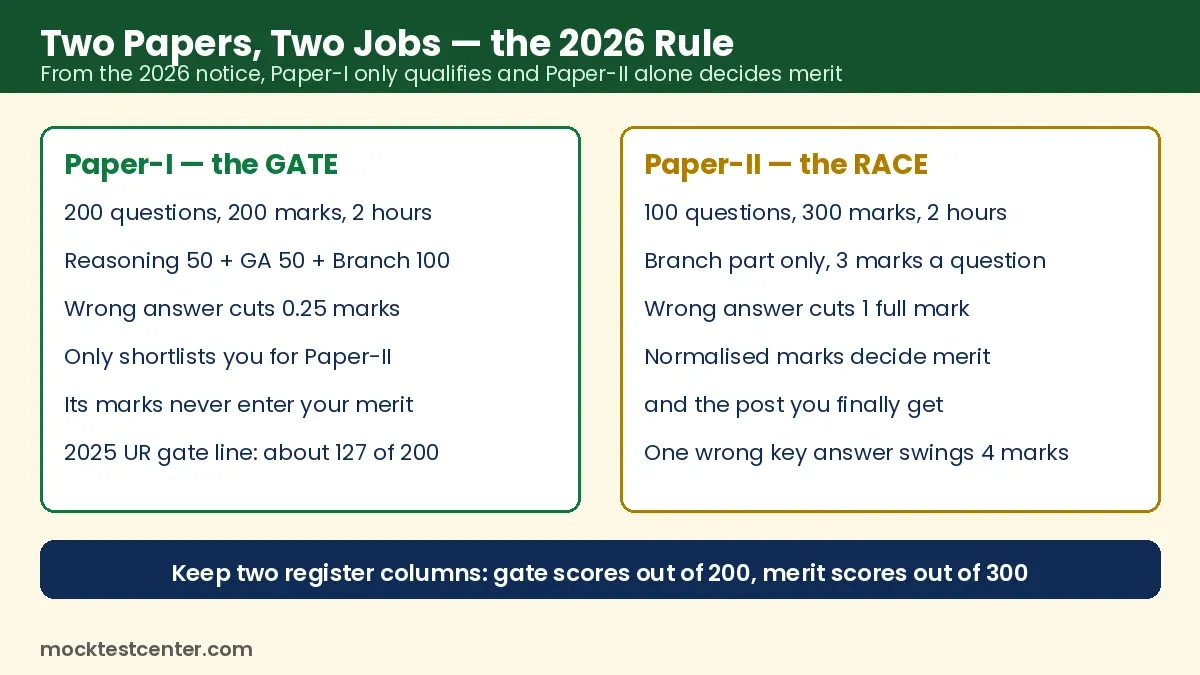
How SSC Answer Keys Work in This Exam
A paper without the right key is a trap with good print. SSC runs the key in stages, and the 2026 cycle shows each stage with a date you can check.
First comes the tentative key. SSC uploaded the Paper-I tentative keys with candidate response sheets on 19 November 2026, about two weeks after the main Paper-I days closed on 6 November 2026. Your response sheet shows what you marked, question by question. The tentative key shows what SSC holds right at that stage. Tentative means open to challenge.
Then comes the objection window. A candidate who holds proof that a key answer is wrong can object online and pay Rs 50 for each question. The fee is not returned. Ten objections cost Rs 500, so a wise candidate objects only where a book or a code or an official page stands behind him. For your practice, this stage carries a second lesson. The first key that groups share for any paper is often this tentative key, and one or two of its answers can change later.
Last comes the final key. SSC studies the objections, fixes the key where the proof stands, and uses the final key to process the result. The notice says the final keys and the marks of candidates are put on the site after the result. Score your practice papers with final keys only. A score built on a tentative key can sit 2 or 3 marks away from the truth in Paper-I, and in Paper-II, where one question carries 3 marks, one wrong key answer moves your score by 4 marks at a stroke, 3 lost and 1 cut.
Behind the keys sits one more machine: normalisation. Paper-I ran across many days and shifts, so SSC normalizes marks across shifts before it shortlists. That is why real cut-off lines carry five decimal places, like 127.22748. Your practice score is a raw score on one paper. Read it as a level mark. It cannot tell you your rank among lakhs of candidates, and any page that says it can is selling a story.
The minimum qualifying marks sit under all of this. In both papers, a general candidate must reach 30 percent, OBC and EWS candidates 25 percent, and all other categories 20 percent. On Paper-I that floor is 60 marks of 200. On Paper-II it is 90 of 300. The floor is only a floor. The real shortlisting line in 2025 sat more than twice as high.
Solve a Paper-I Paper in Its True Shape
Sit the paper once, in one sitting, at a fixed time of day, with your phone in another room. Two hours, 200 questions, no pause. That is the whole rule, and it has no soft version.
The JE Paper Solving and Checking Loop: Four Steps
Inside the 2 hours, work in two passes. Pass one takes the questions you can close fast and sure: the one-line branch facts, the direct formula sums, the reasoning sets that open at once. Pass two takes the rest. A branch numerical that eats 4 minutes has eaten the price of 4 one-mark questions in Paper-I, and in Paper-II the same habit eats far more, because there each question pays 3 marks.
Keep the hall tools in your practice too. The notice gives you a scientific calculator on the computer screen for the full exam, and the IS 456:2000 table and the steam table on your console when a question needs them. No paper table and no own calculator enter the lab. A candidate who practises Civil design sums with a book of tables open beside him, and Mechanical sums on a fast hand calculator, is training for a hall that does not exist. Practise with a screen calculator and the code table from the start.
And star your guesses as you mark them. At checking time, a guessed right answer counts in the score but not in your trust list. A guessed wrong answer in Paper-II shows you the exact chapter where your half knowledge keeps paying the 1 mark cut.
Order inside Paper-I is your own choice, and old papers are where you fix it. Many candidates open with General Awareness, because its 50 questions end fast, right or wrong, and a fast first part calms the hand before the branch part. Others open with the branch part while the mind is fresh. Test both orders on 2 real papers each. Keep the order with the higher total. Feelings pick orders badly. Totals pick them well.
Score Both Papers the Honest Way
Scoring takes 10 minutes and most candidates rush it in 2. Slow down. The number you write today is the number your next week will obey.
For Paper-I, follow these steps every time.
- Count right answers part by part. Each right answer pays 1 mark.
- Count wrong answers part by part. Multiply by 0.25. That is your cut.
- Subtract the cut. Write the total, and write each part score beside it.
- Count blanks. A blank costs nothing in Paper-I, but a blank in a chapter you have read costs you trust, so star it.
- Write the paper year and the shift beside the score. A score with no paper name is a rumour in one month.
Work one example. Say your Paper-I branch part shows 68 right and 20 wrong, with 12 blank. Earned: 68 marks. Cut: 20 times 0.25 equals 5. Part score: 63 of 100. Now say the full paper shows 141 right and 41 wrong, with 18 blank. Earned: 141. Cut: 10.25. Total: 130.75 of 200. A candidate who skips the cut writes 141 in his register, feels safe above the 2025 general line of 127.23, and plans a soft month. His true score clears that line by only 3.5 marks, and a hard shift can take those away. The cut is small per question. It is not small per paper.
Paper-II scoring is harsher, and it must be done with a cold hand. Each right answer pays 3 marks. Each wrong answer cuts 1. Say you mark 61 right and 24 wrong, with 15 blank. Earned: 183. Cut: 24. Total: 159 of 300. Now look at the shape, not just the total. If 9 of those 24 wrong answers were guesses where you could cut the field down to two options and still chose the wrong one, your guessing habit is a chapter problem, not bad luck. Fix the chapters and the same paper gives you 180 or more.
Watch the wrong count as hard as the total in both papers. Two candidates can hold the same Paper-II total. One reached it with clean knowledge and many blanks. The other reached it with more right answers and a heavy cut. The first candidate is closer to a jump, because blanks can turn into attempts as speed grows. The second must first unlearn a habit that cuts his own paper.
Use the sectional tests when one part of Paper-I keeps falling behind the other two, and the PYQ PDF tab when you want a paper and its key as files for a print sitting at home.
What the 2025 Numbers Teach a 2027 Candidate
The 2025 cycle is the last full cycle we hold, and its numbers are the best map of the gate. SSC printed its notice on 30 June 2025 with 1,340 tentative vacancies, and later raised the count to 1,731. Paper-I ran from 3 December to 6 December 2025, with one more day on 13 December 2025. The Paper-I result came on 6 March 2026, and 15,607 candidates were shortlisted for Paper-II: 11,593 on the Civil list and 4,014 on the Electrical and Mechanical list.
| Paper-I shortlisting line | Civil list | Electrical and Mechanical list |
|---|---|---|
| 2025 cycle, UR | 127.22748 | 127.30120 |
| 2025 cycle, OBC | 124.45815 | 127.30120 |
| 2025 cycle, EWS | 117.90628 | 115.36583 |
| 2025 cycle, SC | 109.24462 | 112.05213 |
| 2025 cycle, ST | 106.85210 | 102.86832 |
| 2024 cycle, UR | 122.92909 | Separate list, not shown here |
These are normalised marks out of 200, from the SSC result write-ups of those cycles. Read them with care. The general line near 127 means a raw practice score of 120 on an easy paper may still leave you outside the gate, because your shift in the real exam may run hard and the line is drawn after normalisation across all shifts. Aim your practice at 135 or more on Paper-I papers of mixed shifts. That gap is your safety belt.
Notice the second thing in the table. Electrical and Mechanical candidates sit on one list, because some posts are common to both branches. SSC gives the two branches different question papers and then normalizes their scores against each other. So a Mechanical candidate is not only fighting Mechanical candidates. In 2026, direct JE (Mechanical) posts number only 10, while 183 Electrical and Mechanical posts sit behind that common list. Your real fight is the common list, and old E&M papers from both branches belong on your desk.
The 2025 cycle closed with Paper-II on 7 April 2026. Of the 15,607 shortlisted candidates, 14,062 sat for it, and the final result of 3 August 2026 named 1,731 candidates. In that cycle both papers counted toward merit, so its final cut-offs stand on a 500 mark scale. Do not hold a 2025 final number beside your Paper-II practice score and call the gap your distance. The scales are different now. The 2025 numbers teach the gate height and the crowd size. They cannot teach your Paper-II rank.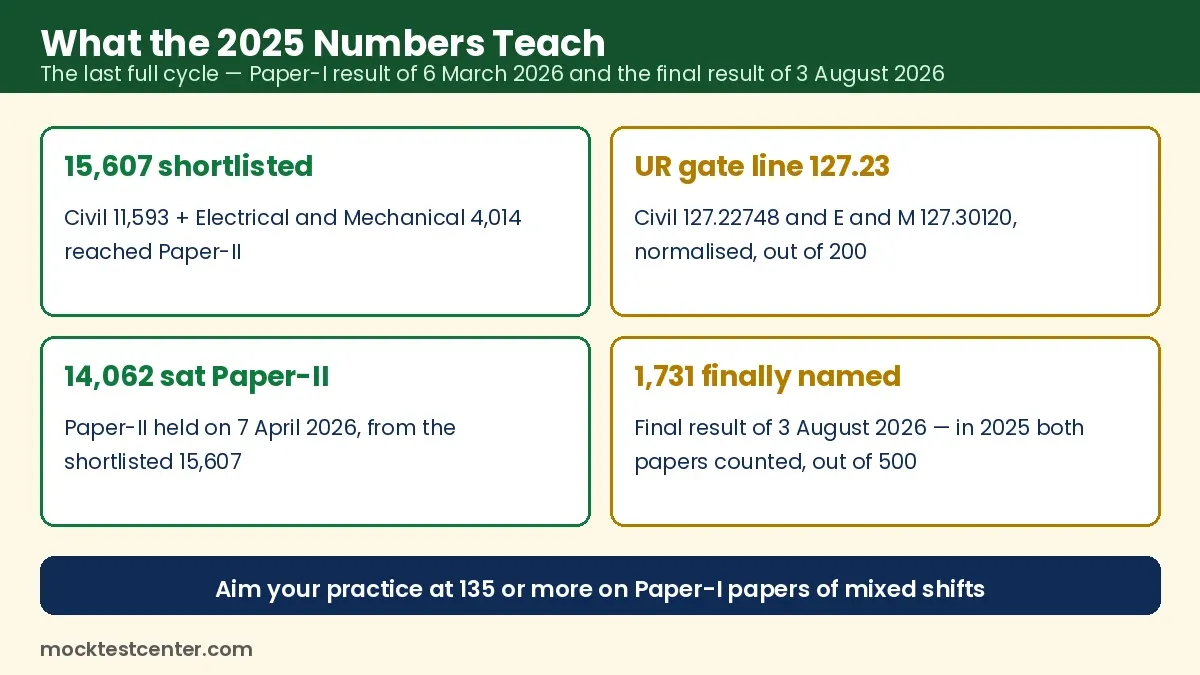
Which Years to Solve First, and the Paper-II Gap
Start with the newest papers. The 2026 Paper-I papers are fresh from November 2026, and the 2025 papers sit close in level and style. Solve those first, across shifts, and let them set your base scores. Keep 2 recent papers unsolved for your last 3 weeks, so the final check runs on papers your memory has not softened.
Then comes the gap, and you should know it before a seller uses it on you. Paper-II in its present shape, 100 objective questions for 300 marks on a computer, is a young paper. The 2024 and 2025 cycles hold it in this shape. In older cycles Paper-II was a written descriptive paper, where you wrote full solutions by hand. Those old descriptive papers are not waste. A Civil candidate can still read them to learn which design topics SSC loves, and a Mechanical candidate can mine them for the numerical types that return year after year. But you cannot sit them as mocks. There is no key to score them with, and the clock feel is gone.
So build the Paper-II side of your plan in two parts. Use the objective Paper-II papers of 2024 and 2025 as true mocks, in full 2 hour sittings. Use the older descriptive papers as a topic bank: read a question, name its chapter, solve it on paper, and note the method in your notebook. When the objective shelf feels thin, the full tests of this sub-category carry the same 100 question, 300 mark shape, and the chapter tests let you drill one branch chapter at Paper-II depth.
Older Paper-I papers, from 2019 to 2023, still earn a place in a smaller job: chapter hunting. Their branch parts match the present syllabus well. A weak chapter shows fast when you solve the branch part of an old paper and count your blanks. Their General Awareness parts belong to their own year, so solve those for the fixed parts, like history dates, polity and basic science, and let the old news questions go. Present news sits on the current affairs tests, and the school base under the fixed parts sits on the NCERT tests.
Three papers a week, done fully, beat seven papers rushed. A Paper-I paper takes 2 hours to solve and about 45 minutes to check and note well. A Paper-II paper takes the same sitting and a longer evening, because each error there costs 4 marks of swing. Plan one Paper-II paper a week from the start, not from the month Paper-I ends. Under the new rule, Paper-II stands as the main stage, with a gate in front of it.
Sitting a Paper-II Paper: The Merit Rehearsal
A Paper-II sitting is not a longer Paper-I sitting. It is a different animal, and it should be rehearsed as one.
The paper holds 100 questions in 120 minutes, about 72 seconds a question, and almost every question carries a number, a code line or a chain of two ideas. Set the sitting up the hall way: screen calculator only, the IS 456:2000 table on the screen for Civil, the steam table for Mechanical, and no book in the room. A candidate who rehearses Paper-II with a hand calculator and a marked code book is rehearsing a paper that ended years ago.
Inside the sitting, run three passes, not two. Pass one takes the one-line questions: terms, code values, direct facts of your branch. In most shifts these run to about a third of the paper, and they fund the rest. Pass two takes the one-step numericals, where one formula and one clean substitution close the question. Pass three takes the chained questions, the design sums and the two-idea problems, with whatever time the first two passes saved.
Write your guess rule before the sitting and hold it inside the sitting. Ours is plain: attempt where you can cut the field to two options, leave where you cannot. At 3 marks gained and 1 mark cut, a two-option guess pays in the long run. A blind guess does not. Ten blind guesses in a paper cost about 5 marks of expected value and add a swing that can move you across a merit line in the wrong direction.
After the sitting, score it in two columns: marks from knowledge, and marks from guesses, right and wrong counted apart. A Paper-II score of 174 built on clean knowledge is a stronger sign than 183 built with 9 guessed right answers, because luck does not report for duty twice. The register should know which kind of score you hold.
One Paper-II sitting a week is the floor. Two is better in the last two months. This paper is now the whole merit of the exam, and it is the paper with the thinnest old shelf, so every true sitting you bank is worth more than it looks.
The Error Notebook That Turns One Paper Into Marks
A solved paper with no notebook is a walk you took and forgot. Keep the notebook thin, ruled, and beside the desk.
Give every wrong or blank question one line with 4 parts. The chapter name in plain words, like Soil Mechanics or DC Machines or Percentage. The cause, in one of 4 fixed words: Concept, Method, Speed, or Careless. The right method in one short line, in your own hand. And a date 7 days later, when you will meet that chapter again in a test.
The cause words matter more than they look. Concept means you did not know the rule, so reading must come before more tests. Method means you knew the rule but took the long road. Speed means the method was right and the hand was slow, which only timed drill can fix. Careless means you knew it, had time, and still marked wrong.
A boy in Gaya who trains with us wrote Careless beside 11 of his 26 branch errors in one Paper-II paper. Eleven. At 4 marks of swing each, that one word was costing him more than a full chapter of weak study. His fix cost no money. He began reading each question twice before touching the options, and his Careless count fell to 4 in the next paper.
Feed the notebook back into your week. Chapters that fill the notebook go first into the chapter wise tests, on the same day you note the error if you can. And every Sunday, read the week notebook pages once, slowly, before you sit the next paper. Papers repeat traps far more than they repeat questions.
Do not copy full solutions into the notebook. A full solution reads like a book you will never open again. One line per error, in your own words, is a page you will read 10 times.
Your Next Step Tonight
Pick the newest Paper-I paper you have not solved. Sit it tonight in one 2 hour sitting. Score it with the final key, write the total, the wrong count and the blank count, and give every error one notebook line with its cause word. Then book one chapter test for tomorrow from the chapter that hurt you most.
And keep one eye on the calendar. Paper-II of the 2026 cycle sits in December 2026, and the SSC JE 2027 notice is expected in 2027 on the rhythm of past years. The Latest Jobs page of this site will carry it the day SSC prints it, and the official word will stand on ssc.gov.in beside it. Do not wait for that notice to start the paper loop. Paper skill grows week by week, and the candidate who starts after the notice starts months behind you on the one skill this exam now pays for in full: Paper-II depth, held up by a gate you can cross without fear.







