About SSC JE 2027 PYQ PDF Downloads
- 1.SSC JE PYQ PDF: Key Facts First
- 2.The JE Files That Are Real
- 3.The Two Minute Check for Any SSC JE PDF
- 4.Download Steps, File by File
- 5.The Old Goods in New Covers, Family by Family
- 6.The 2025 Shelf, Worked as an Example
- 7.Objection Week: What to Do While a Key Is Tentative
- 8.Files for the New Parts: Telecom and IMD
- 9.Name Your Files Like a Soldier
- 10.Read the Notice PDF Like a Syllabus
- 11.The Print Shelf at Home
- 12.How This Site Helps You Use the Real Files
Quick Answer: An SSC JE PYQ PDF is a real Junior Engineer paper of a past cycle, with its answer key, in file form. The papers are real and they are free in their official home, because SSC puts its keys and result files on ssc.gov.in. But the file market around this exam carries old goods in new covers: descriptive Paper-II papers from older cycles sold as the present paper, keys from the tentative stage sold as final, and score sheets built on the old 500 mark merit that the 2026 notice has closed. This page shows which files are real, how to download them, and how to check any JE file in two minutes.
SSC JE PYQ PDF: Key Facts First
The frame in short lines. SSC JE is the Junior Engineer Examination of the Staff Selection Commission, for Junior Engineer posts in Civil, Electrical and Mechanical branches, and from 2026 also Scientific Assistant posts in IMD and a Telecom post in DoT. The latest notice, file number HQ-C-3019/1/2026-C-3, is dated 2 September 2026 and stands on ssc.gov.in. It showed 1,748 tentative vacancies, and the SSC vacancy list of 8 October 2026 put the count at 1,699 posts.
Paper-I holds 200 questions for 200 marks in 2 hours and is qualifying in nature now. Paper-II holds 100 branch questions for 300 marks, and only its normalised marks decide the final merit. That one change poisons a large shelf of old files, because every file that adds the two papers into a 500 mark merit is working on a rule that ended with the 2025 cycle.
The file facts of the live cycle: Paper-I ran from 2 November to 6 November 2026, with the Telecom part on 30 November and 1 December 2026. SSC uploaded the tentative answer keys of Paper-I, with candidate response sheets, on 19 November 2026. Objections cost Rs 50 per question and the fee is not returned. Final answer keys are used for the result and are published with marks after the result, as the notice states.
The SSC JE 2027 notice has not come yet. A notice in 2027 is expected on the yearly rhythm of this exam. The files of 2024, 2025 and 2026 are the working shelf till then, and this page keeps that shelf clean.
| Fact | Detail |
|---|---|
| Exam | Junior Engineer Examination, Staff Selection Commission |
| Real file 1 | The notice PDF of the cycle, with posts, rules, pattern and syllabus |
| Real file 2 | Question papers of past cycles with answer keys, Paper-I and Paper-II |
| Real file 3 | Result write-ups and cut-off files on ssc.gov.in for each cycle |
| Paper-I shape | 200 questions, 200 marks, 2 hours; qualifying only from the 2026 cycle |
| Paper-II shape | 100 questions, 300 marks, 2 hours; objective on computer; merit rests on it alone |
| Tentative key, Paper-I 2026 | Uploaded 19 November 2026 with response sheets; objection Rs 50 per question |
| Final key | Used for the result; published with marks after the result |
| Dead rule in old files | Paper-I plus Paper-II merit out of 500: true till 2025, closed by the 2026 notice |
| Official website | ssc.gov.in |
What This Page Covers
- The JE files that are real
- The two minute check for any SSC JE PDF
- Download steps, file by file
- The old goods in new covers, family by family
- The 2025 shelf, worked as an example
- Objection week: what to do while a key is tentative
- Files for the new parts: Telecom and IMD
- Name your files like a soldier
- Read the notice PDF like a syllabus
- The print shelf at home
- How this site helps you use the real files
The JE Files That Are Real
Start with the notice PDF, because every other file of this exam hangs on it. The 2026 notice runs to 97 pages and carries the post table with education and age for each post, the fee rule of Rs 100 with its exemptions, the scheme of both papers, the syllabus chapter by chapter, and the selection rule. If a fact about this exam is not in that PDF or in a later SSC notice, treat it as a rumour until SSC prints it. One copy of this file, read with a pen, is worth a shelf of summaries.
The second real family is the papers themselves, with their keys. Paper-I papers exist in plenty, cycle after cycle, shift after shift, in Hindi and in English. Paper-II papers exist in two kinds: the objective papers of the recent cycles, 100 questions for 300 marks, which you can sit and score; and the older written descriptive papers, which you can read as a topic bank but cannot score. Both kinds are real. They are not the same tool, and a file that hides which kind it holds is already telling you something.
The third real family is the result shelf: the result write-ups and cut-off files SSC puts on its site for each cycle. From the 2025 cycle these give you the hard numbers of the gate: Paper-I result on 6 March 2026, 15,607 candidates shortlisted, general lines of 127.22748 on the Civil list and 127.30120 on the Electrical and Mechanical list, Paper-II on 7 April 2026, and the final result of 3 August 2026 with 1,731 names. A candidate who holds the notice, the papers with final keys, and the result write-ups holds every real document this exam gives him. The PYQ PDF tab you are standing on is the download home of this sub-category, and the previous year paper page teaches the solving method that goes with the files.
The Two Minute Check for Any SSC JE PDF
The Two Minute SSC JE PDF Check: Four Steps
Run the check in order. Step one: find the cycle year and the paper name on the first page. A real JE file says which cycle it belongs to and whether it is Paper-I or Paper-II. A file named only JE paper final, with no year and no paper name, is hiding its birth. Step two: count the shape. Paper-I holds 200 questions. The present Paper-II holds 100 objective questions for 300 marks. A Paper-II file full of long written questions with no options is the old descriptive paper: real once, but not the paper you will sit, and not a mock.
Step three: ask which key the file holds. SSC first uploads a tentative key, takes objections at Rs 50 per question, and only then fixes the final key that the result is built on. A PDF packed in the objection week carries the tentative key, however bold its cover line sounds. In Paper-II, one changed key answer moves a score by 4 marks. Step four: trace the file home. Real files of this exam are published on ssc.gov.in. Groups and channels repost them, sometimes with their own first page pasted on top. A file whose first page carries a seller's logo and whose last page carries a price has told you what it is.
Teach this check to one friend and you protect two folders. Stale files travel through friend groups because friends trust each other, and a boy in Patna who forwards a 2023 descriptive paper as the new Paper-II means no harm. He just never ran the check. Two minutes at the gate saves a month of wrong study behind it.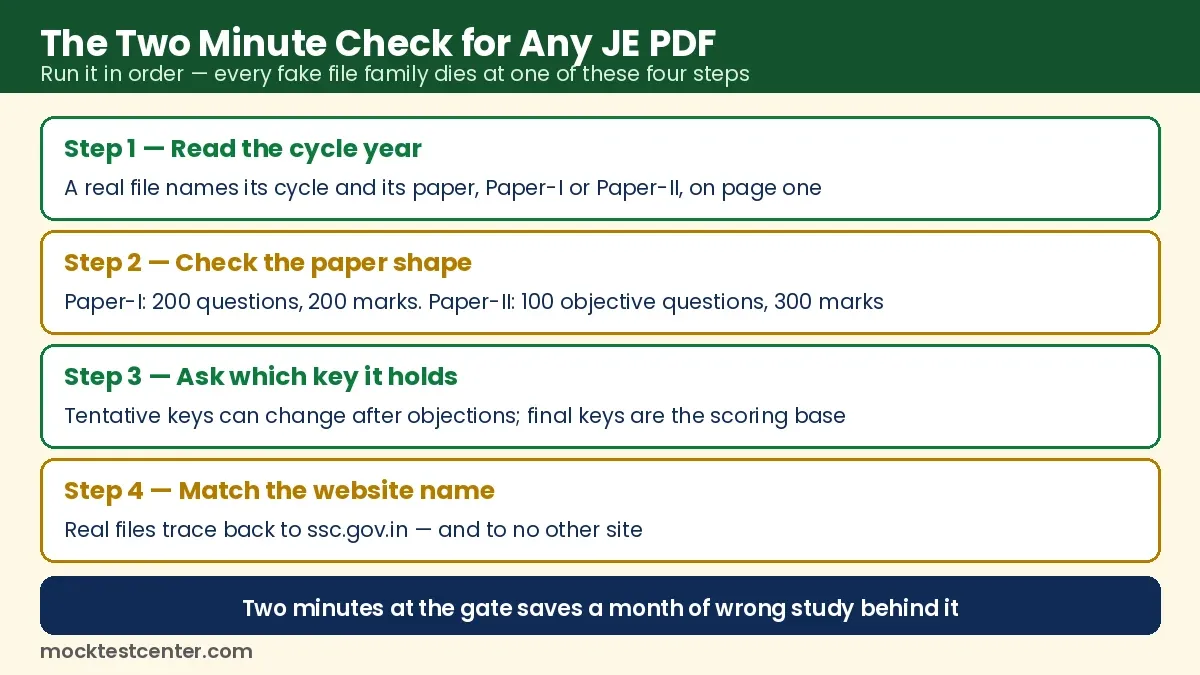
Download Steps, File by File
Step one. Type the address yourself: ssc.gov.in. Do not walk in through a forwarded link. Look-alike pages with neat designs exist, and the address bar is a five second check that costs nothing.
Step two. For the notice, open the notice board and take the Junior Engineer Examination notice of your cycle. Save it with a full name the same day: SSC JE 2026 Notice. A file named je final new 2 will mean nothing to you in the month the keys come.
Step three. For keys, watch the same site after each paper. The tentative key comes with your response sheet, and for Paper-I 2026 it came on 19 November 2026. Download both, and save your response sheet with your admit card papers. Months later, when the final key and the result come, that sheet is the only record of what you marked in the hall.
Step four. For the final key and the cut-off files, return after the result. The notice promises final keys with marks after the result is declared, and the result write-up carries the cut-off lines and the counts of shortlisted candidates. Save them beside the notice with the cycle in the name: SSC JE 2025 Paper-I Cut Off, SSC JE 2025 Final Result.
Step five. Back the folder up once, on a second device or in a mail to yourself, and open each file from the backup to prove the copy works. A backup you never opened is a hope. A backup you opened is a copy.
The Old Goods in New Covers, Family by Family
The first family is the descriptive Paper-II in a new dress. In older cycles Paper-II was a written paper of long solutions. Sellers still move those files with covers that promise the latest Paper-II. The questions are real and the topics are worth reading. But the paper you will sit is 100 objective questions on a computer, and a month spent writing long solutions by hand is a month not spent on objective depth at 3 marks a question. Read such a file as a topic bank if it is free. Do not buy it as a mock, and do not sit it with a clock.
The second family is the 500 mark score sheet. Till the 2025 cycle, final merit added normalised Paper-I and Paper-II marks, a total of 500. Many free files, and some paid ones, still carry score tables, cut-off guesses and rank tools built on that total. The 2026 notice closed that rule: Paper-I qualifies, Paper-II alone makes merit, out of 300. A file that ranks you out of 500 is ranking you for an exam that no longer exists.
The third family is the tentative key sold as final. In the days after a paper, the tentative key is the only key in the world, and packs built in that week carry it under a final stamp. One or two of its answers can change after objections. Your practice scores built on it can sit marks away from the truth, and in Paper-II the swing is 4 marks per changed answer. Wait for the final key for the papers you score seriously, and mark every early score in your register as tentative, in pencil, in your head and on the page.
The fourth family is the wrong exam in the right cover. SSC also runs CGL, CHSL and Selection Post papers by the thousand, and file packs for JE sometimes hold a CGL paper with a JE cover, because both carry the SSC name. Check the shape at the gate: a JE Paper-I holds 50 reasoning, 50 GA and 100 branch questions. A paper with no branch part is not a JE paper, whatever its first page says.
Notice what all four families share. Each one needs you to skip the two minute check. Each one dies the moment you ask for a cycle year, a paper shape, or the stage of the key.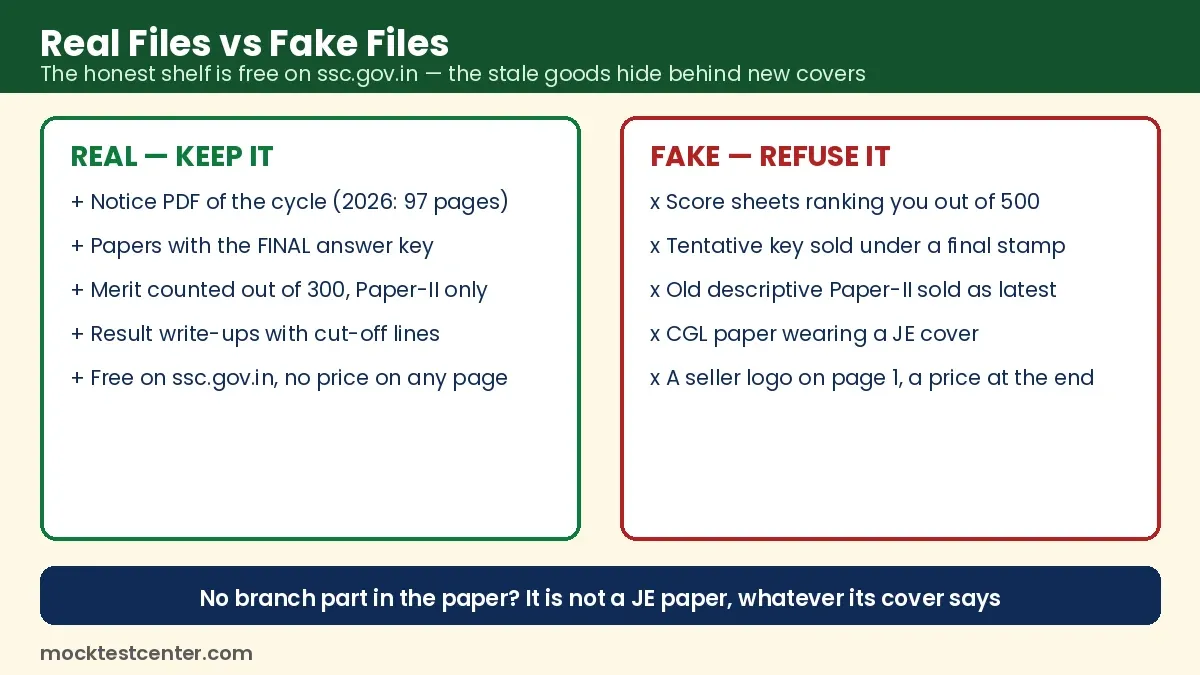
The 2025 Shelf, Worked as an Example
Take one cycle's shelf and lay it out in order, so you can see what a complete set of real files looks like. The cycle is 2025, the last full one.
First file: the notice of 30 June 2025, with 1,340 tentative vacancies. Second: the later vacancy file that raised the count to 1,731. A candidate who holds only the first file quotes 1,340 all year. A candidate who holds both knows why the number moved, and knows to keep watching the shelf after the notice, because SSC adds files to a live cycle for months.
Third: the Paper-I papers of 3 to 6 December 2025 and 13 December 2025, with their keys. Fourth: the Paper-I result write-up of 6 March 2026, the file that carries the shortlisting lines, 127.22748 for Civil and 127.30120 for Electrical and Mechanical on the general list, and the counts, 11,593 and 4,014. Fifth: the Paper-II paper of 7 April 2026 with its key. Sixth: the final result file of 3 August 2026 with 1,731 names.
Six files, and the whole truth of one cycle stands in them: what was asked, what the gate cost, who crossed, and what the merit list finally held. Every summary page on the internet is a shadow of these six files. Work from the files and use the summaries only as pointers.
Now hold the 2026 shelf beside it, still growing: the notice of 2 September 2026, the vacancy list of 8 October 2026 with 1,699 posts, the Paper-I papers of November 2026, and the tentative keys of 19 November 2026. Its Paper-II and result files are still to come, Paper-II standing in December 2026 on the notice schedule. A 2027 candidate who keeps both shelves in order owns the two most useful study objects this exam produces: the last finished story, and the live one he is standing inside.
Objection Week: What to Do While a Key Is Tentative
The days between a paper and its final key have their own rules, and most candidates waste them reading other people's score guesses.
Rule one: score yourself once, with the tentative key, and write the score in pencil, marked tentative. For Paper-I 2026 that key came on 19 November 2026, with your response sheet. Count right, wrong and blank by part. That count is a planning number, not a result.
Rule two: spend your objection money like a soldier, not like a crowd. Rs 50 a question, never returned. Object only where you hold proof: a line in a standard book, a code value, an official page. A feeling that the key must be wrong is not proof, and SSC studies proof, not feelings. If 3 questions in your paper carry real proof, object to 3 and stop. The candidate who objects to 12 on hope has bought 12 lottery tickets at Rs 50 each.
Rule three: do not rebuild your study plan on a tentative score. If the tentative count puts you near the gate line, the wise plan is the same either way: Paper-II depth work starts now, because crossing the gate by 1 mark or by 20 buys the same seat, and the merit race pays only for depth. Candidates who wait for the result to start Paper-II work hand their rivals the exact weeks the race is won in.
Rule four: when the final key lands, rescore the same paper once, cleanly, and ink the true score over the pencil one. Note how many marks the key change moved. That number, usually small in Paper-I and able to reach 4 or 8 in Paper-II, teaches you how much trust a tentative score deserves in the next cycle. Candidates who never rescore carry a soft number in the register for a year and plan a soft year on it.
And keep the response sheet safe through all of it. It is the only file that knows what you marked in the hall, and every later count, yours and SSC's, stands on it.
Files for the New Parts: Telecom and IMD
The 2026 cycle added parts to this exam, and the file shelf for those parts is young. Young shelves need more care, not less.
Part-G, Telecommunication, sat in its own batch on 30 November and 1 December 2026, apart from Parts A to F. Its papers and keys sit on the SSC site like every other part's, and they are the first true Telecom papers of this exam. If you are a Telecom candidate, those two days of files are your whole past paper shelf: download them with their keys the moment they land, because next year's sellers will wrap them in new covers and new names, and the real files will be harder to find, not easier.
IMD candidates hold Parts D, E or F, and their shelf has the same shape: the November 2026 papers are the first set of this exam in the new subjects. There is no deep old shelf behind them. Your PYQ plan must lean harder on the other shelves: the common parts of every JE paper, reasoning and GA, which you share with all candidates, and your own degree level books for depth. Do not let a seller tell you an old file from another exam is an SSC JE paper in your subject. It is a file from another exam, and its weight and its style are not this exam's.
One more file matters for the new parts: the vacancy list of 8 October 2026, which names the new posts with their counts, 462 for IMD and 69 for Telecom. Keep it. In a young shelf, the vacancy file is the map of who you are really running against, and it stops the loudest rumour of a new exam, the rumour about how many seats there are, at the door.
Name Your Files Like a Soldier
Keep one folder per cycle: SSC JE 2026. Inside it, the notice, the papers with their keys, and the result files, each with a full name: cycle, paper, part, and key stage. SSC JE 2025 Paper-I Civil Final Key. SSC JE 2025 Paper-II Electrical Objective. Below them, your own work files: score register, error notebook scans, chapter lists. When the next cycle notice comes, make a second folder and never mix the two. Patterns, vacancy counts and rules change a little each cycle, and a mixed folder is how a candidate quotes the 500 mark rule in a 300 mark year.
Print the notice once and work on the print. Mark the post table against your own education: degree or diploma, experience years where the post asks them. Mark the age lines and check your birth date against the fixed date with your own eyes: for the 2026 cycle, 1 August 2026. A boy in Ranchi found in the printed table that his diploma needed 2 years of experience for the BRO posts he wanted most, and he fixed his preference order in time. On a phone screen he would have scrolled past that line.
Read the Notice PDF Like a Syllabus
Most candidates download the notice, read the dates, and never open it again. That wastes the best study document this exam gives you. Read it in three passes. First pass, the gate: posts, education, experience, age, fee, dates. This pass tells you whether you are in the race and for which posts. Second pass, the field: the scheme of both papers, the qualifying rule, the merit rule, the key stages. This pass tells you what to train, and it is the pass that kills the stale file shelf, because a man who has read the merit rule knows a 500 mark tool is dead. Third pass, the map: the syllabus, chapter by chapter, for Paper-I and Paper-II. This pass builds your chapter plan, and the chapter tests and sectional tests of this sub-category are built on exactly that map.
The result write-ups repay the same care. They tell you the crowd size of your branch: 11,593 Civil candidates shortlisted for Paper-II in 2025 against 4,014 on the Electrical and Mechanical list. They tell you the gate height in hard numbers, cycle after cycle: 122.92909 for the Civil general line in 2024, 127.22748 in 2025. A candidate who reads two result files knows the slope of the gate he must climb. A candidate who reads only the latest notice knows only his own year, and stands surprised by numbers that were public all along.
And keep your practice honest against the real shapes. The full tests hold the 200 question gate and the 100 question merit paper in their true forms. The NCERT tests hold the school base under the GA part, and the current affairs tests carry its news layer. Every tab trains a thing the exam really does, at the weight the present notice gives it.
The Print Shelf at Home
Files live on a phone. Work lives on paper. Print the shelf's working papers: the branch papers you are solving this month, the notice's syllabus pages, and the vacancy list. A printed paper can be marked, folded, carried to the roof and solved under a tree. A phone paper sits beside 40 other calls on your attention, and it loses.
Keep the prints in one folder, in cycle order, with the score of each sitting written on its first page: date, marks earned, marks cut, the 3 chapters that bled. In 3 months that folder becomes the truest book you own for this exam, because it holds not only what SSC asked but what you did with it, in your own hand. Coaches call this material analysis. Soldiers call it the log book. Call it what you like, and keep it.
Print the keys too, and keep each key behind its paper, never in front. A key seen before a sitting turns a test into a reading exercise, and reading exercises build the warm feeling that fails candidates at the gate. Solve first, in full, at the clock. Then turn the folder page and meet the key like an examiner.
One last print: the result write-up of the last cycle, the file with the shortlisting lines. Pin it where you study. Not as fear, and not as a dream. As a ruler. Every score you write on a folder's first page can be laid against those lines, and you will know, in numbers, how far the gate stands from your desk today.
Keep the folder dry, flat and away from the floor. It sounds like a small thing until a monsoon evening or a spilled cup of tea eats a month of sittings. The phone copies stay safe in any case, so the folder is a working copy, not the only copy. Still, a season of hand written scores does not grow back.
Replace prints as the shelf grows. When the final key of a paper lands, print it and retire the tentative key to the back of the folder, marked superseded. A folder that holds two keys for one paper without a mark is a trap for a tired evening. The shelf's whole value is trust, and trust is built by small acts of order, repeated every time a file lands.
How This Site Helps You Use the Real Files
Mock Test Center keeps this sub-category honest the same way. The downloads tab gathers the paper files of this exam in one place. The previous year paper page teaches the solving and scoring method that goes with them. The test tabs train the gate and the merit paper in the order the hall runs them. And when SSC prints something new, a fresh notice, a key, a result, it lands on the Latest Jobs page of this site as well as on ssc.gov.in.
Do the small things today. Download the 2026 notice and save it with its full name. Read the merit rule with a pen. Take one Paper-I paper and one objective Paper-II paper from the shelf, run the two minute check on both, and sit the Paper-II paper this week in a full 2 hour sitting. The folder was never the goal. The goal is a merit line with your name above it, and that line is earned by work on real files, not by a hard disk of renamed ones.