About SSC MTS & Havaldar Exam Series
📖 Table of Contents
- SSC MTS & Havaldar Mock Test Series 2027: Free Session 1 & Session 2 CBT Practice (Hindi/English)
- Why I Built This Mock Test Series
- URGENT CORRECTION / AMBER CALLOUT BOX
- AI-BASED WEAK AREA RECOMMENDATION REPORT
- Attempt Free SSC MTS & Havaldar Mock Test Series 2027 (5-Tab Practice Hub)
- Inside the SSC MTS 2027 Test Series: Total Tests, 15 Regional Languages & Printable PDF Answer Keys
- Why Standard Mock Tests Fail for SSC MTS: 4 Exam-Engine Realities We Built Into This 2027 Series
- How the SSC MTS 2027 Dual-Session Mock Engine Works (Session I vs Session II Pattern)
- Session I Mock Rules (40 Questions, 120 Marks, 45 Minutes — Zero Penalty & Qualifying Gate)
- Session II Mock Rules (50 Questions, 150 Marks, 45 Minutes — Merit-Deciding GA & English with -1 Penalty)
- How Our Mock Rank Predictor Applies SSC's Official Tie-Breaking Order
- Session-Wise Negative Marking & Safe-Guessing Math to Practice in Your Mocks
- Why You Must Attempt 40/40 in Session I (Expected Value = +0.75 Marks per Blind Guess)
- Safe-Guessing Expected Value (EV) Table for Session II (+3 Correct, -1 Wrong)
- 45+45 Minute Dual-Session Time-Split Blueprint for Your First 5 Mock Tests
- Session I Time-Allocation Table (45 Minutes Total — Zero Negative Marking)
- Session II Time-Allocation Table (45 Minutes Total — Strict -1 Penalty)
- Which 2027 Mock Test Track is right for you? (MTS 18-25 vs 18-27 & Havaldar CBIC/CBN Track Selector Matrix)
- Topic-Wise Question Weightage in Our 2027 Mock Tests (Calibrated to Feb 2026 Shifts) & 10 Solved Sample Questions
- Session II General Awareness Weightage & 3 Solved Mock Questions
- Session II English Comprehension Weightage & 3 Solved Mock Questions
- Session I Numerical & Reasoning Weightage & 4 Solved Mock Questions
- Target Score Benchmarks for SSC MTS 2027 Mock Tests (Based on Official Aug & Oct 2026 Session-II Cutoffs Out of 150)
- How to Audit Your Mock Test Response Sheet, Normalization Impact & Error-Log Template
- Mock Test Error-Log Template
- 5 Score-Killing Mistakes Aspirants Make in SSC MTS Mock Tests (And How to Fix Them Before Exam Day)
- How to Start Your Free SSC MTS & Havaldar 2027 Mock Test on MockTestCenter.com
- Daily Current Affairs Quiz: Boost Your 75-Mark Session II General Awareness Score
- About the Author
SSC MTS & Havaldar Mock Test Series 2027: Free Session 1 & Session 2 CBT Practice (Hindi/English)
Verification disclaimer: This 2027 mock test series is set to the latest official SSC dual session CBE pattern and the February 2026 shift response sheets. Candidates are advised to cross-check the number of vacancies and age relaxation details for the upcoming recruitment against the official notification PDF on the SSC website (ssc.gov.in) prior to applying.
Why I Built This Mock Test Series
I'm Shubham Kumar Sah, founder of MockTestCenter.com.
The majority of SSC MTS mock tests treat the paper as a single 90 minute paper where all the questions are of the same type and follow the same pattern. That in itself is a massive disadvantage on the day of the actual exam and will cost you your selection.
SSC MTS and Havaldar are both conducted as two back to back 45 minute sessions in a single day. The pattern of the paper changes at the 45 minute mark. The first session (Session I) is 120 marks of Maths and Reasoning with NO negative marking. The marks from this session only qualify you. Session II is 150 marks of General Awareness and English with a 1 mark penalty for every wrong answer and it is these 150 marks which determine your entire merit rank.
I keep seeing students leave questions blank in Session I (where guessing is pointless) and then go completely wild in Session II (where four wrong guesses will wipe out 4 full marks from their merit score).
A second confusion for Havaldar applicants arises. A number of coaching blogs still have the 8km cycle test (which SSC have removed) listed or are actively trying to scare students into thinking that if you fail the Havaldar physical walk your MTS form is automatically cancelled. According to the official SSC result write-up however, your MTS candidature is absolutely valid even if you don't clear the Havaldar PET.
We've built this series with an auto-locking 45+45 minute dual session timer, separate Session-I qualifying status and Session-II merit rank predictor and actual February 2026 shift mocks in both English and Hindi.
Most of the series is free. A diagnostic test shouldn't be behind a paywall.
Every test in here has to pass that one test really: will it train someone to go for 40 out of 40 in Session I and protect every single mark out of 150 in Session II? If not, it does not get published.
URGENT CORRECTION / AMBER CALLOUT BOX
Direct Clarification for SSC MTS & Havaldar Aspirants:
- (1) The "broken" scoring rule on the coaching sites: The major mock test websites are still propagating the old rules around the scoring such as "0.25 negative marking for the whole exam", "1 mark per question" or a "Tier 2 Descriptive Paper". The actual rules for the mock test engine to remember: The SSC MTS and Havaldar exam is a Single Sitting Computer Based Examination (CBE) of 90 questions (270 marks, 90 minutes). It is strictly divided into Session I (40 Qs, 120 marks, 45 minutes) and Session II (50 Qs, 150 marks, 45 minutes). Session I is a qualifying session (zero negative marking) and Session II is the 100% merit deciding session (1 mark negative marking per wrong answer out of 3 marks).
- (2) Auto-Locking Engine Standard: The generic test series don't actually lock Session I at exactly 45 minutes and they also tend to confuse the qualifying status with the merit rank calculation. Our mock engine will auto-lock Session I at 45:00 and load Session II straight away.
- (3) The outdated Havaldar Physical Test myths: old coaching articles still refer to the '8km / 3km Cycling Test' for the Havaldar post. That has been removed by the SSC permanently. The PET is now purely a walking test (1600m in 15 minutes for males and 1km in 20 minutes for females). Also, failure to pass the Havaldar PET in no way cancels your MTS candidature. Your MTS merit is fully intact.
Preparation for the Multi-Tasking (Non-Technical) Staff and Havaldar (CBIC & CBN) Exam is all about having a complete grasp of dual session time management, the negative marking maths and the discipline required to go from offline OMR to CBT. If you're aiming for a central government post at Pay Level 1 or Level 2 you're going to need to be practising under the actual commission conditions on a regular basis. A good ssc mts mock test 2027 series will be one that perfectly replicates the 90 minute dual session CBT format and will test you on your performance in Numerical Ability, Reasoning, General Awareness and English.
This is a complete cycle aware practice platform for the 10th pass central government job aspirants.
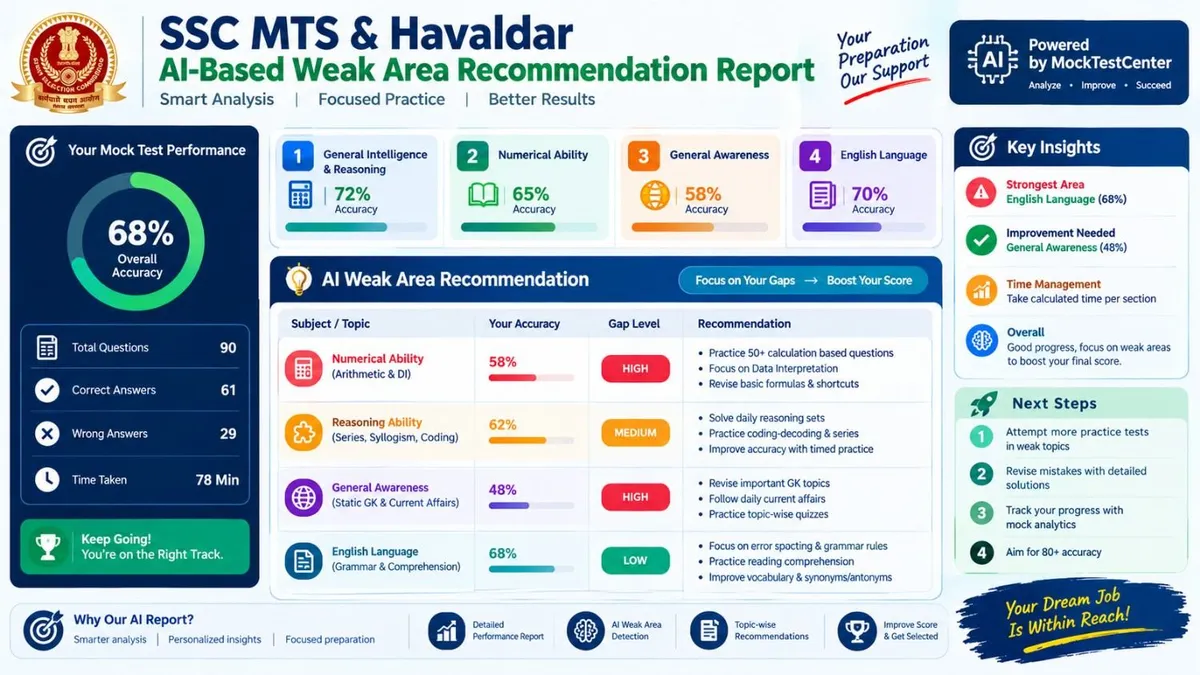
AI-BASED WEAK AREA RECOMMENDATION REPORT
[Simulated Screenshot - MockTestCenter Analytics]Critical Gap Areas Identified:
- Session I Time Management & Pacing [ HIGH GAP ]
- Session II English Cloze Test & Error Spotting [ MED GAP ]
- General Awareness Static GK Facts [ LOW GAP ]
>> Recommended Action: Launch Tab 4 Qualifying Drills & Review Error Log
The test engine's inbuilt diagnostic engine pinpoints exact conceptual and time-management gaps across Session I and Session II, directing you to tailored remedial revision modules instantly.
Attempt Free SSC MTS & Havaldar Mock Test Series 2027 (5-Tab Practice Hub)
To help candidates find the exact diagnostic tool they need with zero friction, our mock resources are neatly arranged under a 5-tab responsive selector at the top of the test portal:
Inside the SSC MTS 2027 Test Series: Total Tests, 15 Regional Languages & Printable PDF Answer Keys
| Test Category | Total Tests in Series | Free Access Tests | Test Duration | Marking Rule & Structure | PDF Availability |
|---|---|---|---|---|---|
| Full-Length Dual-Session Mocks | 25 Tests | 3 Tests | 90 Minutes (45 + 45 Mins) | Session I: +3 Correct, 0 Wrong Session II: +3 Correct, -1 Wrong |
Downloadable PDF Answer Keys & Solutions |
| Session II Merit Sectionals | 40 Tests | 6 Tests | 45 Minutes per test | 50 Questions, 150 Marks (-1 Penalty) | Detailed Explanatory PDFs |
| February 2026 Shift Papers | 15 Shifts | 2 Shifts | 90 Minutes (CBT Format) | Calibrated to Feb 2026 Response Sheets | Official Shift Question Paper PDFs |
| Session I Qualifying Drills | 30 Tests | 5 Tests | 45 Minutes per test | 40 Questions, 120 Marks (0 Penalty) | Sectional PDF Booklets |
| Static GK & English Lab | 50 Tests | 10 Tests | 30 Minutes per test | Topic-specific high-yield drills | Quick-Revision PDF Handouts |
Why Standard Mock Tests Fail for SSC MTS: 4 Exam-Engine Realities We Built Into This 2027 Series
| Evaluation Metric | Flawed Standard Coaching Mocks | MockTestCenter.com 2027 Engine Design |
|---|---|---|
| Session timing and locking | the 90 minutes are treated as a single block so candidates can spend the full 90 minutes on the Maths/Reasoning section. | Session I auto-locks at exactly 45:00, which then triggers an immediate move to Session II as required by the SSC. |
| Negative Marking Calibration | applies a uniform negative mark to all questions or uses the old 0.25 penalty. | Enforces a 0 penalty in Session I and a strict -1 mark penalty in Session II to protect the integrity of your mock rank. |
| Post Mock Rank Analytics | Mashes together the Session I and Session II raw scores into a single, utterly meaningless percentage. | Separates out the Session I qualifying status from the Session II merit score (out of 150) in accordance with the official SSC evaluation methodology. |
| Language Support Interface | restricts the tests to English and Hindi only (ignores regional applicants). | Provides English, Hindi and 13 regional languages (15 languages total) for the Session I and General Awareness sections. |
How the SSC MTS 2027 Dual-Session Mock Engine Works (Session I vs Session II Pattern)
Session I Mock Rules (40 Questions, 120 Marks, 45 Minutes — Zero Penalty & Qualifying Gate)
Subject Distribution: Numerical & Mathematical Ability (20 Qs / 60 Marks) and Reasoning Ability & Problem Solving (20 Qs / 60 Marks)
Marking scheme: +3 for each correct answer; no negative marking for incorrect or unattempted answers.
Qualifying thresholds: all of this assessed purely as a threshold. The mock reports will flag your status against the official category cut-offs: UR is 30% (36 marks / 12 Qs), OBC/EWS is 25% (30 marks / 10 Qs) and all others are 20% (24 marks / 8 Qs).
Session II Mock Rules (50 Questions, 150 Marks, 45 Minutes — Merit-Deciding GA & English with -1 Penalty)
Subject Distribution: General Awareness (25 Qs / 75 Marks) and English Language & Comprehension (25 Qs / 75 Marks).
Marking scheme: +3 for each correct answer; -1 mark (1/3rd) for each wrong answer.
Merit calculation: 100% of your All India and State/CCA wise mock rank is computed purely from Session-II marks (provided you clear the Session I qualifying gate).
How Our Mock Rank Predictor Applies SSC's Official Tie-Breaking Order
Session-Wise Negative Marking & Safe-Guessing Math to Practice in Your Mocks
Why You Must Attempt 40/40 in Session I (Expected Value = +0.75 Marks per Blind Guess)
As Session I has no negative marking, leaving any question unanswered is a certain loss of marks.
With 4 options and +3 for correct answers with 0 penalty for wrong answers, a blind guess across 4 options yields an expected value of +0.75 marks per question ($0.25 \times 3$).
In the mock tests you are expressly trained to bubble all 40 questions in Session I before the time runs out (even if that means resorting to educated guessing in the final minutes).
Safe-Guessing Expected Value (EV) Table for Session II (+3 Correct, -1 Wrong)
In Session II (where a wrong answer costs you 1 mark) blind guessing is statistically neutral but of course very risky. Strategic elimination transforms your odds:
| Elimination Level in Session II | Mathematical Odds | Expected Value (EV) per Guess | Strategic Mock Test Recommendation |
|---|---|---|---|
| No Elimination (Blind guess across 4 options) | 1 in 4 chance of being correct (+3) vs 3 in 4 chance of being wrong (-1) | 0.00 Marks ($0.25 \times 3 + 0.75 \times -1$) | Mathematically neutral, but very high negative variance. Skip unless you're absolutely desperate. |
| 1 Wrong option eliminated (3 options remaining) | 1 in 3 chance of being correct (+3) vs 2 in 3 chance of wrong (-1) | +0.33 Marks ($0.333 \times 3 + 0.667 \times -1$) | Favourable expected value. Attempt if you can eliminate one definite distractor. |
| 2 wrong options eliminated (50:50 choice) | 1 in 2 chance of being correct (+3) versus 1 in 2 chance of being wrong (-1) | +1.00 Mark ($0.5 \times 3 + 0.5 \times -1$) | Highly positive expected value. A must attempt on your OMR/CBT screen. |
Worked Student Scorecard Example 1: Aspirant A attempts all 50 questions in Session II, getting 35 correct and 15 wrong:
$$\text{Raw Score} = (35 \times 3) - (15 \times 1) = 105 - 15 = \mathbf{90.00 \text{ Marks out of } 150}$$
Worked Student Scorecard Example 2: Aspirant B uses 50:50 elimination on 10 doubtful questions, getting 6 correct and 4 wrong, alongside 32 solid correct answers:
$$\text{Raw Score} = (38 \times 3) - (12 \times 1) = 114 - 12 = \mathbf{102.00 \text{ Marks out of } 150}$$
(An intelligent 50:50 attempt strategy gives you +12 net marks).
45+45 Minute Dual-Session Time-Split Blueprint for Your First 5 Mock Tests
Session I Time-Allocation Table (45 Minutes Total — Zero Negative Marking)
Minutes 00 to 22 (22 Mins) — Reasoning Ability (20 Qs): Solve the verbal and non-verbal reasoning questions, coding-decoding, series and direction sense. Identify the longer puzzles and move on.
Minutes 22 to 43 (21 Mins) — Numerical & Mathematical Ability (20 Qs): Arithmetic, data interpretation and simplification questions.
Minutes 43 to 45 (02 Mins) — Final Review & Blind Guess Buffer: Just check the question palette and fill in any blanks you haven't attempted with random guesses. Session I locks automatically at 45:00 and carries no negative marking.
Session II Time-Allocation Table (45 Minutes Total — Strict -1 Penalty)
Minutes 00 to 16 (16 Mins) — General Awareness (25 Qs): A rapid-fire through static GK, current affairs, history, polity and science. Answer the questions you know about straight away, don't spend time on things you don't know.
Minutes 16 to 38 (22 mins) — English Language & Comprehension (25 Qs): Grammar, vocabulary, error spotting, active/passive voice and reading/cloze test passages.
Minutes 38 to 45 (07 Mins) — 50:50 Review & Safe-Guess Execution: Back to the bookmarked questions in GA and English where you've successfully eliminated 1 or 2 options and are going in for some calculated safe guesses before the time runs out.
Which 2027 Mock Test Track is right for you? (MTS 18-25 vs 18-27 & Havaldar CBIC/CBN Track Selector Matrix)
| Mock Test Track | Age Bracket & Post Eligibility | Physical PET Requirement | Recommended Mock Priority Tab | Target Session II Score (Out of 150) |
|---|---|---|---|---|
| Track A: MTS 18–25 All-India General Desk Role | 18 to 25 Years (General MTS vacancies) | None (CBE merit is final) | Prioritize Tab 1 & Tab 2 (Full Mocks & GA/English) | 125–135+ Marks (High competition) |
| Track B: MTS 18–27 Departmental & State Role | 18 to 27 Years (Extended age bracket) | None (CBE merit is final) | Prioritize Tab 1 & Tab 4 (Full Mocks & Qualifying Drills) | 120–130+ Marks |
| Track C: Havaldar in CBIC & CBN Uniformed Role | 18 to 27 Years (Havaldar cadre) | Walking PET Mandatory: Male 1600m in 15 mins; Female 1km in 20 mins | Prioritize Tab 1, Tab 2 & Tab 3 (Full Mocks & Shift Papers) | 115–125+ Marks (PET shortlisting applies) |
Topic-Wise Question Weightage in Our 2027 Mock Tests (Calibrated to Feb 2026 Shifts) & 10 Solved Sample Questions
Session II General Awareness Weightage & 3 Solved Mock Questions
Q1. (Static GK) भारत का कौन सा शास्त्रीय नृत्य उत्तर प्रदेश से शुरू हुआ है, जिसमें राधा और कृष्ण की प्रेम कहानियाँ और कथाएँ दिखाई जाती हैं?
Which classical dance of India came from the state of Uttar Pradesh and is essentially based on the stories and legends of Radha and Krishna?
A. कथकली (Kathakali)
B. कथक (Kathak) [Correct]
C. कुचिपुड़ी (Kuchipudi)
D. मोहिनीअट्टम (Mohiniyattam)
Option (Correct): B. Kathak (Kathak) [Correct] -> Reason: Kathak is the classical dance form of Uttar Pradesh, a dance form which has its origins in the storytelling traditions of northern India (the tales of Krishna and Radha being the most prominent).
Option (Incorrect): A. Kathakali -> Reason: Kathakali is a classical dance-drama from the southern state of Kerala.
Option (Incorrect): C. Kuchipudi -> Reason: Kuchipudi is a classical dance form from the state of Andhra Pradesh.
Option (Incorrect): D. Mohiniyattam -> Reason: Mohiniyattam is a graceful classical solo dance from Kerala.
'कथक' उत्तर प्रदेश और उत्तर भारत का एकमात्र मुख्य शास्त्रीय नृत्य है।
Q2. (Polity) भारतीय संविधान में 'संवैधानिक उपचारों का अधिकार' नागरिकों को अनुच्छेद 32 के तहत दिया गया है।
Under which Article of the Indian Constitution is the 'Right to Constitutional Remedies' guaranteed to the citizens of India?
A. अनुच्छेद 19 (Article 19)
B. अनुच्छेद 21 (Article 21)
C. अनुच्छेद 32 (Article 32) [Correct]
D. अनुच्छेद 51ए (Article 51A)
Option (Correct): C. Article 32 [Correct] -> Reason: Dr B.R. Ambedkar referred to Article 32 as the "heart and soul" of the Constitution as it gives the citizen the right to approach the Supreme Court for enforcement of his Fundamental Rights.
Option (Incorrect): A. Article 19 -> Reason: Article 32 provides for the right to constitutional remedies, not the protection of the six democratic freedoms (freedom of speech and expression, freedom of assembly, freedom of movement etc.).
Option (Incorrect): B. Article 21 -> Reason: Article 21 provides for the protection of life and personal liberty.
Option (Incorrect): D. Article 51a (Section 51A) -> Reason: Article 51A sets out the Fundamental Duties of Indian citizens.
डॉ. बी.आर. अंबेडकर ने इस अनुच्छेद को भारतीय संविधान की 'आत्मा और हृदय' कहा था।
Q3. (General Science) मानव शरीर में रक्त के थक्के बनने में आम तौर पर कौन सा विटामिन सबसे अहम होता है?
Which vitamin is absolutely essential for the coagulation (clotting) of blood in the human body?
A. विटामिन ए (Vitamin A)
B. विटामिन सी (Vitamin C)
C. विटामिन के (Vitamin K) [Correct]
D. विटामिन बी1 (Vitamin B1)
Option (Correct): C. Vitamin K [Correct] -> Reason: Vitamin K is an essential co-factor for the liver in the synthesis of prothrombin and other clotting factors which are required for blood coagulation.
Option (Incorrect): A. Vitamin A -> Reason: Vitamin K is required for vision and for the maintenance of epithelial tissue, not primarily for blood coagulation.
Option (Incorrect): B. Vitamin C (Vitamin C) -> Reason: Vitamin C (Ascorbic Acid) is required for collagen synthesis and for immunity, deficiency of which leads to scurvy.
Option (Incorrect): D. Vitamin B1 (Vitamin B1) -> Reason: Deficiency of vitamin B1 (thiamine) leads to beriberi, has nothing to do with blood clotting.
यह रक्तस्राव रोकने और प्रोथ्रोम्बिन बनाने में यकृत इसका इस्तेमाल करता है।
Session II English Comprehension Weightage & 3 Solved Mock Questions
Q4. (Cloze Test / Grammar) Select the most appropriate option to fill in the blank: "Hardly had the train stopped at the platform __________ the passengers rushed towards the exit."
A. than
B. when [Correct]
C. then
D. before
Option (Correct): B. when [Correct] -> Reason: The correlative conjunction pair for the adverb "Hardly" (and "Scarcely") is always "when" (or "before") to indicate an action occurring immediately after another.
Option (Incorrect): A. than -> Reason: "Than" is the correct correlative to "No sooner" (a comparative adjective/adverb), not "Hardly".
Option (Incorrect): C. then -> Reason: "Then" is used to denote sequence in time ("if-then") and is grammatically incorrect in this context.
Option (Incorrect): D. before -> Reason: "Before" is occasionally acceptable with "scarcely", "when" is the correct and standard pairing as tested in the SSC exams.
याद रखें, अंग्रेजी व्याकरण में 'Hardly' या 'Scarcely' के साथ हमेशा 'when' आता है। 'No sooner' के साथ 'than' आता है।
Q5. (Vocabulary / Synonyms) Select the synonym of the given word: "ABUNDANT"
A. Scarce
B. Plentiful [Correct]
C. Meagre
D. Deficient
Option (Correct): B. Plentiful [Correct] -> Reason: "Abundant" means to be in large quantities; "plentiful" is its exact synonym.
Option (Incorrect): A. Scarce -> Reason: "Scarce" is an opposite meaning i.e. insufficient or rare.
Option (Incorrect): C. Meagre -> Reason: "Meagre" means scanty, inadequate (antonym).
Option (Incorrect): D. Deficient -> Reason: "Deficient" means lacking in some necessary element or amount (antonym).
'Abundant' का मतलब है बहुत ज्यादा मात्रा में, और इसका समानार्थी शब्द 'Plentiful' है।
Q6. (Spotting Errors) Identify the segment in the sentence which contains the grammatical error: "Neither the teacher nor the students was in the classroom yesterday."
A. Neither the teacher nor
B. the students was present [Correct]
C. in the classroom
D. yesterday
Option (Correct): B. the students were present [Correct] -> Reason: Subject-verb agreement rules state that when you have two subjects joined by "neither...nor", the verb agrees with the subject that is closest to it. In this case the subject closest to the verb is "students" (plural) so the verb must be "were" not "was".
Option (Incorrect): A. Neither the teacher nor -> Reason: That correlative conjunction structure is correct.
Option (Incorrect): C. in the classroom -> Reason: That prepositional phrase is grammatically correct.
Option (Incorrect): D. yesterday -> Reason: The adverbial of time is in the correct position.
संकेत: 'Neither...nor' वाले वाक्यों में क्रिया हमेशा सबसे पास वाले कर्ता के हिसाब से आती है।
Session I Numerical & Reasoning Weightage & 4 Solved Mock Questions
Q7. (Arithmetic / Percentage) अगर किसी चीज़ के दाम 25% बढ़ा दिए जाएं, तो कुल खर्च को बराबर रखने के लिए उसकी खपत में कितने प्रतिशत की कमी करनी पड़ेगी?
If the price of an article is increased by 25%, by what % must its consumption be reduced in order that the expenditure on it may remain unchanged?
A. 15%
B. 20% [Correct]
C. 25%
D. 30%
Option (Correct): B. 20% [Correct] -> Reason: Consumption reduction percentage = $\left(\frac{r}{100+r}\right) \times 100 = \left(\frac{25}{125}\right) \times 100 = \frac{1}{5} \times 100 = 20\%$.
Option (Incorrect): A. 15% -> Reason: A 15% reduction is mathematically wrong for a 25% price increase.
Option (Incorrect): C. 25% -> Reason: A typical fallacy is to assume that consumption should fall by precisely 25% as well, thereby reducing total spending.
Option (Incorrect): D. 30% -> Reason: 30% reduction is too much and ends up reducing the total outlay.
Hint: प्रतिशत वृद्धि वाले ऐसे प्रश्नों में शॉर्टकट सूत्र $\frac{r}{100+r} \times 100$ का प्रयोग करें।
Q8. (Arithmetic / BODMAS) Simplify the following expression using BODMAS rule: $50 - [40 - \{30 - (20 - 10)\}]$
A. 10
B. 20 [Correct]
C. 30
D. 40
Option (Correct): B. 20 [Correct] -> Reason: Solving step-by-step using brackets order (Vinculum → Parentheses → Braces → Brackets):
Inner parentheses: $(20 - 10) = 10$
Braces: $\{30 - 10\} = 20$
Square brackets: $[40 - 20] = 20$
Final subtraction: $50 - 20 = 20$.
Option (Incorrect): A. 10 -> Reason: Results from arithmetic errors in the bracket resolution.
Option (Incorrect): C. 30 -> Reason: Wrongly disregards the outer subtraction brackets.
Option (Incorrect): D. 40 -> Reason: Doesn't properly follow the inward-outward bracket reduction.
सुझाव: BODMAS नियम में सबसे पहले हमेशा सबसे अंदर वाले कोष्ठक (Parentheses) को हल करें।
Q9. (Reasoning / Coding-Decoding) अगर किसी कोड भाषा में 'STUDY' को 'TVVEC' लिखा जाता है, तो उसी कोड भाषा में 'PAPER' को क्या लिखा जाएगा?
If in a certain code language 'STUDY' is coded as 'TVVEC', how would 'PAPER' be coded in that same language?
A. RCRGU [Correct]
B. QBOFS
C. SCSHV
D. QBOHQ
Option (Correct): A. RCRGU [Correct] -> Reason: Analyzing the alphabetical shift pattern:
S (+1) = T, T (+2) = V, U (+3) = V, D (+4) = E, Y (+5) = C. (Progressive incremental shift: +1, +2, +3, +4, +5).
Applying the exact same progressive shift to PAPER:
P (+1) = R, A (+2) = C, P (+3) = R, E (+4) = G, R (+5) = U → RCRGU.
Option (Incorrect): B. QBOFS -> Reason: That represents a uniform +1 shift, ignoring the fact that it's a progressive increment.
Option (Incorrect): C. SCSHV -> Reason: Results from incorrect forward addition steps.
Option (Incorrect): D. QBOHQ -> Reason: Incorrect application of reverse subtraction.
संकेत: देखें कि अक्षरों के बीच वर्णमाला में फर्क हर बार एक अंक, फिर दो अंक, फिर तीन अंक और इसी तरह बढ़ता है या नहीं।
Q10. (Reasoning / Number Series) दी गई संख्या श्रृंखला में कौन सी संख्या अगली आएगी: 3, 7, 15, 31, 63, ?
Find the missing number in the following number series: 3, 7, 15, 31, 63, ?
A. 121
B. 127 [Correct]
C. 131
D. 135
Option (Correct): B. 127 [Correct] -> Reason: Analyzing the mathematical pattern: each subsequent number is multiplied by 2 and added by 1 ($\times 2 + 1$):
$3 \times 2 + 1 = 7$; $7 \times 2 + 1 = 15$; $15 \times 2 + 1 = 31$; $31 \times 2 + 1 = 63$; $63 \times 2 + 1 = 127$ (alternatively, doubling the differences: +4, +8, +16, +32, +64).
Option (Incorrect): A. 121 -> Reason: Doesn't fit the geometric doubling progression.
Option (Incorrect): C. 131 -> Reason: Is greater than the precisely calculated progression value.
Option (Incorrect): D. 135 -> Reason: Arithmetically incorrect on the basis of the differences in the series.
Hint: श्रृंखला में प्रत्येक अगली संख्या पिछली संख्या की दोगुनी होकर 1 जोड़ने पर प्राप्त होती है ($\times 2 + 1$)।
Target Score Benchmarks for SSC MTS 2027 Mock Tests (Based on Official Aug & Oct 2026 Session-II Cutoffs Out of 150)
To help you gauge your preparation, we have calibrated our mock scoring zones against the official State/CCA-wise cutoffs from the 2025-26 recruitment cycle (where Delhi CGST closed at 142.35, Lucknow CGST at 141.03, Jaipur CGST at 139.36, Chandigarh CGST at 137.84, Bhubaneswar CGST at 137.73, CBN Directorate at 121.55, Pune CGST at 120.79, and Mumbai Customs at 107.97 out of 150 marks in Session II):
How to Audit Your Mock Test Response Sheet, Normalization Impact & Error-Log Template
After completing any mock test on MockTestCenter.com, audit your performance using this systematic review process:
Verify Session I Qualification: Confirm that your Session I score has cleared the category-wise qualifying gate (36/30/24 marks out of 120) with 0 penalty.
Calculate Session II Raw Score: Multiply your correct answers in GA and English by 3 and subtract 1 mark for every incorrect answer ($\text{Correct} \times 3 - \text{Wrong} \times 1$).
Analyze Multi-Shift Normalisation: bear in mind that the official SSC scores and our mock rank predictor both use multi-shift normalisation. This means the raw scores are adjusted in accordance with the difficulty of the paper on each date.
Mock Test Error-Log Template
| Mock # & Session | Topic / Subject | Error Type | Action Fix / Rule to Remember | Retest Date |
|---|---|---|---|---|
| Ex: Mock 3 (Session II) | English (Grammar) | Subject-Verb Agreement | Check closer subject in 'neither...nor' structures. | After 3 days |
| Ex: Mock 4 (Session I) | Maths (Percentage) | Calculation Speed | Use $\frac{r}{100+r}$ shortcut for constant expenditure. | After 5 days |
5 Score-Killing Mistakes Aspirants Make in SSC MTS Mock Tests (And How to Fix Them Before Exam Day)
How to Start Your Free SSC MTS & Havaldar 2027 Mock Test on MockTestCenter.com
1. Go to the testing portal at https://mocktestcenter.com/ssc-mts-havaldar/mock-test
2. Use the 5-tab selector at the top of the page to select your desired practice mode (Full Length Dual Session Mocks, Session II Merit Boosters, Feb 2026 Shift Papers, Session I Qualifying Drills or Static GK/English Lab).
3. Review the on-screen briefing on the 90 minute structure, the auto-locking 45+45 minute timer and the negative marking per session.
4. Launch your test session and experience the dual session CBT interface.
5. Submit your test to get instant access to your All India rank prediction, sectional analysis, explanatory answer key and AI powered weak area analysis.
Daily Current Affairs Quiz: Boost Your 75-Mark Session II General Awareness Score
General Awareness has 75 marks in Session II and often determines your final selection rank. You absolutely need to revise consistently on a daily basis in order to get the static GK and current affairs down pat without burning out. Practice free daily mini-quizzes on national events, polity, science and current affairs.