About SSC MTS & Havaldar PYQ PDF Downloads
- 1.SSC MTS PYQ PDF: Key Facts First
- 2.The Real Shelf: Which MTS PDFs Exist
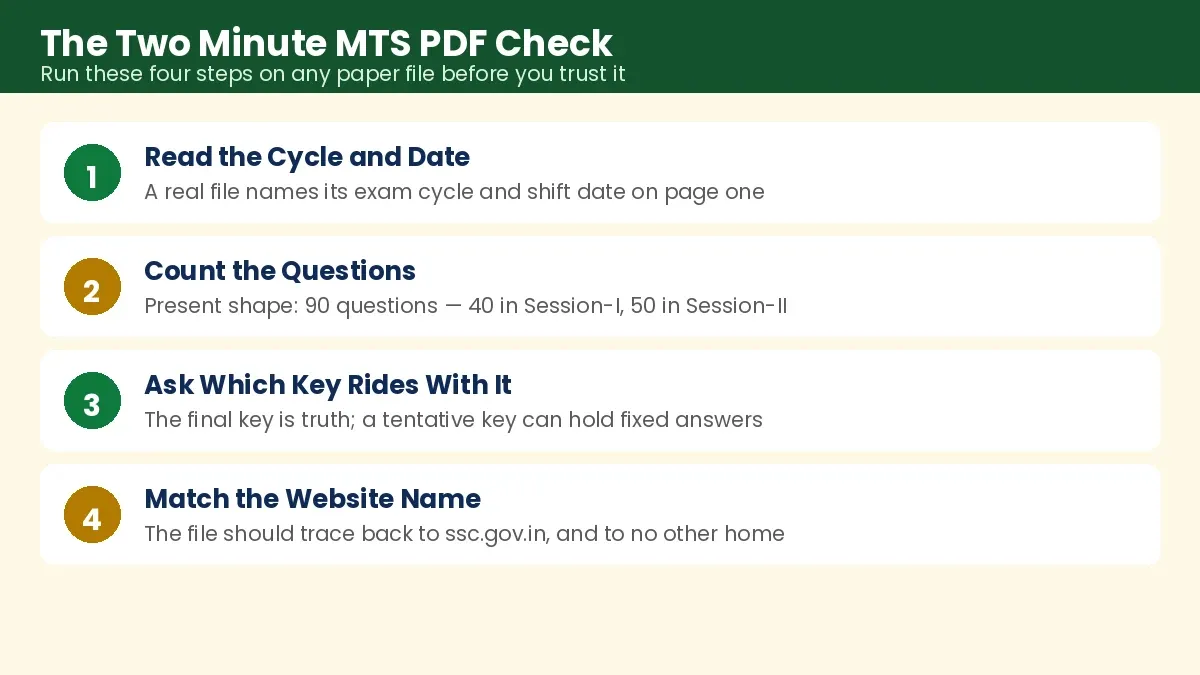
- 3.The Two Minute Check for Any MTS PDF
- 4.Download Steps, From the Official Site and From This Tab
- 5.Old Files, Old Shapes: How to Use Papers Before 2023
- 6.The Fake and Stale Files, Family by Family
- 7.Name Your Files Like a Soldier
- 8.Print Sittings: What Paper Gives That a Screen Hides
- 9.Which Shifts to Download First
- 10.One Paper a Week: The File Habit That Pays
- 11.The Havaldar Files: Paper Around a Ground Test
- 12.How This Site Helps You Use the Shelf
Quick Answer: An SSC MTS PYQ PDF is a real past paper of the MTS and Havaldar exam as a file: the question paper of a past shift with its answer key, ready to print and sit at home. This exam has held written tests for years, so real papers exist in plenty, and SSC itself uploads question papers with final answer keys after each cycle. The catch is the shape. Papers from the 2023 cycle onward run in the present two session shape, 90 questions for 270 marks in two locked blocks of 45 minutes. Older files run in older shapes and must be used with care. This page shows which PDFs are real, how to check a file in two minutes, and how to store and use the shelf.
SSC MTS PYQ PDF: Key Facts First
The exam is the Multi-Tasking (Non-Technical) Staff and Havaldar (CBIC & CBN) Examination, run by the Staff Selection Commission for Group C posts at Pay Level-1, open to Class 10 pass candidates. The latest cycle is MTS 2025: notice dated 26 June 2025, applications from 26 June 2025 to 24 July 2025, fee Rs 100 with no fee for women, SC, ST, PwBD and ex-servicemen candidates. The tentative vacancy list later put the total at 7,948 posts: 6,078 MTS posts in the 18 to 25 age group, 732 MTS posts in the 18 to 27 age group, and 1,138 Havaldar posts.
The computer test of the 2025 cycle ran from 04 to 20 February 2026 in many shifts, and SSC uploaded the tentative answer keys on 03 March 2026. Candidates could challenge a key answer online at Rs 100 per question. The final answer key comes with the marks of candidates, and the final key is the checking base that counts for every practice sitting.
The paper shape those files must be read in: Session-I holds Maths 20 questions and Reasoning 20 questions, 120 marks in 45 minutes, no negative marking, qualifying only. Session-II holds General Awareness 25 questions and English 25 questions, 150 marks in 45 minutes, with 1 mark cut for each wrong answer, and Session-II alone makes the merit list. Every question pays 3 marks. The whole paper is 90 questions for 270 marks in 90 minutes.
Official files live on ssc.gov.in. The PYQ PDF tab you are standing on lists the downloads for this sub-category, and the previous year paper page teaches how to sit and score them.
| Fact | Detail |
|---|---|
| Exam | Multi-Tasking (Non-Technical) Staff and Havaldar (CBIC & CBN) Examination, Staff Selection Commission |
| Latest notice | MTS 2025 notice dated 26 June 2025 on ssc.gov.in; MTS 2026 notice not released as of 24 November 2026 |
| Paper shape, present | 90 questions, 270 marks, 90 minutes: Session-I 40 questions in 45 minutes, Session-II 50 questions in 45 minutes |
| Session-I | Maths 20 and Reasoning 20 questions, 120 marks, no negative marking, qualifying only |
| Session-II | General Awareness 25 and English 25 questions, 150 marks, 1 mark cut per wrong answer, decides merit |
| Keys, 2025 cycle | Tentative keys uploaded 03 March 2026; objections at Rs 100 per question; final key published with the marks of candidates |
| CBE, 2025 cycle | Held 04 to 20 February 2026 in many shifts |
| Vacancies, 2025 cycle | 7,948 tentative: MTS 6,078 (age 18 to 25) and 732 (age 18 to 27), Havaldar 1,138 |
| Official website | ssc.gov.in |
What This Page Covers
- The real shelf: which MTS PDFs exist
- The two minute check for any MTS PDF
- Download steps, from the official site and from this tab
- Old files, old shapes: how to use papers before 2023
- The fake and stale files, family by family
- Name your files like a soldier
- Print sittings: what paper gives that a screen hides
- Which shifts to download first
- One paper a week: the file habit that pays
- The Havaldar files: paper around a ground test
- How this site helps you use the shelf
The Real Shelf: Which MTS PDFs Exist
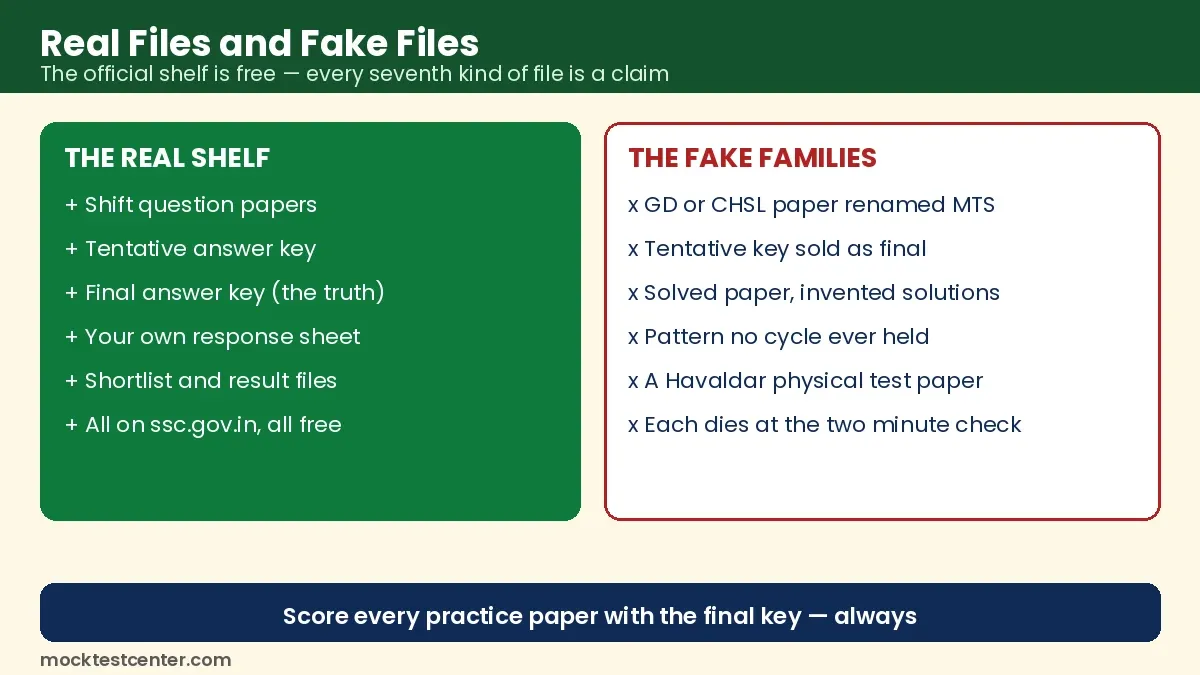
Start with what SSC itself gives. After each cycle, SSC uploads the question papers with the final answer keys, and candidates can also take their own response sheet from the site with their login. So the real shelf of this exam holds three kinds of files: shift question papers, answer keys in their two stages, and your own response sheet.
The question papers come shift by shift. The February 2026 test of the 2025 cycle ran across many days and many shifts, and each shift sat its own paper. That spread is a gift to the candidate who uses it well: ten shifts of one cycle show the mix of the exam ten ways, and the chapters that return in shift after shift name themselves without any coaching guesswork.
The keys come in two stages, and the stage matters. The tentative key comes first, with the response sheets, open to challenge at Rs 100 per question. The final key comes after SSC studies the challenges, and it is published with the marks of candidates. A paper file paired with a tentative key can hold one or two answers that later changed. A paper file paired with the final key is the truth of that shift. When you download a set from anywhere, ask which key rides with it. The answer decides what the file is worth.
Your response sheet is the third file, and it is personal. It shows the answers you marked in your own sitting, question by question. Keep yours from any real or mock sitting you care about. Months later, when you re-sit that paper as practice, your old sheet tells you which traps caught you then and whether they still catch you now. No other file on the shelf can tell you that.
Beyond these, coaching sites hold solved papers with full solutions worked out. Those files can help, above all for maths methods and English rules, as long as you remember what they are: a teacher answer sheet built on a real paper. The paper is SSC. The solutions are the site. Use the paper as truth and the solutions as help, and never let a solution line overrule the final key where the two disagree.
The Two Minute Check for Any MTS PDF
The Two Minute MTS PDF Check: Four Steps
Run the check in order. Step one: find the cycle and the shift date. A real MTS paper names the exam, the cycle year, and the date and shift of the sitting. A file that says only MTS paper with no cycle and no date is hiding its birth, and a paper of unknown birth cannot tell you which shape of exam it belongs to.
Step two: count. The present shape holds 90 questions: Maths 20, Reasoning 20, General Awareness 25, English 25. A file with a very different count belongs to an older shape or to another exam wearing this name. Older shapes are still useful, as a later section shows, but you must know which shape you hold before you sit it on a clock.
Step three is the money step. Find the key and ask its stage. Tentative keys came on 03 March 2026 for the 2025 cycle. The final key came later, with the marks. If the file gives no key at all, take the paper and leave the file answer claims aside; score yourself later against the final key from the official shelf.
Step four: trace the file home. Real files for this exam are published on ssc.gov.in. Other sites repost them, sometimes with their own first page pasted on top and a price on the last page. A repost can still hold a true paper. Just strip the wrapper in your mind, run steps one to three on the paper itself, and let the paper speak.
Teach this check to one friend and you protect two folders. Stale files travel through friend groups because friends trust each other, and a boy in Patna who forwards a 2019 file as a present shape paper means no harm. He just never ran the check. Two minutes at the gate saves a month of wrong clock work behind it.
Download Steps, From the Official Site and From This Tab
Step one. Type the address yourself: ssc.gov.in. Do not walk in through a forwarded link. Look-alike pages with neat designs exist, and the address bar is a five second check that costs you nothing.
Step two. On the official site, open the answer key area and find your cycle. SSC uploads the question papers with the final answer keys there, cycle by cycle. Take the paper and the key of the same shift together, and save them with a full name the same day: MTS 2025 Cycle, the shift date, the shift number. A file named paper final new 2 will mean nothing to you in the month your exam comes.
Step three. On this site, the PYQ PDF tab of this sub-category lists the paper files for print sittings, and the previous year paper tab holds the same papers as online tests with the final keys as the checking base. Use the online form for timed sittings and the files for print sittings. The two forms train two different eyes, and you want both before the season ends.
Step four. Save your own response sheet whenever SSC opens the window for it, and keep it in the same folder as the paper of that shift. The pair, paper plus your sheet, is the only full record of a sitting that exists anywhere. Print one copy of the sheet if the sitting mattered. Paper survives phone changes. Phones do not survive everything.
Step five. Back the folder up once, on a second device or in a mail to yourself, and open each file from the backup to prove the copy works. A backup you never opened is a hope. A backup you opened is a copy. The shelf of one cycle is a handful of files. Keep them like you would keep a mark sheet.
Old Files, Old Shapes: How to Use Papers Before 2023
The MTS shelf reaches back many years, and the older files need a clear rule, because the exam changed its shape more than once. Cycles before the present shape ran different paper plans, and the 2018 and 2019 cycles even held a short descriptive paper after the computer test. That descriptive paper is gone from the exam. A file that holds it belongs to history.
So split the shelf by shape, and give each shape its own job. Papers of the 2023, 2024 and 2025 cycles are your clock papers: sit them whole, in two locked blocks of 45 minutes, scored the present way. Papers of 2022 and before are your chapter papers: pull one part out, say the 20 maths questions or the 25 English questions of their own plan, and use them to hunt weak chapters, the way the chapter tests do.
The questions of old files stay honest even when their clock is dead. A percentage sum from 2021 tests the same method as a percentage sum from 2026. A polity fact from 2019 still stands, if the Constitution has not moved. What you must never carry forward from an old file is its time plan, its marks plan, or its General Awareness news, which belongs to its own year. For present news, the current affairs tests carry that load, and the NCERT tests hold the static base under it.
Mark the shape on the folder itself. When you save an old file, put its cycle year first in the name, so the shelf sorts itself and no 2021 file can dress up as a fresh one in a tired evening. Shape honesty sounds like a small thing. In the last month, when every candidate is tired and every file looks the same at midnight, it is the thing that keeps your final checks true.
The Fake and Stale Files, Family by Family
The first family is the name mix-up. MTS also appears in other names, and SSC runs other exams with papers that travel far. A file of SSC GD or CHSL questions renamed for the MTS crowd tests a different paper for a different post family. Check the exam name on the first page, in full words: Multi-Tasking (Non-Technical) Staff and Havaldar. Short names lie. Full names rarely do.
The second family is the stale key file. The paper is real, the shift is real, and the key riding with it is the tentative key, holding one or two answers SSC later fixed. Your practice score on such a set can sit a few marks away from the truth, and you will chase a fault that lives in the key. The fix costs nothing: score old papers with the final key, always, and treat any key of unknown stage as no key at all.
The third family is the solved paper with invented solutions. Real paper, wrong teaching. A solution that uses a method no school book holds, or a fact that no source holds, can plant errors deeper than ignorance, because it arrives wearing the dress of help. Where a solution and the final key disagree, the key wins. Where a solution method looks too clever for a Class 10 paper, it usually is.
The fourth family is pure invention: a paper pattern built for this exam out of thin air, with question counts and marks that no cycle ever held, sold as the latest pattern. The present shape is printed in the notice and on this page: 90 questions, 270 marks, two sessions of 45 minutes, no negative marking in Session-I and 1 mark cut in Session-II. A file whose pattern argues with the notice loses. The notice is the exam. The file is a claim about the exam, and claims must prove themselves.
Notice what all four families share. Each one needs you to skip the two minute check. Each one dies the moment you ask for a cycle, a count, a key stage, or a home site. The check is small. The money and the months it saves are not.
Name Your Files Like a Soldier
A small habit, worth one paragraph and worth a season of calm. Keep one folder per cycle: MTS 2025 Cycle. Inside it, the papers by shift date, each with its final key, and your response sheets beside the papers they belong to. Below them, your own work files: the error notebook scans, the score register, the formula pages. When the next cycle notice comes, make a second folder with its own year, and never mix the two. Shapes, dates and cut-offs change a little each cycle, and a mixed folder is how a candidate quotes the old floor marks in a new cycle argument with his father.
Print the notice once and work on the print. Mark the session table with your own floor marks: 36, 30 or 24 in Session-I by your category. Mark the age lines and check your birth date against them with your own eyes: for the 2025 cycle, MTS age ran 18 to 25 years as on 01 August 2025, and Havaldar 18 to 27 years. A boy in Ranchi found on the printed table that his age crossed the MTS line by two months and stood inside the Havaldar line, and he fixed his post choice in time. On a phone screen he would have scrolled past that line.
Print Sittings: What Paper Gives That a Screen Hides
The hall is a screen, so most of your sittings should be screens too, on the online tests of this sub-category and the full tests in the two session shape. But once a fortnight, print one paper from this tab and sit it with a pen. Paper slows the eye in a useful way. On paper, you underline the question words, you star guesses in the margin, you strike out the options you cut, and at checking time you can see your whole path through the paper at a glance. Screens hide the path. They show only the answers.
Print sittings expose one fault above all: the misread question. A candidate who marks the opposite of what was asked, or misses a small word like the name of the wrong option family, finds that fault on paper in his own handwriting, circled by his own pen. That sight teaches faster than any score. We have watched candidates cut their careless errors by half in a month of fortnightly print sittings, with no new study at all, only the pen showing them what their eye had been doing.
Keep the print rules the same as the hall rules. Two blocks of 45 minutes. All 40 attempted in Session-I. Guesses in Session-II only at two options, starred. Score with the final key the same day, and write the register numbers before the day ends. A print sitting scored next week is a story. A print sitting scored tonight is a lesson.
And keep the marked prints. A bundle of six prints across a season is a record no app can match: your handwriting slowing, your stars growing fewer, your cuts growing cleaner. On the flat days of the last month, that bundle argues for you better than any speech.
Which Shifts to Download First
A cycle holds more shifts than any candidate can sit well. Choose with a plan, or the folder fills with files your season never touches.
Take the newest cycle first and take it wide: six to eight shifts across its days, not eight sittings of its first day. Shifts differ in mix. One day leans on history, another on science and sports, and a candidate who only holds the first day papers has trained for one weather of the exam. Spread across the days and the mix shows itself.
Inside the wide set, keep two shifts untouched for the last three weeks. Your final checks must run on papers your memory has not softened, or the last scores of the season will flatter you at the exact moment flattery costs the most.
Then take the cycle before it, four to six shifts, for volume. Then the first cycle of the present shape, the 2023 cycle, for its value as a base line: it shows the shape in its first year, a little rawer than later cycles, and candidates who can hold their scores on it hold them anywhere.
Count the shelf that plan builds: about sixteen full papers in the present shape, plus the old shape files you pull parts from. Sixteen papers, sat whole and checked honestly, is a full season of paper work for this exam beside chapter and sectional practice. A folder of sixty papers, forty of them never opened, is a smaller thing wearing a bigger coat. Download for the plan. Let the rest wait on the official shelf, where it keeps well without you.
One Paper a Week: The File Habit That Pays
Files earn nothing sitting in a folder. They earn when a week has a fixed paper day and the day never moves. Pick yours: many candidates hold Sunday morning, when the week work is done and the house is quiet. Sit one downloaded paper whole, in the two locked blocks, with the phone in another room. Score it the same day. Write the register numbers. Give every error its notebook line. Then file the marked print, or a photo of it, in the cycle folder with its date in the name.
The habit compounds in a way single sittings do not. Week one shows you the shape. Week four shows you your traps, because the same chapters have now caught you in three papers and the notebook lines have begun to repeat, and a repeated line is a named enemy. Week eight shows you the change: the repeated lines thin out, the Session-II wrong count falls, and the scores across mixed shifts stop jumping and start standing in a band. A band you can trust is worth more than a peak you cannot repeat, because the hall gives you one shift, not your best one.
Guard the day against the two thieves of paper work. The first thief is the fresh download: a new file feels like progress and asks nothing of you, so candidates download on paper day and sit nothing. The rule stands against it: no new file enters the folder in a week where no paper was sat. The second thief is the soft check, the score written without the Session-II cut. We have named that thief before on this site and we name it again here, because it steals from more registers than any hard paper ever printed.
The Havaldar Files: Paper Around a Ground Test
Havaldar candidates share the same paper shelf as MTS candidates, because the computer test is one test for both posts. The files that differ come after it, and they are worth naming so no seller can invent others.
After the computer test result, SSC publishes the shortlist for the physical test: for the 2025 cycle, that result came on 03 August 2026, with names in the ratio of 7 for each vacancy, CCA wise and category wise. CBIC then held the Physical Efficiency Test and Physical Standard Test from 24 to 31 August 2026, and an additional result on 07 October 2026 shortlisted 542 more candidates. Those result files, the shortlist and the additional list, are real PDFs of this entry, and a Havaldar candidate should keep his cycle set beside his papers.
What does not exist is any written paper of the physical stage. The test is walking and measurement: 1,600 metres in 15 minutes for men, 1 km in 20 minutes for women, height at 157.5 cm for men and 152 cm for women, chest and weight checks as the notice prints. It is qualifying only and carries no marks. A file that offers a Havaldar physical test paper, a PET question set, or a physical test answer key is inventing a document, and the invention tells you what the rest of that shelf is worth.
One more real file closes the cycle: the final result and allocation, where MTS and Havaldar are allotted together on Session-II marks, preferences and age group, after which the user departments call candidates for Document Verification. Keep that file too when your cycle ends. The shelf of one full cycle then reads in order: notice, papers, keys, your response sheet, shortlist, final result. Six kinds of files, all official, all free. Any seventh kind offered to you is a claim, and claims must prove themselves against the notice.
How This Site Helps You Use the Shelf
Mock Test Center keeps this sub-category in one line. The downloads tab lists the paper files of this exam for print sittings. The previous year paper tab holds the papers as online tests, checked with the official final keys. The chapter tests repair one chapter at a time, the sectional tests join a part at session pace, and the full tests stage the whole sitting in Day order: Session-I locked at 45, Session-II opened at once, scored the session way. When SSC prints something new for this exam, a fresh notice, a key, a result, it lands on the Latest Jobs page of this site as well as on ssc.gov.in.
Do the small things today. Download one paper of the newest cycle and save it with its full name. Run the two minute check on it with a pen. Sit it tonight in two locked blocks, score it with the final key, and give every error one line in the notebook. Then take one more file from a friend group chat and run the check on that too. The second check is where the habit forms, and the habit, more than any single file, is what this page was written to give you.