About SSC Stenographer Grade C & D 2027 PYQ PDF Downloads
- 1.SSC Stenographer PYQ PDF: Key Facts First
- 2.The Real Shelf: Papers, Keys and Response Sheets
- 3.The Two Minute Check for Any Steno PDF
- 4.Download Steps That Keep You on Safe Ground
- 5.English and Hindi Files, and the Language Choice in Your Folder
- 6.The Fake Files, Family by Family
- 7.Name Your Files Like a Soldier
- 8.Read a Paper PDF Like a Syllabus
- 9.What Does Not Exist, Said Plainly
- 10.From One Cycle to the Next: What the Real Files Taught Us
- 11.Print Sittings: When Paper Beats the Screen
- 12.How This Site Helps You Use the Real Files
Quick Answer: An SSC Stenographer PYQ PDF is a real file for this exam, because this entry does hold a written test and SSC has held it year after year. Shift papers from 2017 to 2026 sit on record in English and in Hindi, with answer keys. But the file shelf holds traps: tentative keys dressed as final keys, memory based files sold as originals, papers of other SSC exams under a Steno name, and a skill test paper PDF that cannot exist at all, because the dictation is spoken in the hall and never printed. This page shows which files are real, how to check any Steno PDF in two minutes, and how to name and store your files so the right key is always the one in your hand.
SSC Stenographer PYQ PDF: Key Facts First
The exam is the Stenographer Grade C and D Examination of the Staff Selection Commission, for Group B and Group C stenographer posts in Government of India offices. The written test, the Computer Based Examination, holds 200 questions for 200 marks: Reasoning 50, General Awareness 50, English 100. From the 2026 cycle the parts run on locked timers of 30, 30 and 60 minutes. Each wrong answer cuts 0.25 marks.
The latest cycle is the 2026 cycle. SSC printed the notice on 24 April 2026, applications ran from 24 April 2026 to 15 May 2026, and the CBE ran from 09 September 2026 to 15 September 2026. SSC put out the tentative answer key on 23 September 2026, with objections at Rs 50 for each question. The tentative vacancy list of 04 June 2026 counted 1,170 posts: 149 for Grade C and 1,021 for Grade D. You can read the official notice and every later notice on ssc.gov.in, the only official site for this exam.
Selection runs in two stages. The CBE comes first and its marks make the merit. Then comes the Skill Test in Stenography, qualifying only: one dictation of 10 minutes at 100 words per minute for Grade C or 80 words per minute for Grade D, typed out on a computer in the time fixed for your grade and language. Hold that second stage in mind on this page, because half the fake files on the Steno shelf are built on it.
What SSC truly gives you in file form is this: the question papers of past CBE shifts, the tentative answer key with your response sheet after each exam, and the final answer key with the result. Those are the real files. Everything else on the shelf is a copy, a memory file, or a fake, and the sections below teach you to tell them apart in two minutes.
| Fact | Detail |
|---|---|
| Exam | Stenographer Grade C and D Examination, Staff Selection Commission |
| Real paper files | CBE shift papers from 2017 to 2026, in English and in Hindi |
| Real key files | Tentative key with response sheet after the exam; final key with the result |
| Latest cycle | 2026 notice 24 April 2026; CBE 09 to 15 September 2026; tentative key 23 September 2026 |
| Paper shape | 200 questions, 200 marks; parts locked at 30, 30 and 60 minutes from 2026 |
| Negative marking | 0.25 marks cut for each wrong answer |
| Skill test paper PDF | Does not exist. The dictation is spoken in the hall and is never printed or released |
| Vacancies, 2026 list | 1,170 tentative: Grade C 149, Grade D 1,021 |
| Official website | ssc.gov.in |
What This Page Covers
- The real shelf: papers, keys and response sheets
- The two minute check for any Steno PDF
- Download steps that keep you on safe ground
- The fake files, family by family
- Name your files like a soldier
- Read a paper PDF like a syllabus
- What does not exist, said plainly
- How this site helps you use the real files
The Real Shelf: Papers, Keys and Response Sheets
Start with the papers. SSC has held this exam on a steady beat: 17 and 18 November 2022, 12 and 13 October 2023, 10 and 11 December 2024, 06 to 08 August 2025, and 09 to 15 September 2026, with the 2017 to 2021 cycles behind them. Each day ran in shifts, and each shift had its own paper. Those papers, in English and in Hindi, are the real study files of this exam. A paper file that names its year, its date and its shift is a file with a birth certificate. A paper file that names none of the three is a file hiding its birth.
Next, the keys, and here the shelf holds two kinds that must never be mixed. The tentative key comes first, days after the exam, with the response sheet that shows the answers you marked. For the 2026 cycle it came on 23 September 2026. Tentative means open to challenge at Rs 50 a question, and one or two answers in it can change. The final key comes with the result, after SSC has read the objections and fixed the key where the proof stood. The final key is the only key to score practice with. A score built on a tentative key can sit 1 or 2 marks away from the truth, and a candidate can spend a month fixing a fault that lived in the key, not in him.
The response sheet is the third real file, and it is yours alone. After your own exam, download it and keep it with your admit card papers. Months later, when the final key and the result come, that sheet is the only record of what you marked in the hall. Candidates lose objection windows and result checks every cycle for want of a file that took 2 minutes to save.
Beyond these, the official shelf holds the notice itself and the vacancy lists. The 2026 notice opened with about 731 tentative vacancies, and the list of 04 June 2026 raised the count to 1,170. Keep the notice PDF of your cycle in the same folder as your papers. It is the one file that settles every fight about pattern, age, fee and dates: Grade C age 18 to 30, Grade D age 18 to 27, 12th standard pass, fee Rs 100 with the known exemptions, and the part timers of 30, 30 and 60 minutes that older notices do not show.
The Two Minute Check for Any Steno PDF
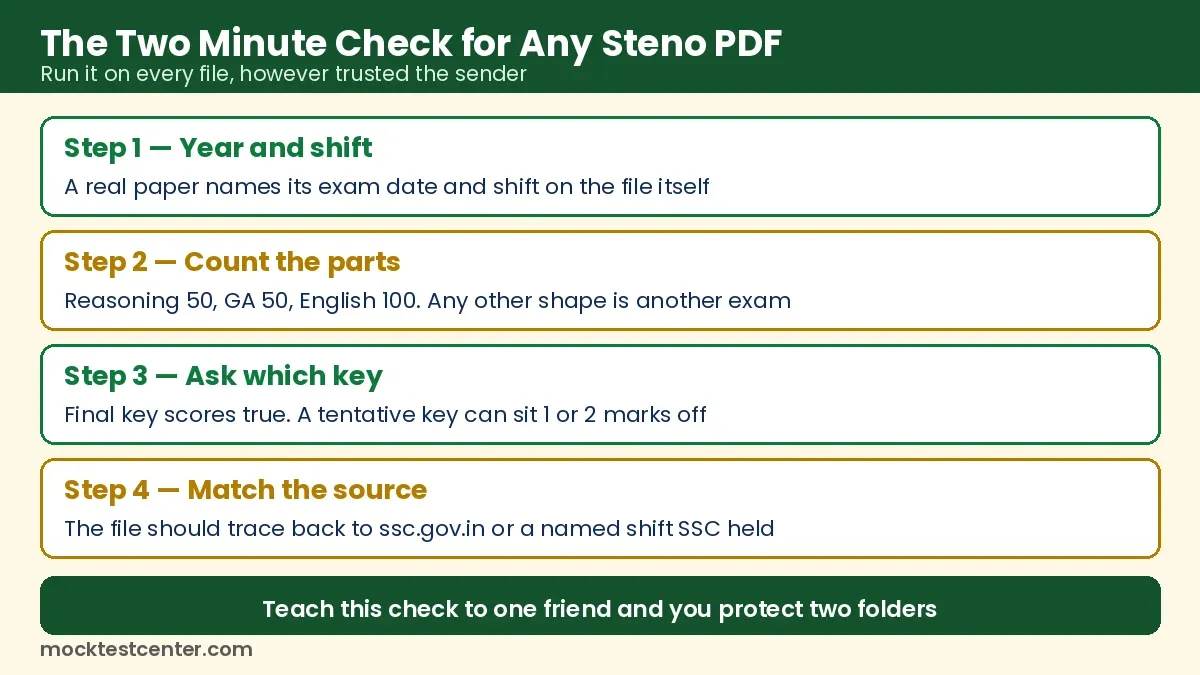
The Two Minute Steno PDF Check: Four Steps
Run the check in order. Step one: find the year, date and shift. A real Steno paper carries them, because the exam ran on many days and the papers differ by shift. Step two: count the parts. Reasoning 50, General Awareness 50, English 100, in that weight. A file with 4 parts, or with a maths part of 25 questions, belongs to another SSC exam, most often CHSL or CGL, whatever its cover says. Step three: ask which key rides with the file. If the seller or the site cannot say whether the key is tentative or final, treat the file as unscored practice only, never as a score you write in your register. Step four: trace the file home. Real files for this exam trace back to ssc.gov.in or to a named shift of a named date that SSC truly held.
Teach this check to one friend and you protect two folders. Fake files travel through friend groups because friends trust each other, and a boy in Patna who forwards a CHSL paper renamed as Steno means no harm. He just never ran the check. Two minutes at the gate saves a month of wrong study behind it.
 Download Steps That Keep You on Safe Ground
Step one. Type the address yourself: ssc.gov.in. Do not walk in through a forwarded link. Look-alike pages with neat designs exist, and the address bar is a five second check that costs you nothing.
Step two. Take the notice, the vacancy list, your response sheet and the keys from the official site as they come. Save each file the same day with a full name: Steno 2026 Notice, Steno 2026 Tentative Key, and later, Steno 2026 Final Key. A file named ssc new final 2 will mean nothing to you in the month your result comes.
Step three. For past papers, take them shift by shift and name them by their birth: Steno 2025, 06 August, Shift 1. The papers on the PYQ PDF tab of this sub-category are listed in that same order, year, date and shift, so the file you print for a Saturday sitting is the file your register names on Sunday.
Step four. Back the folder up once, on a second device or in a mail to yourself, and open each file from the backup to prove the copy works. A backup you never opened is a hope. A backup you opened is a copy.
Step five. Keep the tentative key and the final key as two files with two names, never one file overwritten. The day the final key lands, rescore your last practice paper if its first score stood on the tentative key. The gap between the two scores is a lesson about keys that no page can teach as well as your own register can.
Step six. Once a month, open the folder and read only the file names. If any name fails to tell you its year, its kind and, for a paper, its date and shift, rename it on the spot. File names are the index of your season. An index you cannot read at speed is a shelf you will stop trusting, and a shelf you stop trusting is a shelf you stop using, however good the files inside it are.
English and Hindi Files, and the Language Choice in Your Folder
Steno papers come in English and in Hindi, and your folder should hold the medium you will sit in. The Reasoning and General Awareness parts are set in both mediums. The English part is English for every candidate. A candidate who practises Reasoning from Hindi files all season and downloads English files in the last month for extra volume loses time to reading, not to reasoning. Medium is a speed choice. Fix it early, and let your folder match it from the first download.
The language choice runs deeper in this exam than in any sister exam, because it follows you into the second gate. The skill test is taken in English or Hindi, as you chose in your application form. Grade C Hindi dictation runs at the same 100 words per minute, with 55 minutes to type it out; Grade D Hindi gives 65 minutes. And one 2026 line belongs in every Hindi candidate's folder, printed and marked: SSC made the Mangal font mandatory for the Hindi skill test in 2026. If your transcription practice runs in another font, your files and your practice are training for a screen the hall will not show you.
The notice adds one more line that folder keepers should note. A candidate who takes the skill test in Hindi must learn English stenography after appointment, and the other way round, as the user office needs. The language of your files is your starting language, not your last one. Keep both mediums of the notice in the folder. You will read the second one again on the day the appointment letter comes.
The Fake Files, Family by Family
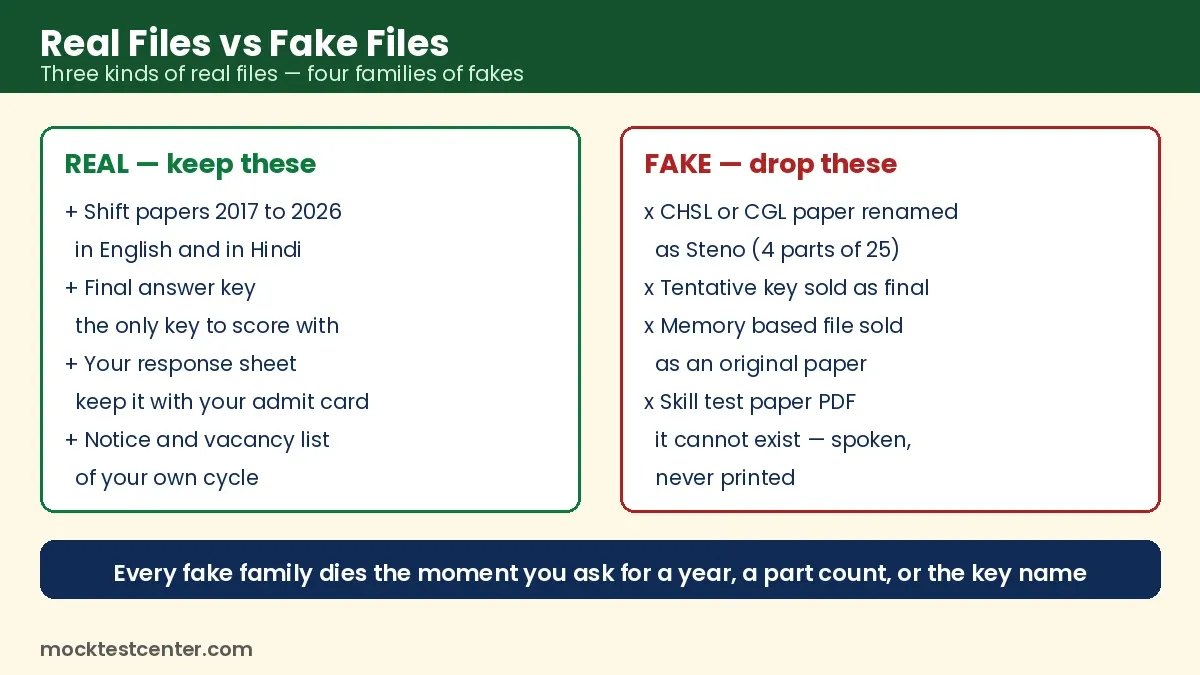
The first family is the renamed paper of a sister exam. SSC runs many exams with near names, and their papers fill the same groups and channels. A CHSL paper holds 4 parts of 25 questions. A CGL Tier 1 paper holds 4 parts of 25 with 2 marks a question. Neither is a Steno paper, whose shape is 50, 50 and 100 at 1 mark each. The part count check kills this family in seconds. Run it on every file, however trusted the sender.
The second family is the tentative key dressed as the final key. The file is a real paper, the key is a real key, and the lie is in one word on the cover. Scores built on it drift by 1 or 2 marks, and the drift always seems to land against the candidate at the worst time, in the last month, when registers are read as promises. If a file does not say which key it carries, ask. If the answer is a shrug, score the paper for practice and write no score in the register.
The third family is the memory based file sold as an original. After each exam, coaching teams rebuild papers from the memory of candidates who sat them. Such files can be fair practice, above all for the freshest cycle before better copies move. But memory drops questions, swaps options, and softens hard questions into easy ones. File it in your head as practice, not as a paper, and never score your season on it.
The fourth family is pure invention, and it is built on the skill test. Sellers offer a Steno skill test paper PDF, a dictation passage PDF of last year, a shorthand paper with answers. None of these can exist. The dictation is spoken aloud in the hall from a passage the candidates have never seen, it is not printed as a question paper, and SSC releases no such file after the test. A seller who offers you last year's dictation passage is selling you a story with a price on it. Walk away from the whole shelf it sits on.
Notice what all four families share. Each one needs you to skip the two minute check. Each one dies the moment you ask for a year and shift, a part count, or the name of the key. The check is small. The money and the months it saves are not.
 Name Your Files Like a Soldier
A small habit, worth one paragraph and worth a year of calm. Keep one folder per cycle: Steno 2026. Inside it, the notice, the vacancy list, your response sheet when your turn comes, and the keys with their kind in the name. Below them, a papers sub folder, one file per shift, named year, date and shift. When the next cycle notice comes, make a second folder, and never mix the two. Patterns change between cycles: the 2026 folder holds locked part timers that the 2025 folder never knew, and a mixed folder is how a candidate trains a full season on the wrong clock.
Print the notice once and work on the print. Mark the part table with the timers. Mark the age lines and check your birth date against them with your own eyes: for the 2026 cycle, Grade C born on or after 02 August 1996 and on or before 01 August 2008, Grade D born on or after 02 August 1999 and on or before 01 August 2008. Mark the skill test table too, the speeds and the typing times, because that table is the second gate in print, and candidates forget it is in the same PDF as the first.
Read a Paper PDF Like a Syllabus
Most candidates download a paper, solve it once, and file it. That wastes the best study document the shelf holds. Read each paper you solve in three passes. First pass, the sitting itself: 3 locked parts of 30, 30 and 60 minutes, phone away, guesses starred. This pass gives you the score. Second pass, the checking: score with the final key, write the 3 register numbers, total, wrong count and blank count, and give every error one line in the error notebook with its cause word. This pass gives you the fixes. Third pass, the map: read the paper as a setter's letter. Which chapters filled the English part? Which GA families carried the news questions? Which reasoning families ran long? This pass gives you next month's chapter list, and it is the pass almost no candidate takes.
The keys also teach, if you let them. When the final key of a cycle moves an answer that the tentative key held the other way, note the question's chapter. Chapters where keys get challenged are chapters where the setter walks near a line, and those chapters repay a careful second reading in your books.
And keep your practice honest against the real tests. The chapter tests build the chapters one by one. The sectional tests run one full part on its locked clock. The full tests join the 3 parts into the full sitting, and the previous year paper tests hold the same papers in test form. Every one of those tabs trains a thing the exam truly does. No tab sells you a skill test paper, because there is none to sell.
What Does Not Exist, Said Plainly
Say it once, in full, so no seller can bend it later. There is no skill test paper PDF for this exam. There is no last year dictation passage PDF. There is no official shorthand question paper with an answer key, because the skill test is a spoken dictation and a typed transcription, not a printed paper. There is no subject wise paper for the skill test and no shift wise paper for it. SSC does not hide these files. SSC never made them.
What exists is better, once you see it straight. The CBE papers of 10 cycles, in two mediums, shift by shift. The final keys that score them true. Your own response sheet when your exam comes. Three kinds of files, all real, all named, all checkable in two minutes. A candidate with those files and a daily shorthand habit holds more real material than a candidate with a hard disk of renamed papers and invented dictation sets.
One last word on money, because this page will be read by boys and girls counting rupees. The notice, the keys and your response sheet are free. The application fee of the last cycle was Rs 100, and many candidates paid nothing at all. Spend on a good reasoning book or a fair priced practice set if you like. Do not spend on any file whose name promises you a paper of a test that was spoken, not printed.
From One Cycle to the Next: What the Real Files Taught Us
Hold the 2025 files and the 2026 files side by side and the exam teaches you its own story. The 2025 notice came on 06 June 2025, with applications from 06 June 2025 to 26 June 2025 and fee payment to 27 June 2025. It opened with about 261 tentative vacancies, and its later tentative list rose to 1,590 posts, 230 for Grade C and 1,360 for Grade D. Its CBE ran from 06 August 2025 to 08 August 2025, and its skill test ran on 28 and 29 January 2026. The 2026 notice came earlier in the year, on 24 April 2026, with applications to 15 May 2026, a tentative list of 1,170 posts by 04 June 2026, and a CBE from 09 September 2026 to 15 September 2026.
The files also teach you what stays fixed and what moves. Fixed across both cycles: the 3 parts and their weights of 50, 50 and 100, the 200 marks, the 0.25 cut, the age lines of 18 to 30 and 18 to 27 read on 01 August of the cycle year, the 12th standard pass, the fee of Rs 100 with the same exemptions, and the skill test speeds of 100 and 80 words per minute with the same typing times. Moved: the clock. The 2025 paper ran on one free block of 2 hours. The 2026 paper locked its parts at 30, 30 and 60 minutes. One line in the pattern table changed, and it changed how every old paper must be practised.
There is one more lesson in the two folders, and it is about trust. Every number in the paragraph above came out of the two notices and the SSC lists, not out of coaching summaries. Coaching summaries of the 2026 cycle could not even agree with each other on the vacancy count, printing 731 and 1,170 in the same week, because one read the notice and the other read the later list and neither said which. The notice never argues with itself. When a number matters to your life, a date, an age line, a vacancy count, take it from the PDF SSC signed, and let every other page on the internet be a pointer to that PDF and nothing more.
Print Sittings: When Paper Beats the Screen
The CBE is a screen exam, and most of your practice should live on a screen for that reason alone. But the PDF shelf earns a special place in the season: the print sitting. Once a week, print one real paper and sit it on paper, in the 3 locked parts, with a pen and a rough sheet. The print sitting does two jobs no screen sitting does. It slows the eye in a good way for the English passages, where a pen underlining the hunt list words holds the reading together. And it leaves a marked paper behind, a thing you can spread on the desk beside the error notebook while you check, with your stars, your cuts and your second thoughts all visible at once.
Candidates who check on paper find a class of error the screen hides: the question read half way. On paper the half read question shows its face, because the pen stopped mid line. Keep those questions in a small list of their own. They are not chapter errors. They are reading errors, and their fix is a habit, read the full question once before the options, that costs nothing and pays in every part.
Do not let print sittings eat the season. One a week is the dose. The hall is a screen, the clock on it is locked, and the hand that will sit your exam must know the screen's pace above all. Paper is the audit. The screen is the training ground.
How This Site Helps You Use the Real Files
Mock Test Center keeps this sub-category honest the same way. The PYQ PDF tab lists the real papers of this exam by year, date and shift, in English and in Hindi. The previous year paper page teaches the sitting and scoring method that stands behind the files. The test tabs train the parts in the order the hall runs them. And when SSC prints something new, a fresh notice, a key, a result, it lands on the Latest Jobs page of this site as well as on ssc.gov.in.
Do the small things today. Download the full 2026 notice and save it with its full name. Run the two minute check on every Steno file already sitting in your phone and your laptop, and rename or drop the ones that fail it today. Then sit one real paper in 3 locked parts, score it honestly with the final key, and close the day with a full 20 minutes of dictation at your grade speed. The folder was never the goal. The goal is a hand that is fast in the written rooms and a hand that is ready in the dictation room, and both are earned by work, not by downloads. A clean folder simply makes sure the work is never wasted on the wrong paper, the wrong key, or a clock the exam left behind in 2025.