
About SSC Stenographer Grade C & D 2027 Previous Year Papers (PYQ)
- 1.SSC Stenographer Previous Year Papers: Key Facts First
- 2.Real Papers Exist for This Exam, Year After Year
- 3.The 2026 Change: One Free Clock Became Three Locked Clocks
- 4.How SSC Answer Keys Work, Stage by Stage
- 5.Sit an Old Paper in the New Shape
- 6.Score Yourself the Honest Way
- 7.The Error Notebook That Turns One Paper Into Marks
- 8.Which Years to Solve First
- 9.The Skill Test Stands Behind Every Paper
- 10.Hindi and English Papers, and Your Next Step
Quick Answer: An SSC Stenographer Previous Year Question Paper is a real paper from a real Steno exam, and this exam has plenty of them. The Staff Selection Commission has held the Grade C and D test year after year, in English and in Hindi, and the papers sit on record from 2017 to 2026. One thing changed in 2026, and it changes how you must practise: the Computer Based Examination now runs on locked part timers of 30, 30 and 60 minutes, where older papers ran on one free block of 2 hours. This page teaches you how to sit an old paper in the new shape, how to score it with the 0.25 cut, and how to turn every wrong answer into a fix before the next paper.
SSC Stenographer Previous Year Papers: Key Facts First
The exam is the Stenographer Grade C and D Examination of the Staff Selection Commission. Grade C is a Group B, Non-Gazetted post. Grade D is a Group C post. Both sit in ministries, departments and offices of the Government of India, and Grade C pays at Pay Level 6 or Level 7 by department, while Grade D pays at Pay Level 4.
The base need is small and fixed. You must have passed the 12th standard or an equal exam from a known board on or before 01 August 2026 for the 2026 cycle. And the notice opens with a hard line: only candidates who have skills in stenography can apply. A candidate with no shorthand has no place in this exam at all, however strong his written paper may be.
Age runs by grade. For Grade C, 18 to 30 years as on 01 August 2026, with birth dates from 02 August 1996 to 01 August 2008. For Grade D, 18 to 27 years, with birth dates from 02 August 1999 to 01 August 2008. SC and ST candidates get 5 years of age relief, OBC candidates get 3 years, and PwBD candidates get 10, 13 or 15 years by category.
The latest cycle is the 2026 cycle. SSC printed the notice on 24 April 2026, and applications ran from 24 April 2026 to 15 May 2026, with fee payment open to 16 May 2026. The fee was Rs 100, and women of all categories paid no fee, and SC, ST, PwBD and ex-servicemen paid no fee either. The notice opened with about 731 tentative vacancies, and the SSC tentative list of 04 June 2026 raised the count to 1,170 in all: 149 for Grade C and 1,021 for Grade D.
The written test, called the Computer Based Examination or CBE, ran from 09 September 2026 to 15 September 2026. SSC put out the tentative answer key on 23 September 2026, and objections cost Rs 50 for each question. The paper holds 200 questions for 200 marks: Reasoning 50, General Awareness 50, and English Language and Comprehension 100. Each wrong answer cuts 0.25 marks.
After the CBE comes the Skill Test in Stenography, and it only qualifies you. One dictation of 10 minutes, at 100 words per minute for Grade C and 80 words per minute for Grade D, typed out on a computer inside a fixed time. Final merit comes from CBE marks alone. But fail the skill test and the merit list never sees your name.
| Fact | Detail |
|---|---|
| Exam | Stenographer Grade C and D Examination, run by the Staff Selection Commission |
| Latest notice | Stenographer 2026 notice dated 24 April 2026 on ssc.gov.in; 2027 notice not released as of 25 November 2026 |
| Vacancies | About 731 tentative in the notice; 1,170 in the SSC tentative list of 04 June 2026 (Grade C 149, Grade D 1,021) |
| Education and skill | 12th standard pass on or before 01 August 2026; stenography skill is a must to apply |
| CBE shape | 200 questions, 200 marks: Reasoning 50, General Awareness 50, English 100 |
| Part timers, new in 2026 | Reasoning 30 minutes, General Awareness 30 minutes, English 60 minutes; total 2 hours |
| Negative marking | 0.25 marks cut for each wrong answer; no cut for a blank answer |
| Qualifying marks in CBE | UR 30 percent, OBC and EWS 25 percent, all other categories 20 percent |
| Tentative key, 2026 cycle | Out on 23 September 2026; objections at Rs 50 per question |
| Skill test | Dictation of 10 minutes at 100 wpm for Grade C and 80 wpm for Grade D; qualifying only |
| Papers on record | Real shift papers from 2017 to 2026, in English and in Hindi |
| Official website | ssc.gov.in |
What This Page Covers
- Real papers exist for this exam, year after year
- The 2026 change: one free clock became three locked clocks
- How SSC answer keys work, stage by stage
- Sit an old paper in the new shape
- Score yourself the honest way
- The error notebook that turns one paper into marks
- Which years to solve first
- The skill test stands behind every paper
- Hindi and English papers, and your next step
Real Papers Exist for This Exam, Year After Year
SSC has run this exam on a steady beat. The 2022 papers were held on 17 and 18 November 2022. The 2023 papers ran on 12 and 13 October 2023. The 2024 papers ran on 10 and 11 December 2024, 3 shifts a day. The 2025 papers ran from 06 August 2025 to 08 August 2025, and the 2026 papers ran from 09 September 2026 to 15 September 2026. Behind those sit the papers of 2017 to 2021. That is a full shelf of real tests, in English and in Hindi.
A real paper gives you three things a made set cannot copy well. First, the true level. SSC English questions lean hard on reading passages, error spotting and close tests at a set level, and books often print a level above or below it. Second, the true mix. In one shift the General Awareness part may lean on history and polity, and in the next shift it may lean on science and awards. Books guess at that mix. Papers show it, shift by shift.
Third, the true weight of English. Half the paper is one part. English holds 100 of the 200 questions and 100 of the 200 marks, and no other SSC exam at this level gives one subject that much room. A candidate who treats English as one part of three trains the wrong exam. Old papers teach that weight in the hand, paper after paper, in a way no pattern table can.
Use the SSC Stenographer previous year papers on this tab as your main ground. The full mock tests still earn their place, because a mock lets you test a new order of parts or a new guessing rule at no cost. But a rule that has never met a real paper is a hope. For every 3 sets you solve, make at least 2 of them real papers from past years.
One more thing a real paper holds: the crowd behind it. The 2025 cycle opened with about 261 tentative vacancies in its notice and its later tentative list rose to 1,590 posts, with 230 for Grade C and 1,360 for Grade D. The 2026 list stands at 1,170. When you solve a paper from a small year, remember how many answer sheets stood behind its cut-off. Your score on that paper means something only when you score it with the final key and the right clock.
The 2026 Change: One Free Clock Became Three Locked Clocks
Read this part twice. It is the one fact most old guides get wrong for this exam now.
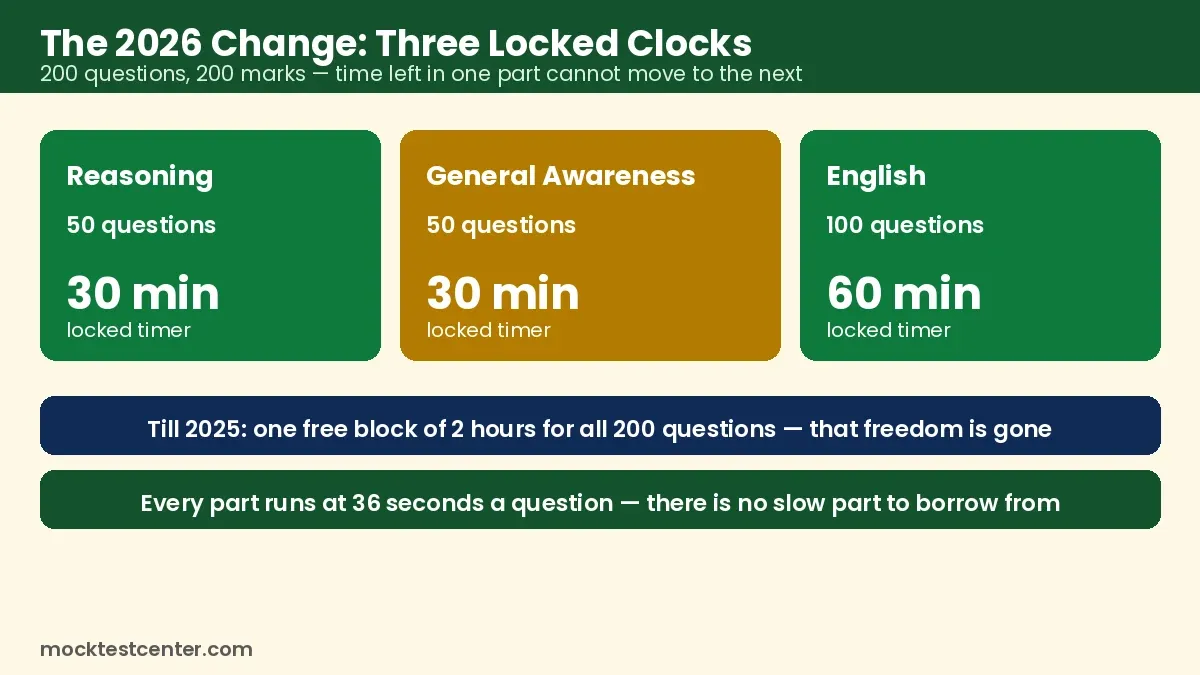
Up to the 2025 cycle, the CBE gave you one block of 2 hours for all 200 questions. You could spend 50 minutes on English, race back to Reasoning, and end with General Awareness. Strong candidates used that freedom well. Weak time sense hid inside it.
The 2026 notice cut that freedom away. Each part now carries its own timer. Reasoning gets 30 minutes for its 50 questions. General Awareness gets 30 minutes for its 50 questions. English gets 60 minutes for its 100 questions. When a part timer ends, that part closes. Time left in one part cannot move to the next part. Scribe-eligible candidates get 40, 40 and 80 minutes, a total of 2 hours 40 minutes, but the parts stay locked for them too.
Do the small maths and the new exam shows its face. Fifty questions in 30 minutes is 36 seconds a question, in Reasoning and in General Awareness both. English gives the same 36 seconds a question across 100 questions. There is no slow part to borrow from and no fast part to save time in. Every part is a speed test of the same tight shape.
So an old paper solved on one free 2 hour clock trains a habit the hall no longer allows. The questions stay gold. The clock must be rebuilt. When you sit any paper from 2025 or before, sit it in 3 locked parts of 30, 30 and 60 minutes, and close each part when its time ends, even with questions left blank. That one rule turns the whole old shelf into training for the new exam.
The 2027 notice has not come yet, and SSC has printed no date for it as of 25 November 2026. The 2027 pattern is expected to follow the 2026 pattern, locked timers and all, until SSC prints a new notice. Train for the locked shape now. If the new notice ever brings the free clock back, a candidate trained on locked parts will find the free clock easy. The other way round does not hold.
How SSC Answer Keys Work, Stage by Stage
A paper without the right key is a score waiting to lie to you. SSC runs the key in stages, and the 2026 cycle shows each stage with dates.
Stage one comes after the exam. SSC uploads the tentative answer key with the response sheet of each candidate. For the 2026 cycle the upload came on 23 September 2026, days after the CBE closed on 15 September 2026. Your response sheet shows the answers you marked, question by question. The tentative key shows the answers SSC holds right at that stage. Tentative means open to challenge. It does not mean final.
Stage two is the objection window. If you hold proof that a key answer is wrong, you can file an objection at Rs 50 for each question. Ten objections cost Rs 500. So object only where a book or an official source stands behind you, and let weak feelings pass. This stage matters for your practice in a second way too. It tells you that the first key of a fresh paper can hold one or two answers that later change.
Stage three is the final key. SSC studies the objections, fixes the key where the proof stands, and puts out the final answer key with the result. The final key is the checking base that counts. On this site, the papers on the previous year paper tab are checked against official final keys. A paper you pull from a random group may carry the tentative key, and a score checked on a tentative key can sit 1 or 2 marks away from the truth.
Stage four sits behind the rest: normalisation. The CBE runs across many days and shifts, 7 days in the 2026 cycle, and no two shifts hold the exact same level. SSC normalises scores across shifts before shortlisting, under the method it published on 02 June 2025. Your raw score on a practice paper is a level mark for that paper. It is not your rank among lakhs of candidates, and any tool that reads it as a rank is selling you a story.
| Key stage | What SSC gives | What you do with it |
|---|---|---|
| Tentative key | First key with your response sheet, 23 September 2026 for the 2026 cycle | Match your marked answers; note the ones you feel are wrong |
| Objection window | Challenge at Rs 50 per question | Object only with proof in hand; ten weak objections cost Rs 500 |
| Final key | Fixed key published with the result | Score all practice papers with this key only |
| Normalisation | Scores balanced across shifts before shortlisting | Read your raw score as a level mark, never as a rank |
Keep the qualifying floor beside the key story. In the CBE, UR candidates need 30 percent, OBC and EWS candidates need 25 percent, and all other categories need 20 percent. On a 200 mark paper, 30 percent is 60 marks. That floor only lets you stay in the race. The cut-off for the skill test call sits far above it, so score your papers against your last score, not against the floor.
Sit an Old Paper in the New Shape
Here is the sitting rule, and it has no soft version. Sit the paper once, in one sitting, at a fixed time of day, with your phone in another room. Set 3 timers: 30 minutes, 30 minutes, 60 minutes. When a timer ends, close that part and move on, even if 4 questions stand blank. A part you leave open in practice will beg for time in the hall, and the hall will say no.
The Paper Solving Loop for Steno: Four Steps
Inside one locked part, work in two passes. Pass one takes the questions you can finish fast and sure. Pass two takes the rest, in the time left. A reasoning puzzle that eats 3 minutes has eaten the price of 5 easy questions, because each question pays the same 1 mark. A girl in Kanpur who trains with us keeps one rule taped to her desk: no question gets a second full minute in pass one. Her attempts in Reasoning rose from 34 to 46 in 6 papers. Her score rose with them.
English needs its own inside plan, because 100 questions in 60 minutes is the longest locked room of the three. Reading passages eat minutes in blocks. Many strong candidates take the grammar and word questions first, bank those marks, and give the passages the time that is left. Test that order on 2 real papers. Test the straight order on 2 more. Keep the order with the higher total. Feelings pick orders badly. Totals pick them well.
And mark your guesses as you go. Put a small star beside any answer you guessed. At checking time, a guessed right answer counts in your score but not in your trust list, and a guessed wrong answer shows you a chapter where half knowledge keeps paying the 0.25 cut. The star takes one second. It saves you from the oldest lie in practice, which is a score built on luck read as a score built on skill.
Score Yourself the Honest Way
Scoring takes 10 minutes and most candidates rush it in 2. Slow down. The score you write in your register today is the number your whole next week will obey, so a soft score builds a soft week.
Follow these steps in order, every time.
- Count right answers part by part. Each right answer pays 1 mark. That is your marks earned.
- Count wrong answers part by part. Multiply by 0.25. That is your marks cut.
- Subtract the cut from the earned marks. Write the total, and write each part score beside it.
- Count blanks. A blank costs 0 marks, but a blank in a chapter you have read costs you trust, so star it.
- Write the date, the paper year and the shift on the same line. A score with no paper name beside it is a rumour in 1 month.
Work one example with me, with real Steno maths. Say your English part shows 71 right and 21 wrong, with 8 blank. Earned marks: 71. Cut: 21 times 0.25 equals 5.25. Part score: 65.75 out of 100. Now say your full paper shows 152 right and 38 wrong, with 10 blank. Earned: 152. Cut: 9.5. Total: 142.5 out of 200.
That is the honest number. A candidate who skips the cut writes 152 in his register, feels safe, and meets the truth for the first time on result day. Result day is a bad day to meet it.
Watch the wrong count as hard as the total. Two candidates can both score 142.5. One got there with 152 right and 38 wrong. The other got there with 147 right and 18 wrong, with more blanks. The second candidate stands closer to a jump, because his knowledge is cleaner and his blanks can turn into attempts as his speed grows. The first candidate must first fix a guessing habit that cut 9.5 marks out of his own paper. Same total. Very different next week.
This is why the register holds 3 numbers for every paper: total, wrong count, and blank count. Use the sectional tests when one part score keeps falling behind the other two, and use the PYQ PDF tab when you want the paper and the key as files for a print sitting.
The Error Notebook That Turns One Paper Into Marks
A solved paper with no notebook is a walk you took and forgot. The notebook is where a paper pays you twice: once in the score, and once in the fixes. Keep it thin, keep it ruled, and keep it beside the desk, not inside a bag.
Give every wrong or blank question one line with 4 parts. Part one: the chapter name, in plain words, like Percentage or Coding Decoding or Synonyms. Part two: the cause, in one of 4 fixed words: Concept, Method, Speed, or Careless. Part three: the right method in 1 short line, in your own hand. Part four: a date 7 days later, when you will meet that chapter again in a test. A line takes about 1 minute to write. A paper with 30 errors takes 30 minutes. Those 30 minutes are the best paid minutes of your week.
The cause words matter more than they look. Concept means you did not know the rule, so reading must come before more tests. Method means you knew the rule but took the long road, so you need short methods and timed drill. Speed means your method was right and your hand was slow, which only a clock can fix. Careless means you knew it, had time, and still marked wrong, often by reading the question half way.
A boy in Patna wrote Careless beside 11 of his 34 errors in one 2024 paper. Eleven. His fix cost no money and no new book. He began reading each English question twice before touching the options, and his Careless count fell to 4 in the next paper. That is 7 questions saved, and about 8 marks with the negative cut counted.
Feed the notebook back into your week. Chapters that fill the notebook go first into the chapter tests, one chapter on the same day you note the error if you can. Chapters with Concept errors go back to your book first, then to a test. And every Sunday, read the notebook pages of that week once, slowly, before you sit the next paper. You will meet 4 or 5 of those same traps in the next paper. Papers repeat traps far more than they repeat questions.
Do not copy full solutions into the notebook. A full solution feels like work and reads like a book you will never open again. One line per error, in your own words, is a page you will read 10 times. Thin beats fat here, every week of the year.
Which Years to Solve First
You hold 10 years of papers, from 2017 to 2026, and time to solve maybe 30 to 40 papers well before your exam. Order matters. Solve in this order, and know why.
Start with the newest papers. The 2026 and 2025 papers show the present level and the present mix of English and reasoning questions. Solve 4 to 6 of them first, across shifts, and let them set your base scores. The 2026 papers carry one gift no older paper has: they were set for the locked part timers, so their part sizes match the hall you will sit in. Then move to 2024 and 2023, which sit close in style and give you volume. Keep 2 papers of 2026 in reserve, unsolved, for the last 3 weeks, so your final check runs on fresh real papers.
Older papers, from 2017 to 2022, still earn their place, but in a smaller job. Use them for chapter hunting. Their reasoning and English chapters match the present syllabus families well, and a weak chapter shows up fast when you solve one part of an old paper on its own. Their General Awareness belongs to their year. A 2019 paper asks the current affairs of 2019, and those facts will not return. Solve old GA parts for the fixed facts, like history dates and Constitution articles, and let the old news questions go. For present news, the current affairs tests carry that load, and the NCERT tests hold the fixed base under them.
Build the week around 3 papers, not 7. A paper takes 2 hours to solve in the locked shape and about 45 minutes to check and note well. Three papers a week, done this full way, beat 7 papers solved fast and checked soft. On the other days, run chapter tests from the notebook list, one sectional test for your weakest part, and your daily shorthand practice, which no paper can replace.
When the exam date comes close, raise papers to 4 a week and cut new chapter reading. The last month belongs to papers and revision. New chapters in the last month pay very few marks for the hours they eat.
The Skill Test Stands Behind Every Paper
Every PYQ page for other SSC exams can end at the written test. This one cannot. Behind every Steno paper stands a second test that no paper trains: the Skill Test in Stenography.
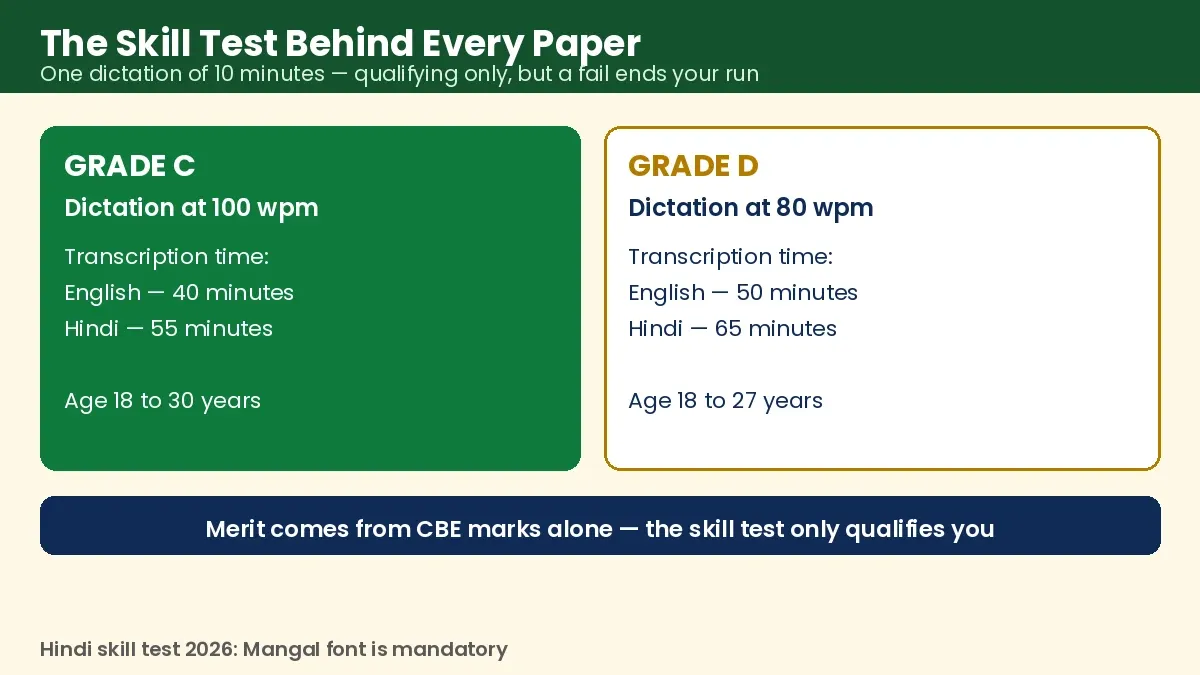
The shape is fixed. One dictation of 10 minutes in English or Hindi, as you chose in your form. For Grade C the dictation runs at 100 words per minute, and you type it out on a computer in 40 minutes for English or 55 minutes for Hindi. For Grade D the dictation runs at 80 words per minute, and you get 50 minutes for English or 65 minutes for Hindi. The test is qualifying only. Its marks never enter merit. But a fail ends your run, whatever your CBE score says.
Read that again and the study plan writes itself. CBE marks decide your post. The skill test decides if you get any post at all. A candidate who gives shorthand 20 minutes a day from the first month reaches the skill test with a warm hand. A candidate who waits for the CBE result to start shorthand gets a few weeks to build a skill that takes months. We see that second candidate every cycle, and his story ends the same way.
Two small 2026 facts belong here. SSC made the Mangal font mandatory for the Hindi skill test in 2026, so Hindi candidates should practise transcription in Mangal, not in a font of their choice. And the notice says a candidate who takes the skill test in Hindi must learn English stenography after appointment, and the other way round, as the office needs. The skill you pick for the test is your starting skill, not your last one.
So keep the two trainings side by side from week one. Papers and tests in the morning hours, shorthand dictation every day, transcription on a computer at the true times of 40, 55, 50 or 65 minutes by your grade and language. The tie break rule of the CBE makes the same point from the marks side: when two candidates tie, SSC looks first at Part III English marks, then at Part II General Awareness marks, then at date of birth. English is worth 100 marks and the first tie break both. Train it like the main subject it is.
Hindi and English Papers, and Your Next Step
Steno papers come in Hindi and in English, and the Reasoning and General Awareness parts are set in both mediums, while the English part is English for every candidate. Pick the medium you will sit in and stay with it for full papers. A candidate who solves Reasoning in Hindi all year and meets English words in the hall loses time to reading, not to reasoning. Medium is a speed choice. Fix it early.
Place the tabs of this sub-category in one line in your mind, because each one feeds the paper work. The previous year papers give you the real test. The chapter wise tests fix the chapters your notebook names. The sectional tests train one locked part at a time in the 30, 30 and 60 minute shape. The PYQ PDF files give you print sittings. And the Latest Jobs page will carry the Steno 2027 notice the day SSC prints it, with the official word always open on ssc.gov.in beside it.
Here is your next step, and it fits in one day. Pick the newest paper you have not solved. Sit it in 3 locked parts of 30, 30 and 60 minutes. Score it with the final key, write the 3 register numbers, and give every error one notebook line with its cause word. Then book one chapter test for tomorrow from the chapter that hurt you most, and close the day with 20 minutes of dictation at your grade speed. Do not wait for the 2027 notice to start this loop. The notice will come on its own day. Your hand speed and your shorthand will be whatever your daily work made them.







