About SSC Stenographer Grade C & D 2027 Sectional Tests
- 1.SSC Stenographer Sectional Tests: Key Facts First
- 2.Three Locked Rooms, Not One Open Hall
- 3.A Minute Plan for Each Part
- 4.The Two Pass Method Inside a Locked Part
- 5.The English Hour: 100 Questions, One Plan
- 6.Read a Sectional Score Like a Report Card
- 7.When Sectional Tests Beat Chapter Tests and Full Papers
- 8.A Weekly Shape That Holds All Three Parts
- 9.Between the Rooms: The Minute Nobody Trains
- 10.What Progress Looks Like in Numbers
- 11.Mistakes Candidates Make With Sectional Practice
- 12.Your Next Step
Quick Answer: SSC Stenographer Sectional Tests train one full part of the paper at a time, under the exact clock that part now carries in the hall. From the 2026 cycle, the Steno CBE runs in 3 locked parts: Reasoning 50 questions in 30 minutes, General Awareness 50 questions in 30 minutes, and English 100 questions in 60 minutes. A sectional test is that part, whole, on that timer, with no pause and no borrowing from the next part. This page gives you a minute plan for each part, the two pass method inside a locked part, and how to read a sectional score so the next week of study writes itself.
SSC Stenographer Sectional Tests: Key Facts First
The Stenographer Grade C and D Examination of the Staff Selection Commission holds one written test, the Computer Based Examination, with 200 questions and 200 marks. Part I is General Intelligence and Reasoning, 50 questions. Part II is General Awareness, 50 questions. Part III is English Language and Comprehension, 100 questions. Every question pays 1 mark. Every wrong answer cuts 0.25 marks.
The 2026 notice changed the clock, and the clock is the whole subject of this page. Till the 2025 cycle, the 200 questions shared one free block of 2 hours. From 2026, each part holds its own timer: 30 minutes, 30 minutes and 60 minutes. When a part ends, it closes. The marks and questions did not change. The freedom did.
The 2026 cycle shows the frame around those timers. Notice on 24 April 2026. Applications from 24 April 2026 to 15 May 2026, fee Rs 100, with no fee for women, SC, ST, PwBD and ex-servicemen. CBE from 09 September 2026 to 15 September 2026. Tentative vacancies 1,170 in the SSC list of 04 June 2026: Grade C 149, Grade D 1,021. Qualifying floor in the CBE: 30 percent for UR, 25 percent for OBC and EWS, 20 percent for all other categories. Scores are normalised across shifts.
Behind the written test stands the Skill Test in Stenography, qualifying only: a dictation of 10 minutes at 100 words per minute for Grade C or 80 words per minute for Grade D, typed out on a computer in the time fixed for your grade and language. Merit comes from the CBE alone, and the tie break reads Part III marks first, then Part II marks. So the English part is worth 100 marks, the first tie break, and a full hour of locked time. Sectional practice must treat it as the main room of the house.
| Fact | Detail |
|---|---|
| Exam | Stenographer Grade C and D Examination, Staff Selection Commission |
| Part I | General Intelligence and Reasoning: 50 questions, 50 marks, 30 minutes |
| Part II | General Awareness: 50 questions, 50 marks, 30 minutes |
| Part III | English Language and Comprehension: 100 questions, 100 marks, 60 minutes |
| Total | 200 questions, 200 marks, 2 hours, in 3 locked parts |
| Scribe-eligible time | 40, 40 and 80 minutes, total 2 hours 40 minutes, parts still locked |
| Negative marking | 0.25 marks cut for each wrong answer |
| Tie break | Part III marks, then Part II marks, then date of birth, then name order |
| Skill test | Dictation at 100 wpm (Grade C) or 80 wpm (Grade D); qualifying only |
| Official website | ssc.gov.in |
What This Page Covers
- Three locked rooms, not one open hall
- A minute plan for each part
- The two pass method inside a locked part
- The English hour: 100 questions, one plan
- Read a sectional score like a report card
- When sectional tests beat chapter tests and full papers
- A weekly shape that holds all three parts
- Mistakes candidates make with sectional practice
- Your next step
Three Locked Rooms, Not One Open Hall
Think of the old exam as one open hall. You walked where you liked for 2 hours. Strong in English? Spend 70 minutes there. Stuck in Reasoning? Leave it, score in Awareness, come back with a cool head. The open hall forgave a weak part, because a strong part could lend it time.
The new exam is 3 locked rooms. You sit in the Reasoning room for 30 minutes, and the door shuts. You sit in the Awareness room for 30 minutes, and the door shuts. You sit in the English room for 60 minutes, and the exam ends. No room lends time to another room. A weak part can no longer hide behind a strong one.
This is why sectional tests exist as their own practice form. A full paper mixes the 3 rooms into one score, and one score cannot tell you which room is leaking. A chapter test is smaller than a room. It tells you about one shelf inside the room. A sectional test is the room itself: all 50 or 100 questions, the true mix of chapters, the true clock, the true end, where the door shuts with questions left unseen if your pace fails.
A candidate in Bhopal learned this the hard way in a mock season. His full paper totals looked fine, near 135, because his English carried his Reasoning in the free hours he gave himself at home. When he sat his first locked sectional set, Reasoning closed at question 41. Nine questions never seen. Nine marks never in the race. His home practice had been training for an exam that stopped existing in 2026. Sectional tests are how you stop training for that old exam.
Scribe-eligible candidates get longer rooms, 40, 40 and 80 minutes, but the doors still lock. If that line covers you, run every sectional test at your own true times, not at the standard ones. Practice must match your hall, not another candidate's hall.
A Minute Plan for Each Part
The Three Room Minute Plan: Four Moves
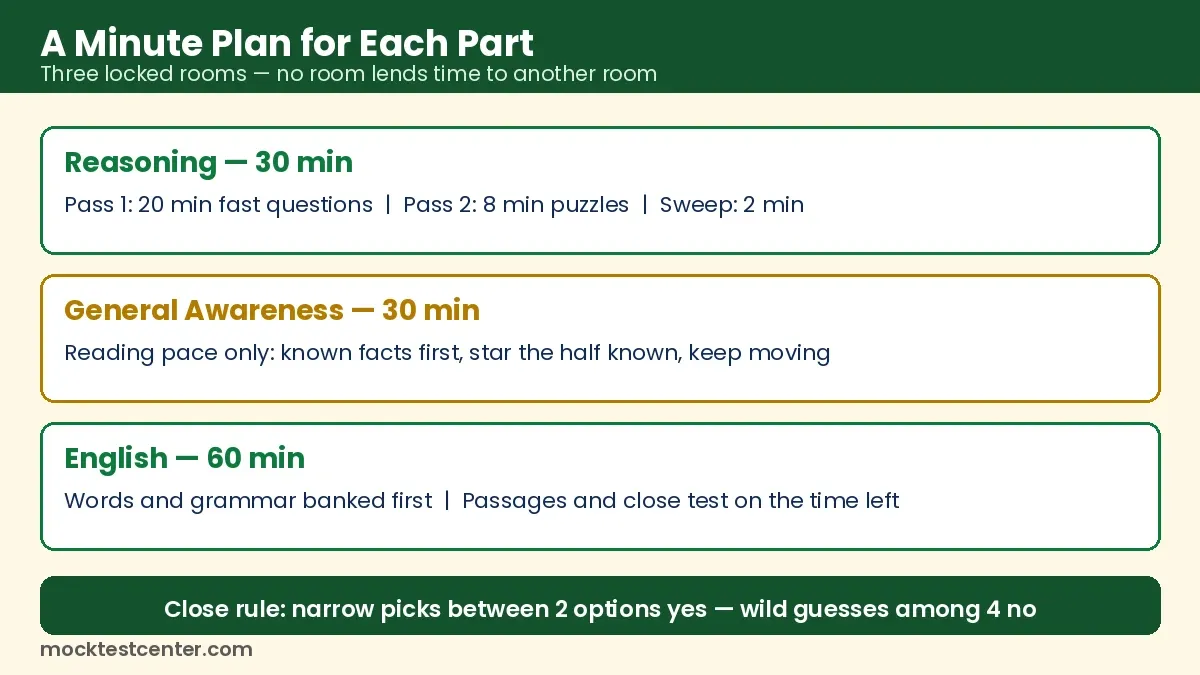
Reasoning in 30 minutes. Give the first pass 20 minutes for the questions that fall fast: series, coding, analogies, odd one out, blood relations read once and drawn small. Give the second pass 8 minutes for the puzzles and the statement questions you marked. Keep the last 2 minutes to sweep the part once, so no easy question sits unseen at the end. A puzzle that holds you past 90 seconds in pass one is not a puzzle any more. It is a tax on 3 other questions.
Awareness in 30 minutes. This part has no method time at all. A fact is known or it is not known, and no 3 minute think will birth a date you never read. Move at full speed, mark what you know, star what you half know, and leave what you do not know. Fifty questions at 36 seconds is a reading pace, not a thinking pace. The candidates who score in this part are the ones whose heads were stocked before the exam, by the NCERT base and the current affairs loop, not the ones who think longest inside it.
English in 60 minutes gets its own section below, because 100 questions need more than a line.
And the close matters. In the last minute of each part, mark something on every question you have read and can narrow to 2 options. A blank pays 0 for sure. A pick between 2 pays half the time and loses 0.25 the other half, which is a winning trade over a season. A wild guess among 4 is a losing trade. The close rule is: narrow picks yes, wild guesses no.
 The Two Pass Method Inside a Locked Part
A locked part punishes the straight line reader. Question 6 is a hard puzzle, question 7 is a gift, and the straight line reader meets the gift at minute 29, if he meets it at all. The two pass method exists to meet gifts first.
Pass one: take only the questions you can finish fast and sure. Read once, solve, mark, move. If a question asks for a second read in pass one, star it and go. Your aim in pass one is not a score. Your aim is a full sweep of the part, so every easy mark in the room is banked before the clock grows teeth.
Pass two: return to the starred questions in the time left, hardest value first. Now spend the longer minutes, because the easy marks are safe behind you. A puzzle solved in pass two pays the same 1 mark as a gift solved in pass one. Order is the whole game. Gifts first, fights later.
Keep a hard cap inside pass two as well. No single question takes more than 2 minutes, even in pass two, even if you feel the answer is one step away. That feeling is the most costly feeling in this exam. It has eaten more marks than any hard chapter. When the cap rings in your head, mark your best pick, star it in your mind for the notebook, and move.
A girl in Indore practised this method on sectional sets for 5 weeks. Her Reasoning attempts rose from 39 to 48 of 50, and her wrong count fell from 11 to 6, because pass one stopped feeding her hard questions while her hand was still cold. Same knowledge. New order. Eleven marks of swing, from order alone.
The English Hour: 100 Questions, One Plan
The English part is half the paper and the longest locked room. It needs a plan of its own, built before the exam, tested on sectional sets, and never left to the mood of the day.
Split the hour in your head before you split it on screen. The word and grammar questions, synonyms, antonyms, idioms, one word names, spelling, error spotting, sentence improvement, voice and speech, are fast questions for a prepared candidate. Most fall in 20 to 30 seconds. Bank them first. They are also the questions where the tie break lives, since Part III marks are read first when totals tie.
The reading questions, comprehension passages and the close test, eat time in blocks. A passage with 5 questions can take 4 to 6 minutes of honest reading. Give them the second half of the hour, with the banked marks safe behind you. Read the questions of a passage before the passage itself, so your eye reads with a hunt list. And hold one rule for the close test: read the full passage once at a steady pace, filling as you go, rather than stopping at each blank to fight it alone. Blanks settle easier when the whole sense of the passage is in your head.
Watch your per 10 minute count as you train. A sound English hour runs near 16 to 18 questions per 10 minutes in the grammar half and slower in the passage half. If your first 10 minutes of a sectional set close under 12 questions, your start is too slow, and no late rush will repair an hour built like that. Sectional tests show you this count plainly. Full papers hide it inside a total.
One more English note, and it links this page to the second gate. The same reading speed that carries your English hour carries your skill test transcription. A dictation passage typed at Grade C speed, 100 words per minute in, 40 or 55 minutes to type out, punishes a slow reader at every line. English sectional work is quietly training your transcription hand all season.
Work one English hour in numbers, so the plan stops being a feeling. Say the part opens with 40 word and grammar questions. At 25 seconds each, they take about 17 minutes and, for a prepared candidate, pay near 30 marks. The close test and sentence sets in the middle take about 13 minutes for 20 questions. That leaves 30 minutes for the reading passages, about 40 questions in most papers, at 45 seconds a question with the hunt list method. The hour ends with every question seen, which is the first win. A candidate who starts with the passages spends the same 30 minutes there, reaches the grammar bank at minute 45 with a tired eye, and leaves 10 fast questions unseen at the close. Same knowledge, same hour, a gap of 8 to 10 marks built by order alone. Sectional tests exist to burn that order into the hand before the hall charges you for learning it.
Read a Sectional Score Like a Report Card
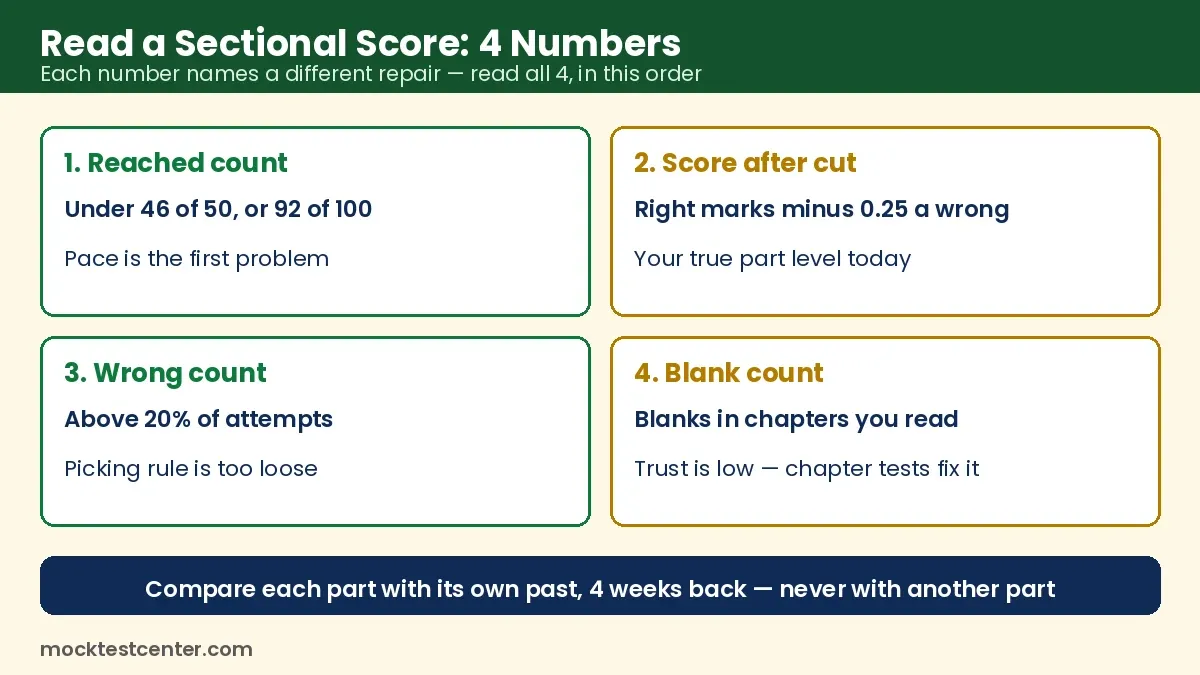
A sectional test gives you 4 numbers, not 1. Read all 4, in this order, every time.
First, the reached count: how many questions you saw before the door shut. Under 46 of 50, or under 92 of 100 in English, means pace is your first problem, whatever the score says. Second, the right count and the score after the 0.25 cut. Third, the wrong count: above 20 percent of your attempts means your picking rule is loose, and the fix is in your guessing habit, not in your books. Fourth, the blank count among questions you reached: high blanks in chapters you have read mean trust is low, and trust grows by chapter tests, not by more sectional sets.
Write the 4 numbers in your register with the part name and the date. A line of sectional scores across 6 weeks tells a story no single test can: pace rising, wrong count falling, blanks turning into attempts. That story is what keeps a candidate going on flat days. And when one part's line stops moving for 3 weeks, the register has named your next month of chapter work for you.
Score the parts against their own past, never against each other. An Awareness score of 31 and an English score of 68 do not mean English is your strong part and Awareness your weak one in any useful sense; the parts hold different totals and different natures. Compare each part with itself, 4 weeks back. Growth inside a part is the only fair line.
Use the sectional tests on this tab for this work. They are built part wise in the 2026 shape, so the clock you train on is the clock you will meet.
One reading habit ties the 4 numbers to the week. On Sunday, lay the week's sectional lines side by side and ask 2 questions only. Which part lost the most marks to the clock, and which part lost the most marks to wrong picks? The first answer names next week's pace work. The second names next week's chapter work. A register that answers those 2 questions every Sunday is a coach that costs nothing and never sleeps.
 When Sectional Tests Beat Chapter Tests and Full Papers
The three forms of practice do three different jobs, and the season asks for each at its own time. Chapter tests fix one chapter. They are the repair tool. Sectional tests train one locked room: the mix, the pace, the two pass order, the close. They are the room training tool. Full papers join the 3 rooms with the skill of moving from one locked door to the next without carrying the last room's mood into the new one. They are the dress run.
Early season, chapters carry the week, because rooms cannot be trained on broken shelves. Mid season, sectional tests take the lead: 3 to 4 a week, one per part in turn, with chapter tests filling the gaps the sectional scores name. Late season, full papers rise to 3 or 4 a week, and sectional tests drop to the one part that still leaks. A candidate who runs full papers all season never repairs a room. A candidate who runs chapters all season never learns the doors. The forms are a ladder. Climb it in order.
One clear sign tells you a sectional test is due. When your chapter scores in a part all sit above two thirds and your full paper score in that part still lags, the fault is not knowledge. The fault is room craft: order, pace, the close. Only a sectional test trains room craft, because only a sectional test is a room.
A Weekly Shape That Holds All Three Parts
Here is a mid season week built on sectional work. Monday: Reasoning sectional, full 30 minutes, then error lines. Tuesday: chapter tests from the chapters Monday named, plus vocabulary. Wednesday: English sectional, the full hour, with the per 10 minute counts noted. Thursday: chapter repair from Wednesday errors, and a dictation block that never moves. Friday: Awareness sectional, 30 minutes at reading pace. Saturday: the weakest part again, a second sectional of the same part in the same week, because a room visited once a week stays a stranger. Sunday: one full paper in the locked shape, and the notebook read for the week.
Count the shape. Four sectional tests, one full paper, chapter repair on 2 days, shorthand daily. That week trains rooms, shelves and doors in the right shares for mid season. In the last month, drop Saturday chapter work, raise full papers to 3, and keep one sectional of your weakest part each week until the exam.
Working candidates can run a half shape: one sectional on each study day, parts in turn, one full paper on the weekly off. The order of parts matters more than the count. Never let 10 days pass without a sectional of each part, or the room sense of the skipped part goes cold.
And keep the dictation block inside this week where it belongs, daily and unmoved. A sectional heavy week can quietly eat the shorthand hour, because sectional scores feel like the real fight. They are only the first fight. The Grade C hand must still meet 100 words per minute and the Grade D hand 80, in a room that gives no marks for trying. Twenty to thirty minutes of dictation a day, every day of this week, is the price of the second door. Pay it before the sectional work, if your evenings keep stealing it. A skill paid first gets paid. A skill left for the end of the day gets the day that is left, and some days nothing is left.
Between the Rooms: The Minute Nobody Trains
There is a minute in this exam that no chapter test and no sectional test holds on its own: the minute when one part closes and the next part opens. The Reasoning room shuts, ready or not. The Awareness room opens on a fresh screen. Candidates carry the last room with them. A Reasoning part that ended badly walks into Awareness as a heavy head, and the first 10 Awareness questions get read by a mind still fighting the last puzzle. Ten questions at reading pace is 6 minutes of the part gone to a mood.
Train the change of rooms as its own small skill. When a sectional test ends in practice, stand up, drink water, and start the next part's work only after 2 full minutes of nothing. In the hall the gap is shorter, but the habit is the same: close the room in your head when the screen closes it. A line that helps many candidates is a fixed first act for each part. Awareness always starts with the polity and history questions you can see on the first screen. English always starts with the word questions. A fixed first act gives the mind a door handle. It does not wander in holding the last room's bags.
Full papers train this change best, because only a full paper holds all 3 doors in a row. That is why the weekly shape on this page keeps a Sunday full paper even in a sectional heavy week. Sectional tests build the rooms. The full paper teaches you to leave them.
What Progress Looks Like in Numbers
Sectional progress has a shape, and seeing the shape keeps you from chasing the wrong number. In the first 2 weeks of honest sectional work, the reached count moves first. A Reasoning part that closed at question 41 opens up to 47, then to 50. The score may barely move in those weeks, because the new attempts carry new wrong answers with them. That is normal. Reach comes before right.
In weeks 3 to 5, the wrong count should start to fall. The two pass method beds in, the wild guesses thin out, and the 0.25 cut shrinks. A wrong count falling from 12 to 7 in Reasoning is worth more than a score rise of the same size built on luck, because it holds on a bad day too. In the last weeks, the score itself climbs, as chapter repair and room craft pay together. If your line moves in the other order, score first and reach last, check your practice honesty. Scores that rise before reach usually rise on soft clocks, paused tests, or parts given more time than the hall gives.
Keep one more line in the register: the count of questions left unseen in English. English is the part candidates most often fail to finish, because its room is the longest and its passages eat time in blocks. An unseen count falling from 14 to 4 across a month is a gain of up to 10 marks of chance, before any new knowledge enters the story. No other single number in your register pays that fast.
Mistakes Candidates Make With Sectional Practice
The first mistake is the pause button. A sectional test paused for tea is not a sectional test. It is reading. The locked door is the whole point, and a door you can open at will teaches your hand a lie it will believe in the hall.
The second mistake is borrowing time in practice: 35 minutes for Reasoning today because English felt strong. That habit built the Bhopal story above. The hall lends nothing. Practice must lend nothing either.
The third mistake is checking answers mid test. Every check breaks the room spell and feeds the hand a rest the hall will not give. Check after the door shuts, all at once, with the notebook open.
The fourth mistake is running sectional tests of your strong part because the scores please you. Run the weak part twice a week and the strong part once. Pleasure is not a plan.
The fifth mistake is reading a sectional score as 1 number. Score, wrong count, blank count, reached count. A candidate who reads only the score will fix the wrong thing for a month and call sectional practice useless, when the useless thing was his reading of it.
Your Next Step
Place the tabs of this sub-category in one line in your mind. The chapter tests repair shelves. The sectional tests on this tab train rooms. The full tests and the previous year papers join the rooms into the full exam, and the PYQ PDF tab holds the papers as files. Official word on dates and notices stays on ssc.gov.in, and the Latest Jobs page of this site will carry the 2027 notice when SSC prints it.
Start with the part you fear. Tonight, sit one sectional test of that part at its true time: 30, 30 or 60 minutes, phone in another room, no pause. When the door shuts, write the 4 numbers. Give every error one notebook line. Then close the day with dictation practice, because the rooms of the written test are only the first house you must learn to live in. The skill test house stands right behind it, and its door, too, locks on time. A week from tonight, sit the same part again and lay the 2 lines side by side. That small pair of lines, reach rising and wrong count falling, is the truest report card this exam gives before the real one.