About UPSSSC Mandi Parishad 2027 Exam Series
📖 Table of Contents
- UPSSSC Mandi Parishad Mock Test 2027: Free Online Test Series for Mandi Sachiv (70+15+15) & Combined Posts
- Why I Built This Mock Test Series
- AMBER CALLOUT BOX: 3 Big Exam-Pattern Changes Every 2027 Mandi Parishad Aspirant Must Know
- Attempt Free UPSSSC Mandi Parishad Mock Test 2027 (5-Tab Practice Hub & AI Weak-Area Engine)
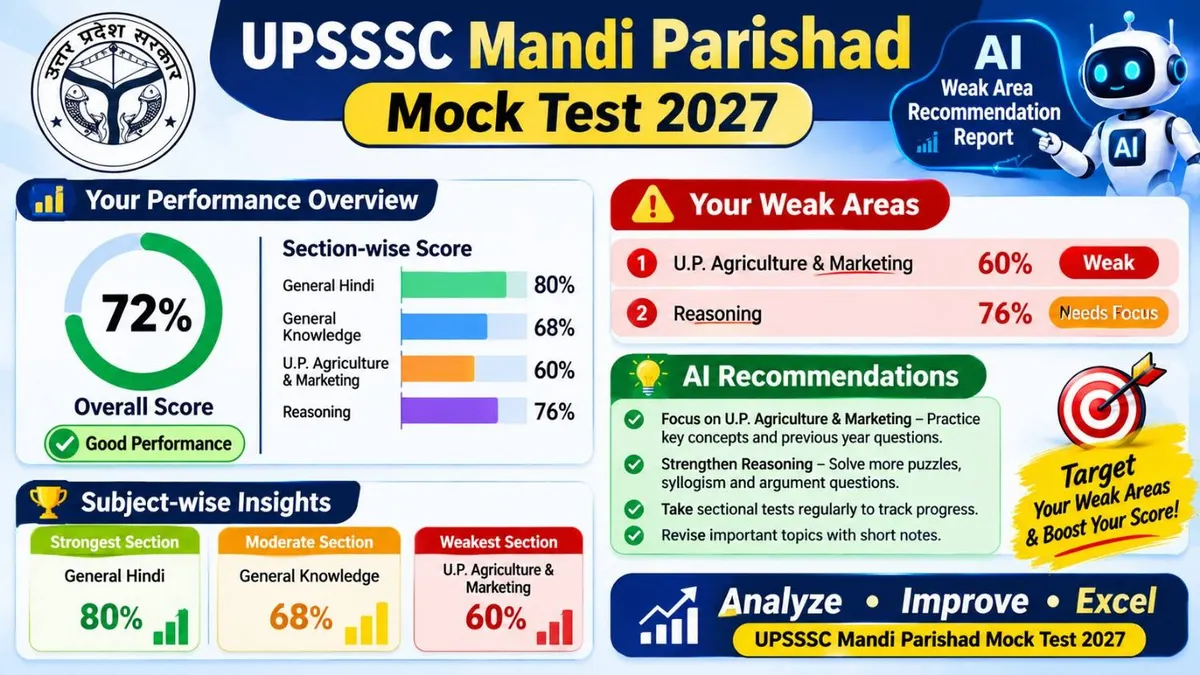
- How Our AI Weak-Area Recommendation Engine Fixes Your Score Between Mock Tests
- Inside the UPSSSC Mandi Parishad 2027 Test Series: Track-Wise Mock Counts, Bilingual Interface & PDFs
- Clearing the 4 Big Confusions About the UPSSSC Mandi Parishad Exam (2026–27)
- UPSSSC Mandi Parishad Exam Pattern 2027 & How Our 100-Mark Simulator Works
- Part 1 Simulator (70 Marks for Sachiv) — Mastering the 7 Pillars of Agricultural Marketing, UP Mandi Act 1964 & Agronomy
- Part 2 Simulator (15 Marks) — Computer Fundamentals, MS Office, Digital Payments & Emerging Tech (AI, Big Data, IoT)
- Part 3 Simulator (15 to 20 Marks) — Uttar Pradesh State GK, 9 Agro-Climatic Zones of UP, ODOP & Rural Schemes
- The negative marking (−0.25 instead of the previous −0.50) together with the use of safe guessing in the Mandi Parishad mock exam.
- 120-Minute (2-Hour) Pacing Blueprint: How to Allocate 72 Seconds per Question Without Rush
- Which mock examination track for the UPSSSC Mandi Parishad 2027 suits your graduation subject? (A selection matrix by subject)
- High-Yield Topics from the 13 April 2025 Mains Paper & 10 Step-by-Step Solved Sample Questions
- Part 1 (70 Marks — UP Mandi Act 1964, e-NAM, MSP, NABARD, GIS & Post-Harvest): 5 Solved MCQs
- Part 2 (15 Marks — Computer, AI, Big Data, IoT & Digital Financial Tools): 3 Solved MCQs
- Part 3 (15 Marks — Uttar Pradesh Agriculture, Agro-Climatic Zones & State GK): 2 Solved MCQs
- Post-Wise Safe Score Benchmarks in Mock Tests (Calibrated to the 134-Post 2024–26 Cycle & Combined Cutoffs Out of 100)
- 6 Common Mistakes Aspirants Make in UPSSSC Mandi Parishad Mock Tests (And How to Fix Them)
- How to Attempt the Free UPSSSC Mandi Parishad 2027 Mock Test & Audit Your Scorecard on MockTestCenter.com
- UPSSSC Mandi Parishad Post-Mock Error-Log Template Table
- Daily UP GK, Agricultural Economy & Current Affairs Quiz: Lock In 25+ out of 30 in the Common Sections
- About the Author
UPSSSC Mandi Parishad Mock Test 2027: Free Online Test Series for Mandi Sachiv (70+15+15) & Combined Posts
Last updated: 31 October 2026 | Reviewed by Ali Hassan, Senior Content Editor (Government Exams), MockTestCenter.com
Why I Built This Mock Test Series
"I'm Shubham Kumar Sah, founder of MockTestCenter.com.
When UPSSSC released the new 100-mark syllabus for and UPSSSC Mandi Parishad Mock Test the Mains examination on 13 April 2025, the old 2018-style 400-mark paper became history. Under the current pattern, 70 marks come directly from Agricultural Marketing, the Uttar Pradesh Krishi Utpadan Mandi Adhiniyam 1964, e-NAM, MSP, rural credit and post-harvest management, while Computer & IT (15 marks) and Uttar Pradesh GK (15 marks) make up the remaining 30 marks.
Yet most practice sets available online still hand you old 2018 papers filled with 50 Reasoning questions and a 50% negative marking penalty. Even worse, Science, Commerce and Economics graduates—who are officially eligible for Mandi Sachiv alongside Agriculture graduates—struggle to find topic-wise tests for the 70-mark Agricultural Marketing and UP Mandi Act section.
So we built this 2027 UPSSSC Mandi Parishad Mock Test Series with two dedicated engines: Track A on the exact 70+15+15 Mandi Sachiv pattern (calibrated to the 13 April 2025 paper) and Track B on the 65+15+20 Combined Mandi Inspector and Supervisor pattern. Our AI weak-area engine pinpoints whether you are losing marks in UP Mandi Act provisions, Agronomy basics, IoT/AI computer questions or UP Agro-Climatic Zone facts.
Most of the series is free. A diagnostic test should not sit behind a paywall.
Every test here has to pass one check: does it match the exact 100-mark, 120-minute UPSSSC Mandi Parishad blueprint and the real depth of the 13 April 2025 paper? If not, it does not get published."
AMBER CALLOUT BOX: 3 Big Exam-Pattern Changes Every 2027 Mandi Parishad Aspirant Must Know
The 2018 pattern (200 questions / 400 marks / –0.50 penalty) has been replaced by the new one consisting of 100 questions / 100 marks / 120 minutes with a –0.25 penalty: despite this change, outdated practice portals and the old library guidebooks continue to offer the 200-question papers which carry 400 marks and a severe negative marking penalty of 50% (–0.50) from the 2018 cycle. The current UPSSSC Mandi Parishad recruitment procedure involves shortlisting based on the PET, followed by a single, streamlined Main Written Examination comprising exactly 100 objective multiple-choice questions worth 100 marks to be completed in 120 minutes, with a standard penalty of one quarter (–0.25) and no interview.
(2) The Sachiv Track (70 marks on Agri-Marketing plus 15 marks on Computer plus 15 marks on UP GK) is opposed to the Combined Mandi Inspector Track (65 marks on GS/DI/Hindi plus 15 marks on Computer plus 20 marks on UP GK) in that there is no longer a single exam paper suitable for all mandi positions. Track A (for Mandi Sachiv at Grade-II/III) includes a specialised professional core of 70 marks consisting of Agricultural Marketing, the UP Mandi Act of 1964, e-NAM, MSP, and Post-Harvest Management, together with 15 marks on Computer/IT and 15 marks on UP General Knowledge. Track B (for Mandi Inspector and Supervisor) adopts a revised combined subordinate pattern of 65+15+20 marks covering General Studies, Data Interpretation, Environment, Science & Technology, Hindi, Computer, and UP GK.
(3) Sachiv Cycle 2024–26 (134 Posts: Exam on 13 April 2025, Final Result on 30 April 2026) Completed—Use the Actual Paper from This Cycle as Your Baseline for 2027: Be careful that online sites do not regard the most recent Mandi Sachiv recruitment cycle as still ongoing or as something that has not yet taken place. The advertisement No. 06-Exam/2024 for the 134 Secretary positions successfully held its Main examination on 13 April 2025, settled the objections by issuing the revised answer keys on 3 July 2025, and announced the final selection result on 30 April 2026 on upsssc.gov.in. The mock test series we are offering in 2027 will use that same official question paper from 13 April 2025 as its main benchmark.
The following is the ultimate online resource for individuals who are applying for the recruitment to the Uttar Pradesh Rajya Krishi Utpadan Mandi Parishad under the Department of Agricultural Marketing and Foreign Trade. Should you be a graduate in Agriculture, Science, Commerce, Economics, or Agricultural Economics who has passed the UPSSSC PET, you will need to carry out highly concentrated preparation for the forthcoming exam. Our 2027 upsssc mandi parishad mock test series has been designed specifically to cover the new 100-mark single-exam format, so that you will not encounter any surprises on the day of the exam.
Here, you can obtain immediate access to comprehensive, bilingual full-length mock tests which have been carefully calibrated to the official syllabus announced in Advt. No. 06-Exam/2024 and were actually used in the major 13 April 2025 Mains exam. If your aim is to secure the Mandi Sachiv Grade-II/III (Secretary) position via the specialised 70+15+15 pattern or if you are targeting the Mandi Inspector (Mandi Nirikshak), Market Supervisor, and Amin posts through the 65+15+20 Combined Subordinate pattern, our platform provides question banks tailored to each post, practice exercises on a chapter-by-chapter basis based upon the UP Mandi Adhiniyam 1964, AI-powered identification of your weak areas, and downloadable PDF versions of the answer keys.
Before carrying out your first test session, make sure that you go through the important changes to the exam pattern described in the assessment brief listed below. If you understand these structural changes, you will avoid spending valuable study time on practice sets from the 2018 era and will ensure that your preparation matches the specific competency standards required by the examining authorities for the Uttar Pradesh subordinate services.
Attempt Free UPSSSC Mandi Parishad Mock Test 2027 (5-Tab Practice Hub & AI Weak-Area Engine)
The testing interface is divided into five structured tabs, which gives you full control over your preparation at both the pre-board and board levels.
The bilingual simulator, which lasts for 120 minutes, exactly matches the official syllabus from 10 September 2024 and the exam difficulty level set on 13 April 2025, and has been designed specifically for graduates in the fields of Agriculture, Science, Commerce, and Economics who are aiming at Mandi Sachiv Grade-II and Grade-III posts.
It is designed for individuals who hold general degree qualifications and who are aiming at the Mandi Inspector (Mandi Nirikshak), Market Supervisor Grade-II, and Amin positions under the UPSSSC's revised framework for subordinate recruitment.
Check your position against that of history. The tab here gives you the opportunity to work through the full version of the official paper from 13 April 2025 (this having been checked against the revised answer key of 3 July 2025) together with topic-filtered questions from the 2019 Mandi Parishad exam, the bilingual PDF solutions for which can be printed.
The chapter includes 35 detailed question drills for each of the 7 main modules in Part 1; this enables graduates in Science, Commerce, and Economics to become proficient in the subject of agricultural marketing and allows B.Sc. Agriculture graduates to understand the material exactly as it is covered.
Mocks in the form of sectionals that are high speed, concentrating on the 30 to 35 marks which are 100% common to both the Mandi Sachiv and Mandi Inspector syllabi, and emphasizing facts that are specific to each state as well as modern computing.
How Our AI Weak-Area Recommendation Engine Fixes Your Score Between Mock Tests
Once a mock test has been submitted, our post-mock AI diagnostic system looks at your performance. It begins by separating out Legal/Policy Errors—these are cases of not understanding parts of the UP Mandi Act 1964, the APMC licensing rules, or the e-NAM workflow—from the Agronomy/Soil Science Gaps and the Computer/UP GK mistakes. Next, it identifies the Wild-Guess Penalty Drift (-0.25). Lastly, the system automatically produces a targeted 20-question repair quiz drawn from Tab 4 or Tab 5 in order to correct those specific weaknesses before your next full-length test.
Inside the UPSSSC Mandi Parishad 2027 Test Series: Track-Wise Mock Counts, Bilingual Interface & PDFs
| Mock Track & Tab | Target Posts | Total Mocks | Free Diagnostic Tests | Marks Split & Duration | Printable Bilingual PDF |
|---|---|---|---|---|---|
| Tab 1: Sachiv Full Mocks | Mandi Sachiv Grade-II/III | 25 Mocks | 3 Mocks | 70 Agri + 15 Comp + 15 UP GK = 100 Marks (120 minutes, -0.25) | Yes |
| Tab 2: Combined Inspector Mocks | Mandi Inspector, Supervisor, Amin | 25 Mocks | 3 Mocks | 65 GS/DI + 15 Comp + 20 UP GK = 100M (120 minutes, -0.25) | Yes |
| Tab 3: Official & PYQ Shifts | All Mandi Cadres | 15 Shifts | 2 Shifts | Mode-Matched (100M, 120 Mins) | Yes |
| Tab 4: 70M Agri-Marketing Drills | Sachiv Aspirants | 40 Drills | 5 Drills | 35 Qs per drill (30 Mins) | Yes |
| Tab 5: Computer & UP GK Sprints | All Mandi Cadres | 45 Sprints | 5 Sprints | 30–35 Qs per sprint (30 Mins) | Yes |
Verified "Last / Current / Future" Recruitment Calibration Table:
- In the 2018 Combined Cycle (Advt. 05-Exam/2018) there were 284 posts for Mandi Inspector, Amin, Auctioneer, Junior Assistant, Account Clerk, Market Supervisor Grade-II and Stenographer; the exam took place on 30 May 2019 (the old pattern consisting of 200 questions and 400 marks with 1/2 negative marking).
- For the 2024–26 Mandi Sachiv recruitment cycle (Advt. 06-Exam/2024), there are 134 posts. The official revised syllabus consisting of 100 marks was issued on 10 September 2024. The mains examination took place on 13 April 2025, a provisional answer key was released on 15 April 2025, the revised key came out on 3 July 2025, the DV shortlist was announced on 17 October 2025, and the final selection result was published on 30 April 2026 on upsssc.gov.in.
- In 2026 for the Combined Cycle (Advt. 07-Exam/2026) the subordinate positions such as Mandi Supervisor and Inspector were grouped together under the revised subordinate framework.
- For the 2027 cycle, the mocks will be calibrated to anticipate the type of PET-shortlisted 100-mark Mains papers and the level of coverage on agricultural marketing.
Clearing the 4 Big Confusions About the UPSSSC Mandi Parishad Exam (2026–27)
| Common Aspirant Confusion | Outdated Market Belief | Verified Official UPSSSC Rule | How It Shapes Your 2027 Mock Strategy |
|---|---|---|---|
| 400-Mark versus 100-Mark Pattern and Penalty | Thinks that the exam still consists of 200 questions and is worth 400 marks, with a severe penalty of -0.50 (1/2). | The exam is instead a single 100-question, 100-mark paper to be completed in 120 minutes, with a standard penalty of -0.25 (1/4) and no interview. | One should practise only using 100-mark, 120-minute timed CBT simulators. |
| Who is eligible to become a Mandi Sachiv? | The position is open only to those who hold a B.Sc. in Agriculture. | Officially, eligibility covers graduates in Agriculture, Agricultural Marketing, Science (B.Sc.), Commerce (B.Com), Economics, or Agricultural Economics, provided they have obtained a valid UPSSSC PET score. | However, graduates from fields other than agriculture can apply and achieve a high score by thoroughly studying the specialized Agricultural Marketing and UP Mandi Act modules. |
| The split regarding the Sachiv and Inspector Syllabus | Assumes that all mandi posts have the same syllabus. | The Sachiv follows a 70 + 15 + 15 pattern whereas the Combined Mandi Inspector follows a 65 + 15 + 20 pattern. | Choose the exact mock exam route (Tab 1 or Tab 2) according to the specific post you are aiming for. |
| The role of the UPSSSC PET and the interview Stage | People worry about the interview panel being unpredictable or the importance of the old prelims scores. | The PET score is a must for shortlisting for the Mains, and there is absolutely no interview for the Mandi Sachiv and Group C Mandi positions—selection is 100% based on the 100-mark Mains exam. | Therefore, you should devote all your efforts after the PET to maximising your score in the one 100-mark Mains paper. |
UPSSSC Mandi Parishad Exam Pattern 2027 & How Our 100-Mark Simulator Works
| Track Comparison | Syllabus & Part Breakdown | Total Questions, Duration & Marking |
|---|---|---|
| Track A — Mandi Sachiv | Part 1: Agricultural Marketing, UP Mandi Act 1964, e-NAM, MSP, Agribusiness (70M) Part 2: Computer & IT Literacy (15M) Part 3: Uttar Pradesh GK (15M) |
100 Questions, 100 Marks, 120 Mins, -0.25 Penalty, Zero Interview. |
| Track B — Combined Mandi Inspector / Supervisor | Part 1: GS, DI, Environment, Sci-Tech & Hindi (65M) Part 2: Computer & IT (15M) Part 3: Uttar Pradesh GK (20M) |
100 Questions, 100 Marks, 120 Mins, -0.25 Penalty, Zero Interview. |
Part 1 Simulator (70 Marks for Sachiv) — Mastering the 7 Pillars of Agricultural Marketing, UP Mandi Act 1964 & Agronomy
The 70-mark professional core is made up of seven core modules: (1) Agricultural Marketing Policies and the APMC Act, (2) the Uttar Pradesh Krishi Utpadan Mandi Adhiniyam of 1964 (including the detailed institutional framework, the powers of the Mandi Samiti, the collection of market fees, and licensing), (3) integration with e-NAM and the MSP/CACP pricing systems, (4) Agricultural Finance and Rural Credit (covering NABARD, KCC, and the PM Fasal Bima Yojana), (5) Post-Harvest Management, Cold Chains and AGMARK Grading, (6) the application of Remote Sensing (GIS) and IT in agriculture, and (7) General Agriculture (comprising Agronomy, Soil Science, Horticulture and Animal Husbandry). The simulator evaluates your proficiency in all seven areas.
Part 2 Simulator (15 Marks) — Computer Fundamentals, MS Office, Digital Payments & Emerging Tech (AI, Big Data, IoT)
Part 2 is worth 15 marks and includes questions that test knowledge of computer hardware, operating systems, MS Office (including Word, Excel and PowerPoint), internet protocols, digital financial tools (such as UPI, AEPS and mobile banking), and modern technologies including Artificial Intelligence, Big Data analytics, and the Internet of Things (IoT) when applied to agricultural supply chains.
Part 3 Simulator (15 to 20 Marks) — Uttar Pradesh State GK, 9 Agro-Climatic Zones of UP, ODOP & Rural Schemes
Part 3 deals with knowledge specific to states; the mock exams include questions on UP's 9 Agro-Climatic Zones, the major districts which produce crops, the different types of soil, the irrigation networks, the One District One Product (ODOP) industrial schemes, the agricultural universities in UP, the amounts allocated in the state budget, and the present administrative arrangements in Uttar Pradesh.
The negative marking (−0.25 instead of the previous −0.50) together with the use of safe guessing in the Mandi Parishad mock exam.
| Scenario Guessing | Probability of getting +1.00 | Probability of getting -0.25 | Mathematical expected value per question | Net effect on score after 16 guesses | Verdict |
|---|---|---|---|---|---|
| For a blind guess among four options | 0.25 | 0.75 | 0.0625 | +1.00 Mark | Skip (as it's too risky) |
| One option is eliminated (three remain) | 0.33 | 0.67 | 0.1625 | +2.60 marks | Worth considering |
| Two options eliminated (50:50) | 0.50 | 0.50 | 0.375 | +6.00 Marks | Attempt! |
Example A: The change from the severe 50% (–0.50) penalty in 2018 to the present 25% (–0.25) penalty means that eliminating the 50:50 option becomes very profitable. If a question is reduced to just two options, the expected value rises to plus 0.375 marks per question, so that calculated risks result in gains to your overall score.
Example B: Even if you make 16 blind guesses among four options in sections you are unfamiliar with, such as Agronomy or the UP Mandi Act, you still end up with a net loss of 3.00 or more marks because of the accumulation of negative penalties, a situation which can easily cause you to fall outside the selection bracket in smaller cadre sizes.
120-Minute (2-Hour) Pacing Blueprint: How to Allocate 72 Seconds per Question Without Rush
| Time Allocation | Strategy details |
|---|---|
| Minutes 1 to 15 (15 minutes) | Part 3 – Uttar Pradesh general knowledge (15 questions) – begin with one minute per question to build psychological momentum. |
| Minutes 16 to 32 (17 minutes) | Part 2 — Computer, IT, AI and Digital Tools (15 questions). |
| Minutes 33 to 105 (73 minutes) | Part 1. 70 main Agricultural Marketing, UP Mandi Act 1964, Rural Credit, and General Agriculture questions. About 62 seconds per question. Mark any policy or scheme questions with more than one part for Round 2. |
| Minutes 106 to 120 (15 minutes) | Elimination and OMR/Response Verification Pass. |
Which mock examination track for the UPSSSC Mandi Parishad 2027 suits your graduation subject? (A selection matrix by subject)
| Graduation Stream / Background | Target Score Split (To reach 78+/100) | Recommended Starting Mock Tab & Focus |
|---|---|---|
| Stream 1: Graduate in B.Sc. Agriculture or Agribusiness | Aim for 54 out of 70 in Part-1 plus 12 out of 15 in Computer and 12 out of 15 in UP GK which equals 78 out of 100 | Begin with Tab 4 (the UP Mandi Act of 1964 and the Policy Module) and then move on to Tab 5 (Computer and UP GK), concentrating on the aspects relating to law and information technology. |
| Stream 2: B.Com or BA Economics graduate | Aim for 51 out of 70 in Part-1 plus 13 out of 15 in Computer and 14 out of 15 in UP GK which equals 78 out of 100 | Begin with Tab 4 (General Agriculture and Post-Harvest Module) and then do Tab 1. Become proficient in the basic principles of agronomy and soil science. |
| Stream 3: B.Sc. Science Graduate | Aim for 50 out of 70 in Part-1 and 14 out of 15 in Computer and 14 out of 15 in UP GK to get a total of 78 out of 100 | Begin with Tab 3 (the official paper from 13 April 2025) and Tab 4, and at the same time bridge the gap in agricultural marketing. |
| Stream 4: General BA / B.Sc. / B.Com (Combined Mandi Inspector / Supervisor) | Aim to score 80 or more out of 100 on the Combined Track | Begin with Tab 2 (65+15+20 Combined Track) and master DI, Environment, and General Studies. |
High-Yield Topics from the 13 April 2025 Mains Paper & 10 Step-by-Step Solved Sample Questions
On the 13th of April 2025 the Mains paper placed heavy emphasis on various sections of the 11 blocks, among them the UP district schemes, tabular data interpretation, the environment acts, and AI concepts.
Part 1 (70 Marks — UP Mandi Act 1964, e-NAM, MSP, NABARD, GIS & Post-Harvest): 5 Solved MCQs
Q1. (Uttar Pradesh Krishi Utpadan Mandi Adhiniyam 1964 Section/Function/Market-Committee MCQ) उत्तर प्रदेश कृषि उत्पादन मंडी अधिनियम, 1964 के तहत 'मंडी समिति' (Market Committee) के गठन और उसके कामों के बारे में नीचे दिए गए में से कौन सा प्रावधान सही है?
What is the correct provision under the Uttar Pradesh Krishi Utpadan Mandi Adhiniyam, 1964, with regard to the constitution and functions of a 'Market Committee' (Mandi Samiti)?
A. The Central Government alone is responsible for the establishment of the Mandi Samitis without consulting the states.
B. The Market Committee has the responsibility of enforcing the provisions of the Act, granting licences to traders, and collecting the market fees within the market area that has been notified. [Correct]
C. The Market Committees are capable of drawing up national agricultural trade policies.
D. The Mandi Samitis function entirely as private cooperative societies.
Option (Correct) -> Reason: B. The Market Committee has the responsibility of enforcing the provisions of the Act, granting licenses to traders, and collecting the market fees in the area that has been notified [Correct]. The Uttar Pradesh Mandi Adhiniyam of 1964 provides that statutory Market Committees (Mandi Samitis) shall be set up by the State Government for the purpose of regulating agricultural marketing, issuing licenses to traders, collecting market fees (Mandi Shulk), and keeping the market yards in good order.
Option (Incorrect) -> Reason: It was set up by the State Government, not by the Central Government alone.
Option (Incorrect) -> Reason: C. The task of formulating national trade policies is within the domain of central or state legislative powers and not something which belongs to the Samiti.
Option (Incorrect) -> Explanation: D, because they are statutory bodies and not private societies.
Think about the local statutory authority that manages the nearest wholesale agricultural mandi yard.
Q2. (e-NAM / APMC / AGMARK Grading & Standardisation MCQ) 'ई-नाम' (e-NAM, National Agriculture Market) पोर्टल का मुख्य उद्देश्य देश की कृषि मंडियों को एकीकृत करना है। यह किस केंद्रीय मंत्रालय के अंतर्गत संचालित किया जाता है?
The primary aim of the 'e-NAM' (National Agriculture Market) portal is the integration of agricultural mandis all over the country. Which Union Ministry is in charge of it?
A. Ministry of Finance
B. Ministry of Agriculture and Farmers' Welfare [Correct]
C. The Ministry of Commerce and Industry
D. Ministry of Consumer Affairs, Food and Public Distribution
The correct option is B. This is because e-NAM was the pan-India electronic trading portal launched on 14 April 2016 by the Ministry of Agriculture and Farmers Welfare of the Government of India and it was implemented by SFAC.
Option (Incorrect) -> Reason: A, C, and D. Although it is connected with trade and food, the ministry in charge of it is Agriculture and Farmers Welfare.
सुझाव: उस मंत्रालय को देखें जो सीधे तौर पर खेती और किसानों के लिए जिम्मेदार है।
Q3. (MSP / CACP लागत अवधारणाएँ [A2, A2+FL, C2] या पीएम फसल बीमा योजना प्रीमियम MCQ) भारत में न्यूनतम समर्थन मूल्य (MSP) की सिफारिश करने वाली संस्था 'कृषि लागत और मूल्य आयोग' (CACP) फसलों की उत्पादन लागत का आकलन करते समय व्यापक लागत 'C2' में क्या शामिल करती है?
What specific contents does the comprehensive cost concept 'C2' used by CACP cover when it is estimating the production costs associated with MSP recommendations?
A. Only the costs which have actually been paid by the farmer (A2).
B. The actual amounts paid out together with the imputed value of unpaid family labour (A2 + FL).
C. The total cost, which includes the imputed rental value of land owned and the interest on fixed capital, in addition to A2+FL. [Correct]
D. The only support offered was for fertilisers and seeds.
The correct option is C because it includes the full cost, which comprises the imputed rental value of the land that is owned and the imputed interest on the fixed capital, in addition to A2+FL [Correct]. The CACP examines the costs for A2, A2+FL, and C2. The most comprehensive of these cost figures is C2 since it takes into account both the rental value of the land owned and the imputed interest on the fixed capital owned.
Option (Incorrect) -> Explanation: A is the one that defines the narrow A2 cost.
Option (Incorrect) -> Explanation: This is the definition of the A2+FL cost.
Option (Incorrect) -> Explanation: D is wrong because subsidies are separate policy interventions.
Note that the cost metric that is required by farm economists is C2 because it is the most extensive one.
Q4. (NABARD / Rural Credit / Kisan Credit Card MCQ) ग्रामीण क्षेत्रों में खेती और ग्रामीण विकास के लिए पुनर्वित्त देने वाली सबसे बड़ी संस्था 'नाबार्ड' (NABARD) की स्थापना किस समिति की सिफारिश पर हुई थी?
Which committee recommended the establishment of 'NABARD' (the National Bank for Agriculture and Rural Development), which is the apex refinancing institution for agricultural and rural development?
A. Sivaraman Committee [Correct]
B. Narasimham Committee
C. Kelkar Committee
D. Sarkaria Commission
The correct option is A. Sivaraman Committee [Correct]. NABARD was set up on 12 July 1982 as a result of the recommendations of the Committee to Review Arrangements for Institutional Credit for Agriculture and Rural Development (CRAFICARD), which was chaired by B. Sivaraman.
Option (Incorrect) -> Explanation: The Narasimham Committee was concerned with reforms in the banking sector.
Option (Incorrect) -> Reason: C and D. Kelkar and Sarkaria were concerned with taxation and the relations between the centre and the states.
Hint: Consider the committee in 1979 which was headed by B. Sivaraman.
Q5. (Remote Sensing [GIS] in Agriculture / Post-Harvest Cold-Chain or Agronomy MCQ) फसल कटाई के बाद प्रबंधन, यानी Post-Harvest Management, में 'कोल्ड चेन' प्रणाली का मुख्य उद्देश्य क्या है?
What is the main aim of a 'Cold Chain' system within agricultural supply chains as part of Post-Harvest Management?
A. The use of chemical agents to artificially ripen fruits prior to their transportation.
B. In order to keep a consistently low temperature environment so as to preserve the quality and shelf-life of perishable horticultural products. [Correct]
C. For the purpose of permanently freezing grains when storing them for a period longer than 10 years.
D. Dehydrate the vegetables thoroughly before packing them.
Option (Correct) -> Reason: B. In order to keep a consistently low temperature environment so as to preserve the quality and shelf-life of perishable horticultural products [Correct]. A cold chain is a supply chain which involves temperature control and prevents the spoilage of fruits, vegetables, flowers, and dairy products from the point at the farm to the consumer.
Option (Incorrect) -> Explanation: A. Artificial ripening involves the use of ethylene gas chambers, not cold chains.
Option (Incorrect) -> Explanation: C. Grains need dry storage silos rather than refrigerated cold chains.
Option (Incorrect) -> Explanation: D is wrong because dehydration is a different method of preservation (i.e. drying).
Hint: Consider the way in which fresh milk and strawberries are transported without becoming spoiled.
Part 2 (15 Marks — Computer, AI, Big Data, IoT & Digital Financial Tools): 3 Solved MCQs
Q6. (MS Excel Formula / Operating System MCQ) माइक्रोसॉफ्ट एक्सेल (MS Excel) में किसी रेंज, जैसे A1 से A10, के सभी संख्याओं का योग निकालने के लिए किस फॉर्मूले का उपयोग किया जाता है?
What formula in MS Excel is used for calculating the total of all the numerical values in a given range (for example, A1 to A10)?
A. =TOTAL(A1:A10)
B. =ADD(A1:A10)
C. =SUM(A1:A10) [Correct]
D. =PLUS(A1:A10)
Option (Correct) -> Reason: C. =SUM(A1:A10) [Correct]. The =SUM function in spreadsheet programs is the standard built-in mathematical formula for adding up all the numbers in a specified cell range.
Option (Incorrect) -> Reason: A, B, and D. These are not valid default Excel function names for adding cell ranges.
Tip: Search for the standard three-letter addition function.
Q7. (AI / IoT / Big Data Application in Agriculture & Governance MCQ) कृषि क्षेत्र में 'इंटरनेट ऑफ थिंग्स' (IoT) तकनीक का उपयोग मुख्य रूप से किस काम के लिए किया जाता है?
What are the main tasks for which 'Internet of Things' (IoT) technology is used in the agricultural sector?
Real-time monitoring of soil moisture, automated irrigation, and tracking of crop health through the use of smart sensors. [Correct]
B. Printing the deeds relating to physical land revenue and property maps.
C. The manual calculation of the MSP rates in the state mandis.
D. Sending out radio advisory messages to rural households.
Option (Correct) -> Reason: A. Real-time soil moisture monitoring, automated irrigation, and crop health tracking through the use of smart sensors [Correct]. By using a network of sensors in the fields, IoT in smart agriculture is able to gather live environmental data, which in turn allows for precise management of water and fertilisers.
Option (Incorrect) -> Reason: B, C, and D. These relate to administrative printing, manual calculation, and radio broadcasting, not to networked IoT sensors.
Tip: IoT links physical field sensors to the cloud in order to achieve automated data logging.
Q8. (Digital Financial Tools UPI / AEPS / Cyber Security MCQ) भारत में नेशनल पेमेंट कॉर्पोरेशन ऑफ इंडिया, NPCI, द्वारा बनाई गई 'UPI' (Unified Payments Interface) प्रणाली किस साल शुरू हुई थी?
What year did the 'UPI' (Unified Payments Interface), which was developed by the National Payments Corporation of India (NPCI), come out in India?
A. 2014
B. 2016 [Correct]
C. 2018
D. 2020
The correct option is B, since in 2016 [correct] the UPI was officially launched by Dr. Raghuram Rajan, who was then the Governor of the RBI, thereby revolutionising instant mobile-to-mobile digital payments in India.
Option (Incorrect) -> Reason: A, C, and D. The launch years are wrong.
Think about the boom in digital payments in India during the mid-2010s.
Part 3 (15 Marks — Uttar Pradesh Agriculture, Agro-Climatic Zones & State GK): 2 Solved MCQs
Q9. (Uttar Pradesh 9 Agro-Climatic Zones / Major Crop Production Rank / State Agri Research Institute MCQ) उत्तर प्रदेश को कुल कितने 'कृषि-जलवायु क्षेत्रों' (Agro-Climatic Zones) में बांटा गया है?
What is the official number of 'Agro-Climatic Zones' into which the state of Uttar Pradesh is divided?
A. 5 Zones
B. 9 Zones [Correct]
C. 11 Zones
D. 15 Zones
The correct option is B, with the 9 Zones [correct] because, taking into account factors such as soil type, rainfall, temperature, and topography, the Planning Commission / ICAR has divided Uttar Pradesh into nine distinct agro-climatic zones.
Option (Incorrect) -> Reason: A, C, and D. The number of regional zones counted is wrong.
Hint: Consider a single-digit odd number which represents the diverse regional farming areas of UP.
Q10. (UP ODOP / Rural Development Scheme / Cultural Heritage MCQ) उत्तर प्रदेश सरकार की महत्वाकांक्षी योजना 'एक जिला, एक उत्पाद' (ODOP) के तहत 'अलीगढ़' जिले के लिए किस प्रसिद्ध उत्पाद को चुना गया है?
What famous product has been assigned to the 'Aligarh' district under the UP Government's ambitious 'One District, One Product' (ODOP) scheme?
A. Locks and hardware [Correct]
B. हींग (Asafoetida)
C. पीतल के बर्तन (Brassware)
D. कांच के उत्पाद (Glassware)
Option (Correct) -> Reason: A. Locks and Hardware [Correct]. The city of Aligarh is well known worldwide for its traditional lock-making industry and is therefore nicknamed 'Taal Nagri', so locks and hardware are its assigned ODOP product.
Option (Incorrect) -> Explanation: B, because asafoetida is assigned to Hathras.
Option (Incorrect) -> Explanation: C. Brassware is for use in Moradabad.
Option (Incorrect) -> Explanation: D is correct because glassware is designated for Firozabad.
Hint: Alligarh is generally known as India's centre for the manufacture of locks.
Post-Wise Safe Score Benchmarks in Mock Tests (Calibrated to the 134-Post 2024–26 Cycle & Combined Cutoffs Out of 100)
| Category of Post and Executive Cadres | Vacancies (Advt. 06-Exam/2024 and 07-Exam/2026) | Safe Target Mock Score (out of 100) | Strategic Justification |
|---|---|---|---|
| Executive Officer (EO) and Supply Inspector | High Preference Cadres | 79 to 84 or more marks for UR candidates | It is a highly desirable executive post at the state level which calls for excellent accuracy in the areas of DI, Computer, and UP GK. |
| Marketing Inspector and Mandi Supervisor | General Graduate Posts | 75 to 80 or more marks (UR) | Requires strong performance in the blocks of current economic affairs, agriculture, and general studies. |
| Assistant Treasury Accountant and Accounts Inspector | Specialized Commerce Posts | 72 to 77 plus marks (UR) | The eligibility criteria for commerce graduates do slightly reduce the number of applicants, though the competition is still fierce. |
| Waqf Inspector and Assistant District Election Officer | Administrative Cadres | 76 to 81 plus marks | Requires a well-rounded performance across all eleven syllabus sections. |
6 Common Mistakes Aspirants Make in UPSSSC Mandi Parishad Mock Tests (And How to Fix Them)
How to Attempt the Free UPSSSC Mandi Parishad 2027 Mock Test & Audit Your Scorecard on MockTestCenter.com
You can select Track A (Mandi Sachiv 70+15+15) or Track B (Combined Mandi Inspector 65+15+20) or Tab 3 (13 April 2025 Official Paper) without having to pay a login fee.
UPSSSC Mandi Parishad Post-Mock Error-Log Template Table
| Mock # & Date | Exam Part (70M Agri-Marketing / 15M Computer / 15M UP GK) | Specific Sub-Module (e.g., UP Mandi Act 1964 / MSP-CACP / IoT / UP Agro-Zone) | Net Marks Lost (1.25M Swing) | Root Error Cause | AI Assigned Booster Tab | Retest Score |
|---|---|---|---|---|---|---|
| Ex: Mock 1 | Part 1 (70M) | UP Mandi Act 1964 | -1.25M | Act Section Confusion | Tab 4 (Agri-Marketing) | 18/20 |
| Ex: Mock 2 | Part 2 (15M) | IoT & AI in Agri | -1.25M | Computer Innovation Gap | Tab 3 (Computer) | 14/15 |
| Ex: Mock 3 | Part 3 (15M) | UP Agro-Climatic Zones | -1.25M | Zone Fact Slip | Tab 3 (UP GK) | Full Marks |
Daily UP GK, Agricultural Economy & Current Affairs Quiz: Lock In 25+ out of 30 in the Common Sections
10 minutes of daily quiz practice builds rock-solid accuracy in UP GK, Computer, and Rural/Agri Current Affairs. Take today's free quiz to lock in those vital scores.