About RRB ALP (Assistant Loco Pilot) Exam Series
📖 Table of Contents
- RRB ALP 2027 Mock Test: New Pattern CBT-1, CBT-2, CBAT
- Interactive Test Tab Architecture
- Why this RRB ALP 2027 Mock Test Series was built
- RRB ALP's Three Overlapping Cycles: CEN 01/2025, 01/2026 and the Expected 01/2027
- CEN 01/2025 (for reference only) — a completed cycle.
- CEN 01/2026 is the cycle currently in play.
- CEN 01/2027 - What the Annual Calendar suggests (Not yet confirmed).
- 3 major RRB ALP rule changes that every candidate must know.
- Rule Change 1: CBT-1 Restructure
- Rule Change 2: Merit Weightage Rebalance
- Rule Change 3: Medical Self-Screening
- CBT-1 & CBT-2 (Part A + Part B Trade) Exam Pattern
- Registered Candidates
- 1. CBT-1 Screening Exam
- 2. CBT-2 Dual Papers
- 3. CBAT (Psychological Test)
- 4. Document Verification & Medical
- Comprehensive Examination Pattern Matrix:
- Detailed syllabus breakdown for ALP aspirants
- 1. Mathematics (CBT-1 & CBT-2 Part A)
- 2. Mental Ability & Reasoning (CBT-1 & CBT-2 Part A)
- 3. General Science (Class 10 NCERT Standard - CBT-1)
- 4. Basic Science & Engineering (CBT-2 Part A Core - 45 Marks)
- 5. Technical Trade Specifications (CBT-2 Part B - 75 Marks)
- Applied Step by Step Sample Problems
- CBAT: Now 50% of your final merit
- Why most RRB ALP mock tests are outdated
- Tiered Test Architecture on MockTestCenter.com
- Product Feature: AI Based Weak Area Recommendation
- How to attempt the Mock Test on MockTestCenter.com
- Common Mistakes Aspirants Make
- About the MockTestCenter.com Railway Exams team
- Official Portals & Regulatory Verification
RRB ALP 2027 Mock Test: New Pattern CBT-1, CBT-2, CBAT
Last Updated: 25th October 2026
This reference page collates data from a number of recruitment cycles (all of which have been checked against the official notifications and the well established RRCB conventions). It is absolutely vital that the candidate understands the difference between the various cycles:
CEN 01/2025: This is a completed cycle. The score ranges and cutoffs for this cycle are purely for historical purposes and in no way will be used to determine the cutoffs for any future recruitment cycle.
CEN 01/2026 is the current cycle. The figure for number of vacancies (11,127 initial + 3,500 additional = 14,627 posts), number of applications and number of shifts is all taken from the official Railway Gazettes and the administrative circulars.
CEN 01/2027 is the projected cycle. The expectation of a notification window in Jan to Mar is based on the Railway Board's annual recruitment calendar and the historical nodal allocations (e.g. RRB Jammu) not on any actual CEN gazette.
Candidates must check their physical eligibility, visual standards (Medical Standard Aye-One) and trade classification on the official regional railway recruitment websites (rrbapply.gov.in and the regional sites) prior to applying.
Interactive Test Tab Architecture
To help the candidate find the precise diagnostic tool they're after with as little friction as possible, MockTestCentre.com have structured their mock resources under a three tab responsive selector which is situated right at the top of the test portal:
Full length 75 question simulations in the exact 3 section format (Mathematics, Mental Ability, General Science) with a 60 minute countdown timer and a -1/3 negative marking scheme.
Combined test sessions covering Part A (100 questions, 90 minutes) and Part B (Qualifying Trade Papers) of the Trade Papers (75 questions, 60 minutes) as per the ITI and Diploma Engineering syllabi (Fitter, Electrician, Electronic Mechanic, Turner, Machinist, Diesel Mechanic).
Specialised battery modules for all 5 of the cognitive tests (Memory, Direction/Spatial, Depth Perception, Concentration/Selective Attention, Perceptual Speed) with immediate T score diagnostics.
The presence of the interactive diagnostic tabs on the landing page means the user doesn't have to go looking for them and can initiate a real time test simulation in seconds. That in itself is a signal to the user that the content is actually useful and that the site is in line with the way modern search engines work.
Why this RRB ALP 2027 Mock Test Series was built
I'm Subham Kumar Sah, founder of MockTestCenter.com and a civil services aspirant. I've created this test platform after seeing so many structural flaws, data which was incorrectly labelled and a lot of misinformation across the commercial coaching portals.
When the Railway Recruitment Boards changed the ALP selection parameters, most of the coaching institutes just didn't update their material. The commercial institutes make three very serious errors which actually damage the candidate's preparation:
Our editorial remit is on accuracy and on making the diagnostic process as accessible as possible. Each full length mock will be in strict adherence to the 3 section CBT-1 format and the 50% merit weight of the CBAT. All the data points (vacancies, cutoffs, medicals etc) will be cross checked against the official administrative circulars prior to release.
The full diagnostic ecosystem (full length mocks, trade labs, AI based weakness tracking etc) will all remain completely free so that no candidate is in any way blocked by a paywall during a major pattern shift.
RRB ALP's Three Overlapping Cycles: CEN 01/2025, 01/2026 and the Expected 01/2027
To be able to prepare properly the candidate needs to have a clear understanding of where their particular exam sits in the Railway Board's rolling calendar.
| Recruitment Cycle | Operational Stage | Practical Relevance |
|---|---|---|
| CEN 01/2025 | Concluded / Score Archive | Reference Benchmark Only |
| CEN 01/2026 | Active / Examination Window | Immediate CBT-1 & CBT-2 Prep |
| CEN 01/2027 | Projected Annual Calendar | Foundational Long-Term Study |
CEN 01/2025 (for reference only) — a completed cycle.
CBT-1 was in Feb/Mar 2026 and CBT-2 on the 28th of July 2026. The Railway Boards published the normalised qualifying cut-offs across the regional websites on 1st October 2026. The normalised UR cut-offs across the zones ranged from 40.13 to 67.68. This was a result of the differing number of vacancies in each zone, the differing applicant density in each zone and the normalisation at the shift level. These are purely archival cut-offs. The number of candidates, the difficulty of the paper and the number of vacancies will be different in any given cycle so candidates preparing for any active or future cycle should in no way use the CEN 01/2025 cut-offs as their target.
CEN 01/2026 is the cycle currently in play.
The original CEN 01/2026 notification had 11,127 vacancies across the zonal railways. Having looked at the fleet operational indents and the crew strength projections the Railway Board have approved an additional 3,500 posts bringing the total verified allocation to 14,627 (11,127 + 3,500 = 14,627). The official application records show that 8,40,944 applications were received prior to the application close. The testing window is 3rd to 5th November 2026 with the examination city intimation releases to be issued on 24th October 2026. All candidates in CEN 01/2026 are to be in line with the revised 3 section CBT-1 and are to be preparing for CBT-2 and CBAT which are scheduled for early 2027.
CEN 01/2027 - What the Annual Calendar suggests (Not yet confirmed).
The MoR use an annual calendar to manage their technical recruitment and to avoid multi-year backlogs. ALP recruitment is on an annual cycle with the new employment notification being issued in the Jan-Mar quarter. The historical pattern has been that either the RRB Jammu or the RRB Bilaspur would be the RRB to issue the central admin notification. It must be stressed that CEN 01/2027 is still a recruitment cycle that is anticipated on the basis of the annual calendar and is not an actual gazetted employment notification. Until the RRB publishes the CEN 01/2027 notification the actual vacancy numbers, the regional distribution tables and the application cut off dates will remain nothing more than projections.
3 major RRB ALP rule changes that every candidate must know.
The RRB have introduced 3 major structural changes which will have a direct bearing on the way you go about your study and the way your eligibility is going to be assessed.
Rule Change 1: CBT-1 Restructure
Screening Stage⚠ General Awareness completely removed from CBT-1
Rule Change 2: Merit Weightage Rebalance
Final Selection⚠ Psychometric testing now carries equal weight
Rule Change 3: Medical Self-Screening
Eligibility Check⚠ Strict Eye Standard: 6/6 Unaided, Zero LASIK Tolerated
The previous ALP recruitment framework would have assessed the initial candidates on 4 subjects: Mathematics, General Intelligence & Reasoning, General Science and General Awareness/Current Affairs. The new test framework for CEN 01/2026 and all subsequent cycles has seen the Railway Board remove General Awareness from the First Stage Computer Based Test (CBT-1). CBT-1 is now a 75 question intense technical screening test with 25 questions in each of the following 3 subjects:
- Mathematics: 25 Questions (25 Marks)
- Mental Ability / Reasoning: 25 Questions (25 Marks)
- General Science (Class 10 NCERT standard): 25 Questions (25 Marks)
This has a massive bearing on how the candidates should be studying. There's no longer any point in spending hours and hours memorising national awards, sports records, political events etc for the preliminary screening. The study should be focused on the basic equations of Class 10 Physics and Chemistry, the numerical work in maths and the logical reasoning puzzles.
Previously the final merit list for the ALP posts would have been worked out on the basis of a 70:30 formula with 70% of the merit being derived from the normalised marks in CBT-2 Part A and 30% from the normalised marks in the Computer Based Aptitude Test (CBAT). The new selection process has been changed to a 50:50 merit split:
- 50% Weightage: Scaled performance in CBT-2 Part A (Written Merit Paper)
- 50% Weightage: Scaled performance in the CBAT (Psychometric Aptitude Batteries)
The CBAT has gone from being just a qualifier to being a major competitive element. A very high score in CBT-2 Part A can be entirely wiped out by a bad aptitude test. A candidate who simply treats the CBAT as a last minute exercise is going to be at a huge disadvantage to the candidate who has actually trained their perceptual speed, memory and spatial judgement as part of their preparation.
As Assistant Loco Pilots operate high speed passenger and freight locomotives the physical and visual safety standards are of the utmost importance. In the past it was quite the norm for thousands of candidates to pass both the written stages and the CBAT only to be rejected at the document check stage due to uncorrected refractive error or a previous undiagnosed eye surgery. To get rid of this huge amount of time and effort being wasted the Railway Board have introduced the Self Screening Medical Declaration (SSMD) system.
- Annexure VIII-A: A full physical fitness certificate to be completed and certified by a registered General Civil Physician.
- Annexure VIII-B: A specialist ophthalmological certificate to be completed by an authorised Eye Specialist, certifying unaided visual acuity.
- Distant Visual Acuity: 6/6, 6/6 (without glasses) (zero tolerance for refractive error; spectacles or corrective contact lenses are not permitted)
- Near Vision: Snellen 0.6, 0.6 (without glasses)
- Surgical disqualification: any previous corrective laser surgery (including LASIK, PRK, SMILE and IOL implants) will lead to disqualification at the medical examination via slit lamp and corneal topography.
- Color Perception: Absolute normal colour vision as per the standard Ishihara 38 plate books (any degree of colour blindness or anomalous trichromacy is disqualifying)
- Field & Night Vision: Full binocular vision, normal dark adaptation (mesopic vision) and unimpaired peripheral visual fields.
Candidates must have a professional eye test and complete the SSMD certificates prior to spending any time at all on the technical preparation.
CBT-1 & CBT-2 (Part A + Part B Trade) Exam Pattern
The process is a two stage computer based test, followed by a psychometric aptitude test, document verification and medical screening.
Registered Candidates
Initial Registration Pool1. CBT-1 Screening Exam
Screening Filter2. CBT-2 Dual Papers
Main Written Exam→ Determines 50% Final Written Merit
→ Mandatory 35% Flat Qualifying Cutoff
3. CBAT (Psychological Test)
Aptitude Merit4. Document Verification & Medical
Final ClearanceComprehensive Examination Pattern Matrix:
| Examination Stage | Academic & Technical Sections | Questions | Maximum Marks | Duration | Negative Marking | Scoring Function |
|---|---|---|---|---|---|---|
| First Stage CBT (CBT-1) | Mathematics (25 Qs) Mental Ability (25 Qs) General Science (25 Qs) |
75 Questions | 75 Marks | 60 Minutes (80 mins for PwBD) | 1/3rd deduction per incorrect answer | Screening filter to shortlist 15 times the vacancies for CBT-2 |
| Second Stage CBT (Part A) | Basic Maths (30 Qs) Reasoning (25 Qs) Basic Science & Engineering (45 Qs) |
100 Questions | 100 Marks | 90 Minutes (120 mins for PwBD) | 1/3rd deduction per incorrect answer | Drives 50% of the final merit ranking |
| Second Stage CBT (Part B - Trade) | Engineering Trade Paper (mapped to candidate's ITI/Diploma discipline) | 75 Questions | 75 Marks | 60 Minutes (80 mins for PwBD) | 1/3rd deduction per incorrect answer | Qualifying only; mandatory 35% cutoff for all categories |
| Computer Based Aptitude (CBAT) | 5 Psychometric Batteries (Memory, Direction, Depth, Attention, Speed) | Variable by battery | Scaled T-Score (Composite) | ~71 Minutes overall | No negative marking penalties | Drives 50% of the final merit ranking |
Detailed syllabus breakdown for ALP aspirants
Success in both written papers will require a very systematic approach to studying across the quantitative, analytical, scientific and trade disciplines.
1. Mathematics (CBT-1 & CBT-2 Part A)
Tests computational speed and the application of concepts in applied arithmetic and geometry: Number Systems & Fractions: LCM-HCF, recurring decimals, surds, indices, prime factorisation and BODMAS. Commercial Mathematics: Percentages, profit and loss, true discount, simple and compound interest (with variable compounding), ratio and proportion. Kinematics & Rate: Time, speed and distance; relative velocity of trains passing fixed and moving objects; upstream/downstream in rivers; worker efficiency rotas; pipe flow rates. Applied Algebra & Trigonometry: Quadratic equations, roots; linear equations in two variables; polynomial factorisation; trigonometric ratios; complementary angles; practical elevation problems. Coordinate Geometry & Mensuration: Cartesian distance formulae, line slopes, section formulae, area and perimeter of circles and polygons, surface area and volume of spheres, cylinders, cones and prisms. Descriptive Statistics: Grouped data - mean, median and mode; variance and standard deviation.
2. Mental Ability & Reasoning (CBT-1 & CBT-2 Part A)
Pattern recognition, logical reasoning and spatial ability: Deductive Syllogisms: Traditional two premise syllogisms, negative constraints, Venn diagram overlaps, modern 'only a few' type statements. Seating Arrangements & Logic Puzzles: Circular tables (with internal and external), linear dispatch orders, multi-storey building arrangements, day-date scheduling. Vector Displacement & Direction: Multi-leg navigation problems using Pythagoras to find the direct displacement. Coded Relations & Sequencing: Coded family trees, coded alphabets, coded matrices, coded equations and symbol substitution. Critical Reasoning: Distinguishing valid conclusions from invalid ones in Statement-Assumption, Statement-Argument and Course of Action type questions.
3. General Science (Class 10 NCERT Standard - CBT-1)
Everyday physics and chemistry: Classical Physics: Newton's laws of motion, conservation of momentum, acceleration due to gravity (g vs G), kinetic and potential energy, power. Thermal Physics & Optics: Modes of heat transfer (conduction, convection, radiation), specific heat capacity, refractive index, Snell's law, lens formulae and focal length. Electricity & Magnetism: Ohm's law, series and parallel resistors, Joule's heating, electrical power (P=VI=I2R=V2/R), magnetic fields due to current. Applied Chemistry: Types of chemical reactions, balancing of equations, acid-base-salt pH, reactivity of metals, periodicity in the modern periodic table, hydrocarbons. Basic Life Processes: Respiration, circulation, human nutrition and common disease vectors.
4. Basic Science & Engineering (CBT-2 Part A Core - 45 Marks)
45% of the written merit in CBT-2 Part A: Engineering Drawing: Types of projection (First Angle and Third Angle orthographic), isometric views, drawing instruments, lines, dimensions and geometric representations. Units & Measurements: SI and metric units, derived units, conversion procedures, vernier calipers, micrometers and dimensional analysis. Mass, Weight & Density: Volume, density and specific gravity of castings and alloys. Work, Power & Energy: Mechanical advantage, velocity ratio, efficiency of simple machines (levers, pulleys, inclined planes, wheel and axle). Heat & Temperature: Temperature scales (Celsius, Fahrenheit, Kelvin), linear expansion, latent heat of fusion and vaporisation. Basic Electricity: Circuit theory, domestic electrical safety, fuses, earthing, multimeter use and electromagnetic induction. Occupational Safety & Health: Classification of industrial hazards, types of fire extinguishers (A,B,C,D), PPE and first aid. Environmental Education: Industrial waste, air and water pollution, greenhouse gases and energy conservation. IT Literacy: Computer architecture, operating systems, file structure, MS Office, web browsers and cyber safety.
5. Technical Trade Specifications (CBT-2 Part B - 75 Marks)
Part B is a test of technical competence in the candidate's trade and does not contribute to the final merit ranking. A candidate must achieve a minimum of 35% (26.25 marks out of 75) to be eligible. A failure in Part B results in automatic disqualification regardless of performance in Part A. Fitter & Turner: Hand tools, marking tools, limits, fits and tolerances, precision measuring instruments, lathe work, milling and heat treatment. Electrician & Wireman: DC and AC machines, transformers, 3 phase motor windings, AC theory, electrical measuring instruments and domestic wiring. Electronic Mechanic: Semiconductor physics, diodes, bipolar junction transistors (BJTs), op-amps, logic gates, microcontrollers and communication systems. Mechanic (Motor Vehicle) / Diesel Mechanic: 2 stroke and 4 stroke IC engines, fuel injection, turbocharging, transmission and emission control systems.
Applied Step by Step Sample Problems
Problem: Two locomotives start 480 km apart at 08:00 hrs from opposite stations and travel towards each other. Locomotive Alpha travels at 65 kmph and Locomotive Beta at 55 kmph. Locomotive Alpha stops for 30 minutes at 09:30 hrs for a signal check before resuming at its normal speed. At what time do the two locomotives meet?
Step by Step Solution:
Initial period of travel (08:00 to 09:30 hrs) = 1.5 hrs.
Distance covered by Alpha = 65 x 1.5 = 97.5 km.
Distance covered by Beta = 55 x 1.5 = 82.5 km.
Total distance covered by 09:30 hrs = 97.5 + 82.5 = 180 km.
Distance remaining at 09:30 hrs = 480 - 180 = 300 km.
Period of Alpha's stop (09:30 to 10:00 hrs) = 0.5 hrs.
Distance covered by Beta in this period = 55 x 0.5 = 27.5 km.
Distance remaining at 10:00 hrs = 300 - 27.5 = 272.5 km.
At 10:00 hrs both locomotives are in motion. Relative speed of approach = 65 + 55 = 120 kmph.
Time to cover remaining 272.5 km = 272.5/120 = 109/48 hrs = 2 hrs 16.25 mins (2 hrs 16 mins 15 secs).
Meeting time = 10:00 + 2 hrs 16 mins 15 secs = 12:16:15 PM.
Problem: A shunting winch pulls a 1200kg maintenance trolley up a 30 degree incline at a constant velocity of 2.5m/s. The coefficient of kinetic friction between the trolley wheels and the steel ramp is 0.15. Taking g as 9.8m/s2, what is the mechanical power output of the winch in kW?
Step by Step Solution:
Forces acting on the trolley along the plane of the incline are:
Mass (m) = 1200kg
Ramp angle (theta) = 30 degrees
Friction coefficient (mu_k) = 0.15
Velocity (v) = 2.5m/s
Resolve the gravitational force into the perpendicular and parallel components:
Parallel component (down the incline) = mg sin(theta)
mg sin(30) = 1200 x 9.8 x 0.5 = 5880N
Normal force (perpendicular to the incline) = mg cos(theta) = 1200 x 9.8 x cos(30) = 11760 x 0.8660 = 10184.16N
Kinetic friction (opposing motion up the incline) = mu_k x N = 0.15 x 10184.16 = 1527.62N
Total pulling tension force required to move the trolley at constant speed = mg sin(theta) + friction = 5880 + 1527.62 = 7407.62N
Power output = total force x velocity = 7407.62N x 2.5m/s = 18519.05W = 18519.05/1000 = 18.52kW
CBAT: Now 50% of your final merit
The Computer Based Aptitude Test (CBAT) is a very demanding psychometric test which is taken by candidates who have cleared CBT-2 Part A and Part B. Under the new merit structure the CBAT is now 50% of your final appointment score. Aspirants must achieve a minimum qualifying T-score of 42 in each of the 5 batteries. If you score below 42 in any one of the batteries you are automatically eliminated regardless of how high your scores are in the other four or how high your percentile is in CBT-2.
| Diagnostic Battery | Core Cognitive Dimension Tested |
|---|---|
| Battery 1: Memory | Spatial map association & recall |
| Battery 2: Direct | Rapid compass & track navigation |
| Battery 3: Depth | Brick stacking perspective checks |
| Battery 4: Attent. | Odd-digit rapid selective summing |
| Battery 5: Speed | Similar image & perceptual verify |
There is no negative marking for incorrect answers on the CBAT. The scoring is however a balance of speed and accuracy with the raw performance being converted into a normalised T-score relative to the national cohort of applicants.
Why most RRB ALP mock tests are outdated
Many of the general test platforms simply fail to update their mock test materials following changes to the RRB recruitment policy. A review of the various coaching packages available reveals four consistent errors:
- Promoting General Awareness for CBT-1: A number of platforms continue to package General Awareness (history, politics, current affairs etc) into their ALP CBT-1 mock test packages. General Awareness has been removed from CBT-1. Our platform offers no General Awareness content.
- Relying on the outmoded 70:30 merit ratio: A number of platforms still assess overall readiness on the basis of the old 70% written and 30% aptitude formula. This causes the candidate to be misled into thinking that they can ignore the CBAT practice entirely as it is not a part of the 70:30 mix.
- Mixing historical and current cutoff benchmarks: A number of platforms will show you the CEN 01/2025 cutoff scores alongside CEN 01/2026 practice sets without making it clear that those CEN 01/2025 scores were from a completely different cycle with a different number of vacancies and a different applicant profile.
- Omitting the SSMD medical framework: A number of sites fail to inform the candidate of the existence of the pre-exam Self Screening Medical Declaration (Annexures VIII-A and VIII-B). The candidate will often spend months preparing only to find out later that they are medically ineligible due to prior laser surgery or uncorrected refractive error.
Tiered Test Architecture on MockTestCenter.com
MockTestCenter.com have a very structured approach to their practice material with the tests being broken down into 4 distinct tiers. Each tier is designed to build speed, accuracy and mental stamina.
Product Feature: AI Based Weak Area Recommendation
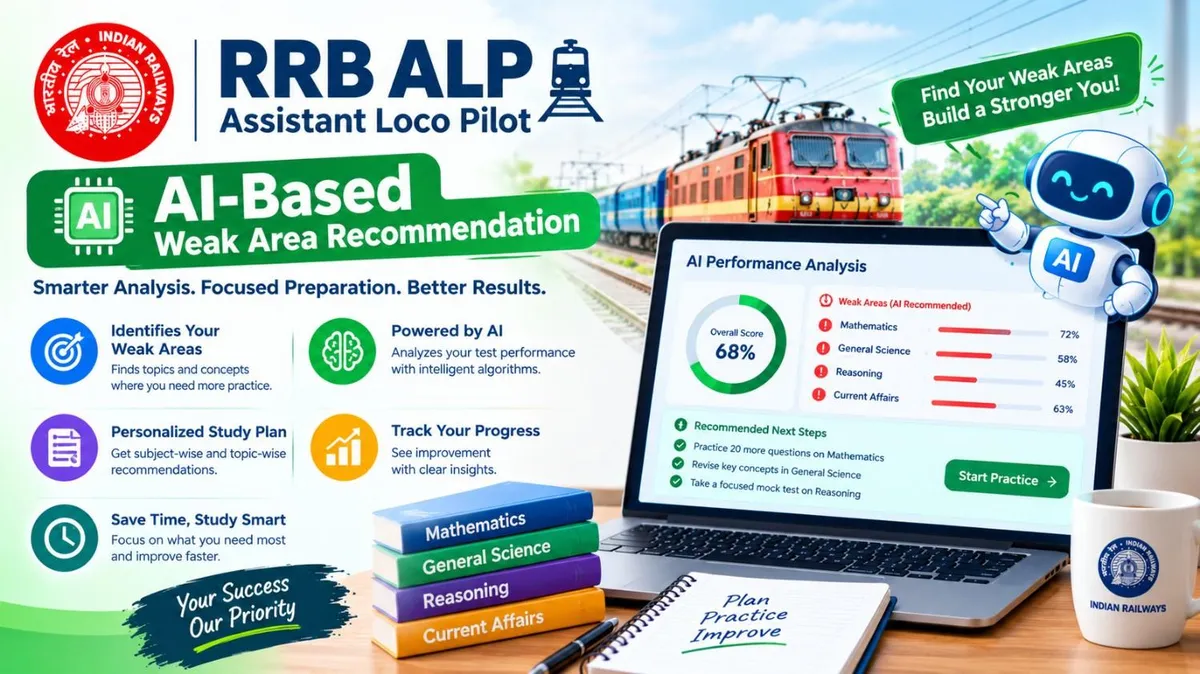
Doing practice tests without some form of diagnosis of your weak areas is absolutely a waste of time. The test engine has an inbuilt diagnostic tracking system which works as follows: Once you've submitted a test the analytical engine goes through your performance in a far more granular way than just looking at your overall percentile. It pinpoints the exact conceptual 'joints' where you've gone wrong (e.g. wrong sign in a coordinate geometry question, a wrong deduction in a negative syllogism, time lost on a multi-tiered caselet DI set etc). It then creates specific revision advice which acts as your very own personal performance mentor, ensuring that your next attempt is focused precisely on your actual weak areas rather than just your well-known strengths.
How to attempt the Mock Test on MockTestCenter.com
Common Mistakes Aspirants Make
- Wasting their daily study hours on General Awareness for CBT-1: A lot of aspirants spend their daily study hours on current affairs, static history and international summits as a form of preliminary preparation. General Awareness has been removed from CBT-1. Use that time to go over Class 10 NCERT Science, quantitative calculations and reasoning puzzles.
- Treating the CBAT as an afterthought: a lot of aspirants don't actually get into their aptitude prep until after they've seen their CBT-2 results. The CBAT now has 50% of the final merit. It is absolutely vital that you build your psychometric reflexes in tandem with your written preparation.
- Using the CEN 01/2025 cutoffs as an absolute target: to think that you'll qualify by simply hitting the cutoff of a previous cycle (say 48 or 56 marks) is pure nonsense. The paper difficulty, the number of candidates and the zonal vacancy profile all vary from cycle to cycle.
- Over the very strict visual standards: many applicants will spend their money on coaching and never actually check that they meet the Aye-One visual standards. Any form of laser eye surgery (LASIK, PRK, SMILE) or uncorrected refractive error will result in instant disqualification at the medical.
- Ignore the mandatory 35% threshold in Part B: some candidates will concentrate absolutely on Part A and completely ignore their trade syllabus. If you don't get at least 35% (26.25 marks out of 75) in Part B your Part A paper is automatically disqualified.
About the MockTestCenter.com Railway Exams team
Official Portals & Regulatory Verification
Candidates must verify all technical guidelines, medical annexures, and administrative notices directly with official railway statutory bodies:
| Authority / Portal | Direct Web Address |
|---|---|
| RRB Central Application Portal | https://www.rrbapply.gov.in/ |
| Railway Recruitment Control Board (Official Portal) | https://www.rrb.indianrailways.gov.in/ |
| Ministry of Railways (Indian Railways Official Site) | https://indianrailways.gov.in/ |