
UGC NET Result 2026 Declared: Scorecard Link, JRF Merit List
UGC NET Result 2026: 84 Subjects Scorecard, Cutoff Marks & JRF Merit List Released
National Testing Agency (NTA) UGC NET June/July Examination Results, Category-Wise Cutoff & December 2026 Strategy
The UGC NET 2026 examination was conducted on June 22, 23, 24, 25, 29, 30, and on July 5, 2026 across designated test centers nationwide. Out of 87 total subjects, with re-examinations underway for 3 subjects, comprehensive scorecards and official cutoff marks for 84 subjects have been published. For candidates who narrowly missed the JRF or Assistant Professor cutoff by 2, 4, or 6 marks, this is the prime window to analyze preparation gaps, address weak scoring units, and execute a structured roadmap for the upcoming December 2026 cycle.
UGC NET Result 2026: Key Overview & Highlights
| Exam Conducting Body | National Testing Agency (NTA) |
|---|---|
| Governing Council | University Grants Commission (UGC) |
| Name of Examination | UGC National Eligibility Test (NET) 2026 |
| Total Registered Candidates | 7,73,806 Candidates (84 Subjects) |
| Total Appearing Candidates | 6,07,151 Candidates |
| Total JRF Selected Candidates | 4,334 Candidates (All India) |
| Assistant Professor Qualifiers | 5,154+ Candidates |
| PhD Only (Category-3) Qualifiers | Approx. 97,000 Candidates |
| Next Examination Cycle | December 2026 Cycle |
| Official Web Portals | ugcnet.nta.ac.in | nta.ac.in |
UGC NET Result 2026 Notice
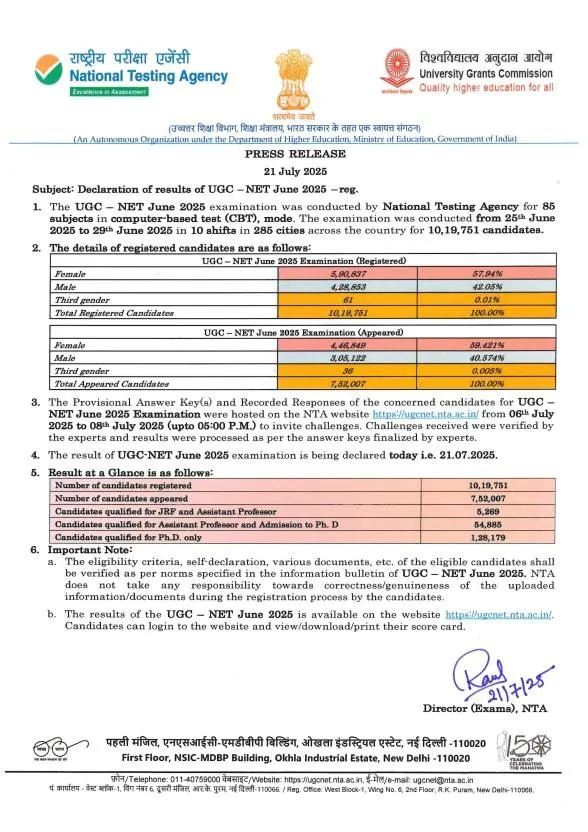
Registered vs Appeared Candidate Statistics (Gender-Wise Demographics)
Female candidate participation in the UGC NET 2026 examination remained significantly higher than that of male candidates. The detailed gender breakdown of the 7,73,806 registered candidates is presented below:
| Gender / Category | Registered Candidates | Percentage Share (%) | Turnout Ratio |
|---|---|---|---|
| Female Candidates | 4,30,195 | 55.59% | Highest Turnout |
| Male Candidates | 3,43,575 | 44.40% | Standard Turnout |
| Third Gender Candidates | 36 | 0.01% | 100% Attendance |
| Total Sum | 7,73,806 | 100.00% | 6,07,151 Appeared |
UGC 3-Tier Eligibility Classification System (Category-Wise Qualification)
Under the updated UGC regulations, examination results are structured into three distinct eligibility categories:
| Eligibility Tier | Qualification Scope | Qualified Candidates | Key Benefits |
|---|---|---|---|
| Category-1 | JRF + Assistant Professor + PhD Admission | 4,334 Candidates | Monthly Research Fellowship + Assistant Professor Eligibility + Direct PhD Admission without Entrance Test |
| Category-2 | Assistant Professor + PhD Admission | 5,154+ (Total ~45,000) | Eligibility for College/University Lectureship + PhD Admission Eligibility |
| Category-3 | Admission to PhD Only | Approx. 97,000 Candidates | Direct PhD Admission eligibility across universities (valid for 1 year with 70% interview weightage) |
Step-by-Step Scorecard Download Guide (How to Check UGC NET Result 2026)
- Visit the official NTA UGC NET portal at ugcnet.nta.ac.in.
- Click on the active link titled "UGC NET 2026 Score Card Download" on the homepage.
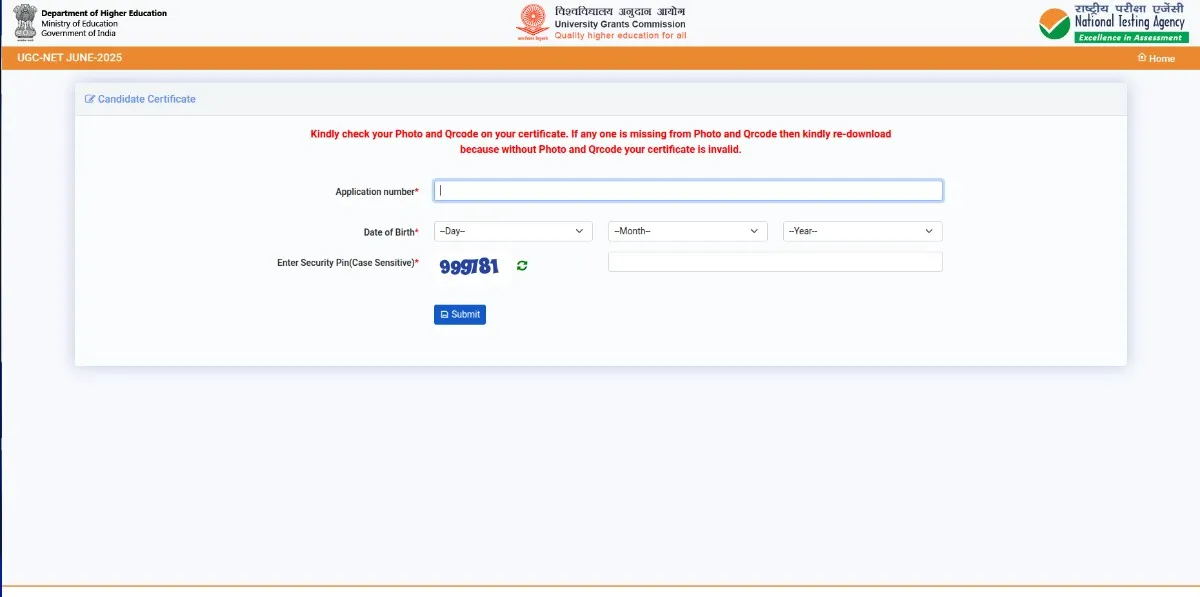
- Enter your Application Number and Date of Birth (DD/MM/YYYY).
- Type the visual security captcha pin displayed on the screen and click Submit.
- Your subject-wise scorecard (Paper 1, Paper 2, Total Marks, Percentile, and Qualified Category Status) will appear on the screen.
- Save the scorecard in PDF format and take at least 2 clear color printouts for documentation.
UGC NET Result 2026- Login Page
Why Candidates Miss JRF by 2 to 6 Marks: Root Cause Analysis
Thousands of serious aspirants fall short of the JRF cutoff by just 1 or 2 questions (2 to 4 marks). This shortfall is rarely due to a lack of domain knowledge; it often stems from tactical errors and neglecting high-scoring general sections:
| Primary Area of Deficit | Common Mistake by Candidates | Actionable Remedial Strategy |
|---|---|---|
| Maths & Data Interpretation Phobia | Skipping or guessing the 5 DI questions and basic quantitative questions due to fear, conceding an immediate 15–20 mark advantage. | Master percentage, ratio, and average formulas; practice 1 timed DI set every day. |
| Logical Reasoning (LR) Conceptual Gaps | Superficial preparation of Indian Logic (Pramanas, Hetvabhasa) and the Classical Square of Opposition rules. | Solve 200+ previous year questions (PYQs) on Nyaya philosophy, syllogisms, and fallacies. |
| People, Development & Environment Data | Failing to update recent statistics regarding SDGs, MDGs, climate protocols (Kyoto, Paris, Montreal), and NEP 2020 initiatives. | Maintain factual summary sheets of international environmental pacts and higher education policies. |
| Provisional Answer Key Discrepancies | Failing to file formal objections with valid textbook citations during the NTA answer key challenge window. | Collate standard academic references promptly and submit structured objections within the prescribed deadline. |
Paper 1: Complete 10-Unit Micro-Syllabus Breakdown
Securing a JRF requires targeting at least 38 to 42 correct answers (76 to 84 marks) in Paper 1. Here is the comprehensive micro-syllabus across all 10 core units:
| Unit Number & Title | High-Yield Micro Themes | Expected Weightage |
|---|---|---|
| Unit 1: Teaching Aptitude | Levels of Teaching (Memory, Understanding, Reflective), Learner Characteristics, SWAYAM, SWAYAMPRABHA, MOOCs, and CBCS Evaluation Systems. | 5 Questions (10 Marks) |
| Unit 2: Research Aptitude | Types of Research (Positivism & Post-Positivist approaches), Sampling Methods, Thesis Formatting, Research Ethics, and ICT applications in research. | 5 Questions (10 Marks) |
| Unit 3: Reading Comprehension | 1 comprehensive unseen passage testing factual retrieval, inference, vocabulary, and core thesis comprehension. | 5 Questions (10 Marks) |
| Unit 4: Communication | Types & Characteristics of Communication, Verbal vs Non-verbal, Barriers to Effective Communication, Mass-Media & Society, Classroom Interaction. | 5 Questions (10 Marks) |
| Unit 5: Mathematical Reasoning & Aptitude | Number Series, Letter Series, Coding-Decoding, Relationships, Fractions, Time & Distance, Ratio & Proportion, Percentages, Profit & Loss, Simple/Compound Interest, Averages. | 5 Questions (10 Marks) |
| Unit 6: Logical Reasoning | Classical Square of Opposition, Categorical Syllogisms, Formal & Informal Fallacies, Indian Logic (Pramanas: Pratyaksha, Anumana, Upamana, Shabda), Hetvabhasa. | 5 Questions (10 Marks) |
| Unit 7: Data Interpretation (DI) | Quantitative Data Sets, Table Charts, Bar Charts, Line Graphs, Pie Charts, and 2-Variable comparative tables. | 5 Questions (10 Marks) |
| Unit 8: Information & Communication Technology (ICT) | General Abbreviations & Terminology, Internet/Intranet Basics, Email Protocols, Audio/Video Conferencing, Digital Initiatives in Higher Education, ICT Governance. | 5 Questions (10 Marks) |
| Unit 9: People, Development & Environment | MDGs and SDGs, Anthropogenic Pollution (Air, Water, Soil, Noise), Renewable Energy Resources (Solar, Wind, Hydro, Biomass), International Agreements (Paris, Montreal, ISA). | 5 Questions (10 Marks) |
| Unit 10: Higher Education System | Ancient Indian Institutions of Learning, Post-Independence Educational Evolution, Oriental/Non-Conventional Programs, NEP 2020 Provisions, Regulatory Frameworks (HECI, NIRF). | 5 Questions (10 Marks) |
90-Day Study Roadmap for December 2026 Examination Cycle
| Phase / Timeline | Paper 1 Focus Area | Paper 2 (Domain Subject) Focus | Target Benchmarks |
|---|---|---|---|
| Month 1 (Days 1 to 30) | Complete foundational concepts of Unit 1 (Teaching), Unit 2 (Research), Unit 4 (Comm), and Unit 5 (Maths). | Consolidate structured notes for core domain subject Units 1 through 4. | Solve 100 PYQs per completed unit. |
| Month 2 (Days 31 to 60) | Intensive practice on Unit 6 (Logical Reasoning), Unit 7 (DI), Unit 8 (ICT), and Unit 9 (Env). | Cover domain Units 5 through 8 along with theory-based conceptual revisions. | Attempt 2 full-length sectional mock tests weekly. |
| Month 3 (Days 61 to 90) | Unit 10 (Higher Education) + complete fast-track revision of Paper 1 short notes. | In-depth analysis of 2020–2026 all-shift question papers for Paper 2. | Complete 3 full-length timed grand mock tests (300 marks) per week. |
Important Links
| Facility / Document | Direct Portal Link |
|---|---|
| Download UGC NET Result | Click Here to Download Scorecard (Active Link) |
| Official Result Notification PDF | Download Detailed Result & Cutoff Press Note PDF |
| UGC NET Official Website | Visit ugcnet.nta.ac.in |
Recruitment & Result Details Summary
| Component Parameter | Official Status / Statistics |
|---|---|
| Name of Examination | UGC NET (National Eligibility Test) 2026 |
| Exam Conducting Agency | National Testing Agency (NTA) |
| Result Declaration Date | August 2026 (Live Now) |
| Total Evaluated Subjects | 84 Subjects (3 subjects pending re-examination) |
| Total Registered Candidates | 7,73,806 (Female: 4,30,195 | Male: 3,43,575 | Third Gender: 36) |
| Total Appearing Candidates | 6,07,151 Candidates |
| JRF Qualified Candidates | 4,334 Candidates |
| Assistant Professor Qualified | 5,154+ (Overall Qualified: ~45,000) |
| PhD Only (Category-3) Qualified | ~97,000 Candidates |
| Next Examination Session | December 2026 |
Frequently Asked Questions (FAQ)
Q. Q1: How can candidates check and download the UGC NET Result 2026 online?
Ans: Candidates can check their scorecard by visiting the official NTA website at ugcnet.nta.ac.in. Click on the "UGC NET Score Card 2026" link on the homepage, enter your Application Number, Date of Birth (DD/MM/YYYY), and security captcha pin, then click Submit to download your scorecard.
Q. Q2: How many candidates qualified for JRF in the UGC NET Result 2026?
Ans: In the UGC NET Result 2026, a total of 4,334 candidates across 84 subjects successfully qualified for the Junior Research Fellowship (JRF) along with Assistant Professor eligibility.
Q. Q3: How many total candidates appeared for the examination?
Ans: Out of 7,73,806 registered candidates (4,30,195 female, 3,43,575 male, and 36 third gender), approximately 6,07,151 candidates appeared for the exam, with female candidate turnout reaching 55.59%.
Q. Q4: What is the difference between Category-1, Category-2, and Category-3 in UGC NET Result 2026?
Ans: Category-1: Eligible for JRF, Assistant Professor recruitment, and PhD admissions. Category-2: Eligible for Assistant Professor appointment and PhD admissions without JRF. Category-3: Eligible solely for PhD admissions across universities (valid for 1 year with 70% merit weightage).
Q. Q5: How many candidates qualified for PhD Admission Only (Category-3)?
Ans: Approximately 97,000 candidates qualified under Category-3 for direct PhD admissions without needing to take separate university-level entrance tests.
Q. Q6: What should candidates do if they missed JRF by 2 to 6 marks?
Ans: Candidates who narrowly missed the cutoff should focus on high-scoring areas in Paper 1 (such as Data Interpretation, Mathematical Reasoning, and Logical Reasoning). Start early preparation for the upcoming December 2026 cycle using a 90-day mock test and PYQ analysis routine.
Q. Q7: Is there any provision for re-evaluation or re-checking in UGC NET Result 2026?
Ans: No. As per official NTA regulations, there is no provision for re-evaluation, re-totalling, or verification of marks once the final answer keys and scorecards are published.
Q. Q8: When will the UGC NET 2026 E-Certificate and JRF Award Letter be issued?
Ans: NTA will upload the digital E-Certificates and official JRF Award Letters on ugcnet.nta.ac.in and ecertificate.nta.ac.in within 2 to 3 weeks of the result declaration.
Q. Q9: What is the validity period of the UGC NET JRF Award Letter?
Ans: The JRF Award Letter remains valid for 3 years from the date of issuance. Qualified candidates must enroll in a recognized M.Phil/PhD program within this window to avail of the monthly fellowship grant.
Q. Q10: When will the application process for the next UGC NET exam cycle begin?
Ans: The next examination cycle will be held in December 2026. The official notification and online application window are expected to go live in October/November 2026.

UPSC Aspirant 5+ Yrs Experience SEO & Content Specialist Ashu Kumari Writer | Graphic Designer | Editor | SEO Expert | Chemistry Graduate Bio Brief: A passionate UPSC aspirant with...