About UPSC CSE Prelims 2027 Exam Series
📖 Table of Contents
- Why Take Upsc prelims 2027 mock test?
- Why Should You Attempt Upsc prelims 2027 mock test Free?
- 1. Official Updates and Eligibility Rules for 2027
- 2. Exam Pattern and Safe Passing Marks (Cutoff)
- Prelims Exam Pattern
- Mains Exam Pattern (The Real Test)
- 3. Subject-wise Weightage in Prelims (What to Read First)
- 4. Full Micro Syllabus: Know Exactly What to Read (Prelims & Mains)
- Prelims Micro Syllabus
- Mains Micro Syllabus (GS 1 to GS 4)
- 5. Previous Year Analysis: Secrets from Old Papers
- 6. Simple Step-by-Step Preparation Strategy
- Step 1: Read NCERTs (Months 1 to 3)
- Step 2: Standard Books & Newspaper (Months 4 to 8)
- Step 3: Answer Writing & Optional (Months 9 to 12)
- Step 4: Only Prelims Mock Tests (Last 3 Months)
- 7. Important Books to Read
- How to Start UPSC Prelims Mock Test Step by Step Guide
- About the Expert Guide
UPSC Prelims 2027 Mock Test: Your Simple Guide to Become an IAS Officer
The Union Public Service Commission (UPSC) Civil Services Exam is the biggest exam in India. If you want to become an IAS, IPS, or IFS officer, you must pass this test. Reading books is good, but giving a Upsc prelims 2027 mock test is the real secret to passing. Read this simple page to know the full Prelims and Mains syllabus, the best books, and how to start your preparation today.
Every year, more than 10 lakh students fill the UPSC form. But only a few thousand pass the Prelims exam. Why do so many students fail? Because they only read books and never check their memory. If you do not practice, you will make many silly mistakes in the exam hall. To fix this, you must find a good Upsc prelims 2027 PYQ Mock Test and solve it with a timer.
The UPSC exam tests your common sense. Sometimes, they ask very hard questions. You have to learn how to skip those hard questions to save your time. We have made this guide very simple. We use Green, Yellow, and Red colors to tell you what to read first and what to read last. Keep reading to know everything about the 2027 exam.
Why Take Upsc prelims 2027 mock test?
Taking a mock test is like playing a practice match before the final world cup. Here is why you must take it:
- Speed and Time: In Paper 1, you have to read 100 big questions in 120 minutes. A test helps you read faster.
- Negative Marking: If you guess blindly, you will lose marks. A mock test teaches you how to guess smartly.
- Memory Check: When you read a book, you feel you know everything. A test tells you the truth about your memory.
- Find Weak Subjects: A test will clearly show if your History is weak or your Geography is slow.
Why Should You Attempt Upsc prelims 2027 mock test Free?
Many coaching centers ask for thousands of rupees for test series. But as a beginner, you should always start with a Upsc prelims 2027 mock test free. Why?
- Save Money: You can use that money to buy good books like Laxmikanth and Spectrum.
- Check Paper Level: Before paying money anywhere, a free test tells you if the coaching center makes good questions.
- Easy PDF Download: You can do a Upsc prelims 2027 mock test pdf free download from our website and print it. Solving on paper is better than solving on a phone.
1. Official Updates and Eligibility Rules for 2027
Before you dream of becoming an IAS, you must check if you can fill the form. Look at this simple table to understand the age and education rules.
| Rule / Topic | What is the Rule? | Simple Explanation |
|---|---|---|
| Education Needed | Graduation Degree. | You must pass BA, BCom, BSc, BTech, or MBBS. Final year students can apply, but they need their final result before the Mains exam. |
| Age Limit (General) | 21 to 32 Years. | You must be 21 years old on 1st August of the exam year. Maximum age is 32. |
| Age Limit (OBC/SC/ST) | OBC: 35 Years. SC/ST: 37 Years. | The government gives extra years to reserved categories. |
| Number of Attempts | General: 6 | OBC: 9 | SC/ST: Unlimited. | If you go to the exam hall and sign the paper, it is counted as one attempt. |
| New Question Style Update | "Only one pair, Only two pairs" pattern. | UPSC has removed the old elimination trick. Now you must know the exact facts to answer correctly. |
2. Exam Pattern and Safe Passing Marks (Cutoff)
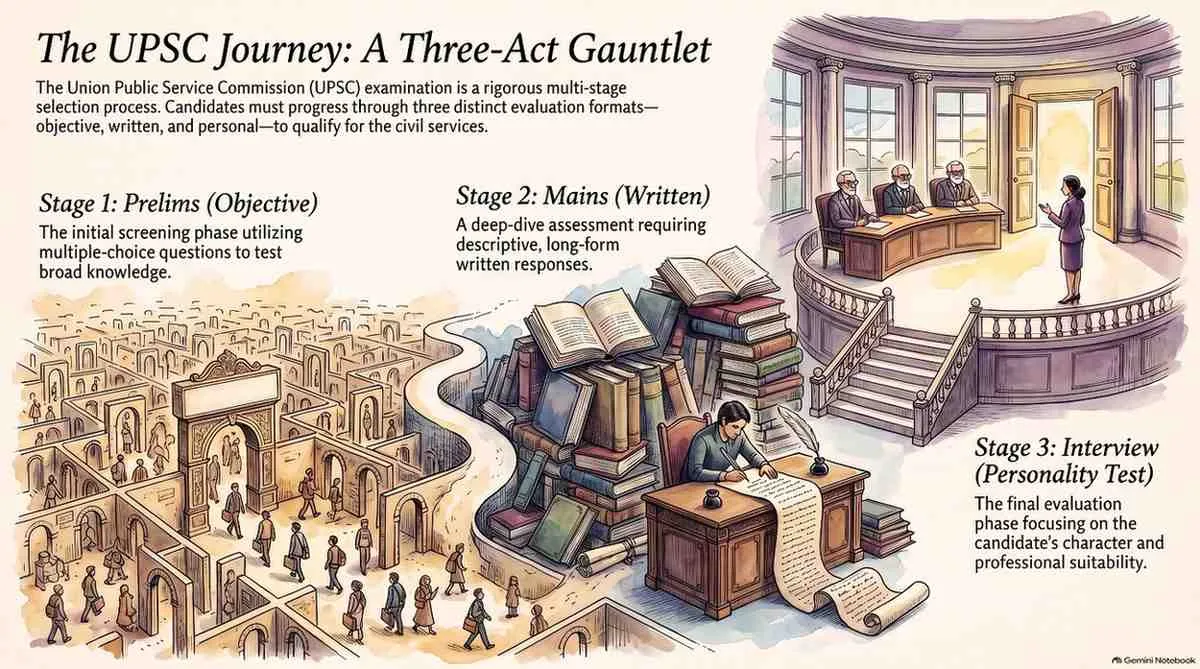
The UPSC exam has three stages: Prelims (Objective), Mains (Written), and Interview (Personality Test). Let us understand the marks for each stage.
Prelims Exam Pattern
| Paper Name | Total Questions | Total Marks | Time Given | Safe Cutoff Marks |
|---|---|---|---|---|
| Paper 1: General Studies (GS) | 100 | 200 (2 Marks each) | 2 Hours | 90 to 95 Marks |
| Paper 2: CSAT (Aptitude) | 80 | 200 (2.5 Marks each) | 2 Hours | Only 33% (66 Marks) |
Warning: Both papers have 1/3rd negative marking. If you give 3 wrong answers, the marks of 1 correct answer will be cut.
Mains Exam Pattern (The Real Test)
Mains is a written exam. You have to write long answers using pen and paper. This decides your final rank.
| Paper Name | Subject Details | Marks |
|---|---|---|
| Paper A & B | Compulsory Indian Language & English. (Only for Passing). | 300 each |
| Paper 1 | Essay Writing (Write two big essays). | 250 |
| Paper 2 (GS 1) | Indian Heritage, History, and Geography of the World. | 250 |
| Paper 3 (GS 2) | Governance, Constitution, Polity, and International Relations. | 250 |
| Paper 4 (GS 3) | Technology, Economy, Environment, Security, and Disaster. | 250 |
| Paper 5 (GS 4) | Ethics, Integrity, and Aptitude (How good a human you are). | 250 |
| Paper 6 & 7 | Optional Subject Paper 1 and Paper 2 (You choose the subject). | 250 + 250 |
| Total Mains Marks | 1750 Marks |
After Mains, there is an Interview of 275 marks. Total marks for final rank = 2025 Marks.
3. Subject-wise Weightage in Prelims (What to Read First)
You cannot give equal time to all subjects. Some subjects give more questions. We have grouped them into Green, Yellow, and Red colors. You can take an Open Mock Test UPSC Prelims 2027 to check these colors.
| Color Code | Subjects Name | Expected Questions | How to Study? |
|---|---|---|---|
| GREEN ZONE (Very Important) |
Polity, Economy, Environment. | 45 to 55 Questions | These subjects are the heart of UPSC. Read Laxmikanth and Economy notes 10 times. Understand concepts, do not just memorize. |
| YELLOW ZONE (Medium Important) |
Modern History, Geography, Science & Tech. | 30 to 35 Questions | Focus on Freedom struggle in History. Map-based questions in Geography are very important. Read current Science news. |
| RED ZONE (Hard & Unpredictable) |
Ancient/Medieval History, Art & Culture. | 10 to 15 Questions | The syllabus is very huge, but questions are few. Only read basic NCERT. If the question is too hard, skip it in the exam. |
4. Full Micro Syllabus: Know Exactly What to Read (Prelims & Mains)
UPSC writes a very short syllabus in its official PDF. But the real syllabus is hidden. We have opened every small chapter for you. Read this huge table to know the micro syllabus.
Prelims Micro Syllabus
| Subject | Micro Syllabus (Chapter by Chapter) | Most Important Area |
|---|---|---|
| Indian Polity |
|
Fundamental Rights and Parliament give maximum questions. |
| Indian Economy |
|
RBI policies and Banking terms are always asked. |
| Environment & Ecology |
|
International Treaties and National Parks map locations. |
| History (Modern & Ancient) |
|
Buddhism/Jainism and Acts of British India. |
| Geography (India & World) |
|
World mapping and Indian River systems. |
| Science & Technology |
|
Current affairs in Space and Biology. |
Mains Micro Syllabus (GS 1 to GS 4)
Mains is very big. You have to write everything. See the breakdown below.
| Mains Paper | Micro Syllabus Topics for Answer Writing |
|---|---|
| GS Paper 1 |
|
| GS Paper 2 |
|
| GS Paper 3 |
|
| GS Paper 4 |
|
5. Previous Year Analysis: Secrets from Old Papers
When we look at old UPSC question papers from 2023, 2024, and 2025, we see a clear pattern. The exam does not change its core soul. If you get a Upsc prelims 2027 mock test pdf free, you will notice these simple things:
- End of Elimination Tricks: Earlier, students used tricks to guess the answer. Now, UPSC gives options like "Only one statement is correct, Only two are correct." You cannot guess. You must know the facts.
- Map Questions are Direct: Every year, 3 to 4 questions come from World Maps. Places where wars or disasters happened are asked directly.
- Economy is Conceptual: They do not ask numbers or data in Economy. They ask concepts. Like, "What happens to inflation if RBI increases the repo rate?"
- CSAT is Becoming Very Hard: Paper 2 (CSAT) math is now like the CAT exam (MBA exam). Many students who score 110 in GS fail because they get only 60 marks in CSAT. You must practice CSAT daily.
6. Simple Step-by-Step Preparation Strategy
Do not buy 100 books. Do not watch 100 YouTube videos. Follow this simple 4-step plan to study without tension.
Step 1: Read NCERTs (Months 1 to 3)
Read Class 6 to 12 NCERT books for History, Geography, and Polity. Read them like a storybook. Do not make notes in the first reading.
Step 2: Standard Books & Newspaper (Months 4 to 8)
Start reading Laxmikanth for Polity and Spectrum for History. Read The Hindu or Indian Express newspaper daily. Make short notes of current affairs.
Step 3: Answer Writing & Optional (Months 9 to 12)
Start writing 2 answers daily for the Mains exam. Finish your Optional subject completely in this time.
Step 4: Only Prelims Mock Tests (Last 3 Months)
Stop reading Mains topics. Give a full 100-question Upsc prelims 2027 mock test free every second day. Solve CSAT papers every Sunday.
7. Important Books to Read
To pass, you must read one book ten times, not ten books one time. Here are the simplest and best books.
| Subject | Best Book to Read |
|---|---|
| Indian Polity | Indian Polity by M. Laxmikanth (This is like the Bible for UPSC). |
| Modern History | A Brief History of Modern India by Spectrum. |
| Geography | NCERT Class 11 & 12 + GC Leong + Orient Blackswan Atlas. |
| Indian Economy | Indian Economy by Nitin Singhania OR Mrunal Patel Notes. |
| Environment | Environment by Shankar IAS Academy OR PMF IAS. |
| Art and Culture | Indian Art and Culture by Nitin Singhania + Class 11 Fine Arts NCERT. |
| Mock Test Papers | Get an UPSC Prelims Mock Test free PDF with answers from a good website to practice daily. |
How to Start UPSC Prelims Mock Test Step by Step Guide
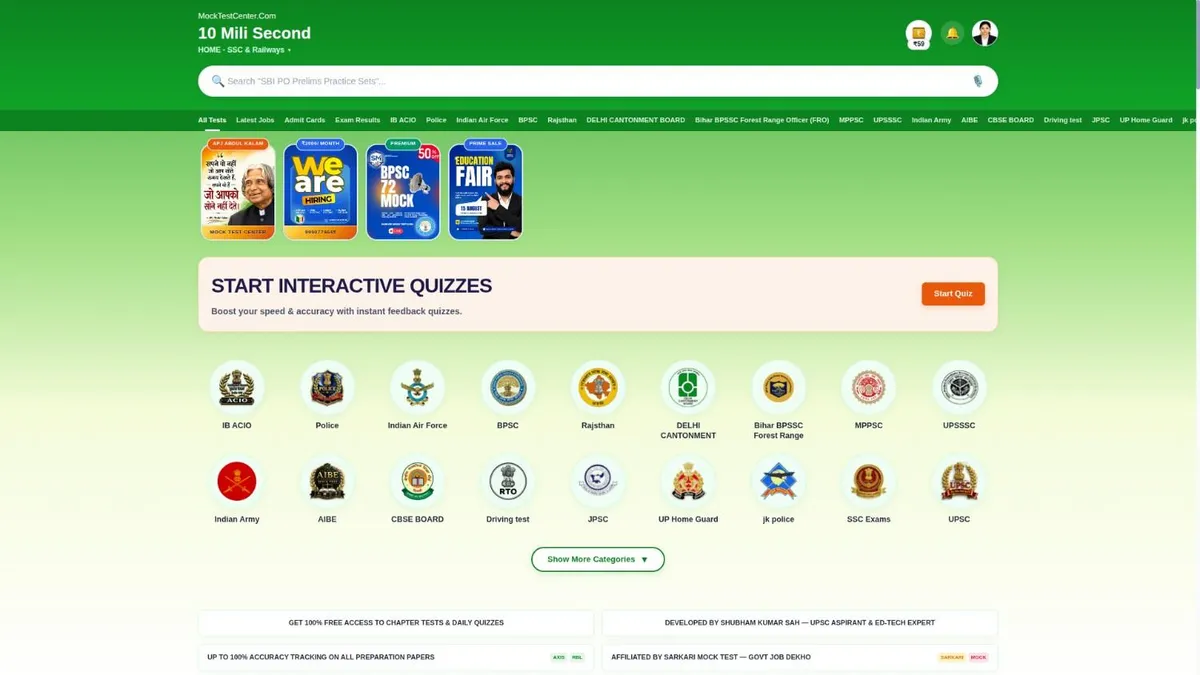
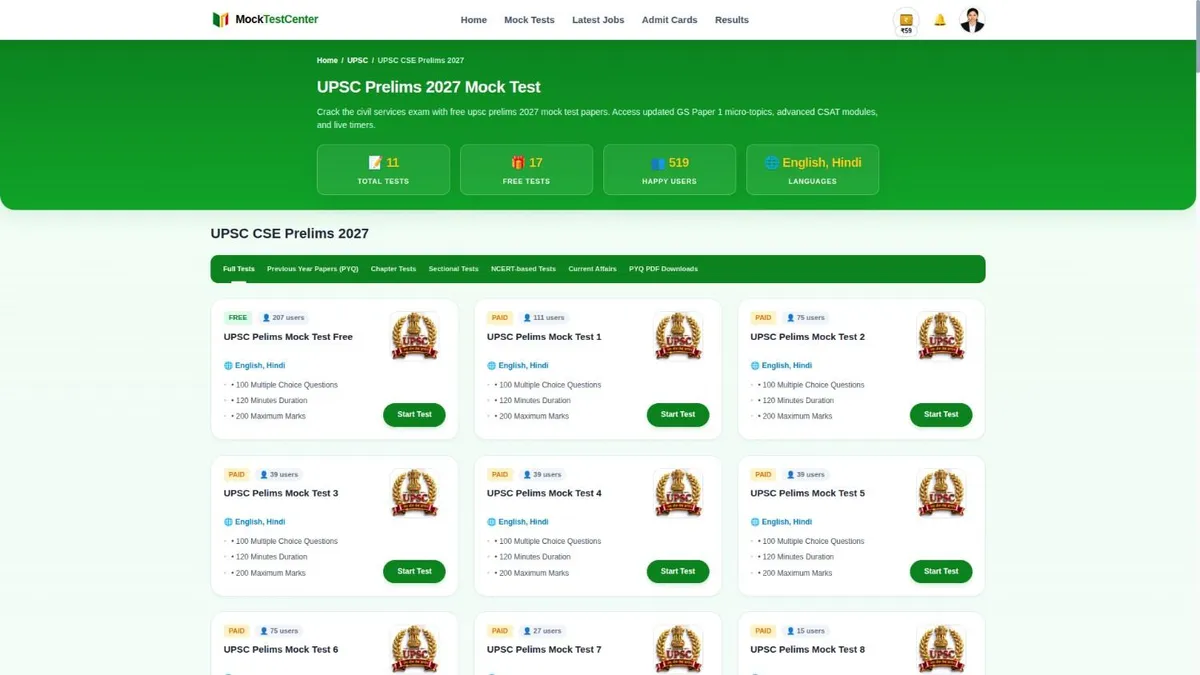
This is home page ''mocktestcenter.com'' india's best mock test platform find UPSC (Category) and click.
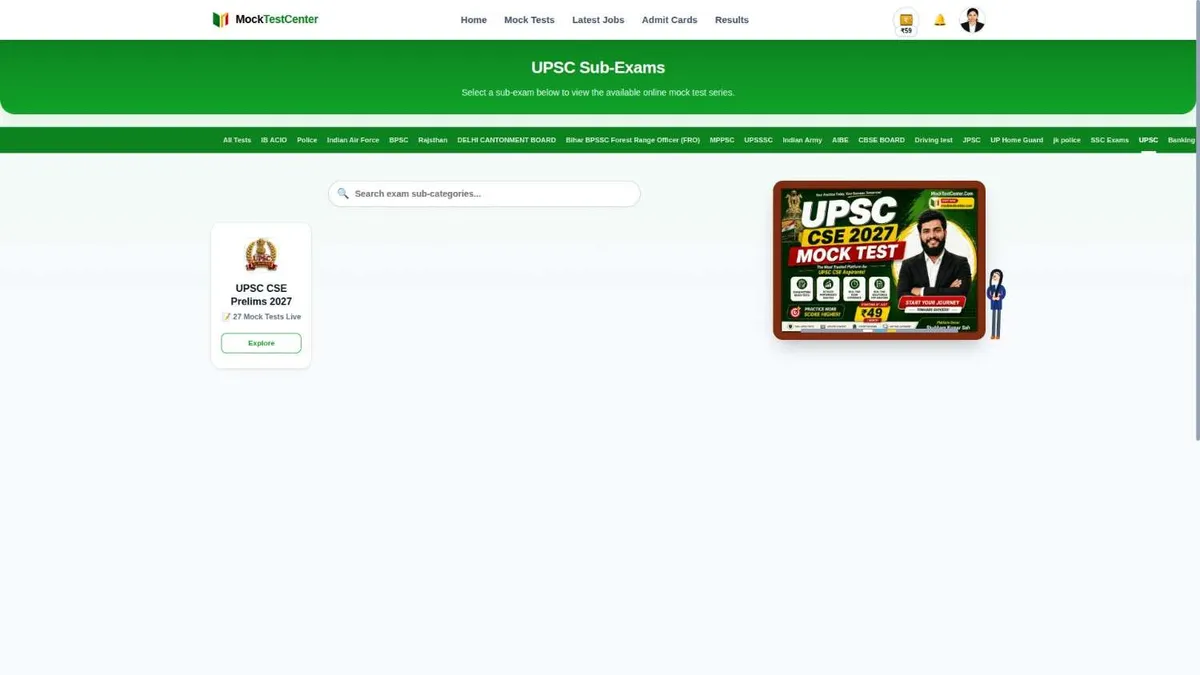
Now you can see upsc prelims 2027 mock test card start button click start button to start mock test.
Then some instructions agre and see youre mock test interface solve quuestions are both language ''hindi and english'' you can change language top section right side ''view in'' button to select youre exam language.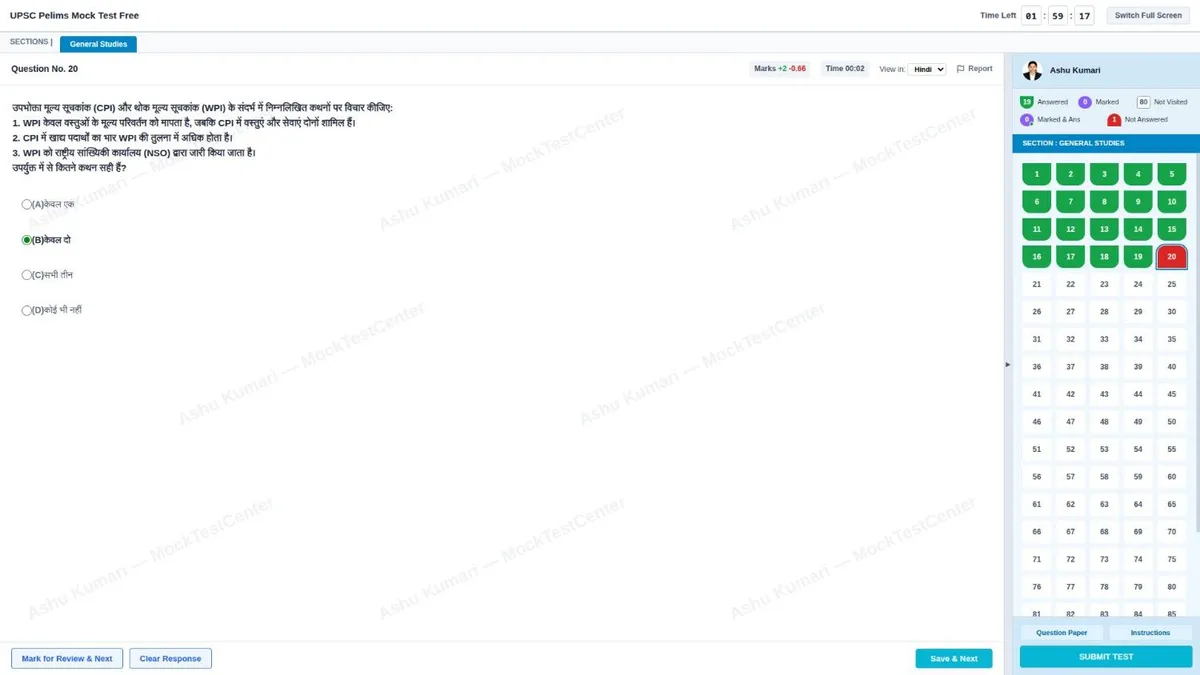
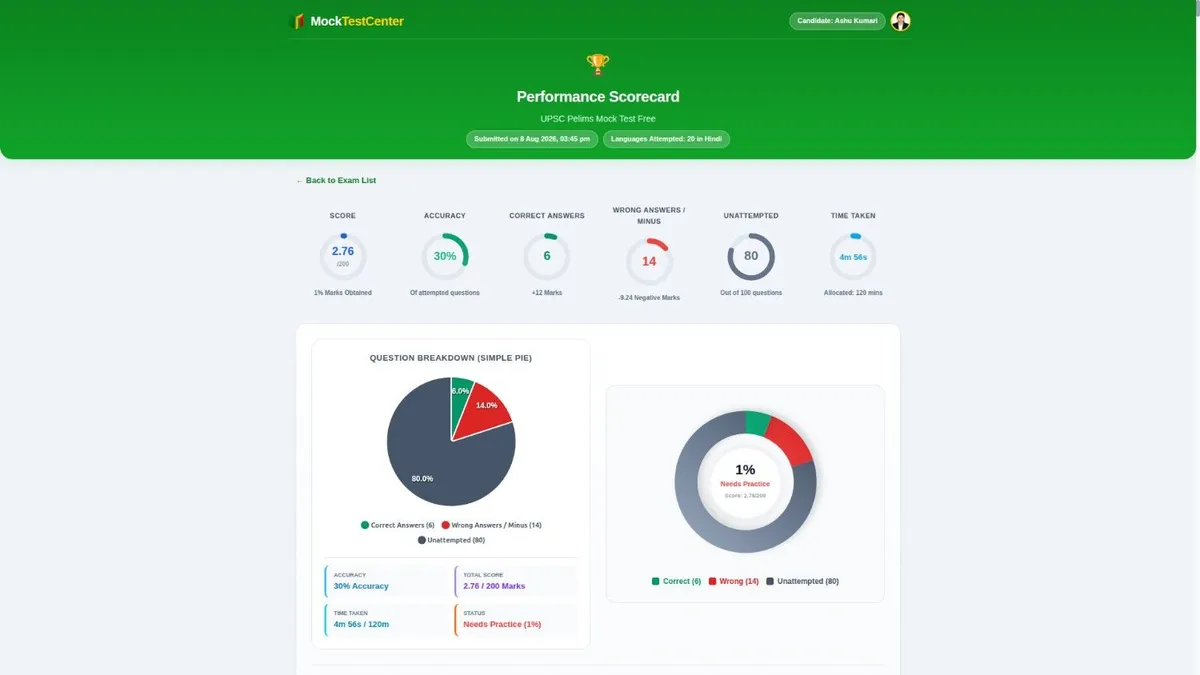
And Final showing youre result page full detailed anwer with explanation.
About the Expert Guide
Shubham Kumar Sah is the founder of MockTestCenter.com, a mock test platform built for students preparing for competitive government exams across India. With over 4 years of experience in the Indian ed-tech and exam preparation space, he is also a UPSC Civil Services aspirant himself, which shapes how he designs and reviews every test on the platform — from the questions asked to the exam interface students see.
Shubham has worked on exam preparation content for UPSC, SSC, Railways, Defence, Police, and State Government exams. Under his guidance, MockTestCenter.com built a mock test interface modeled on the real TCS iON system used in many government exams, so students get comfortable with the actual exam environment before test day.
His focus is simple: give students clear, honest, and free-to-access study material, especially those preparing from small towns and villages who cannot afford expensive coaching classes.