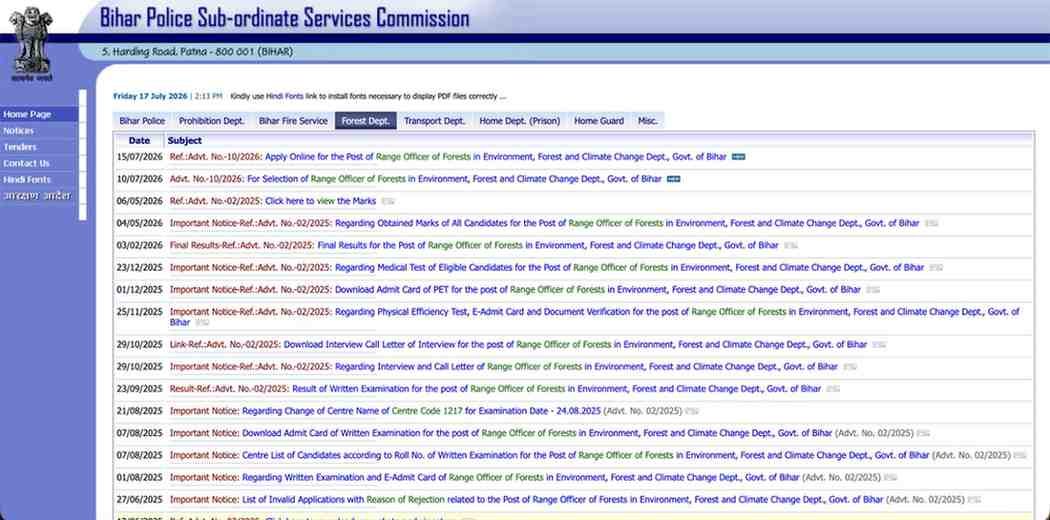
About Bihar BPSSC Forest Range Officer (FRO) Exam Series
📖 Table of Contents
- Ace the Bihar Forest Range Officer Exam 2026
- Q&A Format: Core Exam Doubts Answered
- Latest Exam Pattern & Scoring Structure
- Detailed Topic-Wise Exam Syllabus
- Real Experience: How Sunil Balanced Theory and the Walking Test
- Success Story: Moving Past Hindi Section Failures
- Original Insights: The Hidden Filter inside Paper 2
- Exam Layout Parameters & Benchmarks
- Directions: How to Start Your Free Mock Test
- Strategic Guidance: Interview Advice
- Comparison Breakdown: Range Officer vs Police Sub-Inspector (SI)
- The Triple-Action Revision Framework
- Real Written Test Problem Situations
Bihar BPSSC Forest Range Officer (FRO) 2026 is one of the most prestigious state-level job updates for science and forestry backgrounds seeking a uniform rank career. Passing this multi-stage evaluation requires balancing structural general studies with deep mental alertness and high physical endurance. By systematically practicing our updated online test bundles, you can review your live capabilities, fix hidden speed blockages, and get fully accustomed to handling the strict negative marking structure effectively.
Ace the Bihar Forest Range Officer Exam 2026
Unlock free high-yield General Studies mock sets, qualifying Hindi grammar practice papers, and strategic physical guidelines built to guarantee your selection.
Q&A Format: Core Exam Doubts Answered
The selection process spans across four stages: a written competitive test (Paper 1 and Paper 2), a personal interview evaluation, a strict Physical Efficiency Test (PET walking test), and a final medical check. Your ultimate rank relies on your written and interview scores combined.
No, the General Hindi paper is strictly qualifying in nature. You only need to score a minimum of 30% marks to pass. However, if you fail to reach this threshold, your main Paper 2 General Studies response sheet will not even be checked by the board.
Paper 1 and Paper 2 have different negative marking values (0.2 and 0.3 marks deducted per error). Practicing on an online platform stops you from making reckless wild guesses, teaching you exactly when to lock an option and when to skip a doubtful question safely.
Latest Exam Pattern & Scoring Structure
The written evaluation uses an objective multiple-choice question framework across two separate timed panels:
Features 50 questions worth 100 marks with a time limit of 1 hour. Each correct answer gives you 2 marks, while an incorrect click loses you 0.2 marks. A minimum score of 30 marks is mandatory.
Features 100 questions worth 300 marks with a time limit of 2 hours. Each correct option adds 3 marks, while a wrong selection takes away 0.3 marks. This score forms the foundation of your final selection rank.
Detailed Topic-Wise Exam Syllabus
To streamline your study hours, we have listed the core micro-topics you need to practice. These are all covered extensively in our online practice modules:
1. Paper 1: General Hindi Core Fields
- Hindi grammar rules (Sandhi, Samas, Upsarg, Pratyay, Karak balances).
- Vocabulary usage (Synonyms, antonyms, single-word substitutes, gender variations).
- Sentence correction updates, idioms, local phrases, and basic comprehension passages.
2. Paper 2: General Studies & Science Foundation
- General Science & Environment: Advanced biology concepts, plant and animal cell structures, ecosystems, forest protection laws, and climate variables.
- Social Science Parameters: Indian freedom struggle highlights, Bihar local history, physical geography maps, river channels, and Indian constitution pillars.
- Current Events: National awards, environmental summits, defense updates, and recent state government initiatives.
3. Paper 2: Math Logic & Mental Reasoning
- Number system simplifications, average data tables, percentage splits, and profit-loss problems.
- Time-distance equations, simple interest ratios, and basic arithmetic mensuration shapes.
- Reasoning charts, coding-decoding structures, blood line trees, and missing alphabet series.
Real Experience: How Sunil Balanced Theory and the Walking Test
"I passed the written test with great marks because my science base was solid. But I made a major mistake by taking the Physical Efficiency walking round lightly. Walking 25 kilometers in 4 hours sounds simple until you hit the 15th kilometer mark under a hot sun. Your legs start to cramp up, and your pace drops quickly if you have not practiced. Thankfully, a friend advised me to build my stamina by taking long walks twice a week while working through general studies tests on my phone during rest periods. Balancing my physical walking stamina alongside daily online testing practice is the only reason I cleared the final rounds."
Success Story: Moving Past Hindi Section Failures
Let us look at Meera, a physics graduate from Muzaffarpur. Meera spent months memorizing advanced science data sets and core general studies history books for the Range Officer entry. However, in her practice attempts, she kept ignoring the basic Hindi language paper, assuming it was too simple to require real attention.
During a realistic simulated full-length exam trial, she discovered a shocking surprise: she failed to reach the 30% pass mark in Hindi due to simple grammatical confusion, which meant her excellent General Studies paper was completely wasted. She immediately changed her approach. Meera started setting aside 20 minutes every morning to practice basic Hindi grammar tests alongside her main subject papers. This simple change saved her final attempt and helped her clear the official exam easily.
Original Insights: The Hidden Filter inside Paper 2
Most general coaching platforms treat the BPSSC FRO exam like a standard police sub-inspector test paper. This is a massive mistake that hurts your chances. The Range Officer profile specifically requires a strong understanding of environmental biology, forestry conservation rules, and basic applied science.
Our honest insight is that standard history or polity topics will only help you reach the average score line. The true rank-defining filter lies in the 25-30 questions dedicated to ecology, plant science, and basic math calculations. If you master these specific areas through target testing, your name will easily make it to the top merit list.
Exam Layout Parameters & Benchmarks
Based on recent recruitment statistics and board parameters, here is the official breakdown of the evaluation rounds:
| Evaluation Stage | Total Questions / Marks | Negative Score Rule | Qualifying Target |
|---|---|---|---|
| Paper 1: General Hindi | 50 MCQs / 100 Marks | -0.2 Marks | Minimum 30% Marks Required |
| Paper 2: General Studies | 100 MCQs / 300 Marks | -0.3 Marks | Merit Deciding Round |
| Stage 3: Personal Interview | 50 Marks Max | None | Added to final written score |
Directions: How to Start Your Free Mock Test
To simplify your online practice sessions, follow these easy directional steps on your phone or computer:
Open your browser search and go to mocktestcenter.com. Move straight to the state-level examinations link options.
Click directly on the "Bihar BPSSC Forest Range Officer (FRO) 2026 Mock Test" option link from the dashboard group list.
Click the green "Start Test" button. A mobile-friendly full-width layout will load instantly with an active digital countdown clock tracking your time limits.
Submit your paper to instantly view your final score report sheet. Check your wrong answers, read the simple plain-text solutions, and adjust your speed for the next test round.
Regular practice removes exam anxiety, builds fast calculation habits for math logic sections, simplifies complex science topic review, and ensures your testing speed aligns perfectly with the live online platform atmosphere.
Strategic Guidance: Interview Advice
K. Sinha (Retired State Forest Officer & Exam Panelist):
"Candidates frequently assume that a Forest Range Officer entry requires the exact same prep style as standard civilian administrative desk jobs. They miss the core focus. During the 50-mark interview stage, we look for analytical decision-making skills under stress, clear teamwork potential, and a basic understanding of environmental laws. Do not just memorize history facts; spend your prep hours learning how to remain calm and accurate during timed testing screens."
Comparison Breakdown: Range Officer vs Police Sub-Inspector (SI)
Understanding the core differences helps you adjust your testing strategy effectively:
| Structural Metric | BPSSC Forest Range Officer (FRO) | Bihar Police Sub-Inspector (SI) |
|---|---|---|
| Written Exam Base | Heavy focus on General Science & Ecology concepts | Heavy focus on traditional History & Civics parameters |
| Physical Evaluation Mode | 25 Km / 14 Km continuous walking test limit | High jump, long jump, shot put, and fast sprints |
| Negative Score Rule | Paper 2 features a strict -0.3 mark deduction per error | Standard -0.2 mark deduction rule per mistake |
The Triple-Action Revision Framework
Incorporate this smart study system into your weekly routine to get the best results from your practice tests:
- 1. The Hindi Safety Block (30 Mins Twice a Week): Use this time to quickly review basic Hindi grammar questions to secure your 30% qualifying mark.
- 2. Core Science Isolation (60 Mins Daily): Dedicate this time to reviewing ecology updates, plant cell patterns, and environmental law questions.
- 3. Live Speed Simulation (120 Mins Every Alternate Day): Take a full-length, timed Paper 2 test to build your speed and learn how to manage the strict -0.3 negative score penalty.
Real Written Test Problem Situations
Here are a few common problem styles you will face inside the online testing interface:
A question might ask you to identify the primary gas responsible for ozone layer depletion or name the year a specific forest conservation law was passed. These questions test direct accuracy rather than complex guessing games.
The math section will present a standard work-time ratio problem involving a set number of workers completing a project. You will need to calculate the exact days required using simple math shortcuts.